Last year, it was the 80th Victory Anniversary of the War of Resistance Against Japanese Aggression. This year, it is the 80th Anniversary of the Victorious Return of the Central Government to Capital Nanking. Victory against Japan was credited to the tens of millions of Chinese deaths and martyrdoms, return to capital Nanking was the glory exemplified by the emblem of White Sun and Blue Sky of the Republic of China. Even in hundreds or thousands of years, they will continue to inspire and forge the National Spirit of China.
Harking back to 5 May 1946, the 35th year of the Republic of China, the Central Government officially returned to the capital of Nanking from the provisional capital of Chungking. On that day, a solemn celebration took place at the Mausoleum of Sun Yat-sen in Nanking, hosted by President Chiang Kai-shek, attended by all the senior civil and military officials. The event conveyed that the pursuit of a free and democratic China as envisioned by Dr. Sun Yat-sen was to continue with earnestness, and the Republic of China would rise from the ashes of war.
At the time, Li Chia-mien (李加勉), the Kwangtung Provincial Government Representative in Nanking, invited many prominent men especially those from his own province who were residing in the capital, to inscribe their thoughts on paper, plentiful enough to be compiled into an album. After the fall of mainland China to the communists in 1949, he took the album with him to Taiwan. Afterwards it entered the custodianship of the descendants. On the 80th Anniversary of the Return to Capital Nanking, we have the good fortune to peruse this album, yet at a loss to the encroaching melancholy.
Curatorial and Editorial Department
The date 3 September of the 114th year of the Republic of China 2025 will be remembered as the 80th Victory Anniversary of the War of Resistance Against Japanese Aggression. Li Lung-neng (李龍能) of Taipei had hoped to publish before this date, the Album of Calligraphy and Painting to Celebrate the Triumphant Return to Capital Nanking, originally compiled and collected by his late father, Mr. Li Chia-mien (李加勉). Lung-neng recalled with affection the literary proficiency and commendable lifework of his father, and was full of admiration for the history and grand accomplishments of the National Government. His thoughts and intentions were altogether earnest. I ventured to offer him a presumptuous suggestion: “The circulation of a printed book cannot match the reach of online dissemination; if you permit its revelation at the Chinese Heritage Virtual Museum, we can take advantage of our English translation to reach a wider world.” Shortly after, Li Lung-neng gave an interview to the United Daily News (聯合報) on 16 October under the headline: Album of Calligraphy and Painting to Celebrate the Triumphant Return to Capital Nanking: Calligraphic Treasures by Forty-Four Notable Figures of the Republic of China. In the interview, Lung-neng also indicated that the album would soon be exhibited at the Chinese Heritage Virtual Museum.
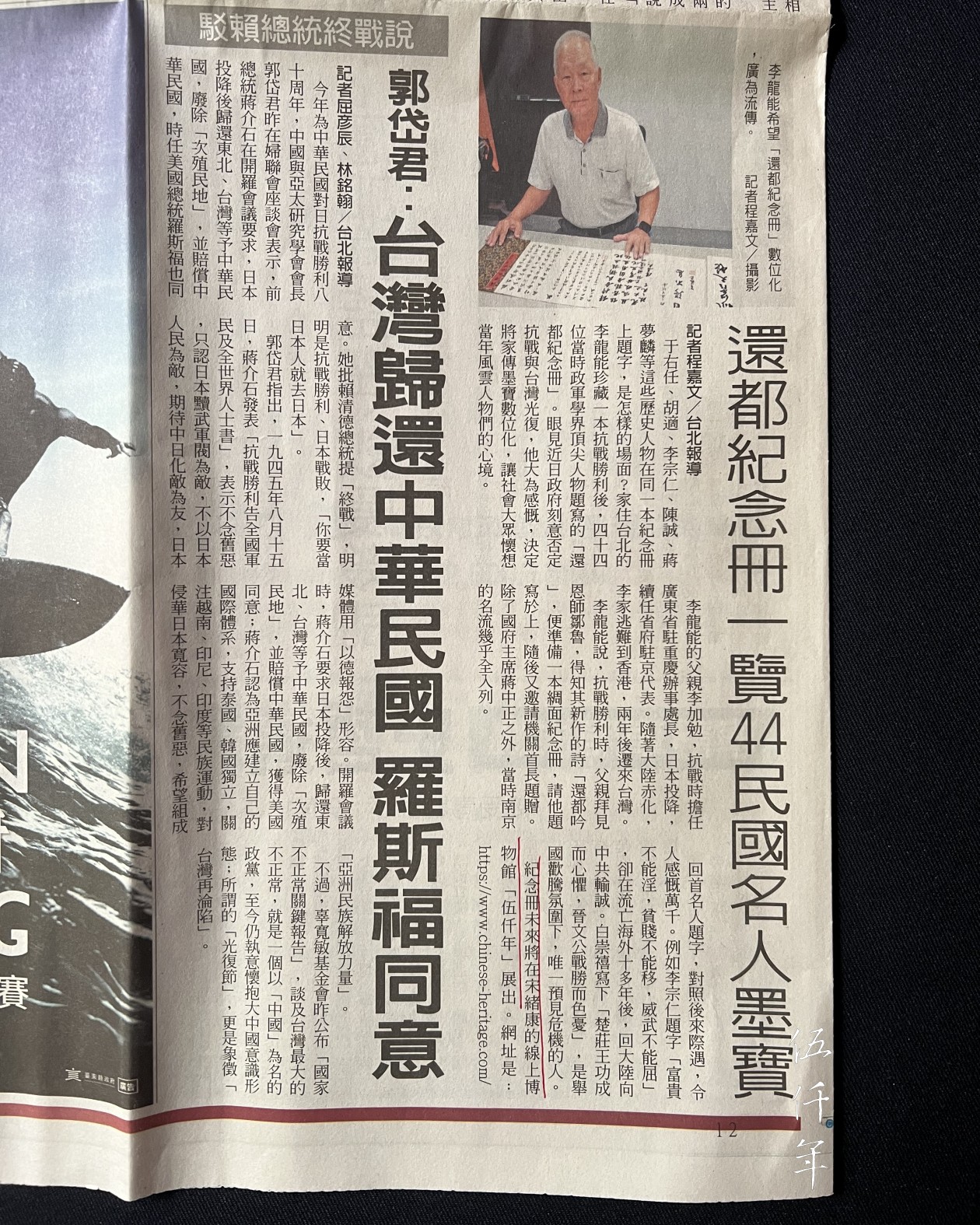
Article in the United Daily News titled: Album of Calligraphy and Painting to Celebrate the Triumphant Return to Capital Nanking: Calligraphic Treasures by Forty-Four Prominent Men of the Republic of China, dated 16 October 2025
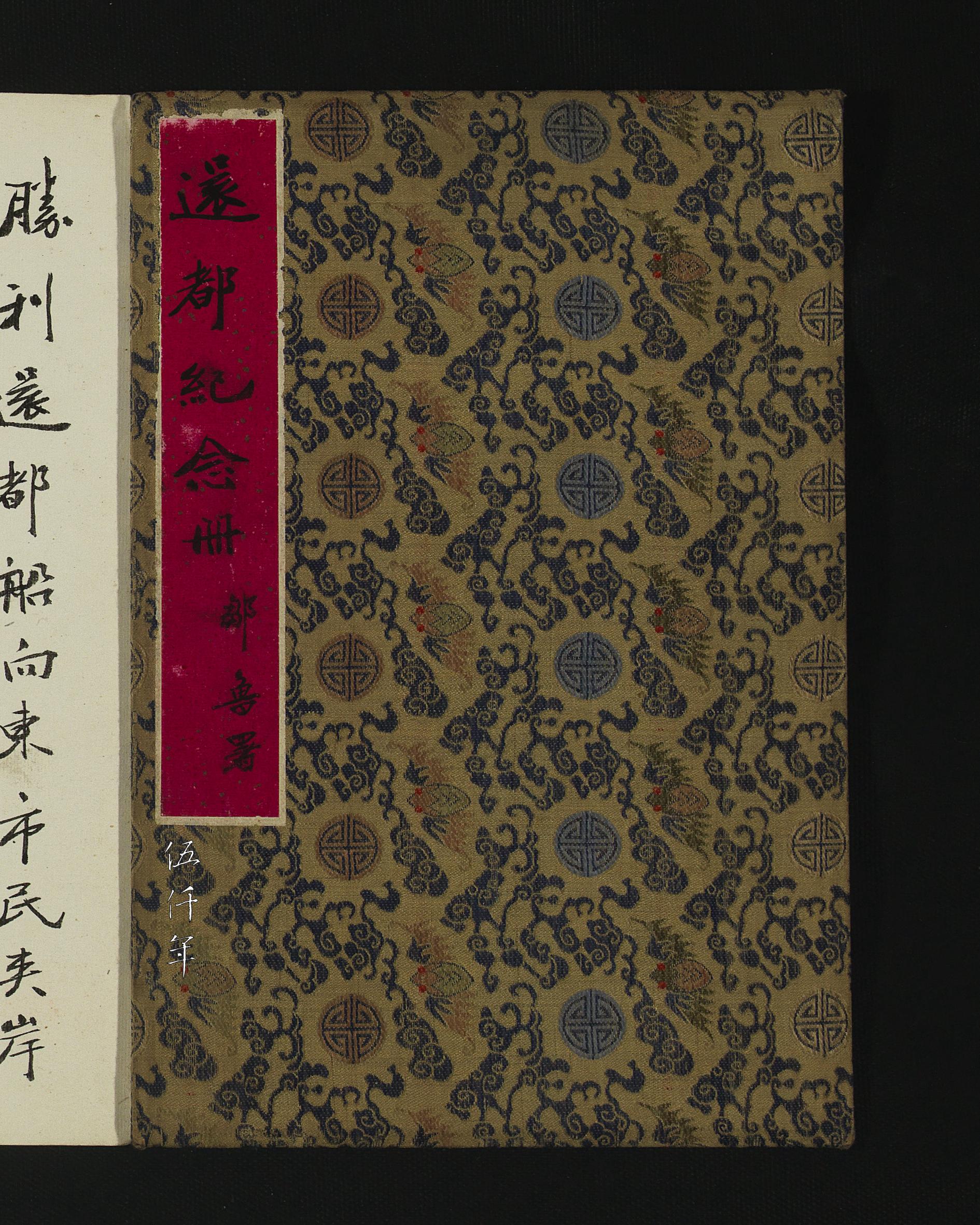
Front cover of Album of Calligraphy and Painting to Celebrate the Triumphant Return to Capital Nanking
The date 5 May of the 115th year of the Republic 2026, marks the 80th anniversary of the triumphant return of the National Government from the provisional wartime capital of Chungking to the capital of Nanking. On 20 November of the 26th year of the Republic 1937, the National Government relocated westward to Chungking because of the Japanese invasion, and on 5 May of the 35th year of the Republic 1946, officially returned to the old capital, having been absent from Nanking for nearly nine years. The presentation of the Album of Calligraphy and Painting to Celebrate the Triumphant Return to Capital Nanking serves as a testament to the heroism of the War of Resistance, a means to redress public disinformation, an inspiration to many weary spirits, and an evocation of the broken dream of our old capital.

Front page of Wu-han Daily News, dated 5 May 1946, announcing the ceremony to celebrate the return to the capital of Nanking
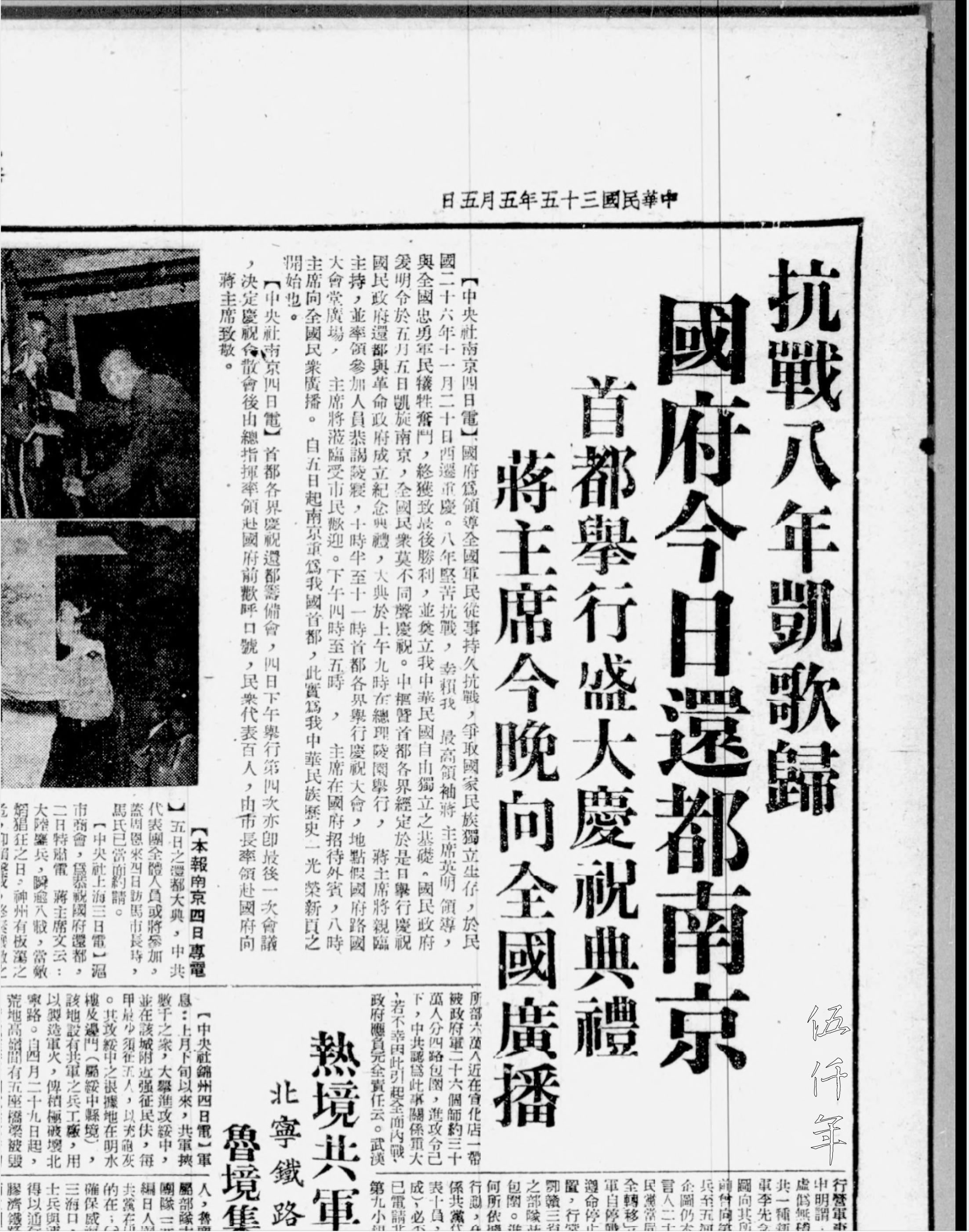
Front page of Hua-pei Daily News, dated 5 May 1946, announcing the ceremony to celebrate the return to the capital of Nanking
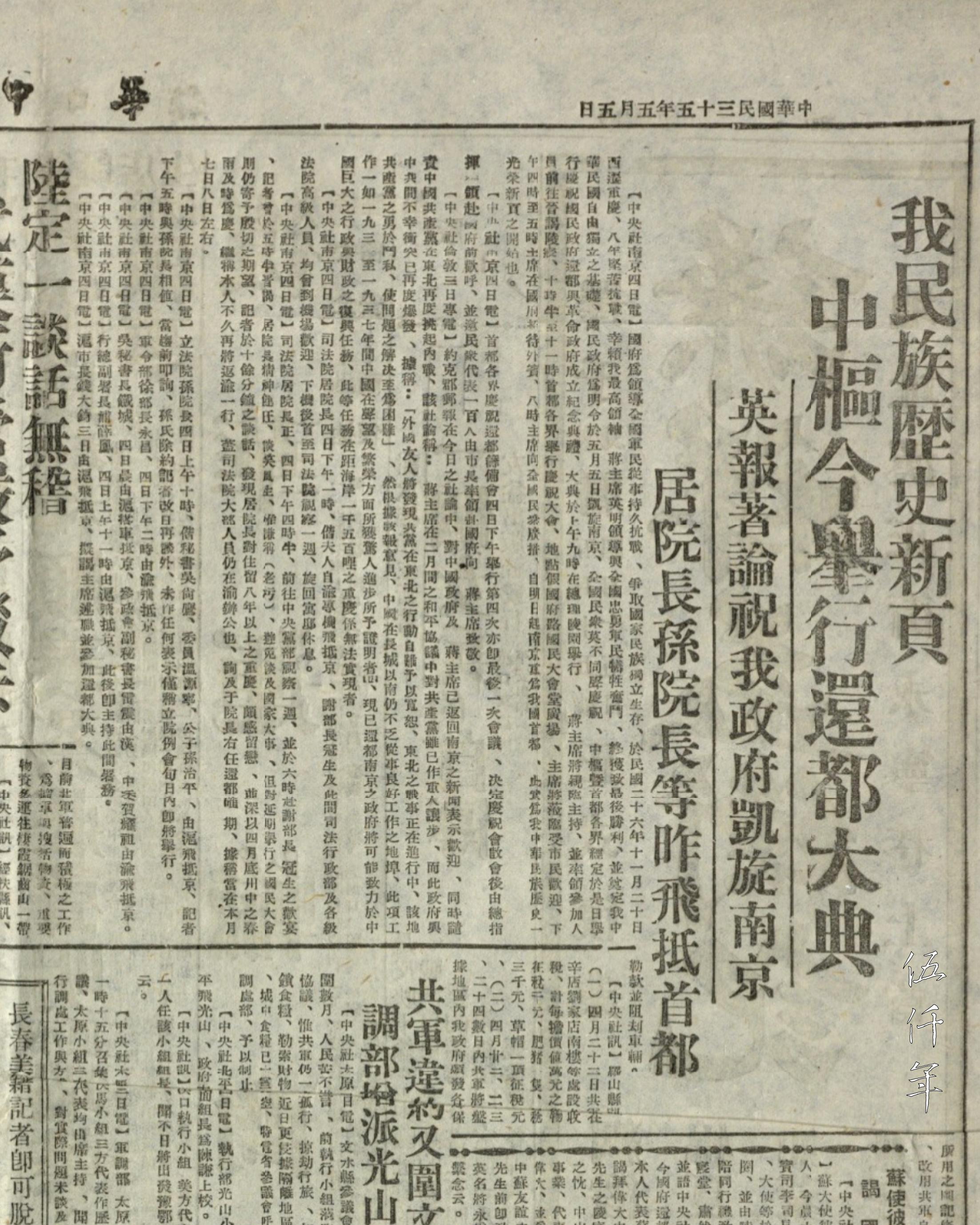
Front page of Hua-chung Daily News, dated 5 May 1946, announcing the ceremony to celebrate the return to the capital of Nanking
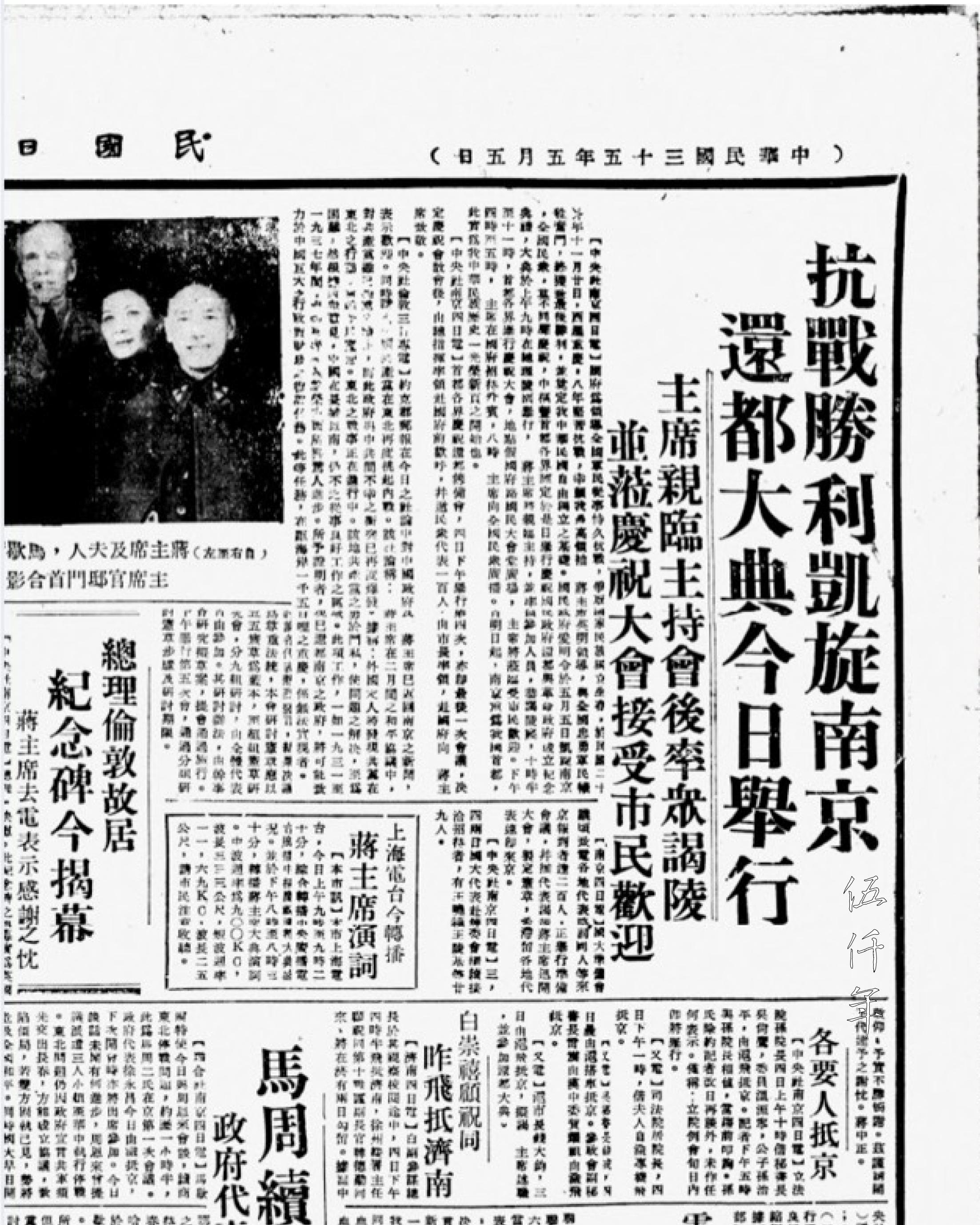
Front page of Min-kuo Daily News, dated 5 May 1946, announcing the ceremony to celebrate the return to the capital of Nanking
On 5 May of the 35th year of the Republic 1946, the National Government held a stately ceremony at the Sun Yat-sen Mausoleum in Nanking to celebrate the triumphant return to the capital. In the days preceding 5 May, senior government officials arrived in succession. On 29 April, Tai Ch’uan-hsien (戴傳賢), president of the Examination Yuan, reached the capital from Chungking with a group of high ranking colleagues from the Examination Yuan, including Vice President Chou, Secretary-General Shih, chairman of the Examination Committee and others. On 1 May, the Examination Yuan formally resumed operations in Nanking. On 3 May, President Chiang Kai-shek arrived from Hsi-an, and Mayor Ch’ien Ta-chün (錢大鈞) arrived from Shanghai. On 4 May, President Chü Cheng (居正) of the Judicial Yuan arrived from Chungking, President Sun Fo (孫科) of the Legislative Yuan arrived from Shanghai, Secretary-General Wu T’ieh-ch’eng (吳鐵城) of the Chinese Nationalist Party arrived from Shanghai, and Minister Hsü Yung-ch’ang (徐永昌) of the Ministry of Military Operations of the National Military Council arrived from Chungking. Taken together, it offered a glimpse of the revitalization of Nanking.
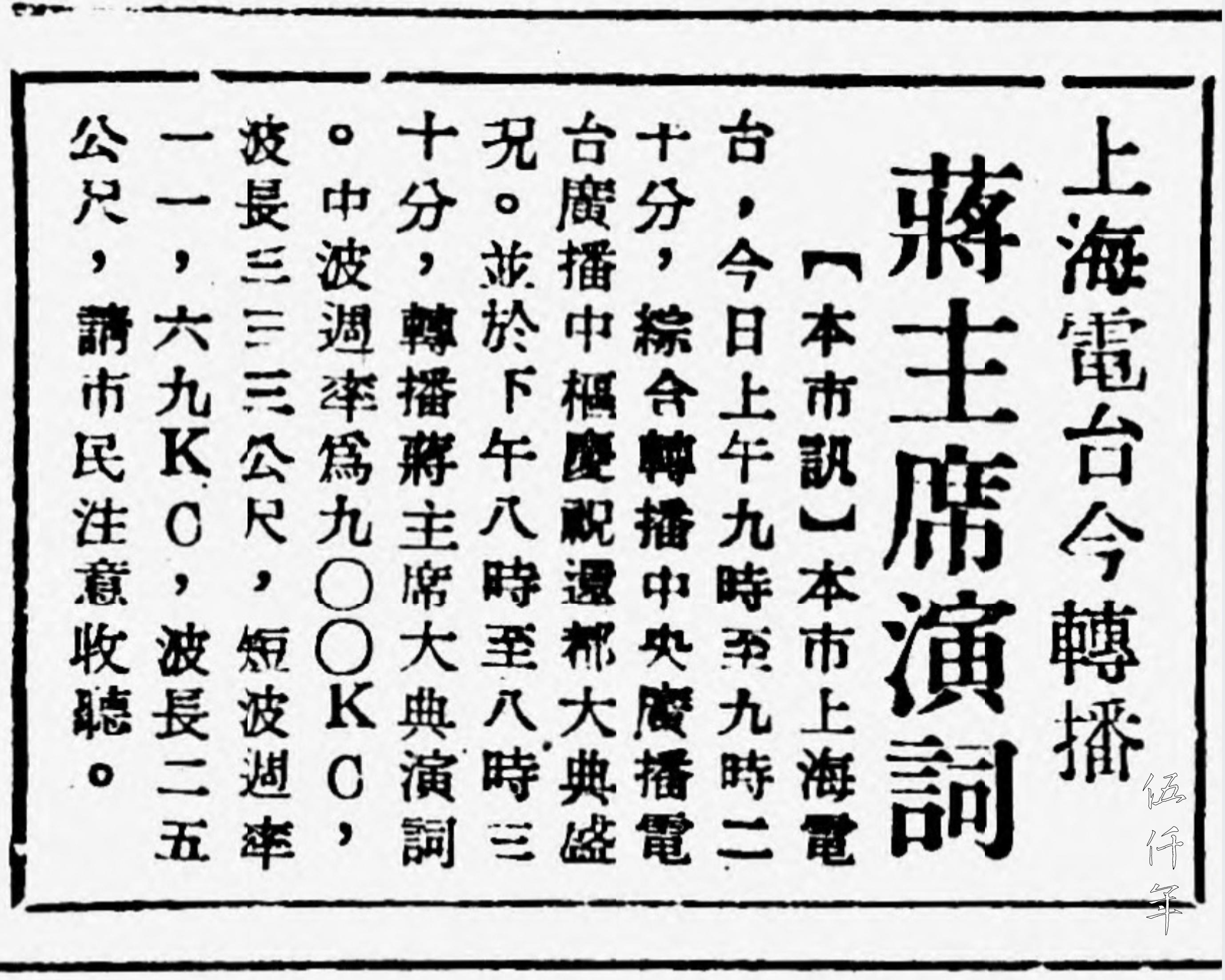
Detail of front page of Min-kuo Daily News, Notification of Speech by Generalissimo Chiang, dated 5 May 1946
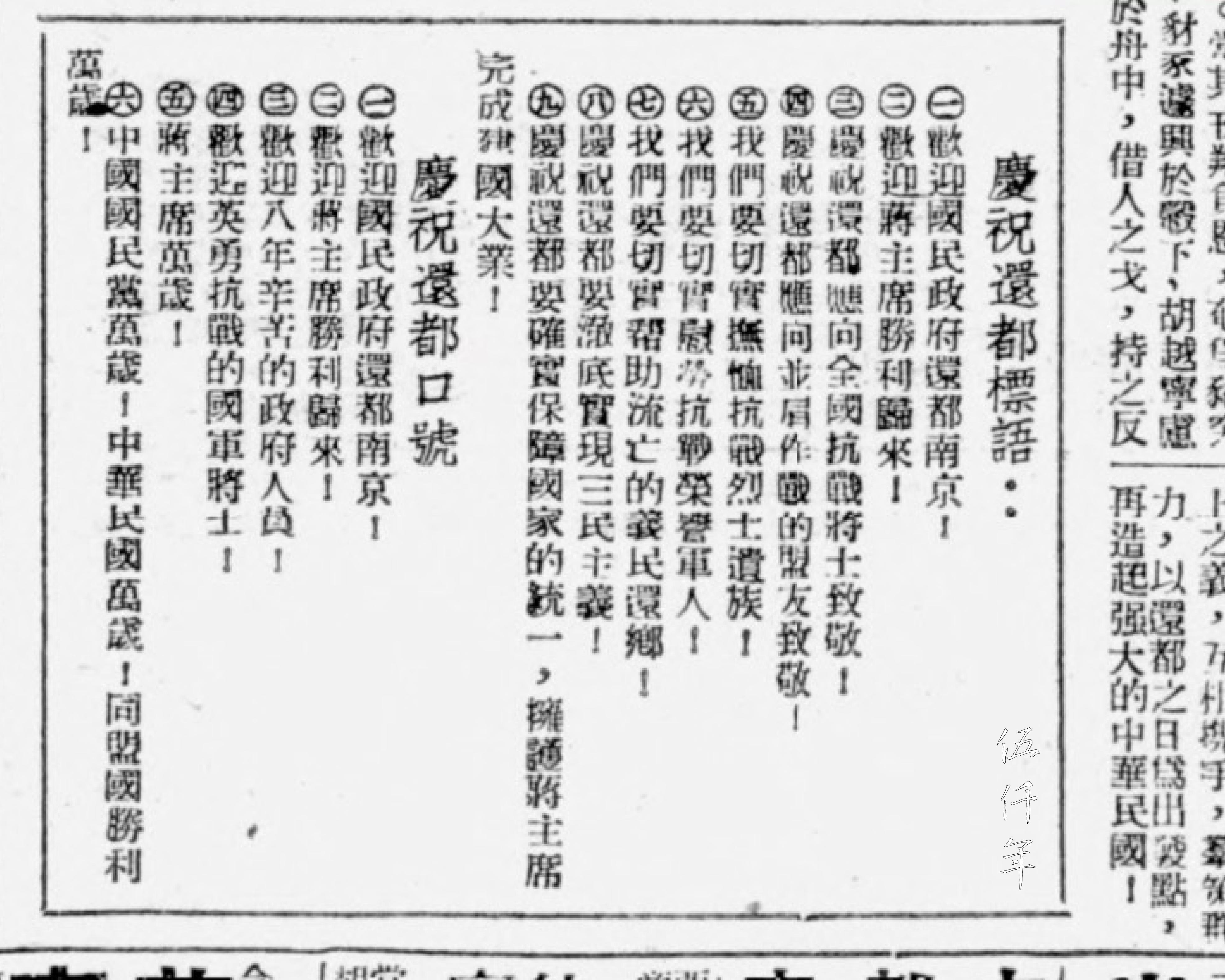
Detail of front page of Hua-pei Daily News, Taglines of Return to Nanking and Catchphrases of Return to Nanking, dated 5 May 1946
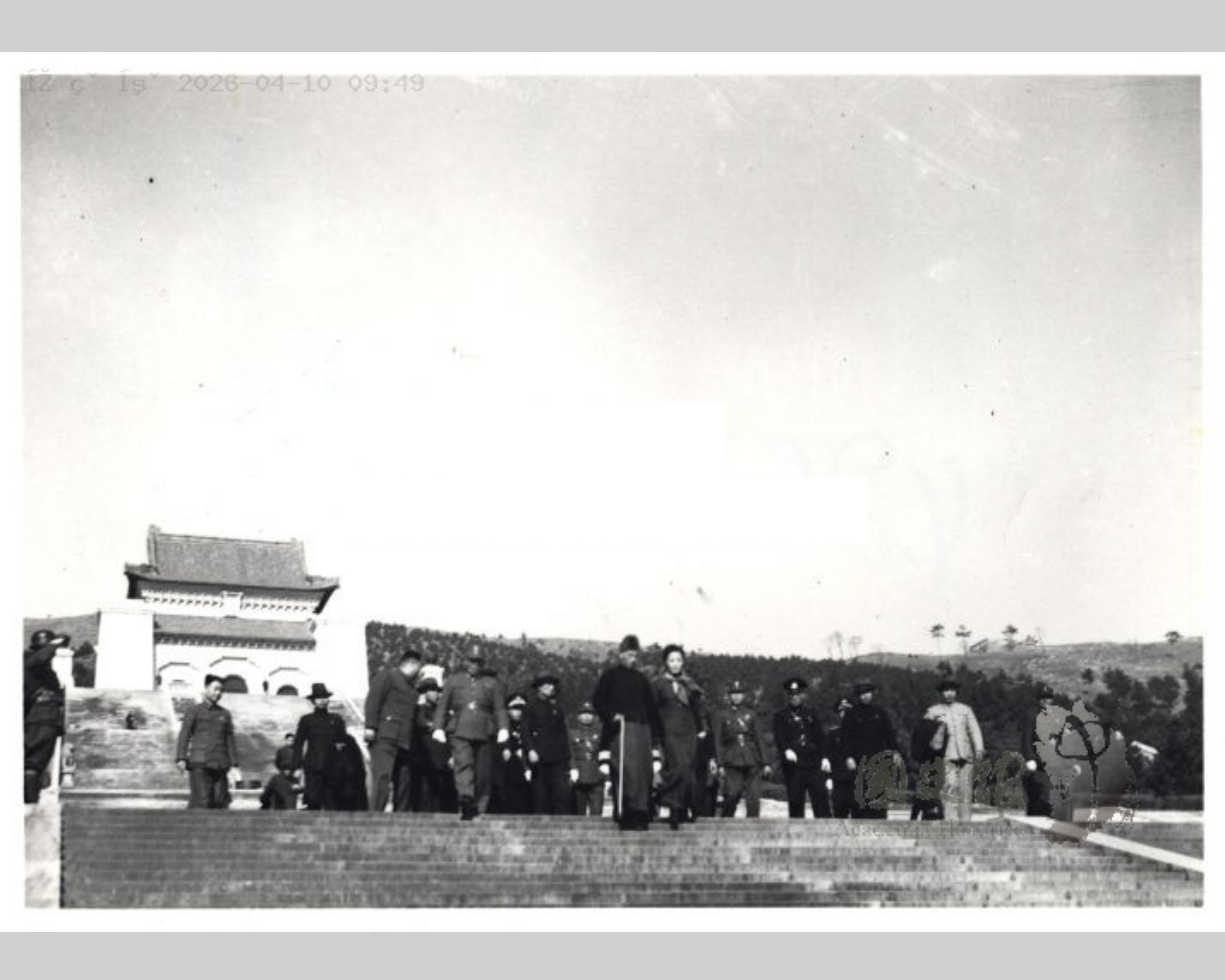
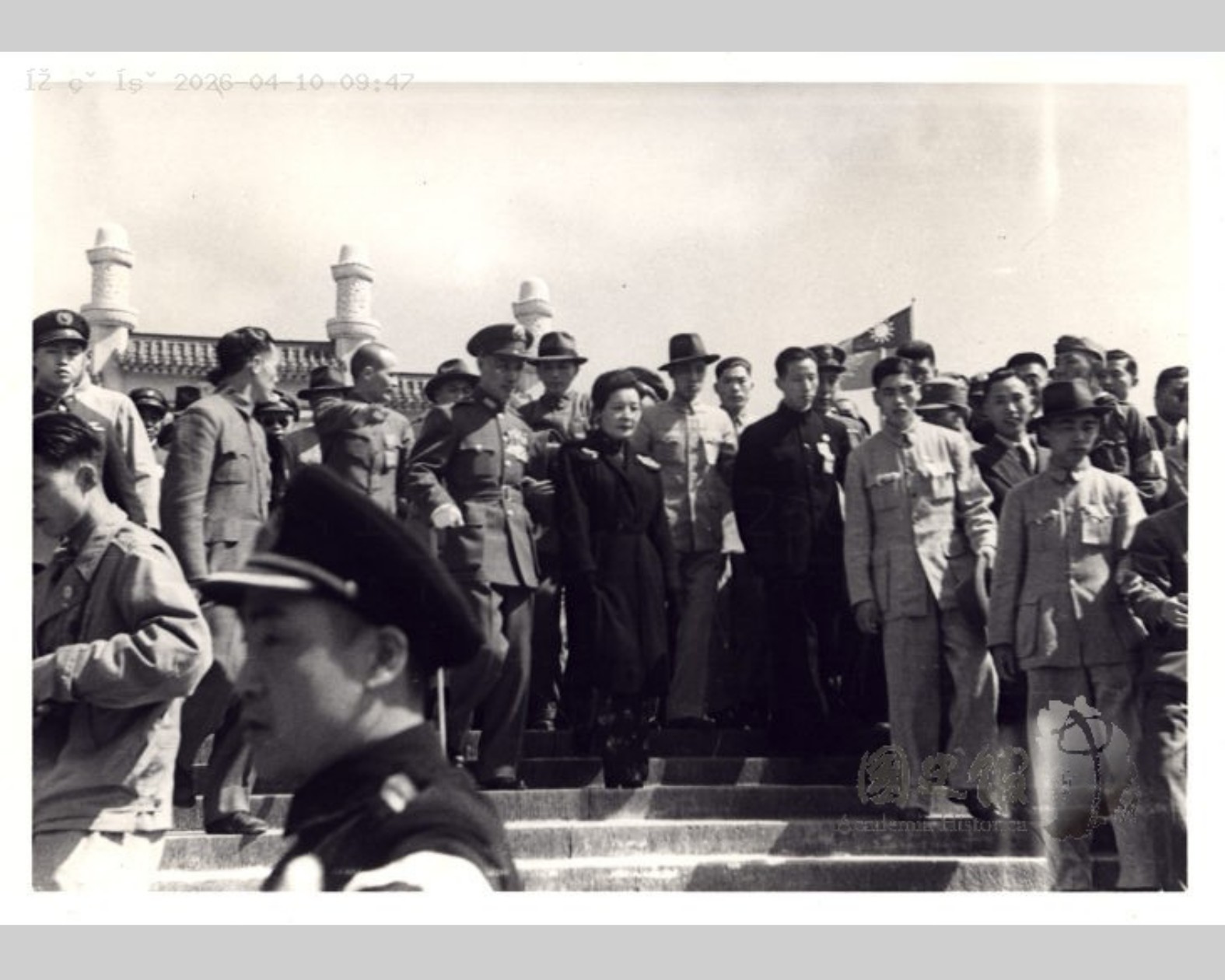
At 8:45 a.m. on 5 May, President Chiang Kai-shek, clad in an olive-green military uniform and in white gloves, arrived at the stone steps of the Sun Yat-sen Mausoleum. He was accompanied by Madame Chiang, who wore a floral silk ch’i-p’ao (旗袍) beneath a black overcoat. The President and his wife then proceeded slowly up the more than three hundred stone steps to the mausoleum hall, where they were greeted by resounding cheers from the assembled civil and military officials. President Chiang then bowed three times before the statue of Dr. Sun Yat-sen. A 101-gun salute thundered from across the Yangtze River. Afterwards the entire assembly sang the National Anthem, with many visibly moved to tears. After reading the Proclamation of the Return to the Capital, President Chiang laid flowers before the statue of President Sun Yat-sen and made a slow circuit around it. Upon exiting the hall, he addressed the gathered crowd, thus bringing the ceremony to its conclusion.
From 9:00 to 9:20 a.m., the Central Broadcasting System transmitted the ceremony live nationwide. President Chiang then proceeded to the plaza of the National Assembly Hall on Kuo Fu Road, where, from 10:30 to 11:00 a.m., he attended a celebration of the return to the capital organized by representatives from a cross-section of Nanking society, and delivered a speech to a crowd of some twenty thousand people. In the afternoon, from 4:00 to 5:00 p.m., President Chiang and Madame Chiang received foreign envoys and guests. At 8:00 that evening, President Chiang addressed the nation by radio. Across Nanking, the city was awash in a sea of white sun and blue sky, the national flag of the Republic of China.
President Chiang Kai-shek at the ceremony to celebrate the triumphant return to the capital of Nanking, 5 May 1946. Photograph courtesy Academia Historica
President Chiang Kai-shek leading a group of officers and civilians to pay respect at the Sun Yat-sen Mausoleum on 5 May 1946. Photograph courtesy Academia Historica
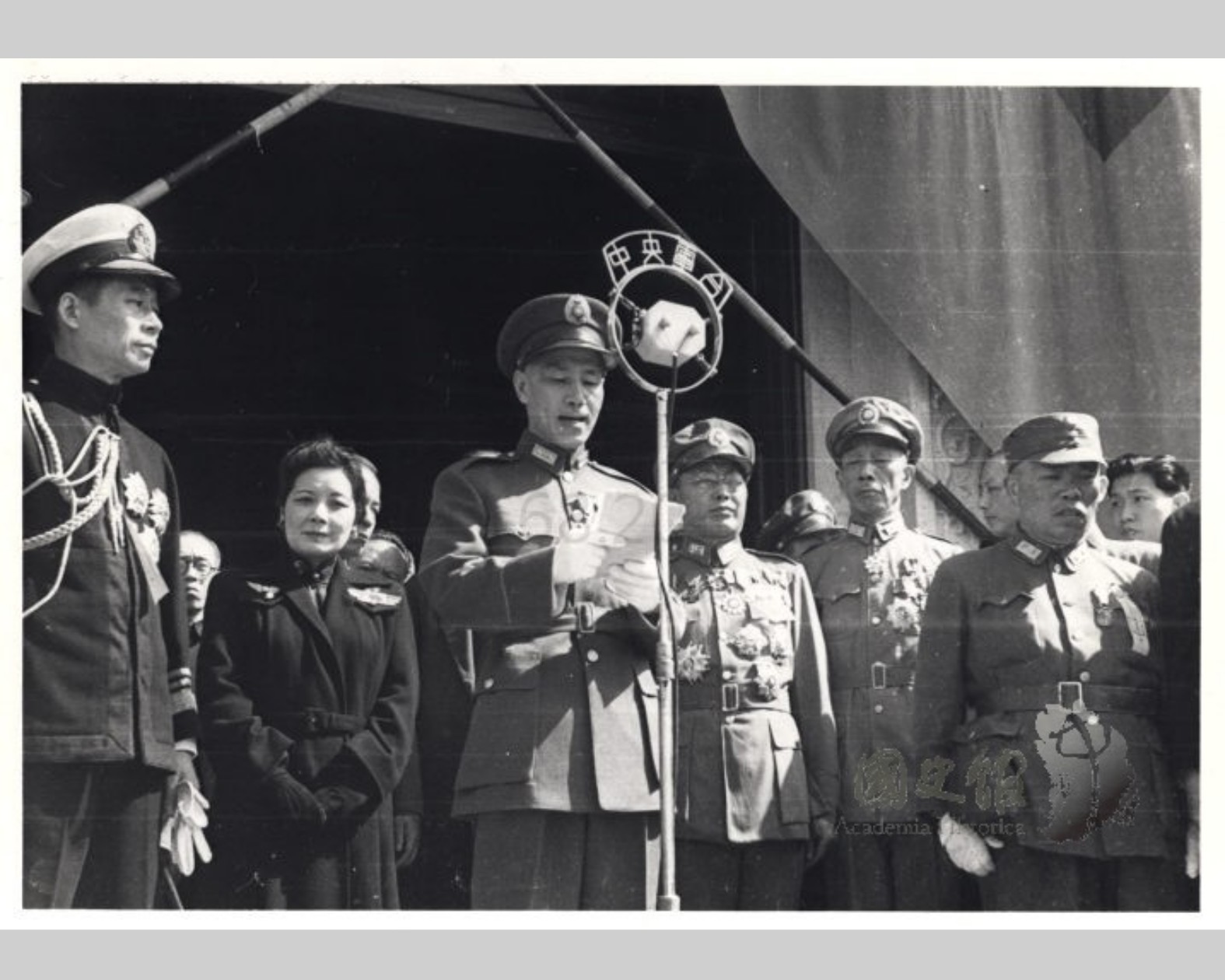
President Chiang Kai-shek giving a speech at the Sun Yat-sen Mausoleum, 5 May 1946. Photograph courtesy Academia Historica
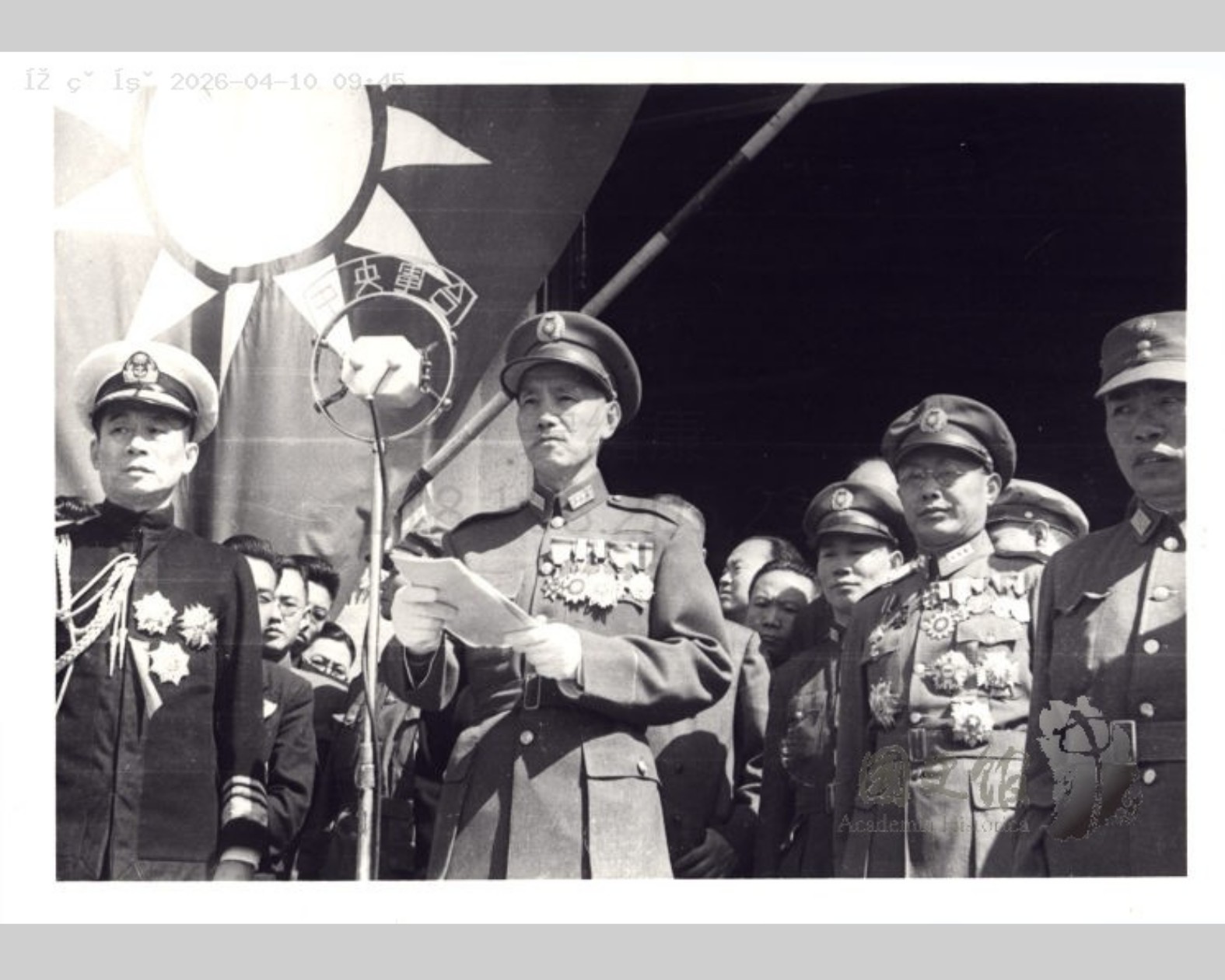
President Chiang Kai-shek giving a speech at the Sun Yat-sen Mausoleum, 5 May 1946. Photograph courtesy Academia Historica
President Chiang addressed the nation that evening, some of his words are:
“Today marks the 25th anniversary of the founding of the revolutionary government in Canton by Dr. Sun Yat-sen. On this day, our National Government has returned to the capital of Nanking. For eight years in the War of Resistance Against Japanese Aggression, it was through the unswerving commitment of all our compatriots, your steadfast support of national resistance policy, your compliance with central command, your indomitable perseverance against countless setbacks, your persistent endeavours, your sacrifices in blood, that we have at last secured final victory. We have also abrogated the unequal treaties and erased a century of national humiliation endured by the Chinese nation. That today I may once again meet with our compatriots in the capital and gather together in one hall is a source of greatest consolation. This is indeed the most memorable day in the history of the Republic of China!
Yet when we recall the fall of Nanking on 13 December of the 26th year of the Republic (1937), our compatriots in Nanking were slaughtered in a catastrophic massacre, we feel the pain and we draw our resolve in this pain. We will never forget the dark, subjugated life we endured for eight years under the enemy’s savagery. All the more we must remain vigilant and assiduous, and dedicate ourselves to self-reliance and self-strengthening...
Going forward, the National Government will continue to uphold the teachings of Dr. Sun Yat-sen, our National Father, and the enduring spirit of the National Revolution, leading our compatriots, both civilian and military, towards the realization of The Three Principles of the People and the completion of postwar national reconstruction… Yet all our compatriots must thoroughly understand that the work of national reconstruction is even more difficult, formidable and painful than the War of Resistance… Only by sustaining the same spirit that carried us through the war, remaining vigilant from dawn to dusk, standing united with our fellow citizens, supporting the National Government, can we create a new China grounded in The Three Principles of the People: unified and independent, free and equal, prosperous and strong, and enjoy lasting peace and well-being…”
Reading this address eighty years from then, the elation of returning to the capital, the anguish and sorrow of the Japanese massacre, the hardships of nation-building, and the hopes for the future of China, can still be felt.

Portrait of Li Chia-mien
In the 35th year of the Republic, Chairman Lo Cho-ying (羅卓英) of the Kwangtung Provincial Government appointed Li Chia-mien to be the Nanking representative. He attended the celebration ceremony for the return to the capital on 5 May. While working in Nanking, he used his spare time to invite prominent figures and fellow provincials to inscribe the Album of Calligraphy and Painting to Celebrate the Triumphant Return to Capital Nanking, thus creating this precious historical manuscript.
Mr. Li Chia-mien, tzu Kai-chih (改之), studio name I-yüeh Lou (倚月樓), was born in the 27th year of Kuang-hsü reign 1901, and died in the 74th year of the Republic 1985. He was a native of Ta-p’u, Kwangtung province. In the 11th year of the Republic 1922, after graduating from Ta-p’u County Middle School, he was retained as an instructor. In autumn the following year, he entered the National Kwangtung University, supporting himself with a part-time job. He came to the attention of the university president, Tsou Lu (鄒魯), who recommended him for membership in the Chinese Nationalist Party, and he graduated in the autumn of the 15th year of the Republic 1926. That same year, he was appointed secretary of the Publicity Department of the Canton Special Municipal Chinese Nationalist Party Headquarters, and successively served as editor of the magazines Cheng-cheng Ts’ung-pao (政政叢報) and Chün-sheng (軍聲). During the Northern Expedition when there was a great many wounded soldiers, he was appointed colonel and superintendent of the Army and Navy Convalescent Institute. In the 21st year of the Republic 1932, he became principal of the Ch’iung-tung County Middle School, and in the 24th year of the Republic 1935, he concurrently served as magistrate of Wen-ch’ang County. The following year, he was appointed chief of the General Affairs Section of the Canton Special Municipal of the Chinese Nationalist Party Headquarters.
In the 28th year of the Republic 1939, as the war situation deteriorated and Canton fell, he left for Hong Kong, where he served as disciplinary director of the South China Middle School. In the winter of the 30th year of the Republic 1941, Hong Kong also fell, and in spring the following year he made his way to Chungking, where he was appointed director of the Documentation Section of the Southeast Asia Research Institute under the Overseas Community Affairs Council, concurrently serving as director of the General Affairs Section. In the 32nd year of the Republic 1943, he became confidential secretary to the Ministry of Transportation and Communications, and concurrently managed confidential affairs in the Fourth Division of the Secretariat. The following year, he was appointed commissioner of the third rank on the National Military Council Engineering Committee, also serving as chief of its General Affairs Section.

Li Chia-mien (first right) and representatives of Kwangtung Provincial Government arriving in Nanking, circa early May 1946
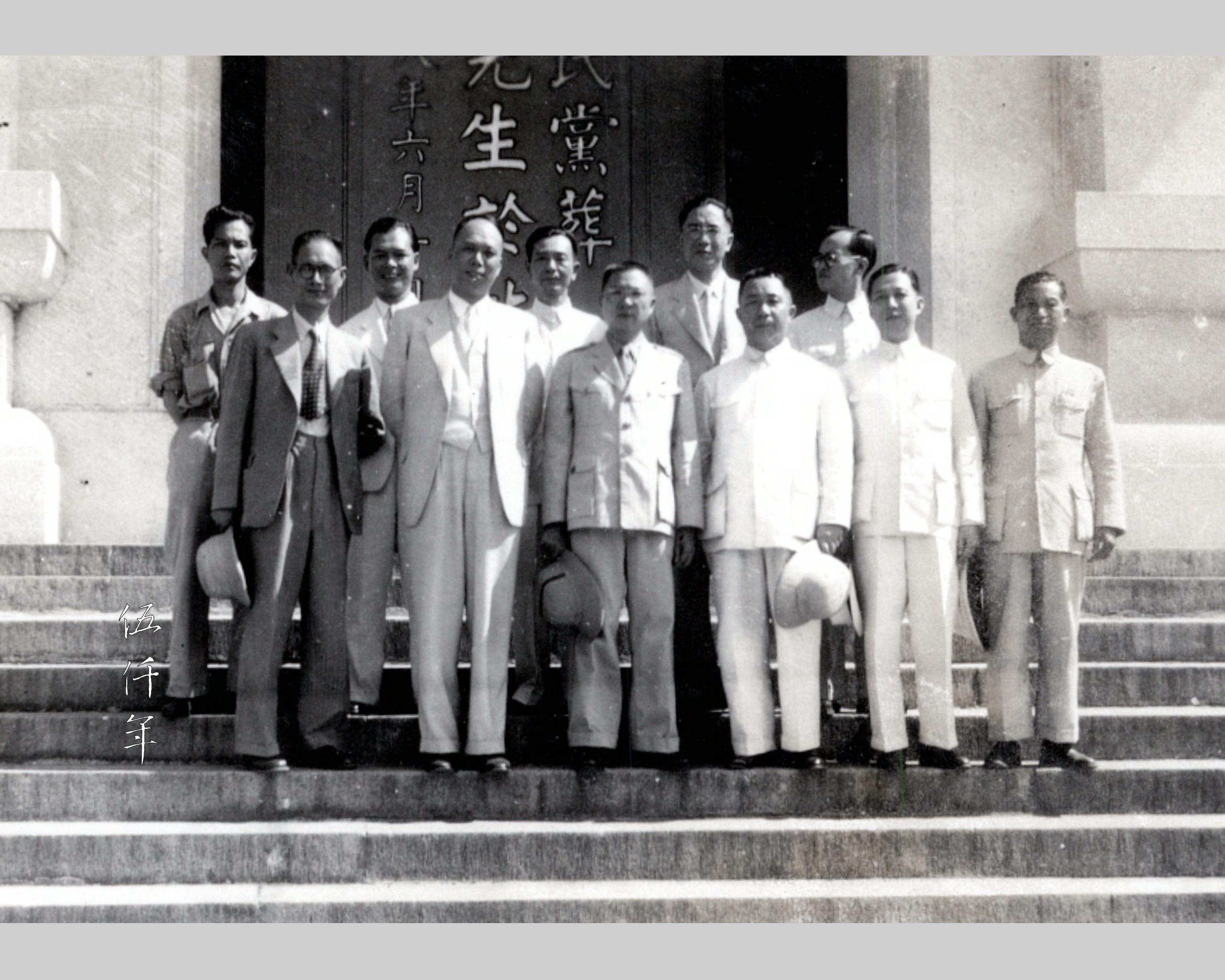
Li Chia-mien (first left front row) and representatives of Kwangtung Provincial Government at Sun Yat-sen Mausoleum in Nanking, dated 5 May 1946
After China’s victory in the War of Resistance, Lo Cho-ying (羅卓英) became Chairman of the Kwangtung Provincial Government, Li Chia-mien was appointed director (chien-jen rank簡仁) of the Chungking Office of the Kwangtung Provincial Government. In the 35th year of the Republic 1946, upon the return to the capital of Nanking, he was appointed advisor to the Kwangtung Provincial Government and concurrently served as the Chairman’s representative in Nanking. The following year, he was appointed a major-general counselor in the General Headquarters for Suppression of Banditry in the Northeast.
In the autumn of the 38th year of the Republic 1949, shortly before mainland China fell to the communists, he left for Hong Kong where he served as director of studies for the senior division of the South China Middle School. In the spring of the 42nd year 1953, he arrived in Taiwan supported by the entry application as a political loyalist and was later appointed director of academic affairs at Cho-lan Middle School in Miao-li County. He compiled Historical Facts of Anti-Chinese Exclusion in Siam (暹羅排華史實) and wrote Poems from I-yüeh Lou (倚月樓吟草).
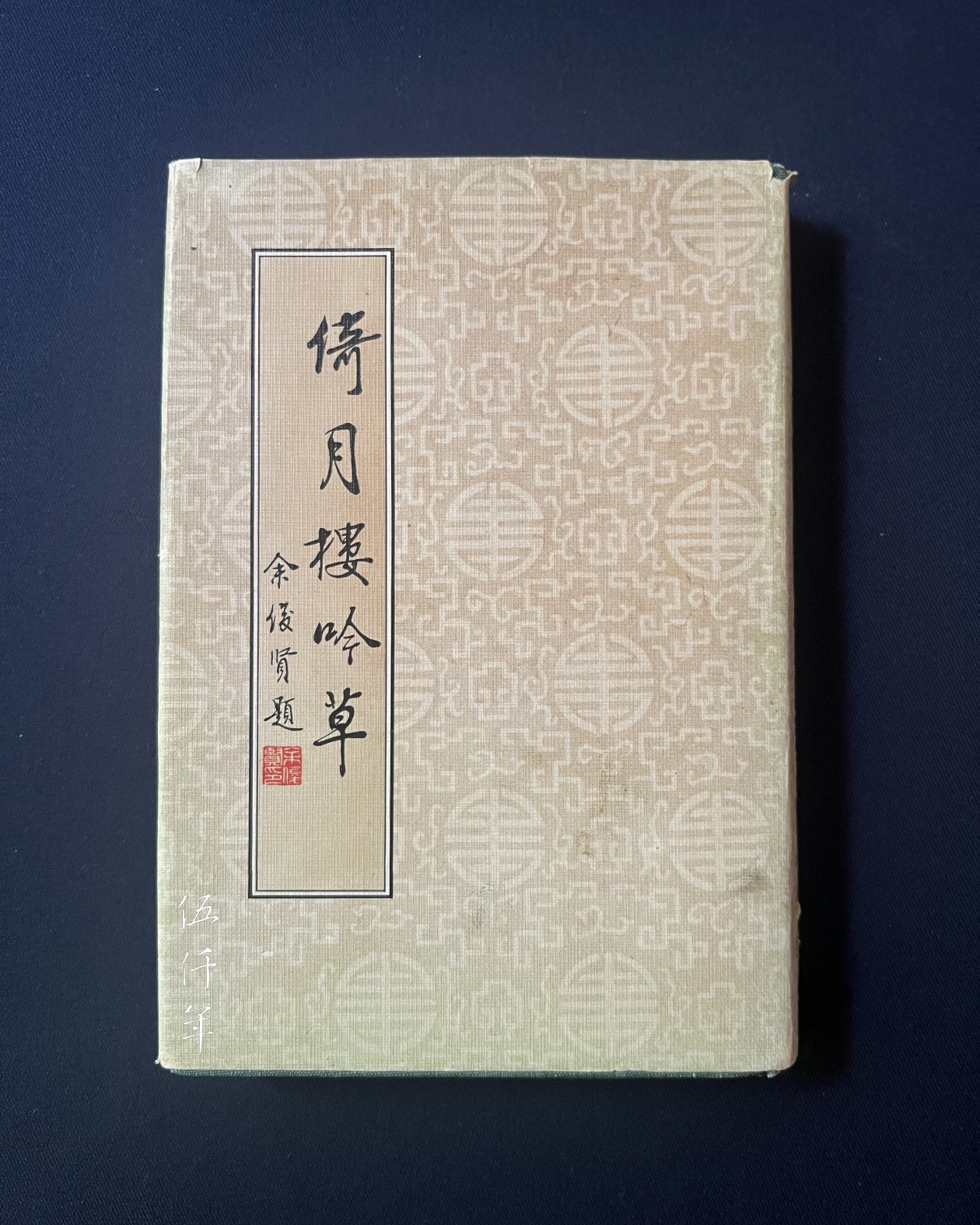
Front cover of Poems from I-yüeh Lou
Having received from his teacher Tsou Lu a poem titled Return to the Capital of Nanking, Li Chia-mien was inspired to collect more calligraphic inscriptions, to be compiled into the Album of Calligraphy and Painting to Celebrate the Triumphant Return to Capital Nanking. Altogether there are forty three inscriptions and one painting, the last inscription by Li Chia-mien himself.
The authors of the inscriptions are here listed according to the sequence inside the album:
1. Tsou Lu, or Zou Lu (鄒魯)
2. Tai Ch’uan-hsien, or Dai Jitao (戴傳賢)
3. Yü Yu-jen, or Yu Youren (于右任)
4. Lo Cho-ying, or Lou Zhuoying (羅卓英)
5. Chü Cheng, or Ju Zheng (居正)
6. Sun Fo, or Sun Ke (孫科)
7. Chang Ch’ün, or Zhang Qun (張群)
8. Ch’en Shu-jen, or Ch’en Shuren (陳樹人)
9. Ch’en Kuo-fu, or Ch’en Guofu (陳果夫)
10. Wang Ch’ung-hui, or Wang Chonghui (王寵惠)
11. Chang Chi, or Chang Ji (張繼)
12. Wu T’ieh-ch’eng, or Wu Tiecheng (吳鐵城)
13. Shao Li-tzu, or Shao Lizi (邵力子)
14. Ch’en Li-fu, or Chen Lifu (陳立夫)
15. Chiang Mon-lin, or Jiang Menglin (蔣夢麟)
16. Li Wen-fan, or Li Wenfan (李文範)
17. Tseng Ch’I, or Zheng Qi (曾琦)
18. Wang Yün-wu, or Wang Yunwu (王雲五)
19. Li Tsung-jen, or Li Zongren (李宗仁)
20. Ho Ying-ch’in, or He Yingqin (何應欽)
21. Ch’eng Ch’ien, or Cheng Qian (程潛)
22. Mo Te-hui, or Mo Dehui (莫德惠)
23. Hu Shih, or Hu Shi (故適)
24. Ch’en Ch’eng, or Ch’en Cheng (陳誠)
25. Yü Pin, or Yu Bin (于斌)
26. Ch’en Pu-lei, or Ch’en Bulei (陳布雷)
27. Pai Ch’ung-hsi, or Bai Chongxi (白崇禧)
28. Chu Chia-hua, or Zhu Jiahua (朱家驊)
29. Hsüeh Yüeh, or Xue Yue (薛岳)
30. Ma Ch’ao-chün, or Ma Chaojun (馬超俊)
31. Lung Yün, or Long Yun (龍雲)
32. Chang Li-sheng, or Zhang Lisheng (張厲生)
33. Liang Han-ts’ao, or Liang Hancao (梁寒操)
34. Chia Ching-te, or Jia Jingde (賈景德)
35. Weng Wen-hao, or Weng Wenhao (翁文灝)
36. Ku Cheng-kang, or Gu Zhenggang (谷正綱)
37. Wang Shih-chieh, or Wang Shijie (王世杰)
38. Yü Han-mou, or Yu Hanmou (余漢謀)
39. Ch’en Ju-hsüan, or Ch’en Ruxuan (陳茹玄)
40. Chou Ch’i-kang, or Zhou Qigang (周啟剛)
41. Yao Yü-p’ing, or Yao Yuping (姚雨平)
42. Wu Ch’i-wei, or Wu Qiwei (吳奇偉)
43. Wen K’o-kang, or Wen Kegang (溫克剛)
44. Li Chia-mien, or Li Jiamian (李加勉)
Of the forty-four individuals mentioned above, twenty were natives of Kwangtung and Kwangsi, reflecting the strong bonds of shared provincial origin. Among them, Tai Ch’uan-hsien (戴傳賢) and Ch’en Pu-lei (陳布雷) committed suicide prior to the fall of mainland China to the communists, demonstrating unbending integrity and the deepest sense of honour. Ch’en Shu-jen (陳樹人) and Chang Chi (張繼) died of illness before the fall, fortunate not to have lived to witness the ensuing catastrophe. Seven out of the forty-four: Shao Li-tzu (邵力子), Li Tsung-jen (李宗仁), Lung Yün (龍雲), Ch’eng Ch’ien (程潛), Weng Wen-hao (翁文灝), Yao Yü-p’ing (姚雨平), and Wu Ch’i-wei (吳奇偉) later defected to the communist side, their treacherous act has been viewed with disdain by traditionalists and historians. Of the forty-four, apart from Tseng Chi (曾琦) who died in the United States, the remaining thirty-one all went to Taiwan, where they held fast to what was seen as the last bastion of Free China and the sole haven of Chinese Orthodox Tradition.
1) Calligraphy by Committee Member Tsou Lu (鄒魯委員) of the Central Executive Committee of the Chinese Nationalist Party.
His tzu (字) was Hai-pin (海濱), native of Ta-p’u in Kwangtung province. He was born in 1885 and died in 1954.

Calligraphy by Committee Member Tsou Lu of the Central Executive Committee of the Chinese Nationalist Party
Inscription reads:
“Back to capital Nanking on eastbound ship,
Welcoming crowds lined the shores.
Shame to leave no lofty mark in Szechwan,
But a united heart brought us victory.
Ten years away I forgot it was a sojourn,
Endless hardships rashly turn me old.
Friends and relatives scattered all over,
Let’s talk no more about the Song of War.
In the 26th year of the Republic 1937, I relocated to the provisional capital of Chungking in Szechwan province. By the time I returned to the capital of Nanking in the 35th year of the Republic 1946, altogether I was in Szechwan for a period of ten years. Apart from Kwangtung province, this is where I spent the most years. Not only have I been touched by the friendships formed in Szechwan, the extraordinary landscape is also unforgettable. On the day of my return to the capital of Nanking, I composed this in deep attachment.
I hope my young brother Chia-mien (加勉) will doubly rectify this.
Tsou Lu (鄒魯).”
Seal impression: “Seal of Tsou Lu”.
2) Calligraphy by President Tai Ch’uan-hsien (戴傳賢院長) of the Examination Yuan
His tzu was Ch’i-t’ao (季陶), native of Wu-hsing in Chekiang province. He was born in 1891, and committed suicide in 1949 before the fall of mainland China to the communists.
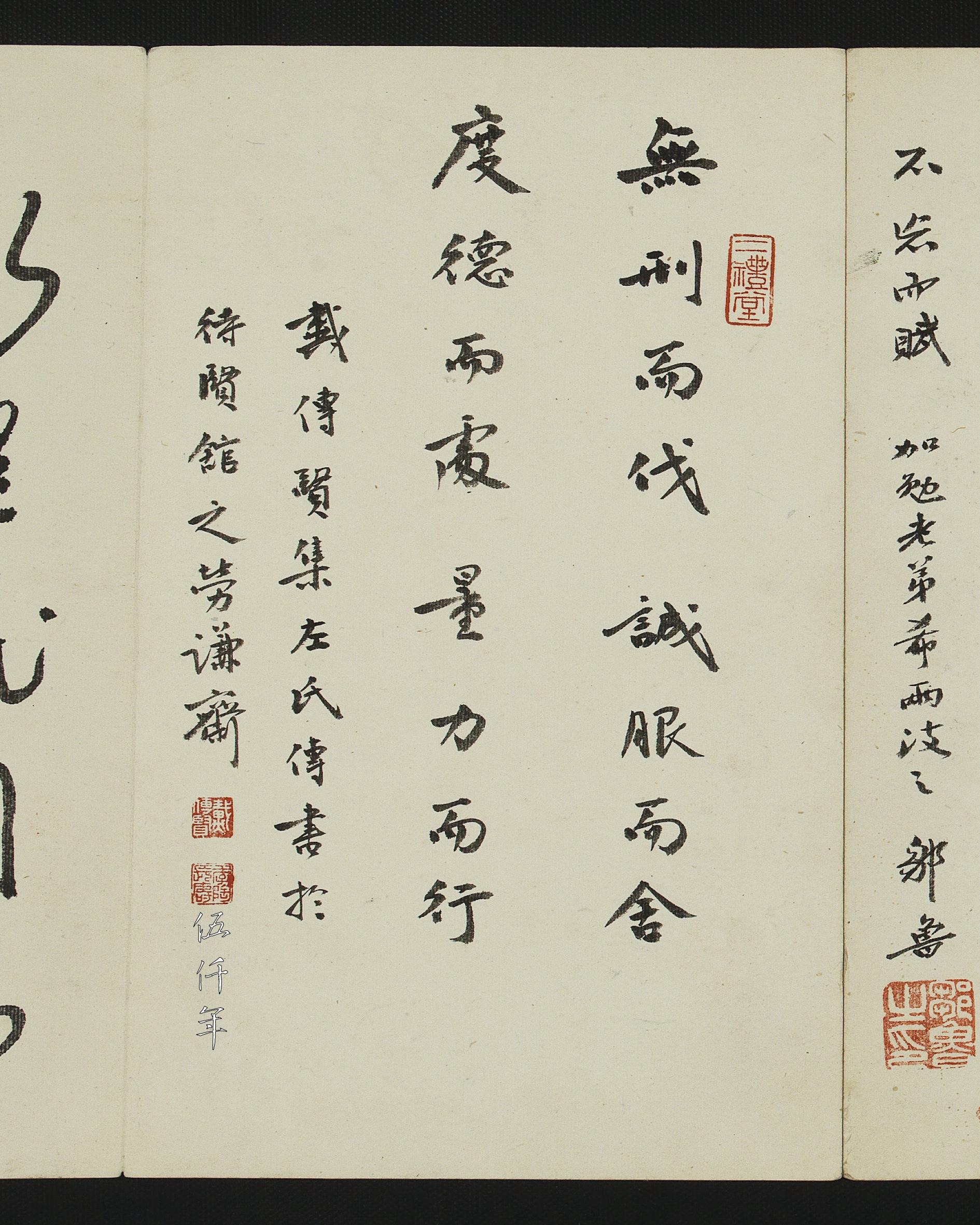
Calligraphy by President Tai Ch’uan-hsien of the Examination Yuan
Inscription reads:
“Strike when rules are discarded,
forgive when adversary repents.
Appraise self-virtue before action,
assess own ability in engagement.
Lines selected from The Commentary of Tso on the Spring and Autumn Annals (左傳) by Tai Ch’uan-hsien (戴傳賢), written in Lao-ch’ien Studio (勞謙齋), located in Ch’uan-hsien Mansion (傳賢館).”
Seal impressions: “Erh-li Studio (二禮堂)”, “Tai Ch’uan-hsien”, “Longevity to Ch’i-t’ao”.
3) Calligraphy by President Yü Yu-jen (于右任院長) of the Control Yuan
A native of San-yüan in Shensi province. He was born in 1879 and died in 1964.
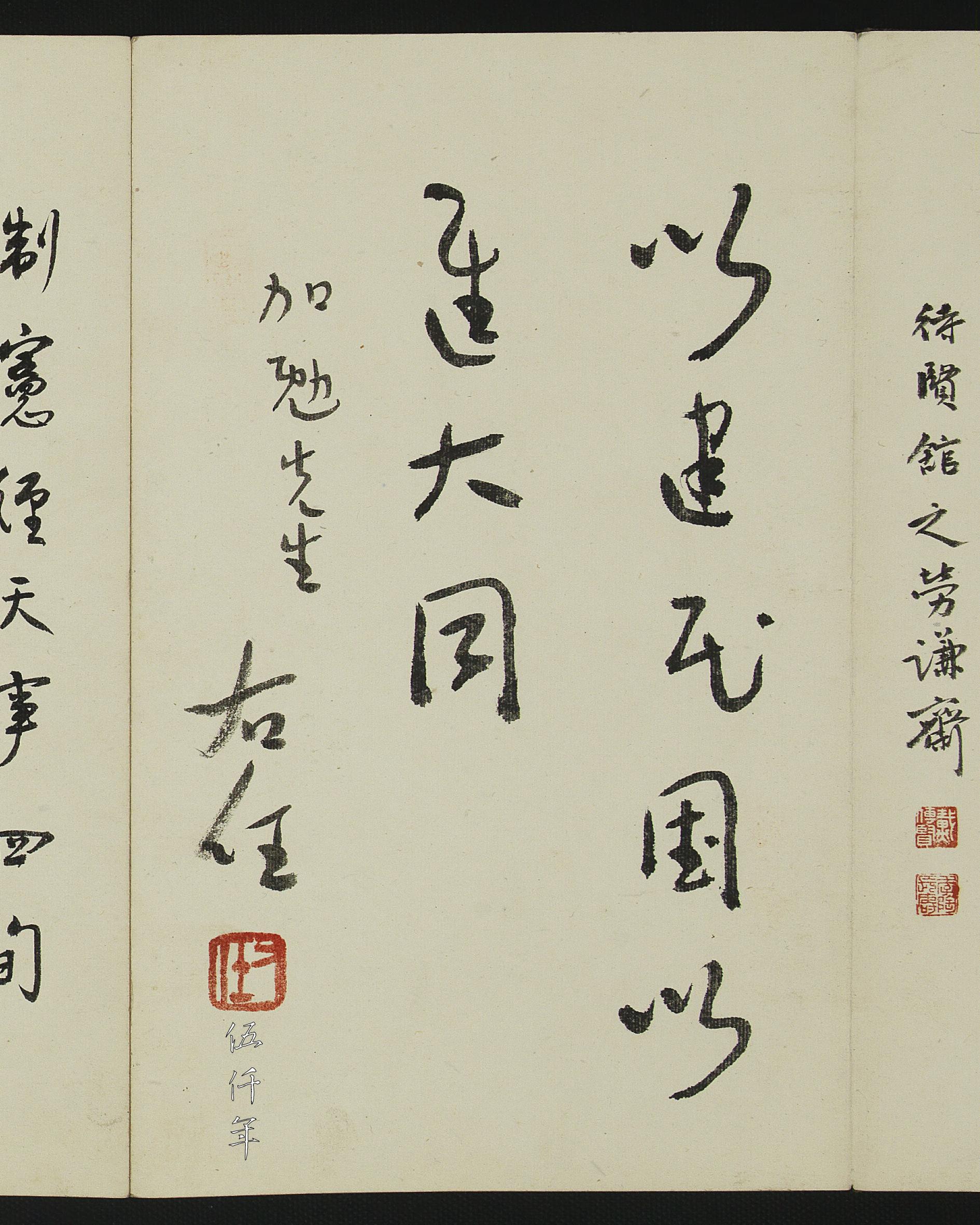
Calligraphy by President Yü Yu-jen of the Control Yuan
Inscription reads:
“To build the Republic of China,
to advance Universal Harmony.
For Mr. Chia-mien (加勉), Yu-jen (右任).”
Seal impression: “Yu-jen”.
4) Calligraphy by Governor Lo Cho-ying (羅卓英主席) of Kwangtung Province
His hao (號) was Tz’u-wei (慈威), his original name was Cho-ying (卓英), and he is better known by his original name. A native of Ta-p’u in Kwangtung province. He attained the title General of the Army of the Republic of China. He was born in 1896 and died in 1961.
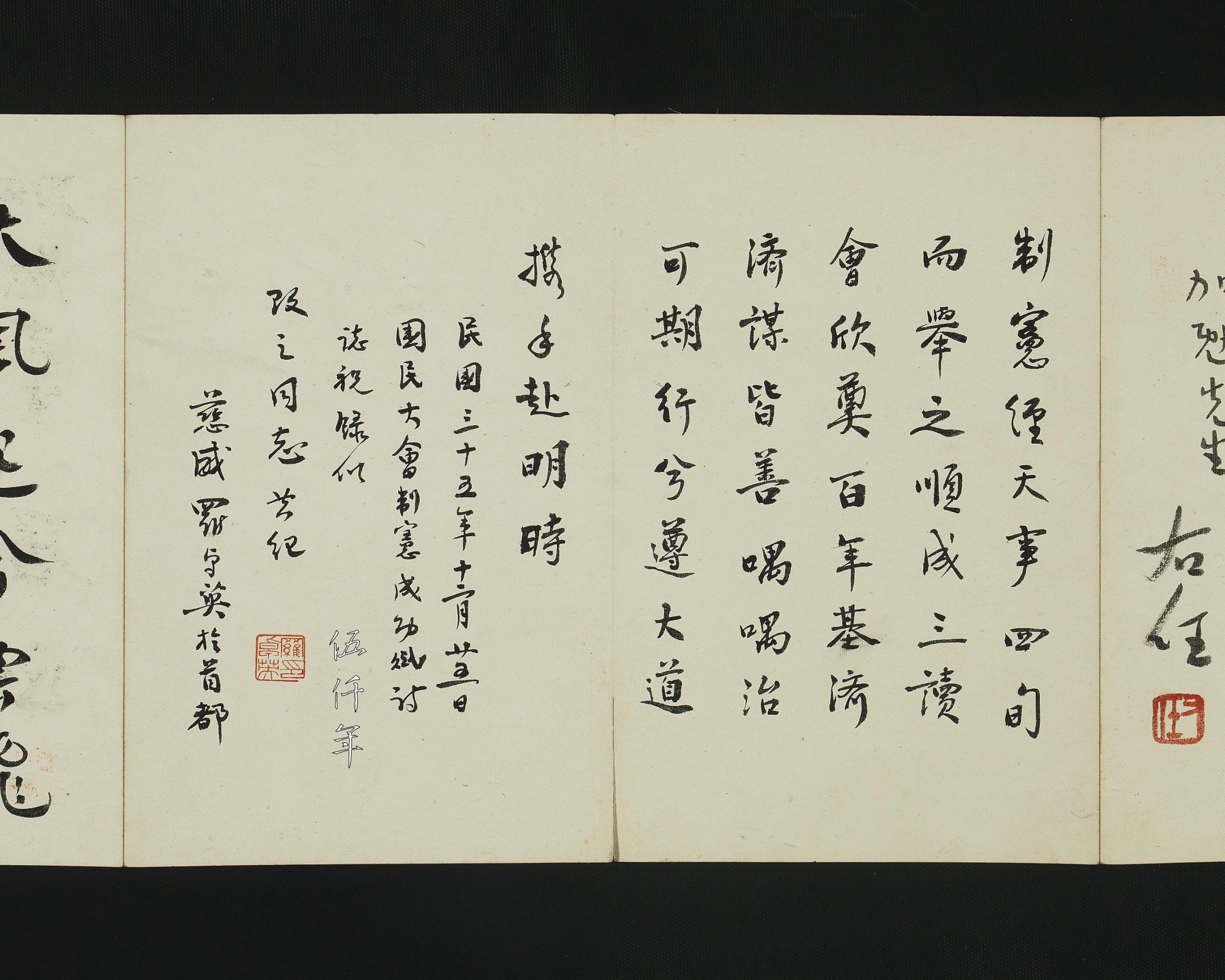
Calligraphy by Governor Lo Cho-ying of Kwangtung Province
Inscription reads:
“Constituent Assembly is for fairness,
Forty years of toil and labour.
Success in passing three readings,
Joyful national foundation laid.
Houseful of delegates sought the best,
Country looks forward to fresh start.
Move forward in unison with the Tao,
March hand in hand towards tomorrow.
Commemorating together with Comrade Kai-chih (改之),
Tz’u-wei (慈威) Lo Cho-ying (羅卓英) in the capital.”
Seal impression: “Seal of Lo Cho-ying”.
5) Calligraphy by President Chü Cheng (居正院長) of the Judicial Yuan
His tzu was Chüeh-sheng (覺生), native of Huang-chou in Hupeh province. He was born in 1876 and died in 1951.
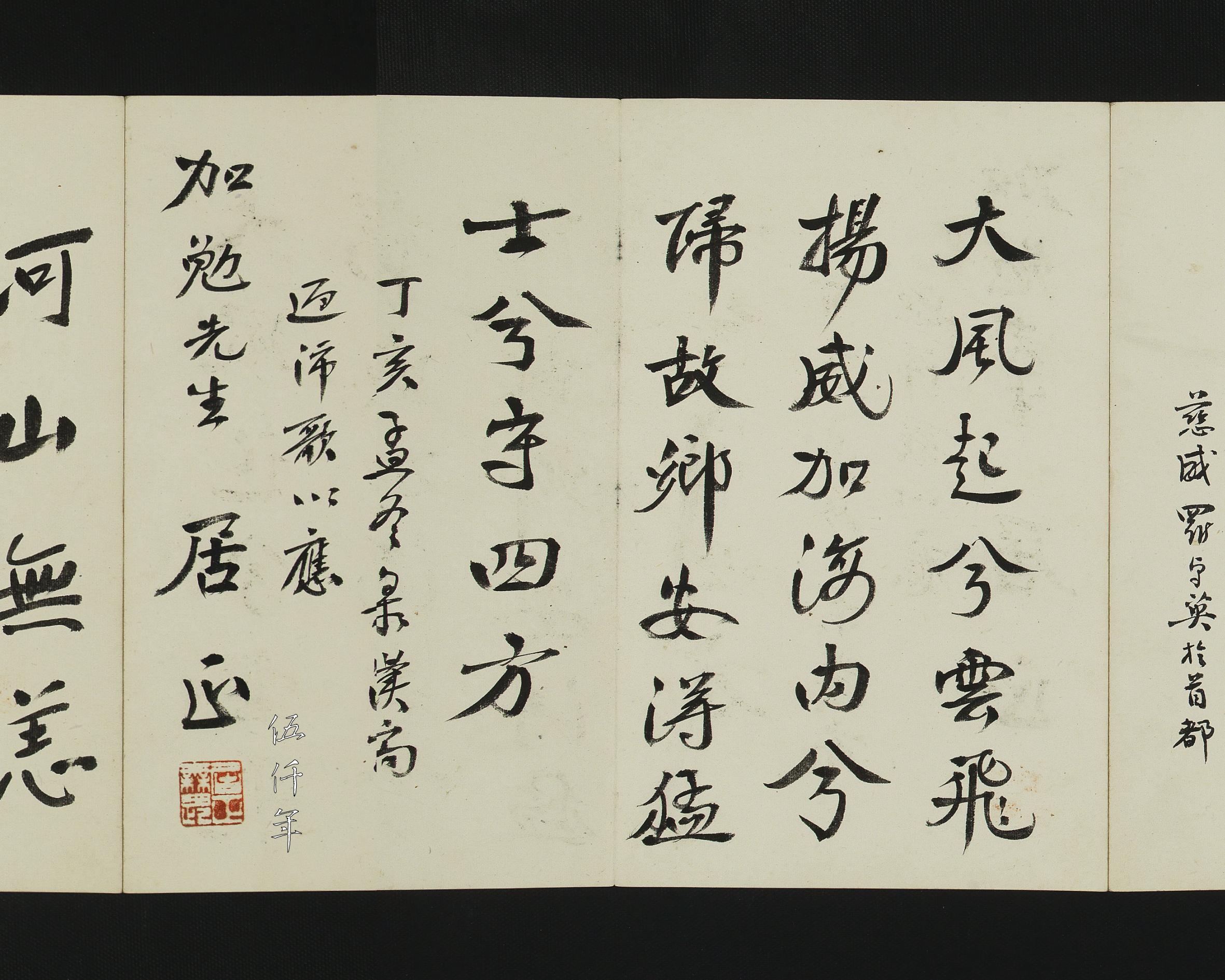
Calligraphy by President Chü Cheng of the Judicial Yuan
Inscription reads:
“A great wind blows and the clouds veer higher,
I return home now that I command the land,
Where are those warriors to guard the four seas?
In the first month of winter in ting-hai (丁亥) year, I copied the song composed in P’ei prefecture by Emperor Kao-tsu (高祖) of the Han dynasty, in response to Mr. Chia-mien’s (加勉) request, Chü Cheng (居正).”
Ting-hai year corresponds to 1947, and the personal name of Emperor Kao-tsu of Han dynasty was Liu Pang (劉邦).
Seal impression: “A rewarding relocation for Chü Cheng (居正橆遷)”.
6) Calligraphy by Premier Sun Fo (孫科院長) of the Executive Yuan
His original name Fo (科) can also be spelled as K’ei (科), his tzu was Che-sheng (哲生), son of Dr. Sun Yat-sen, Father of the Republic of China. A native of Hsiang-shan in Kwangtung province. He was born in 1891 and died in 1973.
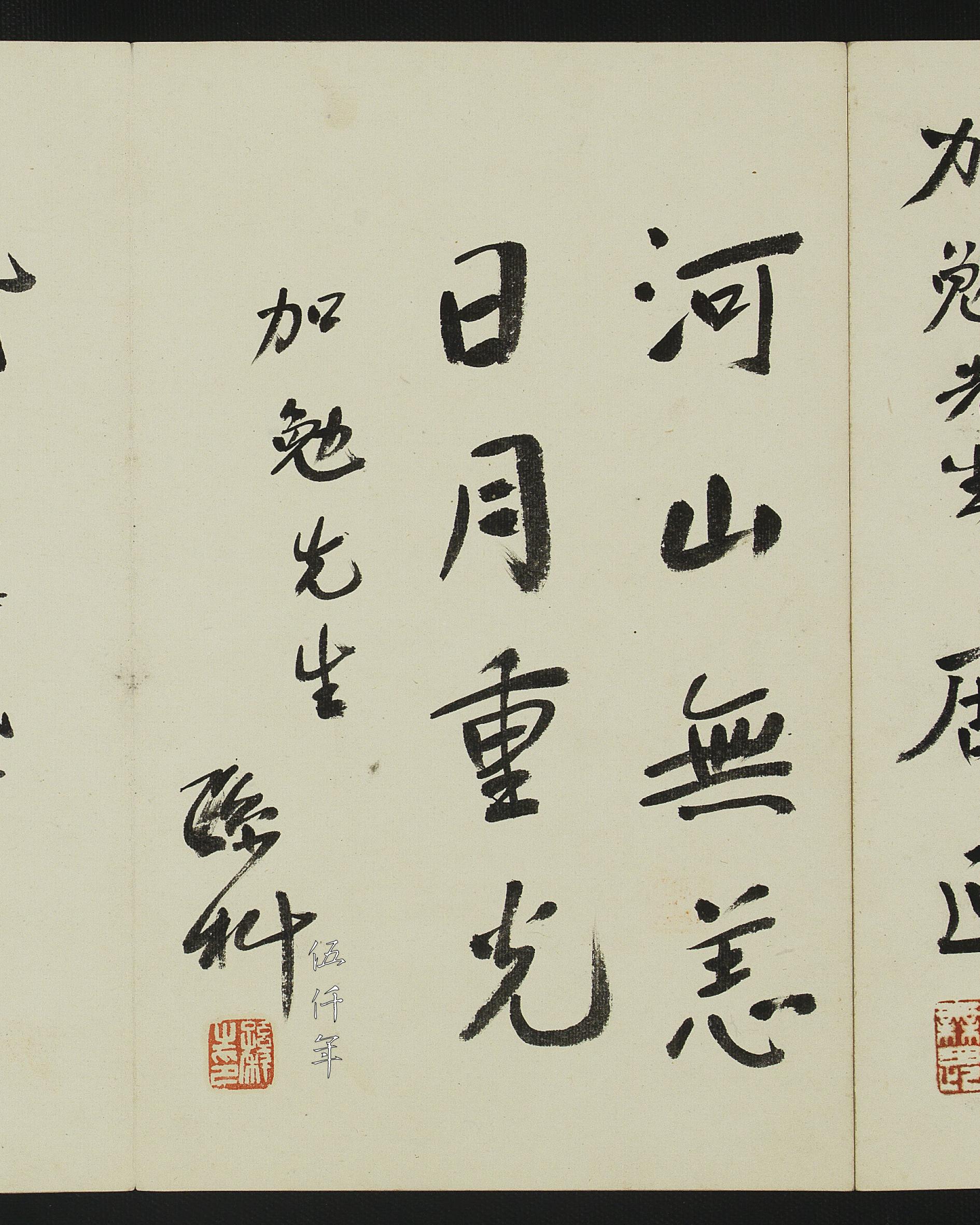
Calligraphy by Premier Sun Fo of the Executive Yuan
Inscription reads:
“The mountains and rivers have survived intact,
the sun and moon have recovered their glow.
For Mr. Chia-mien (加勉),
Sun Fo (孫科).”
Seal impression: “Seal of Sun Fo”.
7) Calligraphy by Premier Chang Ch’ün (張群院長) of the Executive Yuan
His tzu was Yüeh-chün (岳軍), native of Hua-yang in Szechwan province. He was born in 1889 and died in 1990.
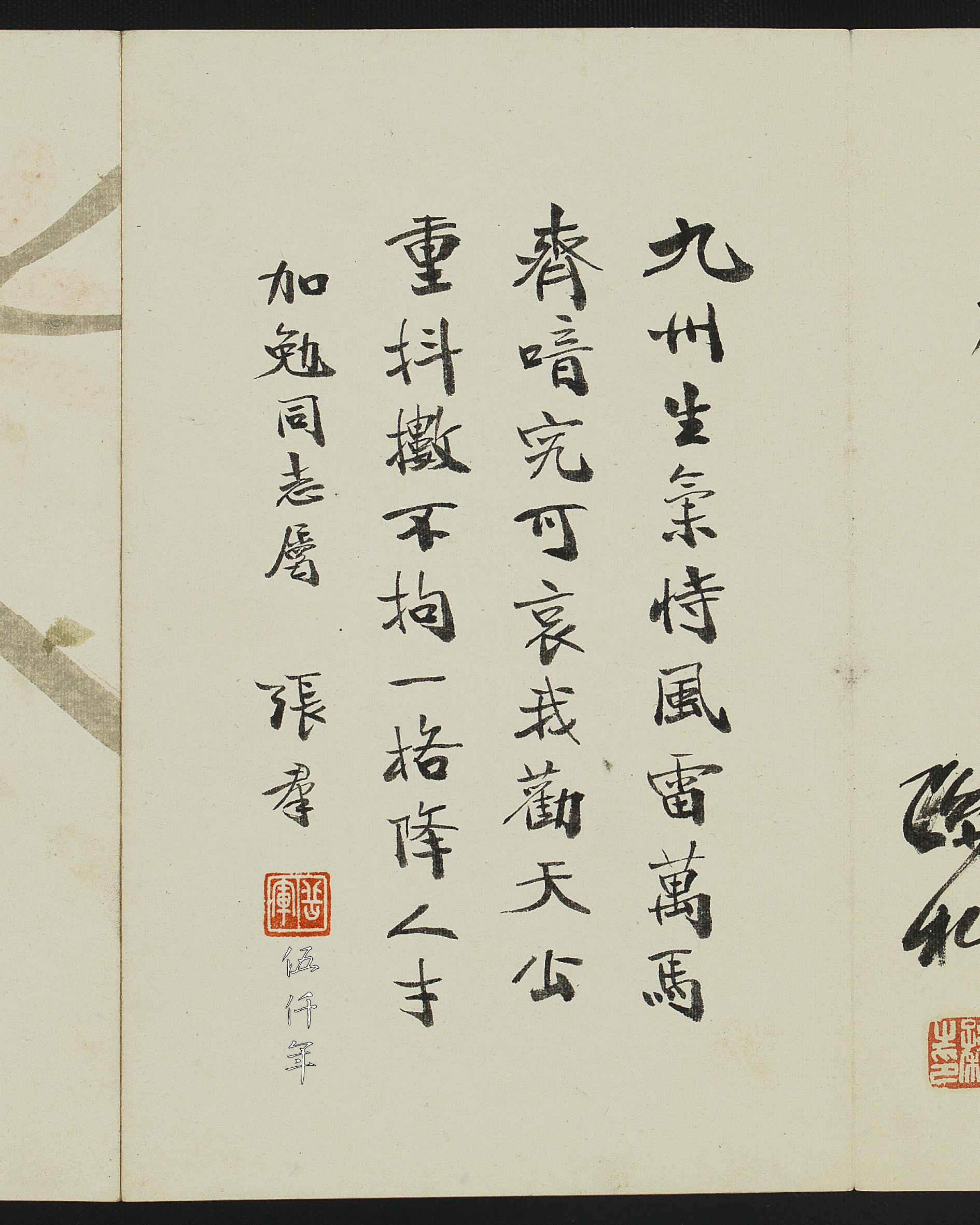
Calligraphy by Premier Chang Ch’ün of the Executive Yuan
Inscription reads:
“Our national spirit is invigorated by storm and thunder,
But saddened by the silence of tens of thousands.
I beseech Heaven to rise to the calling one more time,
Send us talented men and women across the land.
At the request of Comrade Chia-mien (加勉), Chang Ch’ün (張群).”
Seal impression: “Yüeh-chün”
8) Painting of Red Prunus by Secretary-General Ch’en Shu-jen (陳樹人秘書長) of the Nationalist Government
His original name was Shao (韶), his tzu was Shu-jen (樹人), he is known by his tzu. A native of Fan-yü in Kwangtung province. He was born in 1884 and died in 1948.
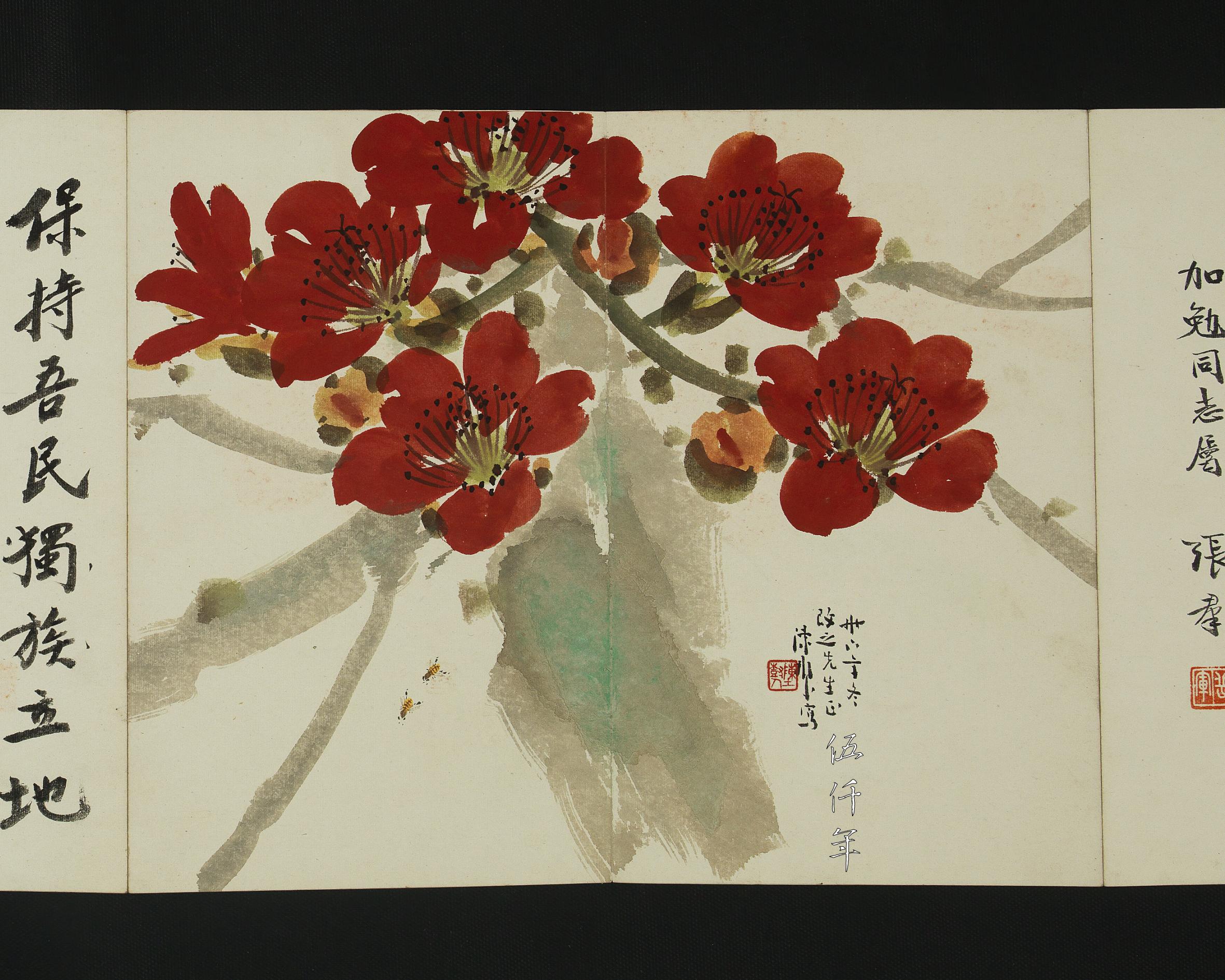
Painting of Red Prunus by Secretary-General Ch’en Shu-jen of the Nationalist Government
Inscription reads:
“Winter of the 36th year,
for the rectification of Mr. Kai-chih (改之),
brushwork by Ch’en Shu-jen (陳樹人).”
The 36th year of the Republic of China corresponds to 1947.
Seal impression: “Ch’en Shu-jen”.
9) Calligraphy by Vice President Ch’en Kuo-fu (陳果夫副院長) of the Control Yuan
His original name was Tsu-tao (祖燾), his tzu was Kuo-fu (果夫), and he is known by his tzu. A native of Wu-hsing in Chekiang province. He was born in 1892 and died in 1951.

Calligraphy by Vice President Ch’en Kuo-fu of the Control Yuan
Inscription reads:
“Maintain the independent status of our race,
promote the traditional culture of our nation,
absorb world cultures and champion them.
An excerpt from the Bequeathed Teachings of the Father of the Nation Dr. Sun Yat-sen.
For Mr. Kai-chih (改之), Ch’en Kuo-fu (陳果夫).
Seal impression: “Seal of Ch’en Kuo-fu”.
10) Calligraphy by President Wang Ch’ung-hui (王寵惠院長) of the Judicial Yuan
His tzu was Liang-ch’ou (亮疇), native of Tung-kuan in Kwangtung province. He was born in 1881 and died in 1958.
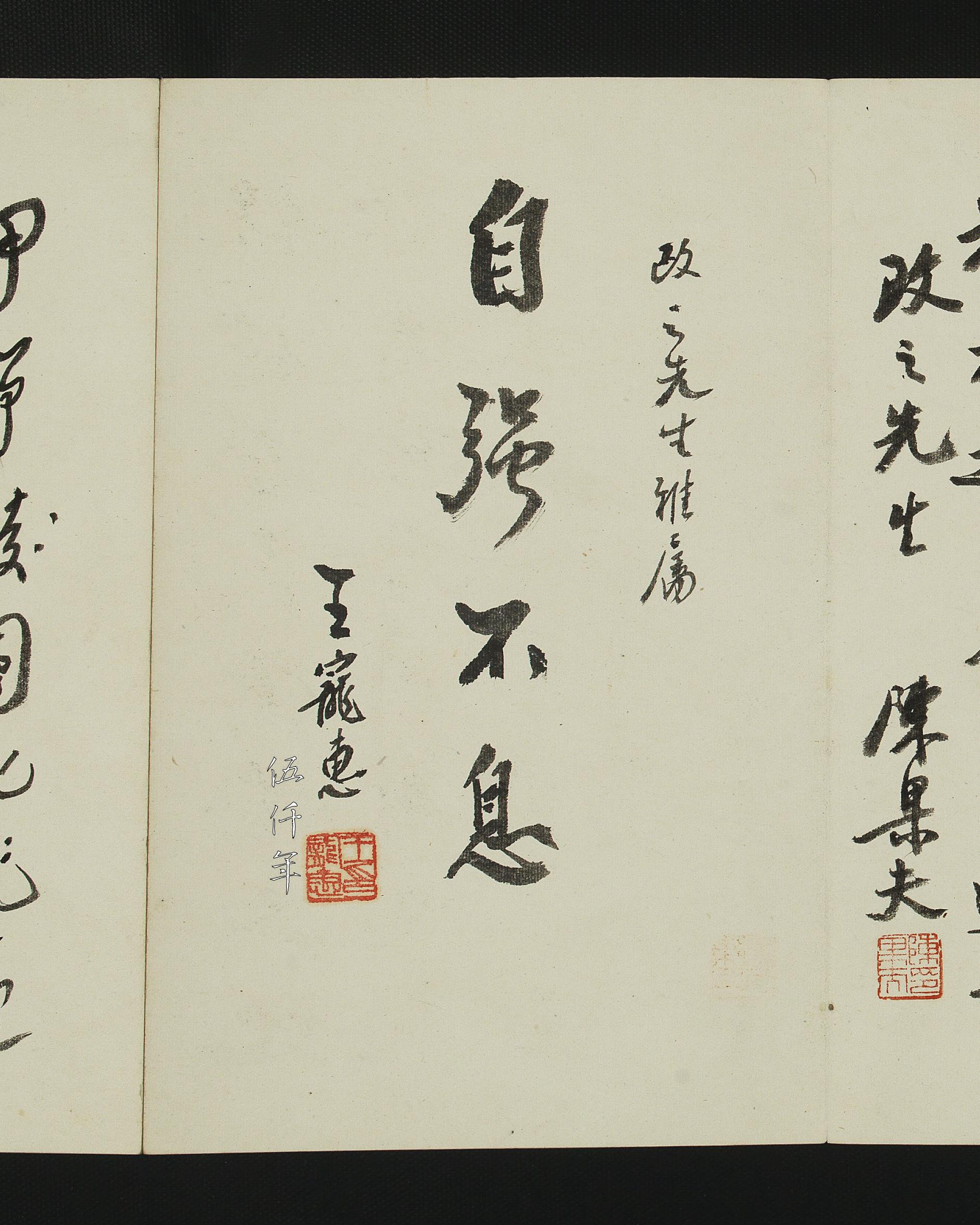
Calligraphy by President Wang Ch’ung-hui of the Judicial Yuan
Inscription reads:
“At the courteous request of Mr. Kai-chih (改之).
We strengthen ourselves continuously without repose.
Wang Ch’ung-hui (王寵惠).”
Seal impression: “Seal of Wang Ch’ung-hui”.
11) Calligraphy by Vice President Chang Chi (張繼副院長) of the Judicial Yuan
His tzu was P’u-ch’uan (溥泉), native of Ts’ang-hsien in Hopeh province. He was born in 1882 and died in 1947.

Calligraphy by Vice President Chang Chi of the Judicial Yuan
Inscription reads:
“Magnificent garden has turned to dust,
Dimly lit cottage still quite new.
Cuckoo is really a bird from west Szechwan,
Why follow tomb sweepers going east?
In June of the 36th year of the Republic, I returned to Nanking from Szechwan, and listened to the cuckoo in the Sun Yat-sen Mausoleum at dusk.
For the double rectifications of Kai-chih (改之),
Chang Chi (張繼).”
Seal impression: “Chang Chi”.
12) Calligraphy by Vice Premier Wu T’ieh-ch’eng (吳鐵城副院長) of the Executive Yuan
A native of Hsian-shan in Kwangtung province. He was born in 1888 and died in 1953.
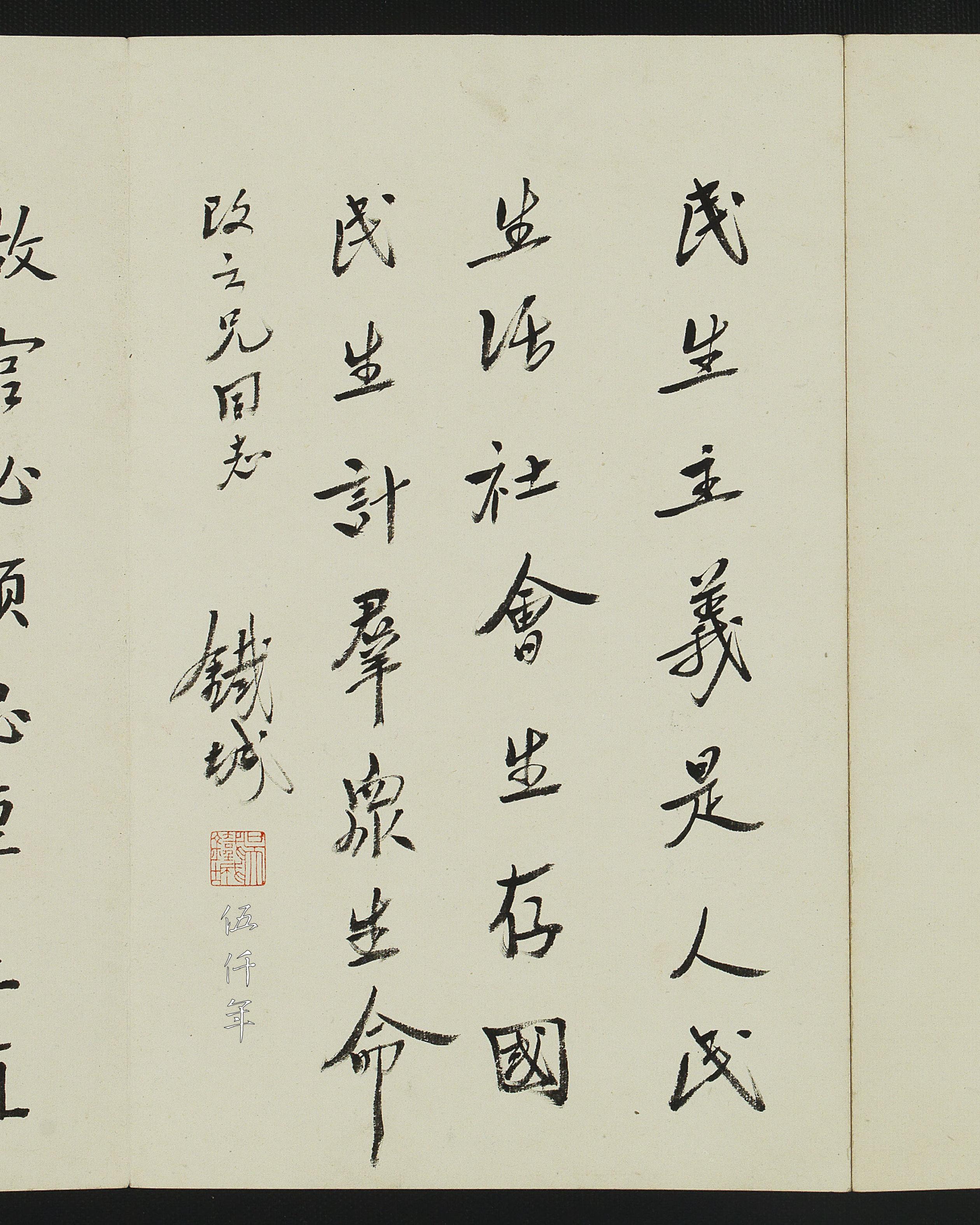
Calligraphy by Vice Premier Wu T’ieh-ch’eng of the Executive Yuan
Inscription reads:
“The Principle of Livelihood is about the livelihood of people,
the survival of society, the subsistence of people, and the collective well-being of society.
For Comrade Kai-chih (改之), T’ieh-ch’eng (鐵城).”
Seal impression: “Wu T’ieh-ch’eng”.
13) Calligraphy by Shao Li-tzu (邵力子)
A native of Shao-hsing in Chekiang province. He was born in 1882 and died in 1967.
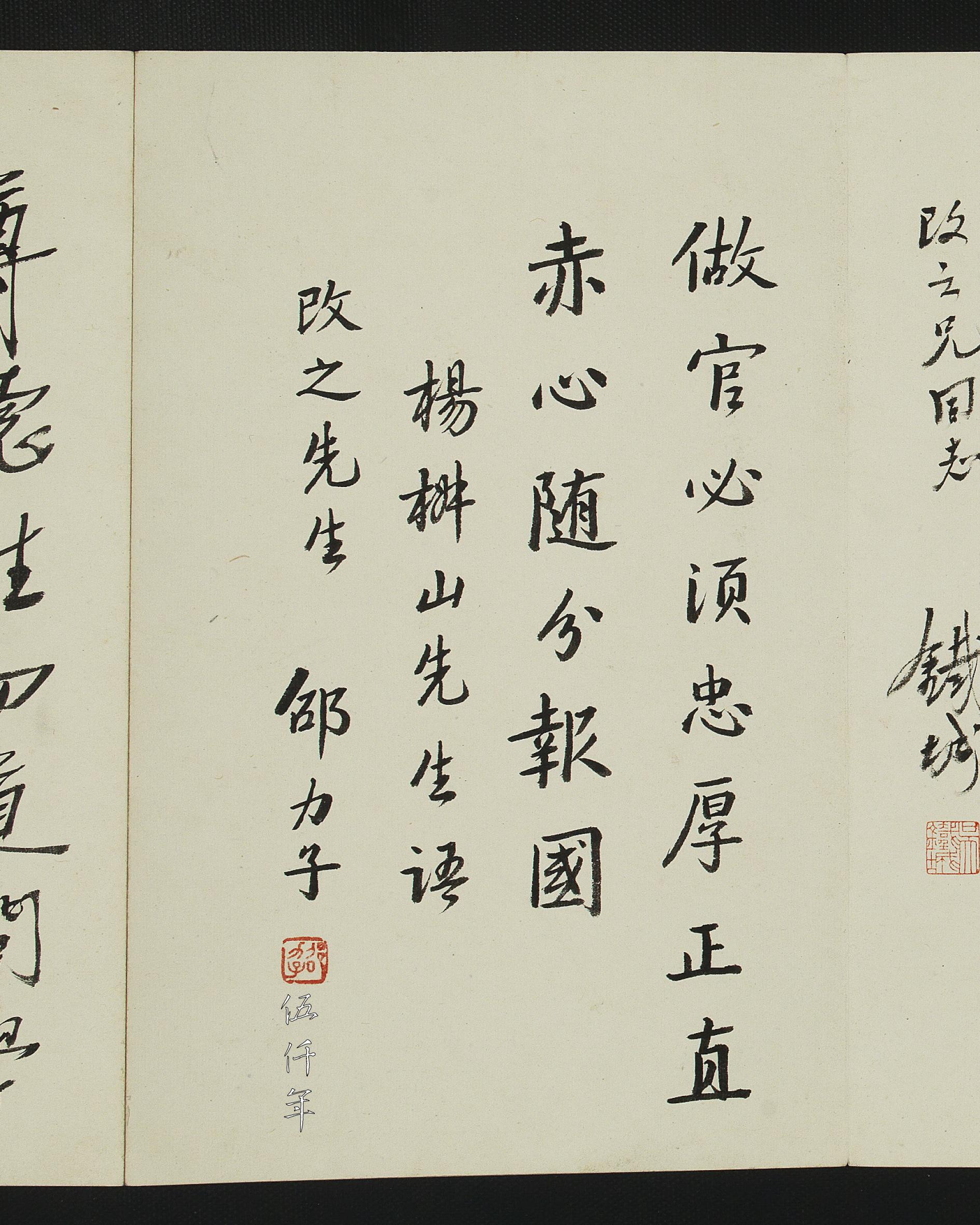
Calligraphy by Shao Li-tzu
Inscription reads:
“To be a government official, one must be loyal and upright,
devoted and ready to serve the country in different capacities.
Words by Yang Ch’iao-shan (楊椒山).
For Mr. Kai-chih, Shao Li-tzu (邵力子).”
The original name of Yang Ch’iao-shan (楊椒山) was Chi-sheng (繼盛), born in 1516 and died in 1555.
Seal impression: “Shao Li-tzu”.
14) Calligraphy by Vice President Ch’en Li-fu (陳立夫副院長) of the Legislative Yuan
His original name was Tsu-yen (祖燕), his tzu was Li-fu (立夫), and he is known by his tzu. A native of Wu-hsing in Chekiang province. He was born in 1900 and died in 2001.
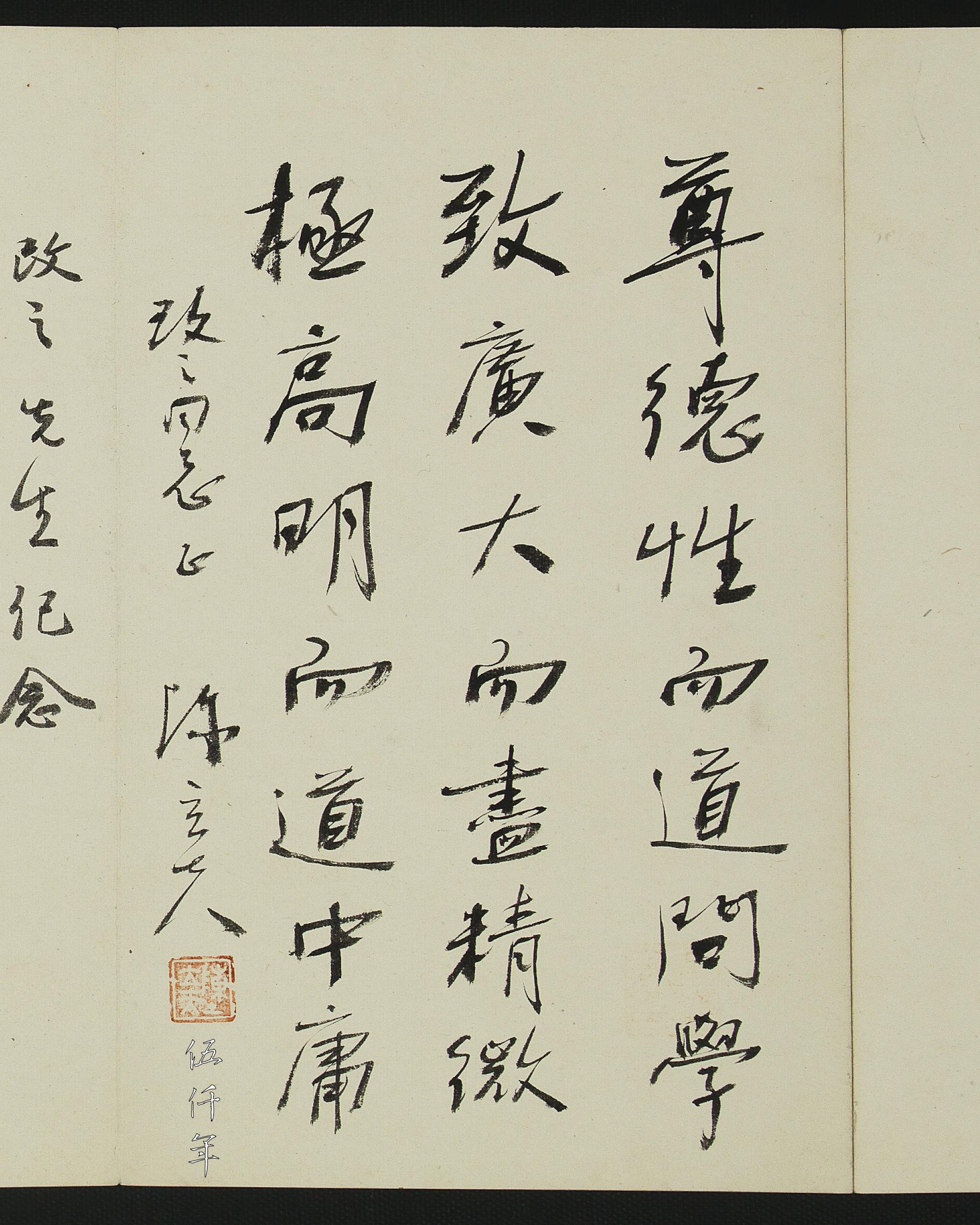
Calligraphy by Vice President Ch’en Li-fu of the Legislative Yuan
Inscription reads:
“Respect virtues and then pursue scholarship,
broaden studies and then seek the profound,
strive for wisdom and then learn moderation.
For the rectification of Comrade Kai-chih (改之), Ch’en Li-fu (陳立夫).”
Seal impression: “Ch’en Li-fu”.
15) Calligraphy by Minister of Education Chiang Mon-lin (蔣夢麟部長)
His original name was Mon-hsiung (夢熊), his hao was Mon-lin (夢麟), and he is known by his hao. A native of Yü-yao in Chekiang province. He was born in 1886 and died in 1964.

Calligraphy by Minister of Education Chiang Mon-lin
Inscription reads:
For Mr. Kai-chih (改之) in remembrance.
Acquire knowledge first in order to realise inadequacy.
Chiang Mon-lin (蔣夢麟).”
Seal impression: “Seal of Chiang Mon-lin”.
16) Calligraphy by Vice President Li Wen-fan (李文範副院長) of the Judicial Yuan
His tzu was Chün-p’ei (君佩), native of Nan-hai in Kwangtung province. He was born in 1884 and died in 1953.
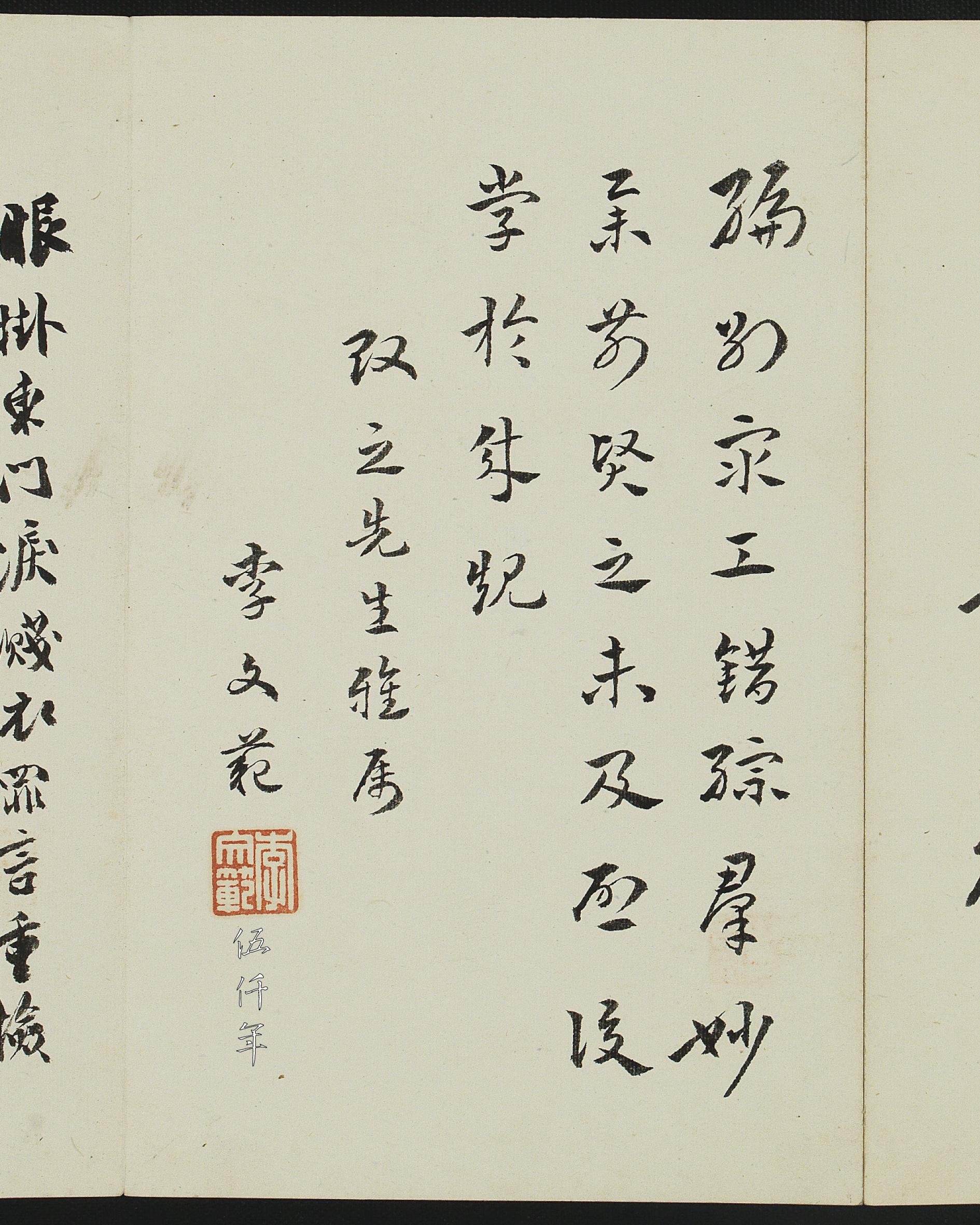
Calligraphy by Vice President Li Wen-fan of the Judicial Yuan
Inscription reads:
“Assemble the finest specimens from all the masters,
synthesise their accomplishments, indicate what they overlooked,
inspire future generations with their principles.
At the courteous request of Mr. Kai-chih (改之),
Li Wen-fan (李文範).”
Seal impression: “Li Wen-fan”.
17) Calligraphy by Chairman Tseng Ch’i (曾琦) of the Young China Party
His hao was I-shan (移山), native of Lung-ch’ang in Szechwan province. He was born in 1892 and died in 1951.
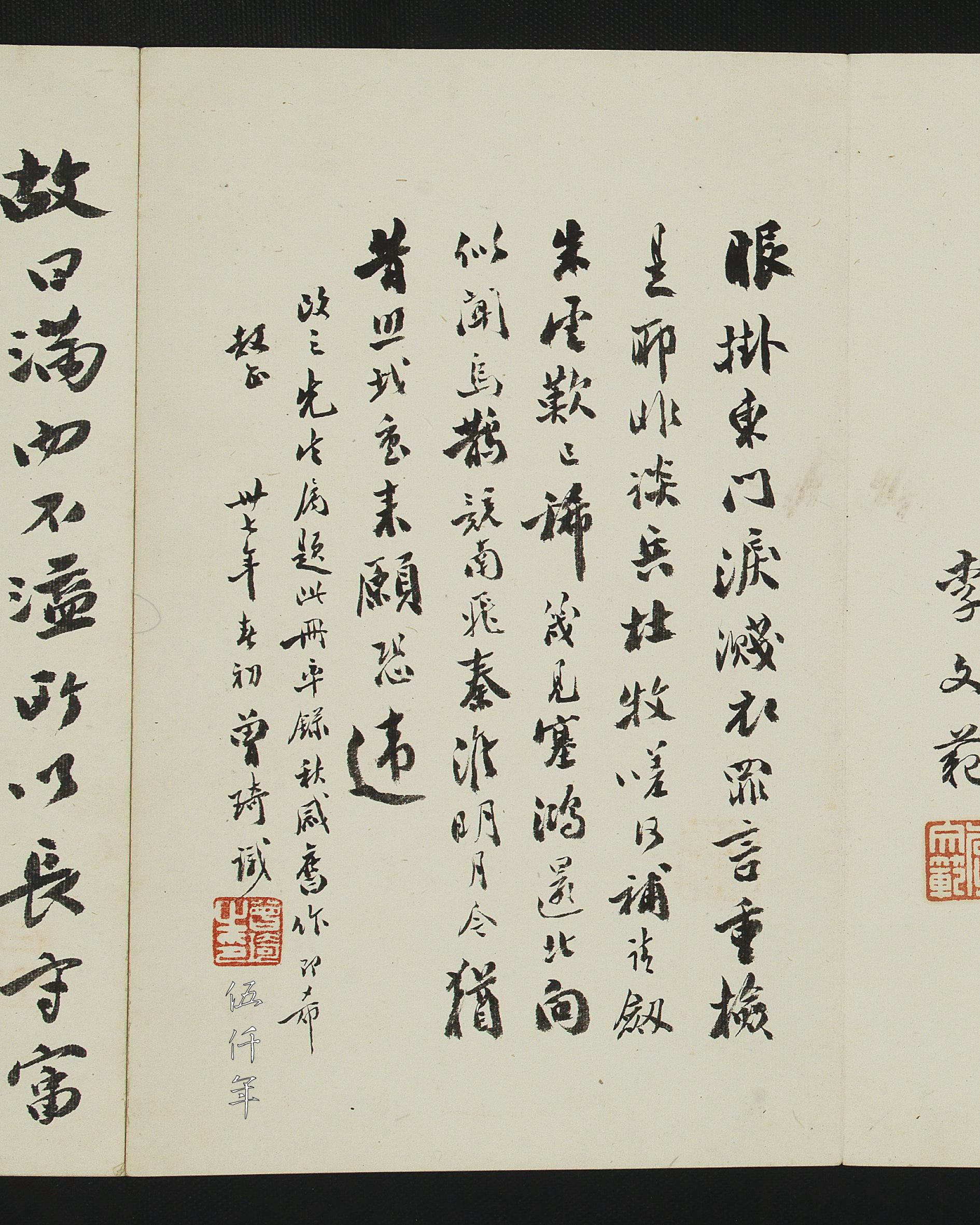
Calligraphy by Chairman Tseng Ch’i of the Young China Party
Inscription reads:
“Gazing at Eastern Gate tears soak my shirt,
Is Tsui-yen’s (罪言) bemoan right or wrong?
To what avail is critique by T’u Mu (杜牧),
Rare are officials who risk life for truth.
Who has seen wild border goose fly northward,
Only heard magpies compete for the south.
The moon in Nanking is same as before,
Light up a fresh start but my wish may balk.
Mr. Kai-chih (改之) requested me to inscribe this album. I hastily copied an old poem to express my Autumn mood, and hope he will amend it. Inscribed in early spring, the 37th year of the Republic, Tseng Ch’i (曾琦).”
Seal impression: “Seal of Tseng Ch’i”.
18) Calligraphy by Vice Premier Wang Yün-wu (王雲五副院長) of the Executive Yuan
His tzu was Hsiu-lu (岫廬), native of Hsiang-shan in Kwangtung province. He was born in 1888 and died in 1979.
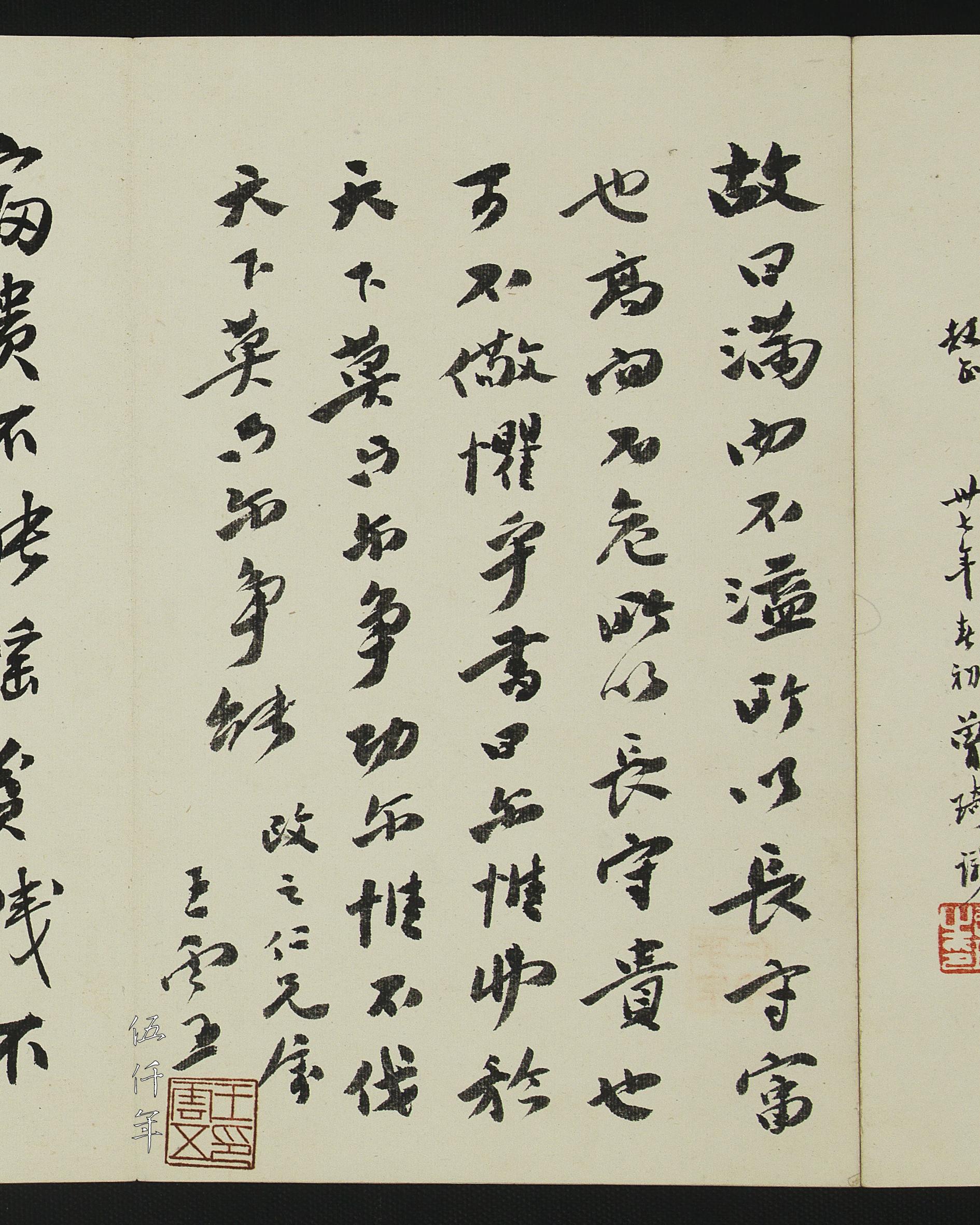
Calligraphy by Vice Premier Wang Yün-wu of the Executive Yuan
Inscription reads:
“Thus says: To be full but does not overflow, hence wealth can be preserved for long; to be eminent but does not imperil, hence position can be retained for long. How can we not be cautious and apprehensive. The Book of Documents (尚書) says: If you are not conceited, no one in the world will vie for your achievement; if you are not boastful, no one in the world will vie for your ability.
At the request of elder brother Kai-chih (改之),
Wang Yün-wu.”
Seal impression: “Seal of Wang Yün-wu”.
19) Calligraphy by Li Tsung-jen (李宗仁)
A native of Kuei-lin in Kwangsi province. He was born in 1891 and died in 1969.
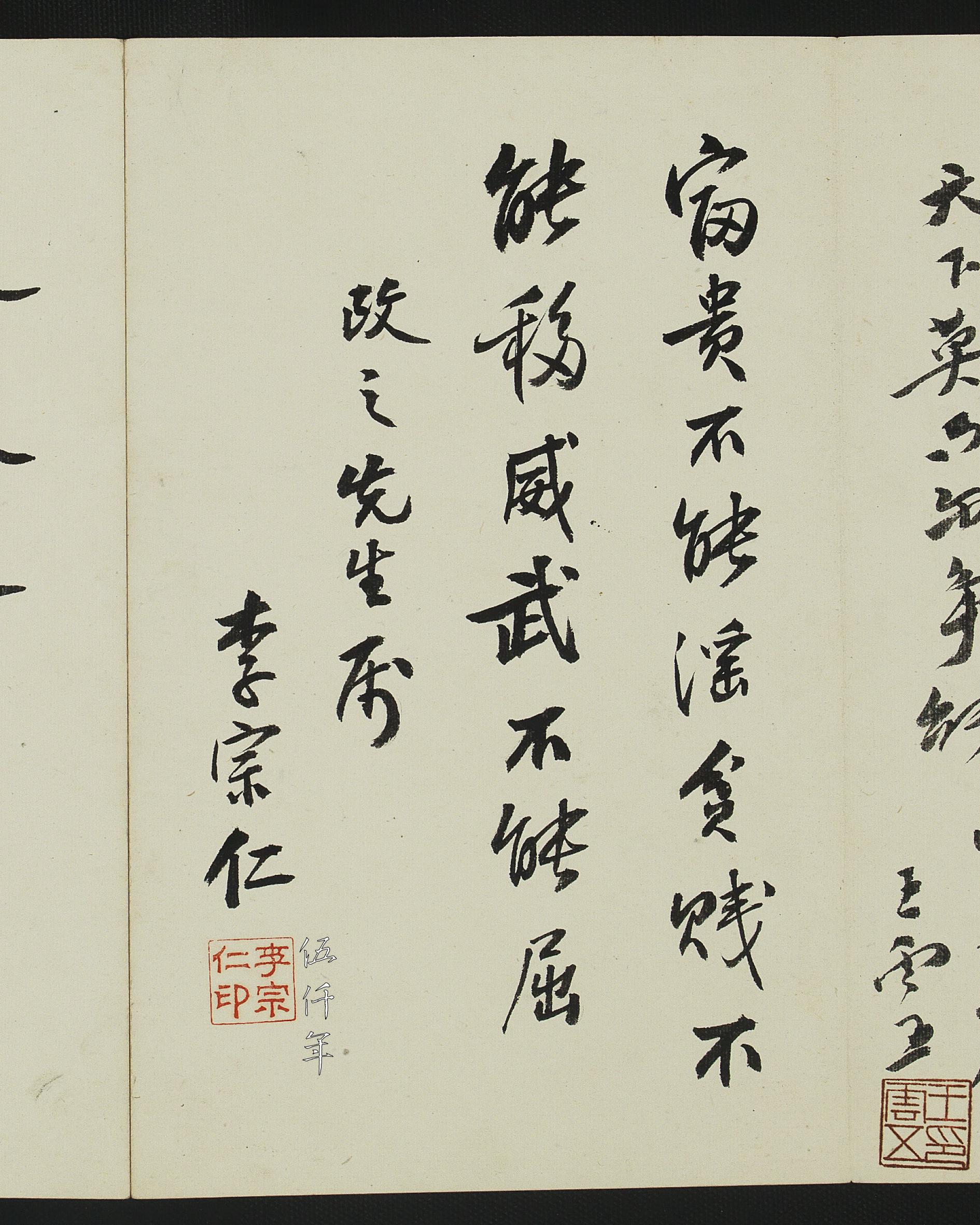
Calligraphy by Li Tsung-jen
Inscription reads:
“Wealth and status cannot corrupt him,
poverty and hardship cannot change him,
power and force cannot subdue him.
At the request of Mr. Kai-chih (改之),
Li Tsung-jen.”
Seal impression: “Seal of Li Tsung-jen”.
20) Calligraphy by Premier Ho Ying-ch’in (何應欽院長) of the Executive Yuan
His tzu was Ching-chih (敬之), native of Chin-hsi in Kiangsi province. He was born in 1890 and died in 1987.
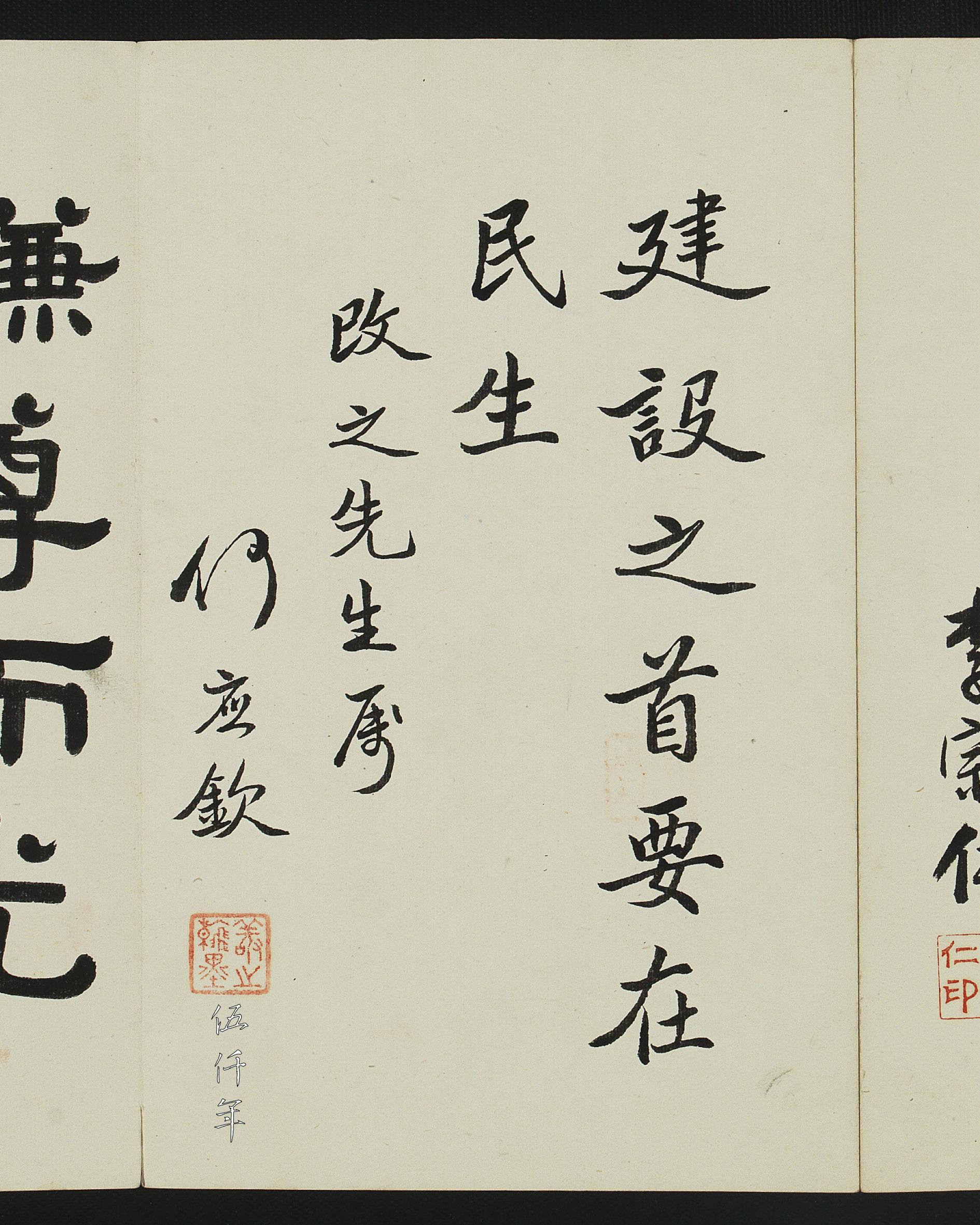
Calligraphy by Premier Ho Ying-ch’in of the Executive Yuan
Inscription reads:
“The top priority of reconstruction is the livelihood of the people.
At the request of Mr. Kai-chih (改之),
Ho Ying-ch’in (何應欽).”
Seal impression: “Ink work by Ching-chih”.
21) Calligraphy by Ch’eng Ch’ien (程潛)
A native of Li-ling in Hunan province. He was born in 1882 and died in 1968.
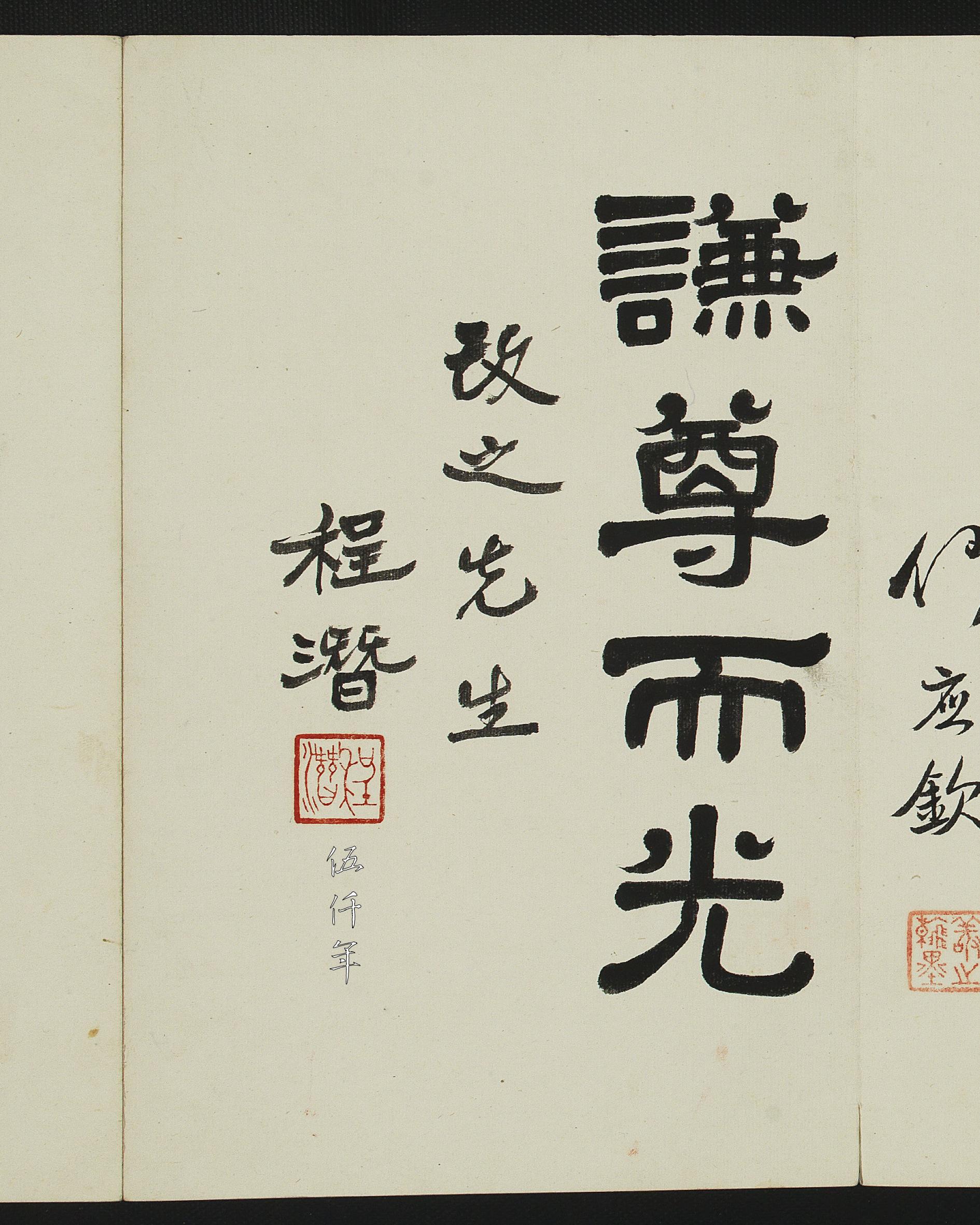
Calligraphy by Ch’eng Ch’ien
Inscription reads:
“Modesty enhances dignity.
For Mr. Kai-chih (改之),
Ch’eng Ch’ien (程潛).”
Seal impression: “Ch’eng Ch’ien”.
22) Calligraphy by President Mo Te-hui (莫德惠院長) of the Examination Yuan
His tzu was Liu-ch’en (柳忱), native of Shuang-ch’eng in Kirin province. He was born in 1883 and died in 1968.
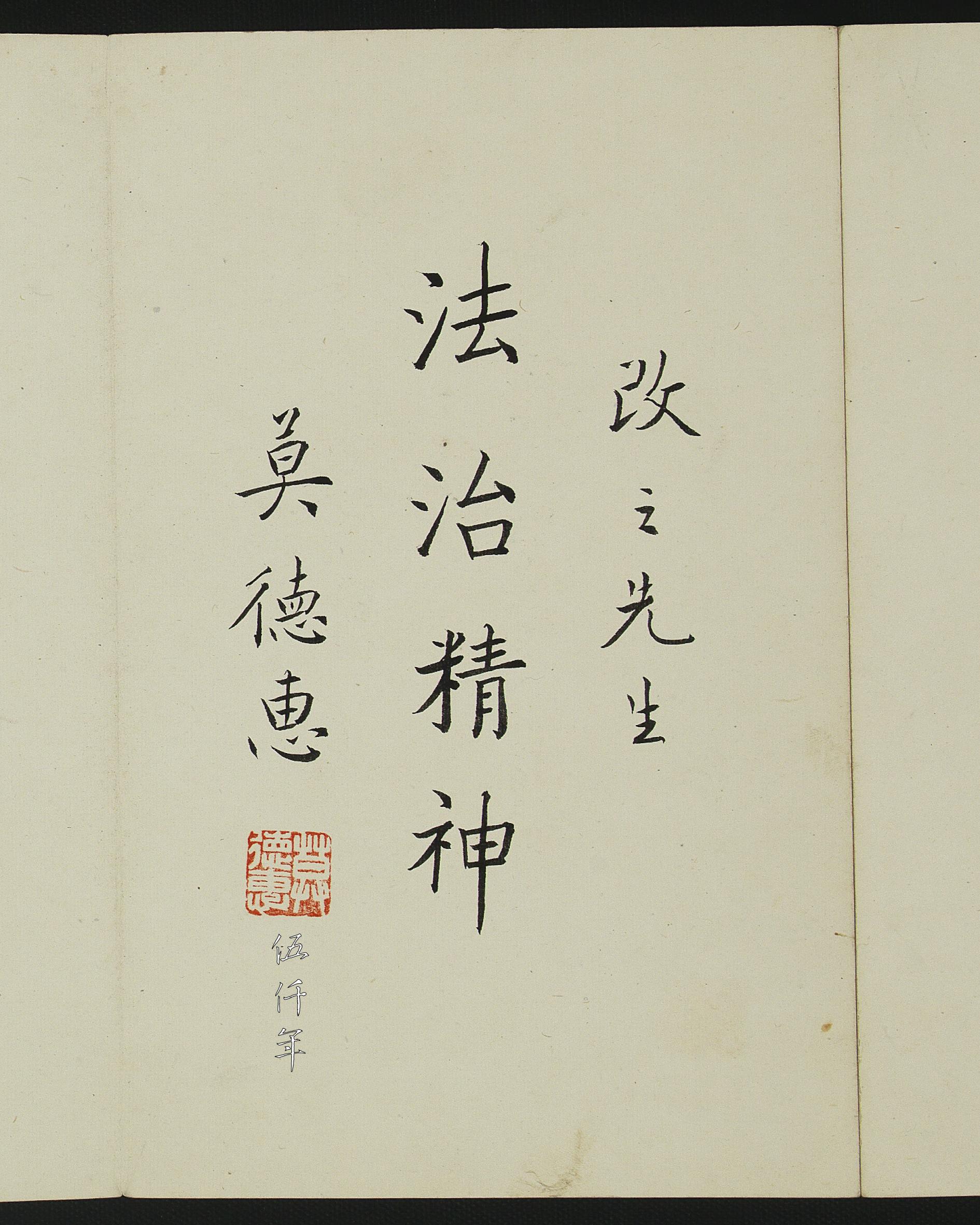
Calligraphy by President Mo Te-hui of the Examination Yuan
Inscription reads:
“For Mr. Kai-chih (改之).
The spirit of Rule of Law.
Mo Te-hui (莫德惠).”
Seal impression: “Mo Te-hui”.
23) Calligraphy by Ambassador Hu Shih (胡適大使) to the United States of America
His tzu was Shih-chih (適之), native of Sung-chiang in Chekiang province. He was born in 1891 and died in 1962.
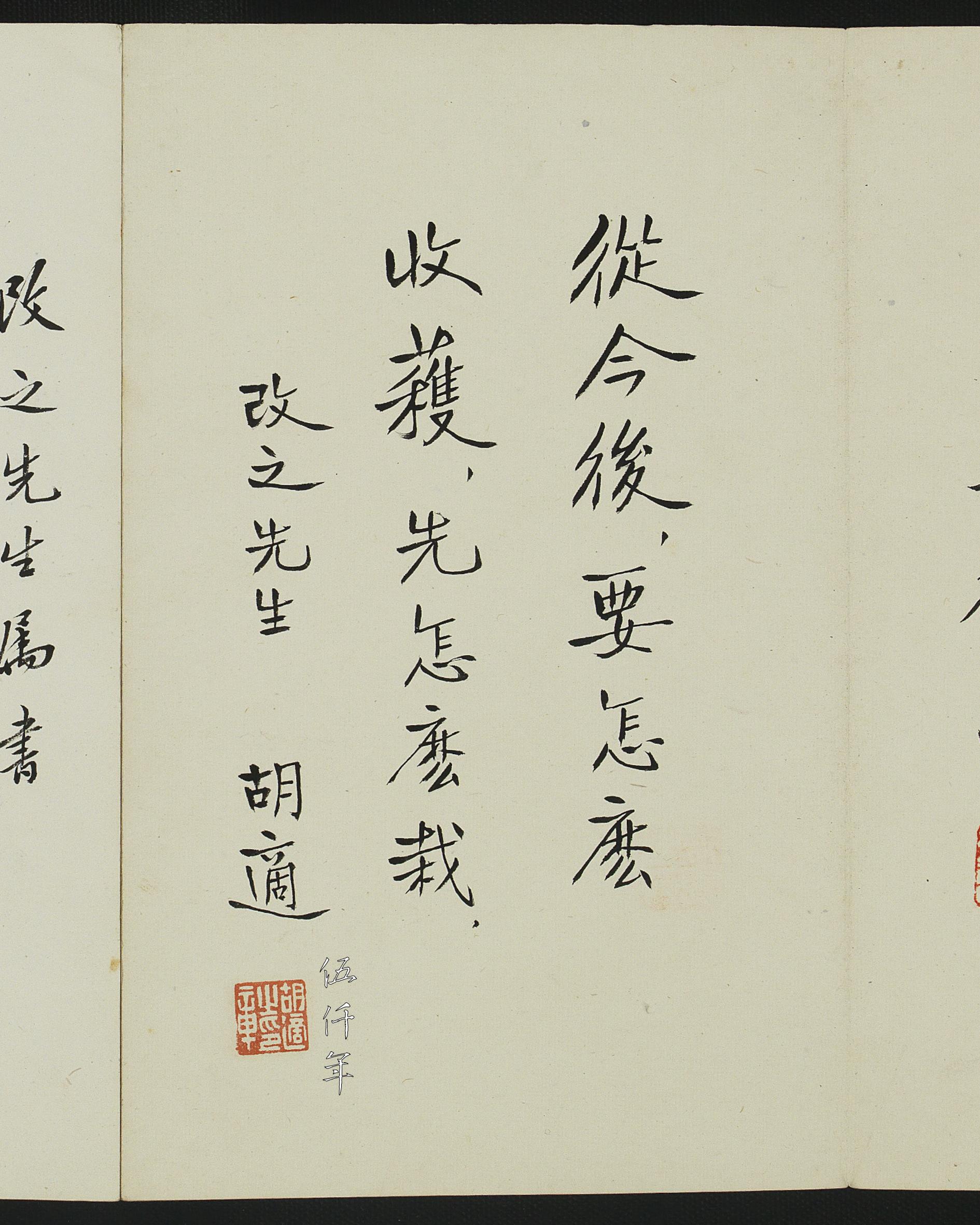
Calligraphy by Ambassador Hu Shih to the United States of America
Inscription reads:
“From now on, whatever the harvest, depends on the sowing.
For Mr. Kai-chih (改之), Hu Shih (胡適).”
Seal impression: “Seal of Hu Shih-chih”
24) Calligraphy by Vice President Ch’en Ch’eng (陳誠副總統)
His tzu was Tz’u-hsiu (辭修), native of Ch’ing-t’ien in Chekiang province. He was born in 1898 and died in 1965.
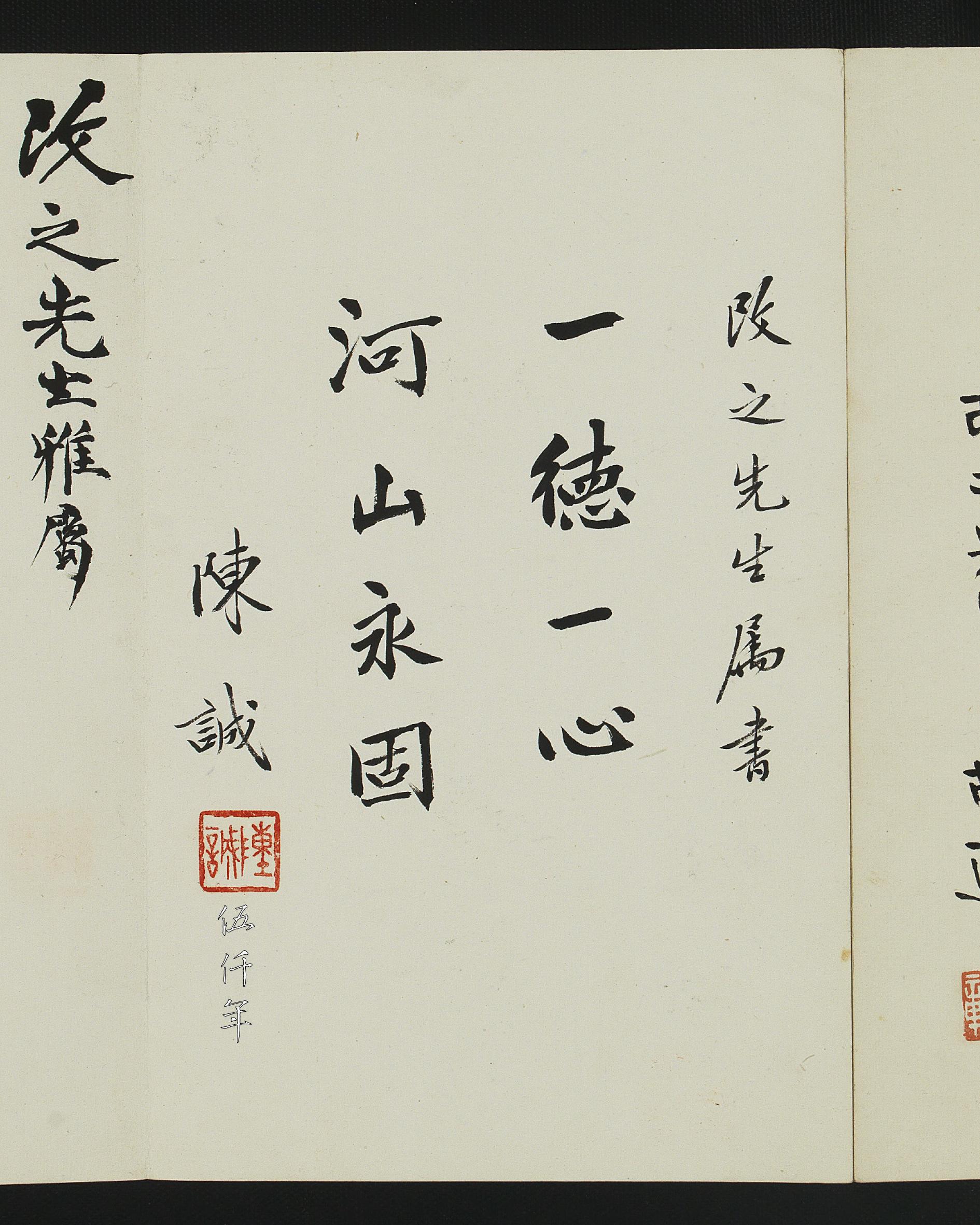
Calligraphy by Vice President Ch’en Ch’eng
Inscription reads:
“At the request of Mr. Kai-chih (改之).
One virtue and one heart
will secure the country forever.
Ch’en Ch’eng (陳誠).”
Seal impression: “Ch’en Ch’eng”.
25) Calligraphy by Cardinal Paul Yü Pin (于斌主教)
A native of Shuang-miao-tzu, Hulan Sub-prefecture in Heilungkiang province. He was born in 1901 and died in 1978.
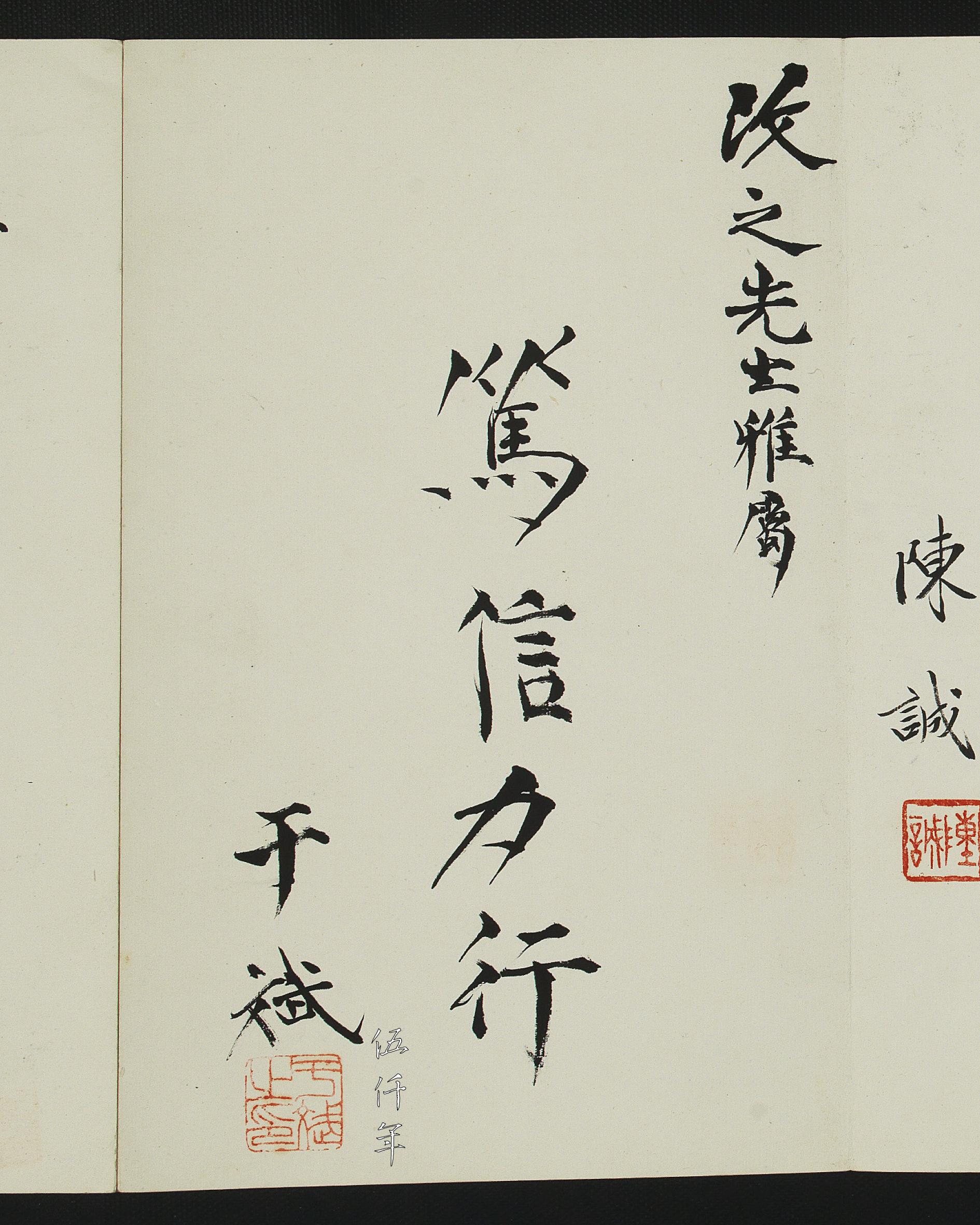
Calligraphy by Cardinal Paul Yü Pin
Inscription reads:
“At the courteous request of Mr. Kai-chih (改之).
Believe fervently and undertake industriously.
Yü Pin (于斌).”
Seal impression: “Seal of Yü Pin”.
26) Calligraphy by Secretary-General Ch’en Pu-lei (陳布雷秘書長) of the Central Committee of the Chinese Nationalist Party
His original name was Hsün-en (訓恩), his hao was Pu-lei (布雷), Wei-lei (畏雷), and he is known by the hao of Pu-lei. A native of Tz’u-hsi in Chekiang province. He was born in 1890 and committed suicide in 1948 before the fall of mainland China to the communists.
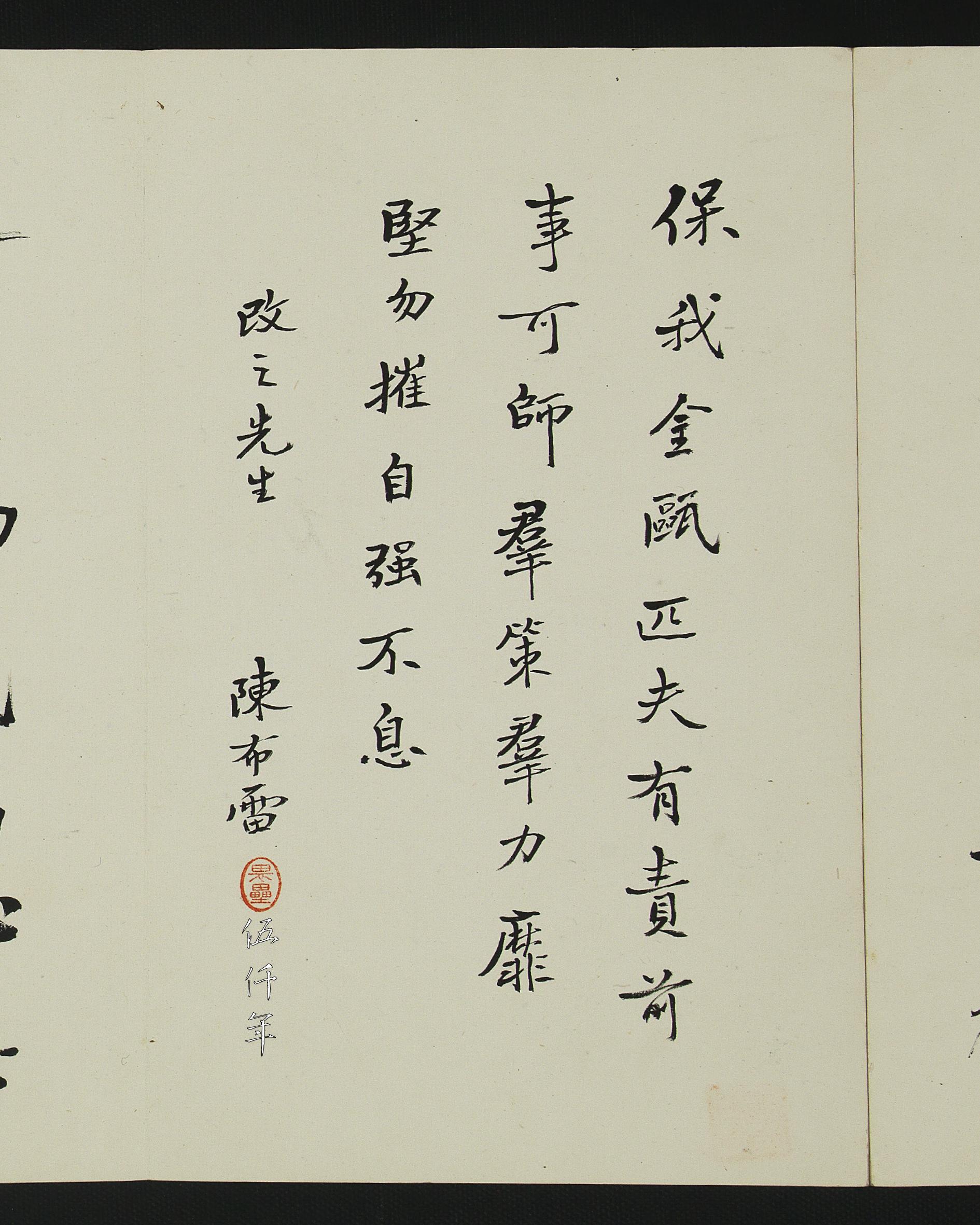
Calligraphy by Secretary-General Ch’en Pu-lei of the Central Committee of the Chinese Nationalist Party
Inscription reads:
“It is a duty for all to protect our national territory.
Events in the past can offer lessons for today.
We plan together and we strive together.
Nothing is too strong and nothing is unbreakable.
We strengthen ourselves continuously without repose.
For Mr. Kai-chih (改之), Ch’en Pu-lei (陳布雷).”
Seal impression: “Wei-lei”.
27) Calligraphy by Minister of Defense Pai Chung-hsi (白崇禧部長)
His tzu was Chien-sheng (健生), his original name was Chung-hsi (崇禧), and he is known by his original name. A native of Kuei-lin in Kwangsi province. He was born in 1893 and died in 1966.
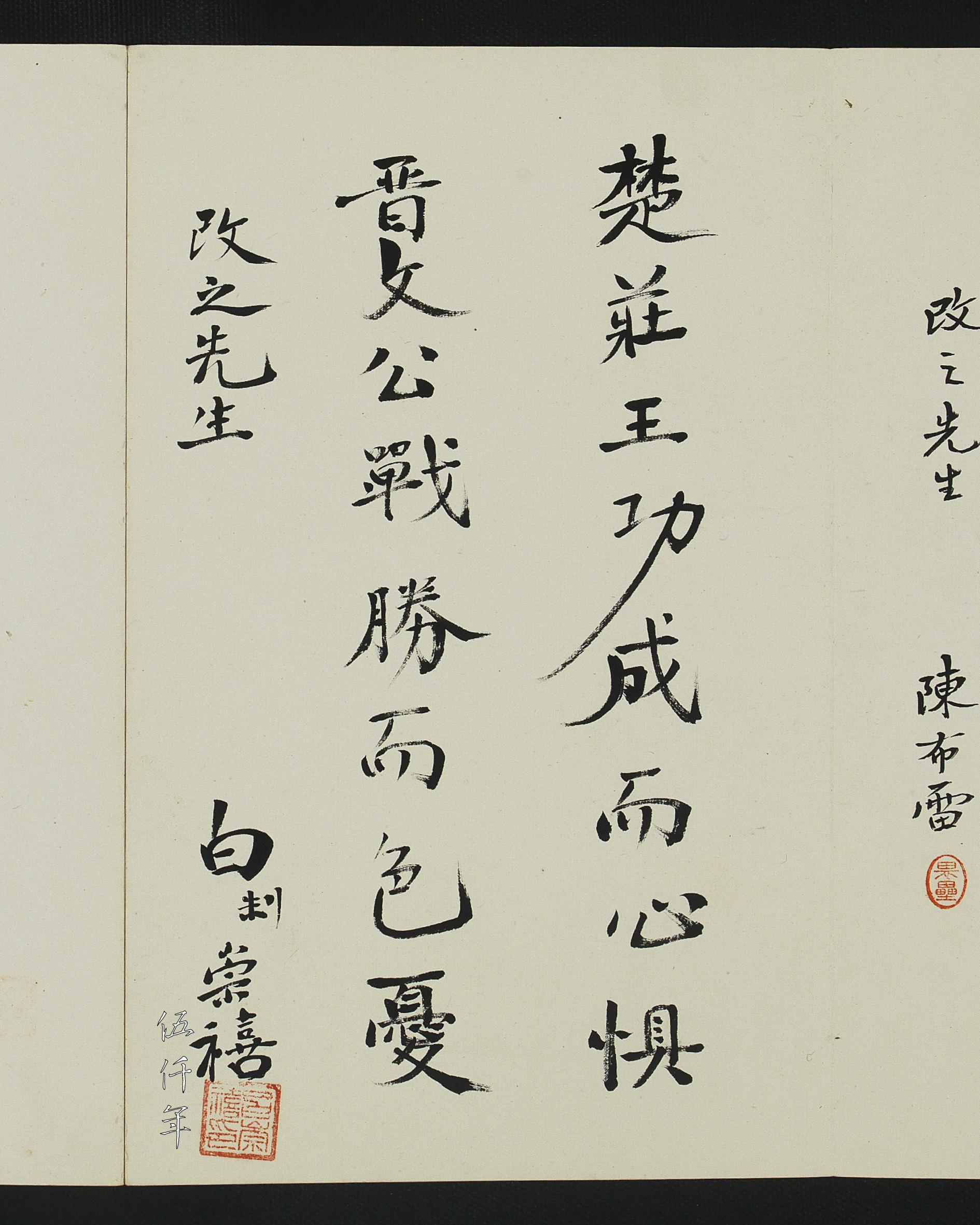
Calligraphy by Minister of Defense Pai Chung-hsi
Inscription reads:
“King Chuang (莊王) of Ch’u Kingdom (楚) was apprehensive after his triumph, Duke Wen (文公) of Chin Kingdom (晉) was worried after his victory.
For Mr. Kai-chih (改之), Pai Chung-hsi (白崇福) in mourning.”
Seal impression: “Seal of Pai Chung-hsi”.
28) Calligraphy by Vice Premier Chu Chia-hua (朱家驊副院長) of the Executive Yuan
His tzu was Liu-hsien (騮先), native of Wu-hsing in Chekiang province. He was born in 1893 and died in 1963.
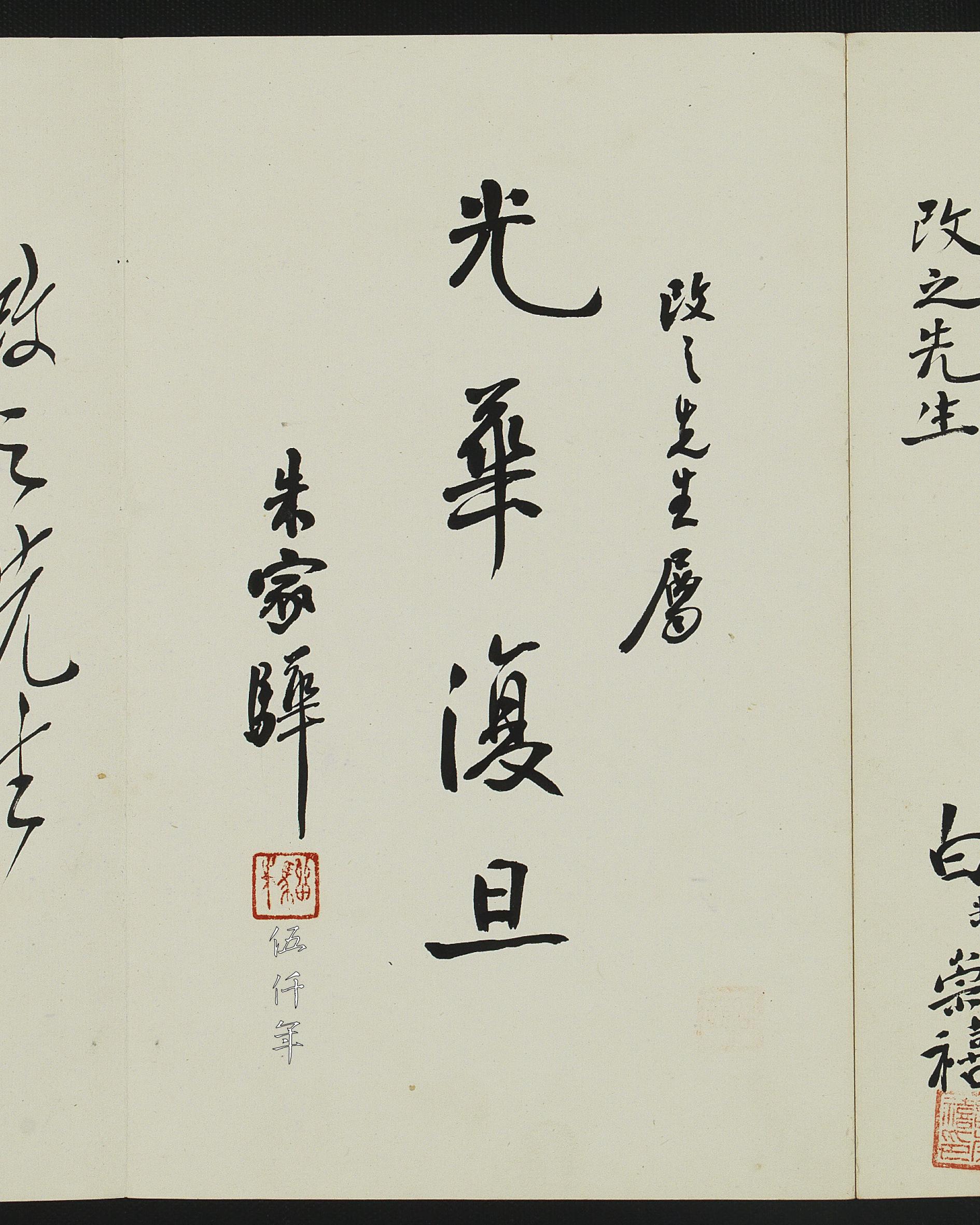
Calligraphy by Vice Premier Chu Chia-hua of the Executive Yuan
Inscription reads:
“At the request of Mr. Kai-chih (改之).
Light will illuminate China.
Chu Chia-hua (朱家驊).”
Seal impression: “Liu-hsien”.
29) Calligraphy by General Hsüeh Yüeh (薛岳上將)
His tzu was Po-ling (伯陵), native of Shao-chou in Kwangtung province. He was born in 1896 and died in 1998.
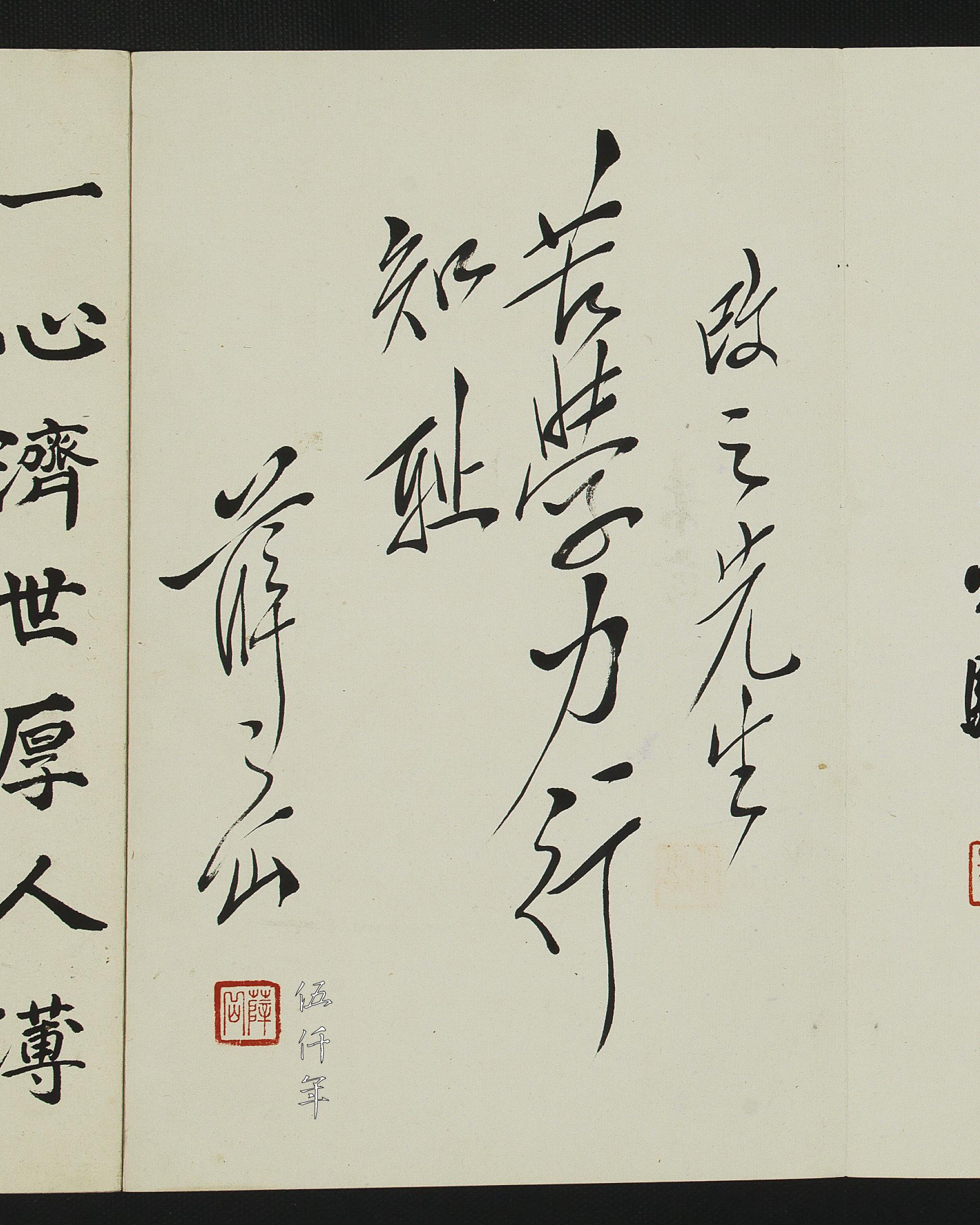
Calligraphy by General Hsüeh Yüeh
Inscription reads:
“For Mr. Kai-chih (改之).
Study wholeheartedly,
act with full strength,
recognize the nature of shame.
Hsüeh Yüeh (薛岳).”
Seal impression: “Hsüeh Yüeh”.
30) Calligraphy by Minister Ma Ch’ao-chün (馬超俊部長) of the Department of Agriculture and Industry of the Chinese Nationalist Party
His tzu was Hsing-ch’iao (星樵), native of Hsing-ning in Kwangtung province. He was born in 1886 and died in 1977.
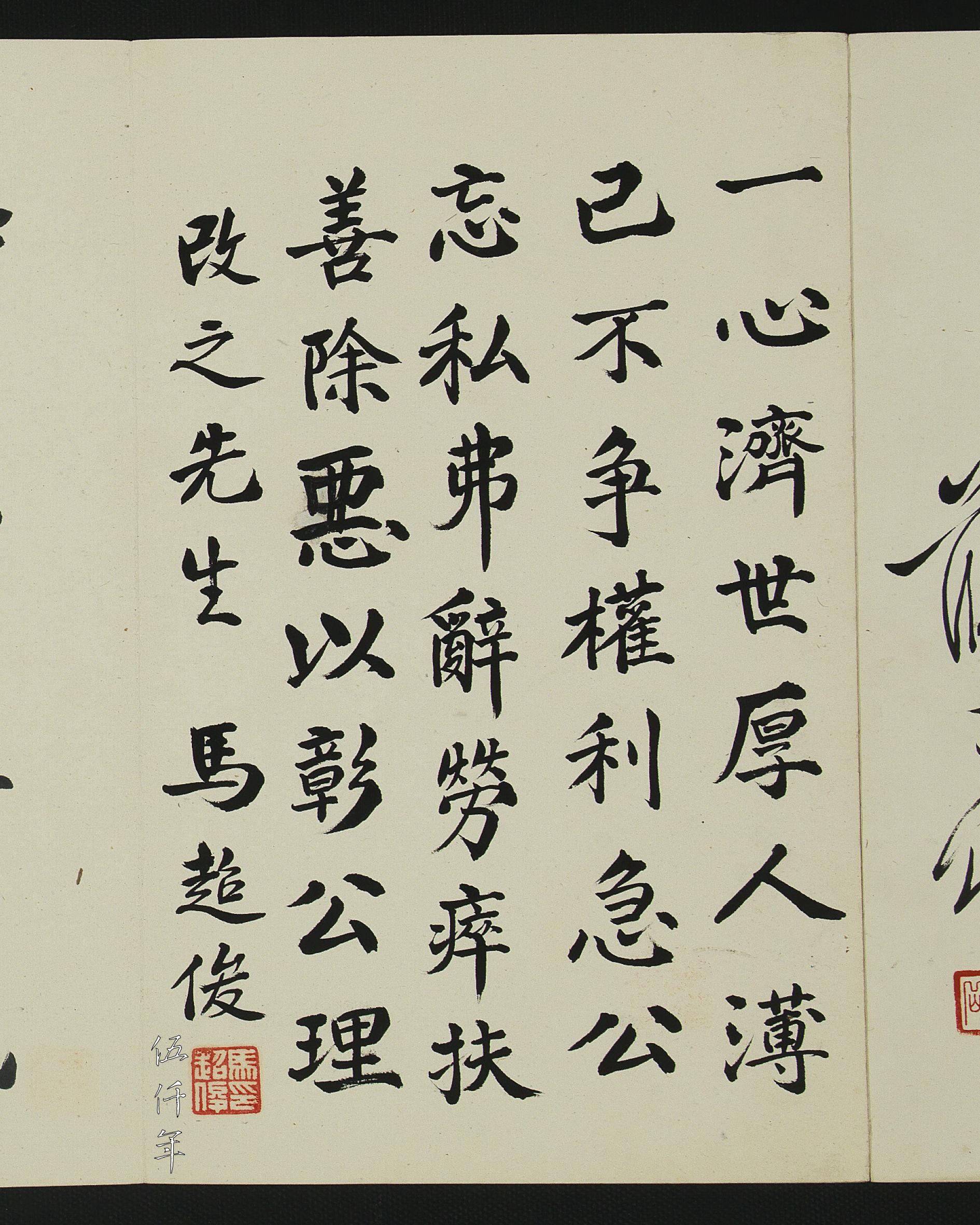
Calligraphy by Minister Ma Ch’ao-chün of the Department of Agriculture and Industry of the Chinese Nationalist Party
Inscription reads:
“Help the world with total dedication, be generous to others and mean to oneself.
Do not vie for power and profit, be quick to address public good and forget personal needs.
Do not shy away from hardship and exhaustion, help the virtuous and eradicate the wicked, in order to promote justice.
For Mr. Kai-chih (改之), Ma Ch’ao-chün (馬超俊).”
Seal impression: “Seal of Ma Ch’ao-chün”
31) Calligraphy by Lung Yün (龍雲)
A native of En-an in Yunnan province. He was born in 1884 and died in 1962.
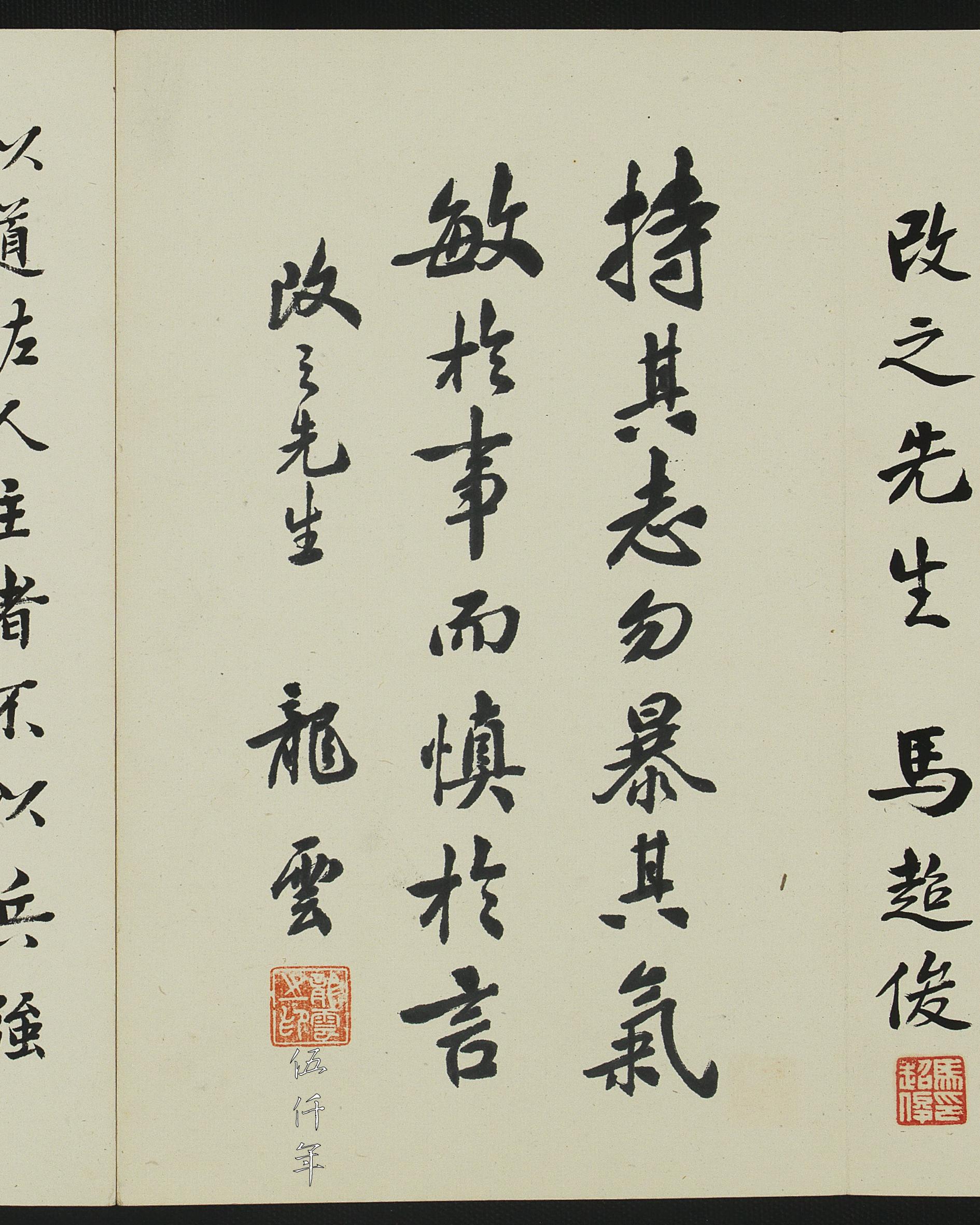
Calligraphy by Lung Yün
Inscription reads:
“Adhere to your goal and do not be impulsive,
be alert to events and be careful with words.
For Mr. Kai-chih (改之), Lung Yün (龍雲)”.
Seal impression: “Seal of Lung Yün”.
32) Calligraphy by Vice Premier Chang Li-sheng (張厲生) of the Executive Yuan
His tzu was Shao-wu (少武), native of Le-t’ing in Hopeh province. He was born in 1901 and died in 1971.
The inscription by Chang Li-sheng is an extract from Chapter Thirty of Tao Te Ching (道德經), the following translation is by the eminent Sinologist Professor John Minford, whose work Tao Te Ching-The Essential Translation of the Ancient Chinese Book of the Tao was published in 2018, and is recognised as the best translation of this treatise.
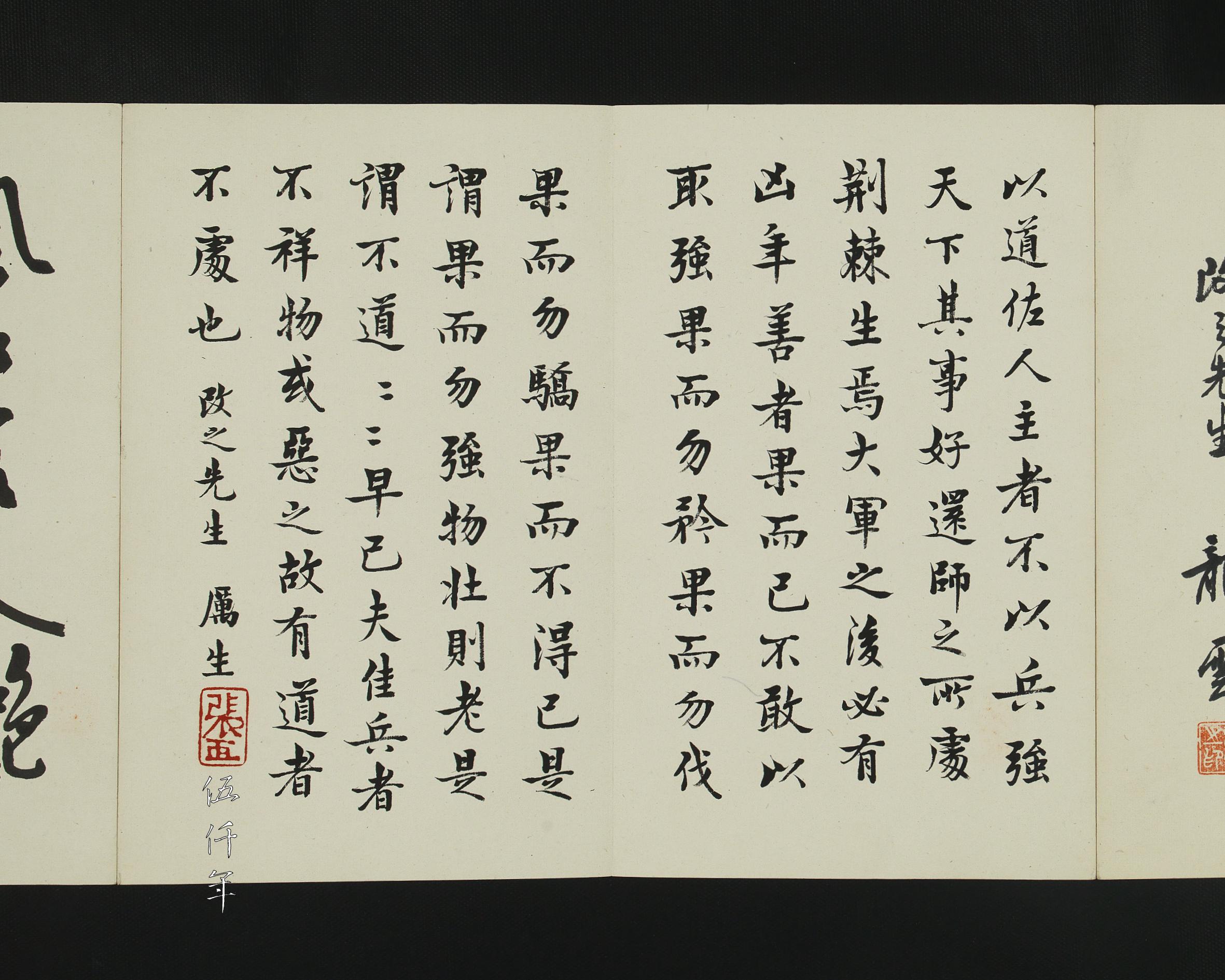
Calligraphy by Vice Premier Chang Li-sheng of the Executive Yuan
“A Ruler
Nourished by the Tao
Never takes up Arms
Does no Violence
To All-under-Heaven.
In the wake
Of any military campaign
Violence rebounds,
Thorns and brambles
Spring up.
The passage of an Army
Is attended
With poor harvests.
The best general
Achieves his Goal
And Let’s Go,
Never ventures
To take more by Force.
He Accomplishes
Without boasting,
Without bragging,
Without pride.
He Accomplishes
And Lets Go,
He stops short
Of Violence.
Brute strength
Decays with Age.
It is not the Tao.
Whatsoever is not the Tao
Meets with an early end.
For Mr. Kai-chih (改之), Li-sheng (厲生).”
Seal impression: “Seal of Chang”.
33) Calligraphy by Minister Liang Han-ts’ao (梁寒操部長) of the Overseas Ministry of the Central Committee of the Chinese Nationalist Party
His hao was Chün-mo (君默), native of Kao-yao in Kwangtung province. He was born in 1899 and died in 1975.
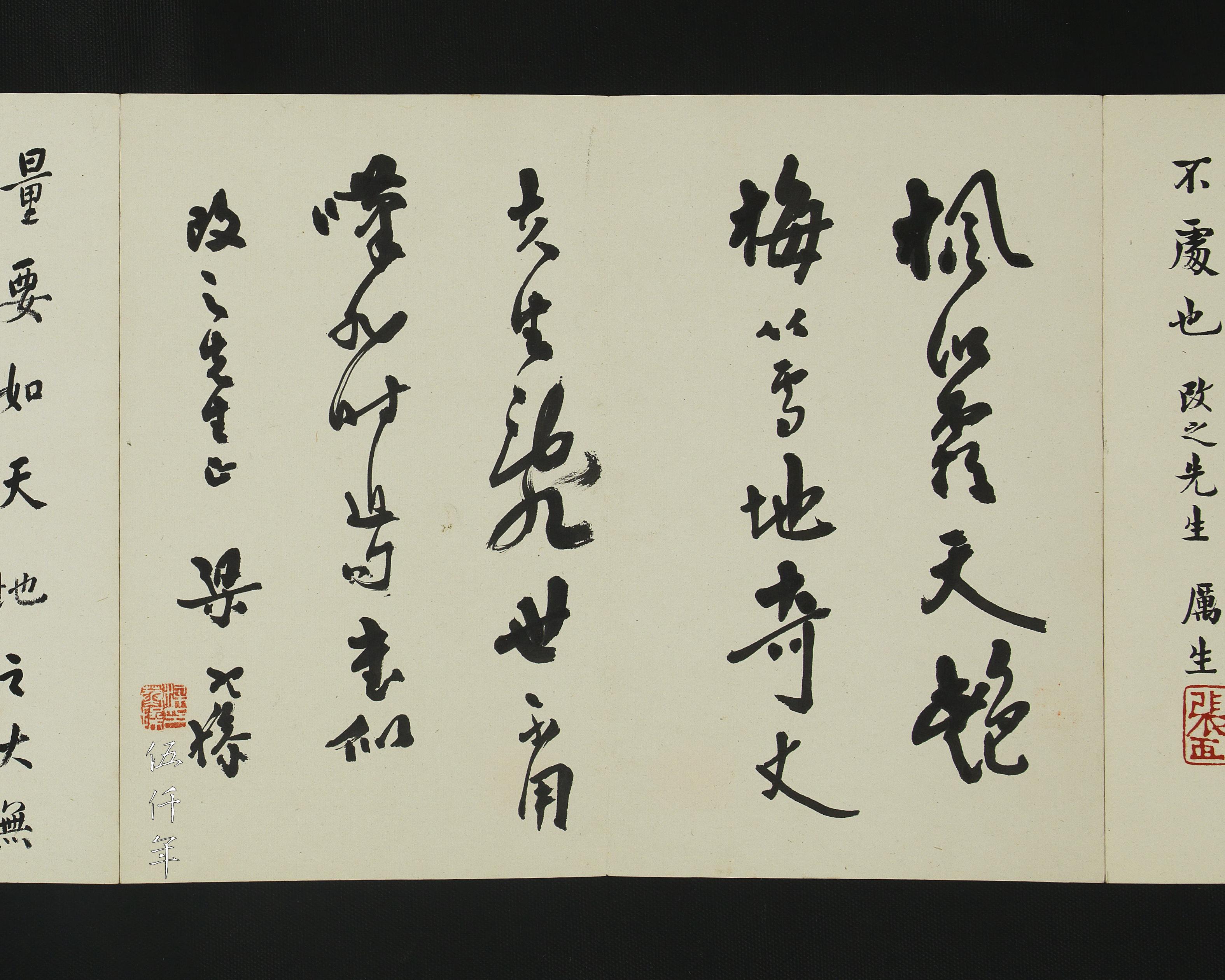
Calligraphy by Minister Liang Han-ts’ao of the Overseas Ministry of the Central Committee of the Chinese Nationalist Party
Inscription reads:
“Maple is charming for the frosted sky,
prunus is spectacular for the snow covered field.
Born into a world of upheavals, don’t bemoan you were born in the wrong era.
These sentences are offered for the rectification of Mr. Kai-chih (改之), Liang Han-ts’ao (梁寒操).”
Seal impression: “Seal of Liang Han-ts’ao”.
34) Calligraphy by President Chia Ching-te (賈景德院長) of the Examination Yuan
His tzu was T’ao-yüan (韜園), native of Ch’in-shui in Shansi province. He was born in 1880 and died in 1960.
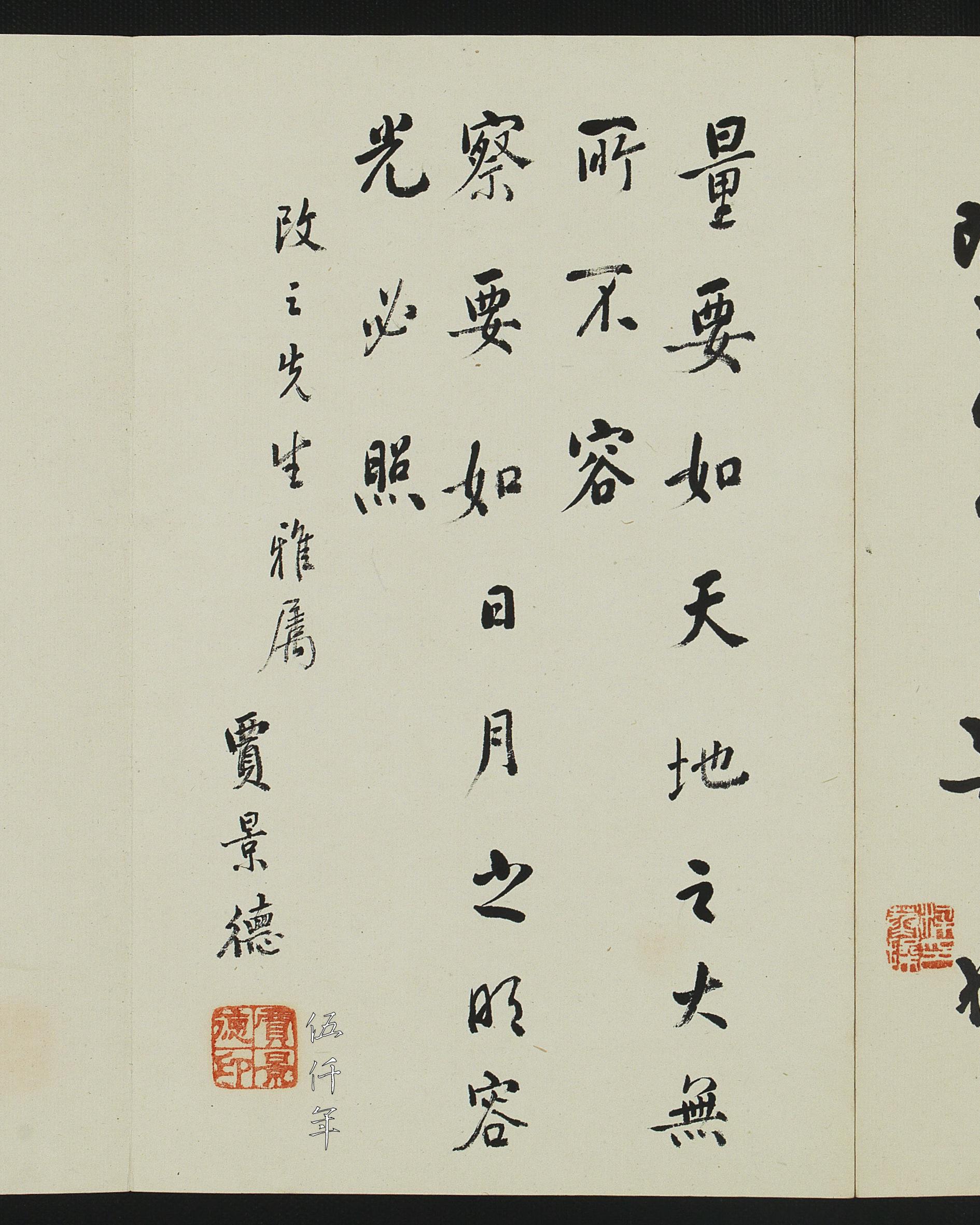
Calligraphy by President Chia Ching-te of the Examination Yuan
Inscription reads:
“Magnanimity should be as immense as the universe, suffice to contain everything;
Scrutiny should be as lucid as the sun and the moon, suffice to clarify everything.
At the courteous request of Mr. Kai-chih (改之), Chia Ching-te (賈景德).”
Seal impression: “Seal of Chia Ching-te”.
35) Calligraphy by Weng Wen-hao (翁文灝)
A native of Yin-hsien in Chekiang province. He was born in 1889 and died in 1971.
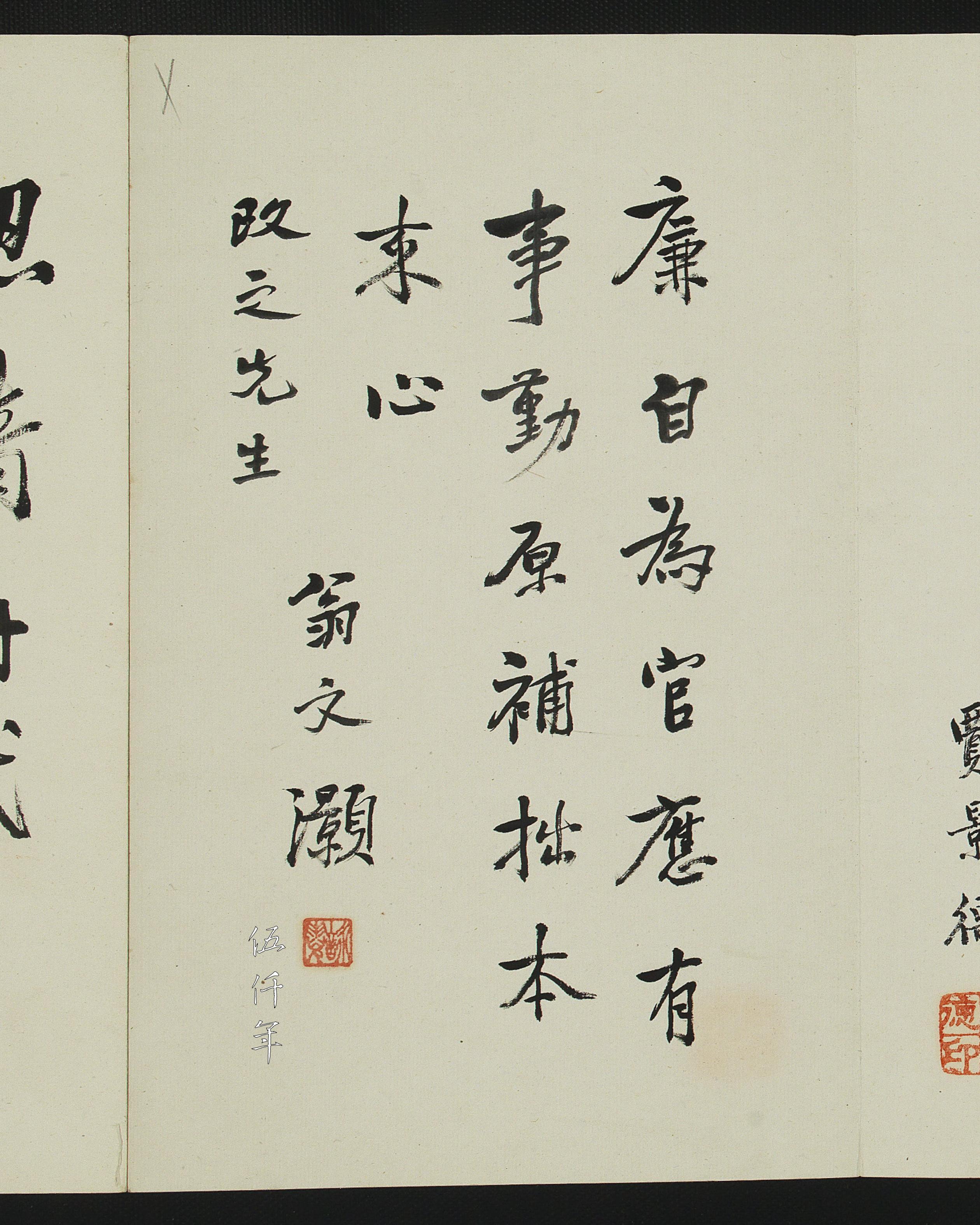
Calligraphy by Weng Wen-hao
Inscription reads:
“Integrity is the prerequisite of officialdom,
diligence to compensate shortcomings is the original motive.
For Mr. Kai-chih (改之), Weng Wen-hao (翁文灝).”
Seal impression: “Yung-ni (詠霓)”.
36) Calligraphy by Minister of the Interior Ku Cheng-kang (谷正綱部長)
His tzu was Shu-ch’ang (叔常), native of An-shun in Kweichow province. He was born in 1902 and died in 1993.
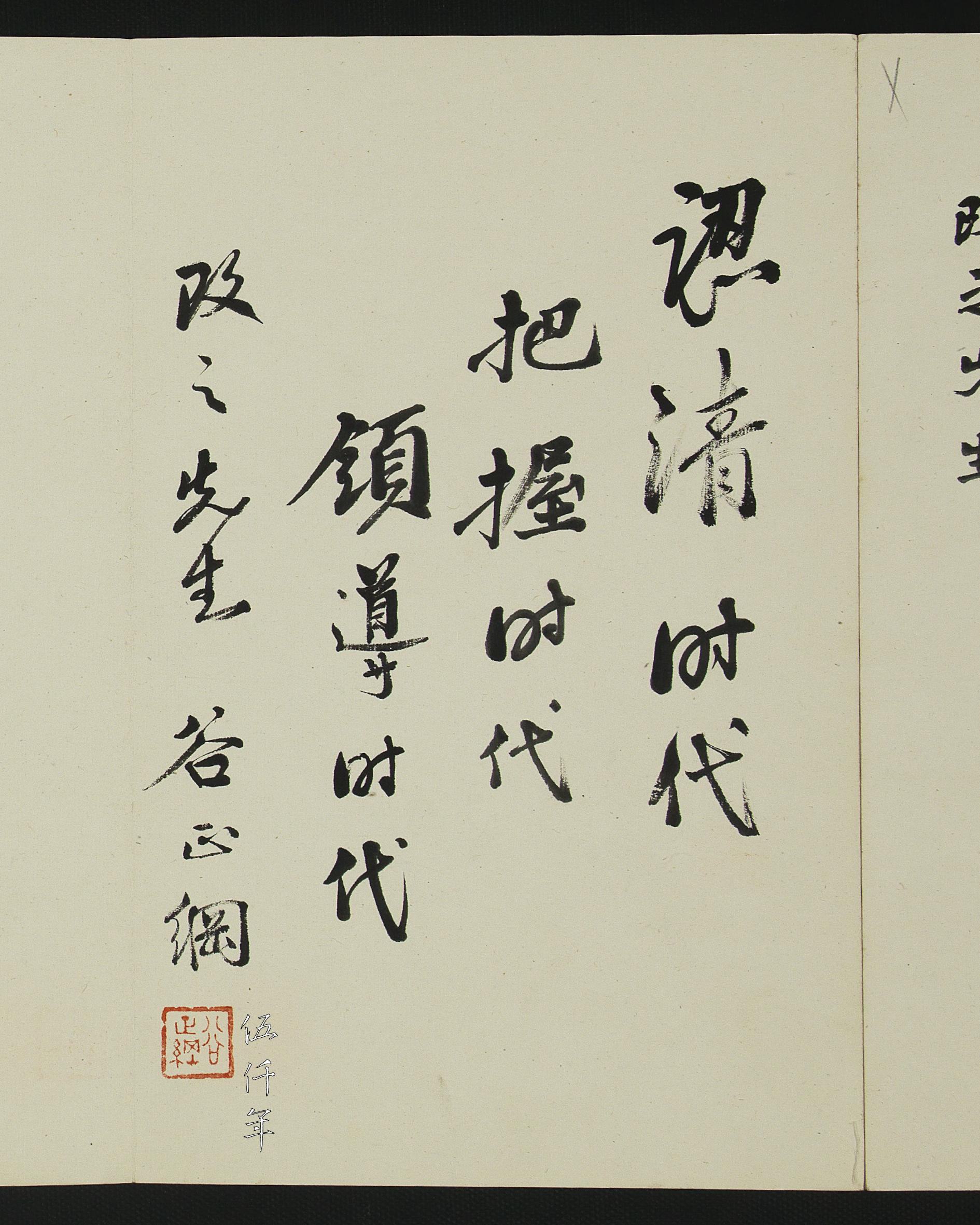
Calligraphy by Minister of the Interior Ku Cheng-kang
Inscription reads:
“Understand the time we live in,
seize the time we live in,
lead the time we live in.
For Mr. Kai-chih (改之), Ku Cheng-kang (谷正綱)”.
Seal impression: “Ku Cheng-kang”.
37) Calligraphy by President Wang Shih-chieh (王世杰院長) of Academia Sinica
His tzu was Hsüeh-ting (雪艇), native of Ch’ung-yang in Hupeh province. He was born in 1891 and died in 1981.
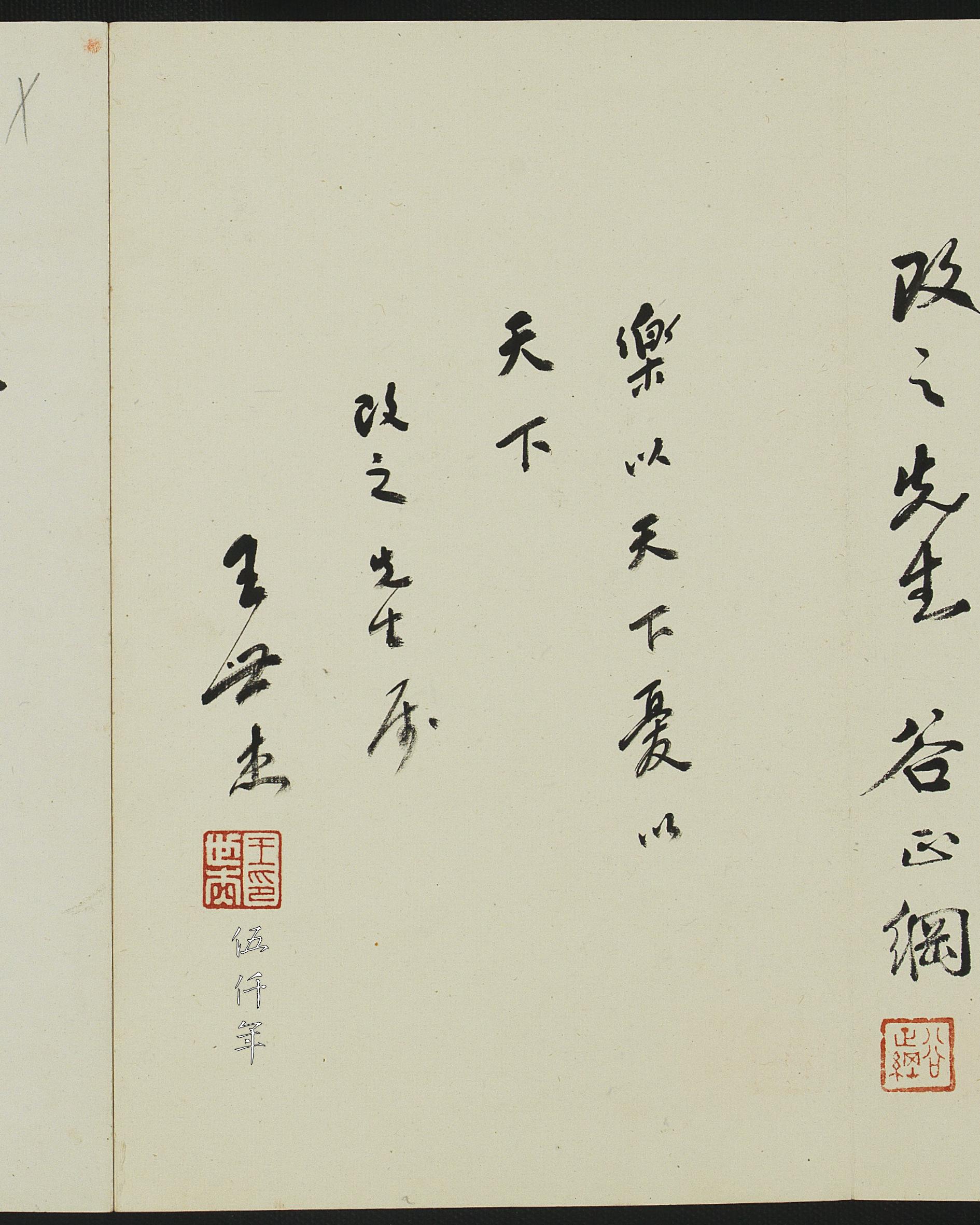
Calligraphy by President Wang Shih-chieh of Academia Sinica
Inscription reads:
“Rejoice in the joy of the people,
grieve at the sorrow of the people.
At the request of Mr. Kai-chih (改之),
Wang Shih-chieh (王世杰)”.
Seal impression: “Seal of Wang Shih-chieh”.
38) Calligraphy by General Yü Han-mou (余漢謀上將)
His tzu was Wo-ch’i (握奇), native of Kao-yao in Kwangtung province. He was born in 1896 and died in 1981.
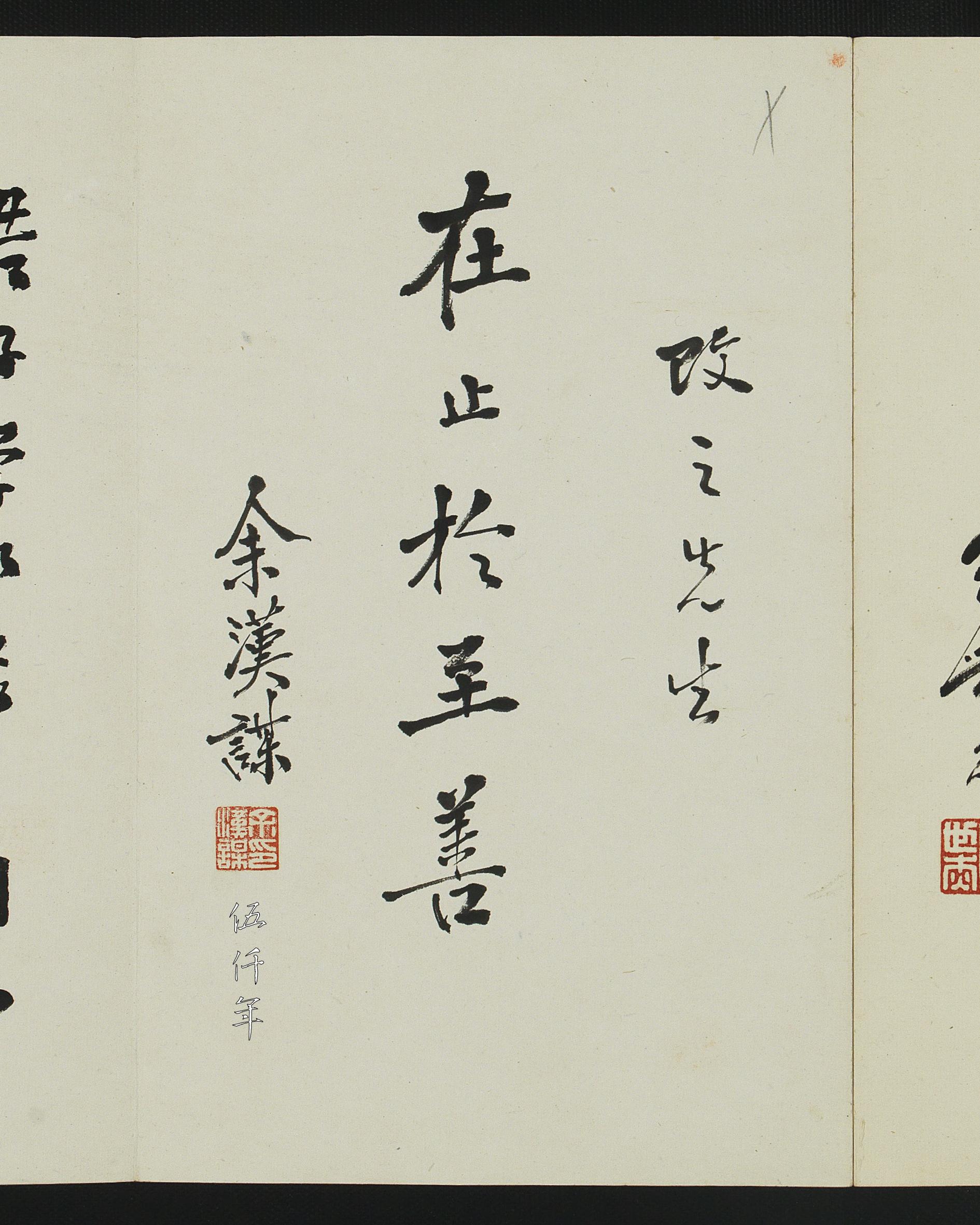
Calligraphy by General Yü Han-mou
Inscription reads:
“For Mr. Kai-chih (改之).
Stop only after reaching true goodness.
Yü Han-mou (余漢謀).”
Seal impression: “Seal of Yü Han-mou”.
39) Calligraphy by Legislator Ch’en Ju-hsüan (陳茹玄立法委員)
His tzu was I-fan (逸凡), native of Hsing-ning in Kwangtung province. He was born in 1891 and died in 1955.
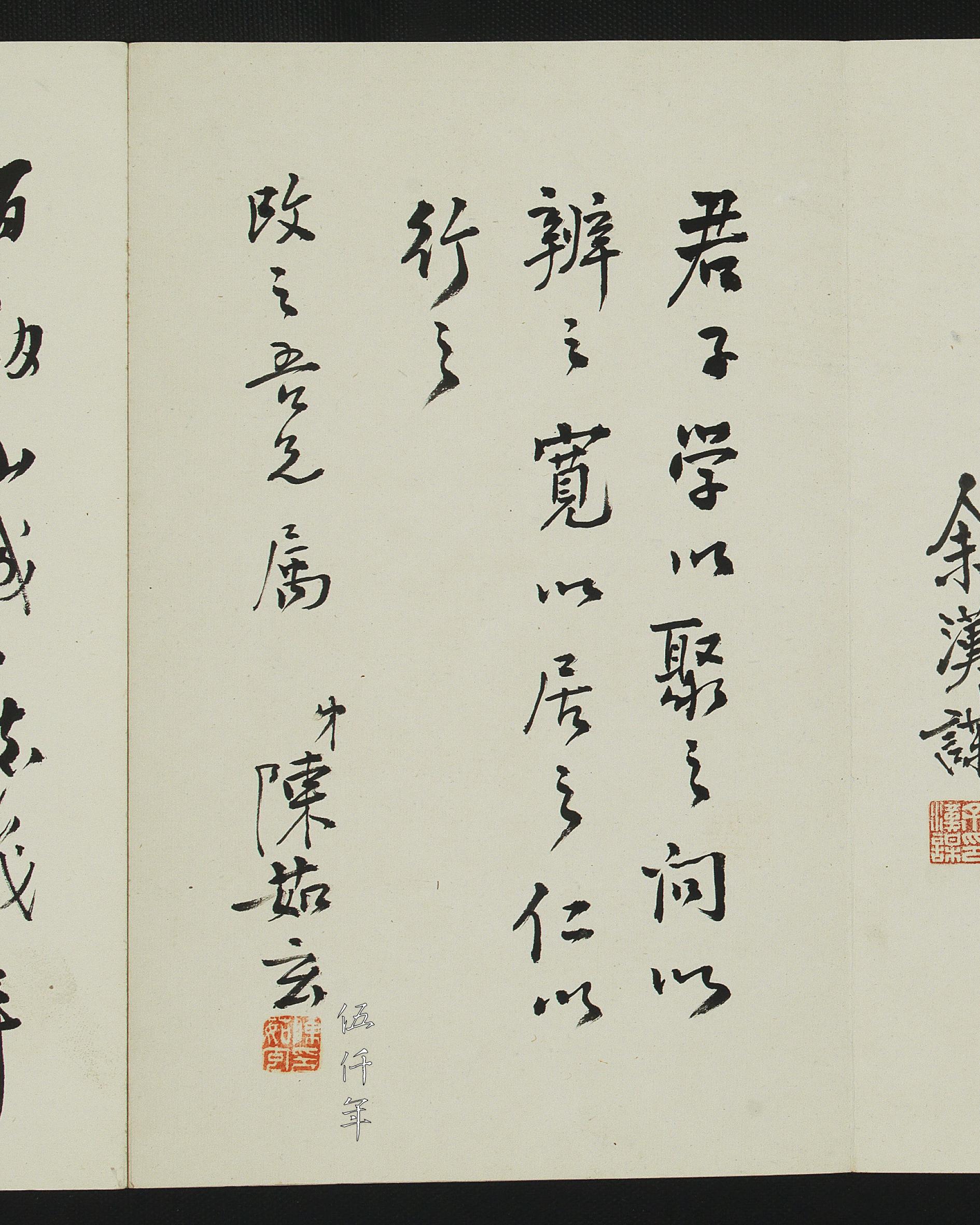
Calligraphy by Legislator Ch’en Ju-hsüan
Inscription reads:
“The superior man studies broadly to accumulate knowledge,
differentiates right and wrong by questioning,
is magnanimous in presence and compassionate in action.
At the request of elder brother Kai-chih (改之), younger brother Ch’en Ju-hsuan (陳茹玄)”.
Seal impression: “Seal of Ch’en Ju-hsüan”.
40) Calligraphy by Deputy Minister Chou Ch’i-kang (周啓剛) of the Overseas Department of the Chinese Nationalist Party
His tzu was Chüeh-yung (覺庸), native of Nan-hai in Kwangtung province. He was born in 1887 and died in 1978.

Calligraphy by Deputy Minister Chou Ch’i-kang of the Overseas Department of the Chinese Nationalist Party
Inscription reads:
“Years are spent in ravaged hillside city,
Friends now line up for temple tributes.
Outside the door are sharp dressed youths,
On the streets loiter some scruffy crowds.
The invading Huns are still not obliterated,
Poor scholar rich family a common sight.
Country is torn between shame and honour,
Just wait for news of victory tomorrow.
After the start of the War of Resistance Against Japanese Aggression, I relocated to the provisional capital of Chungking, and lived in the dormitory of Young Men’s Christian Association. On New Year’s Day of keng-ch’en (庚辰) year, I celebrated with my friends, and composed my random thoughts into a poem. I copied this at the request of Mr. Kai-chih (改之) for his Album of Calligraphy and Panting to Celebrate the Triumphant Return to Capital Nanking, Chou Ch’i-kang (周啓剛).”
Keng-ch’en year corresponds to 1940, while the War of Resistance Against Japanese Aggression broke out on 7 July 1937.
Seal impression: “Chüeh-yung”.
41) Calligraphy by Yao Yu-p’ing (姚雨平)
A native of P’ing-yüan in Kwangtung province. He was born in 1882 and died in 1974.
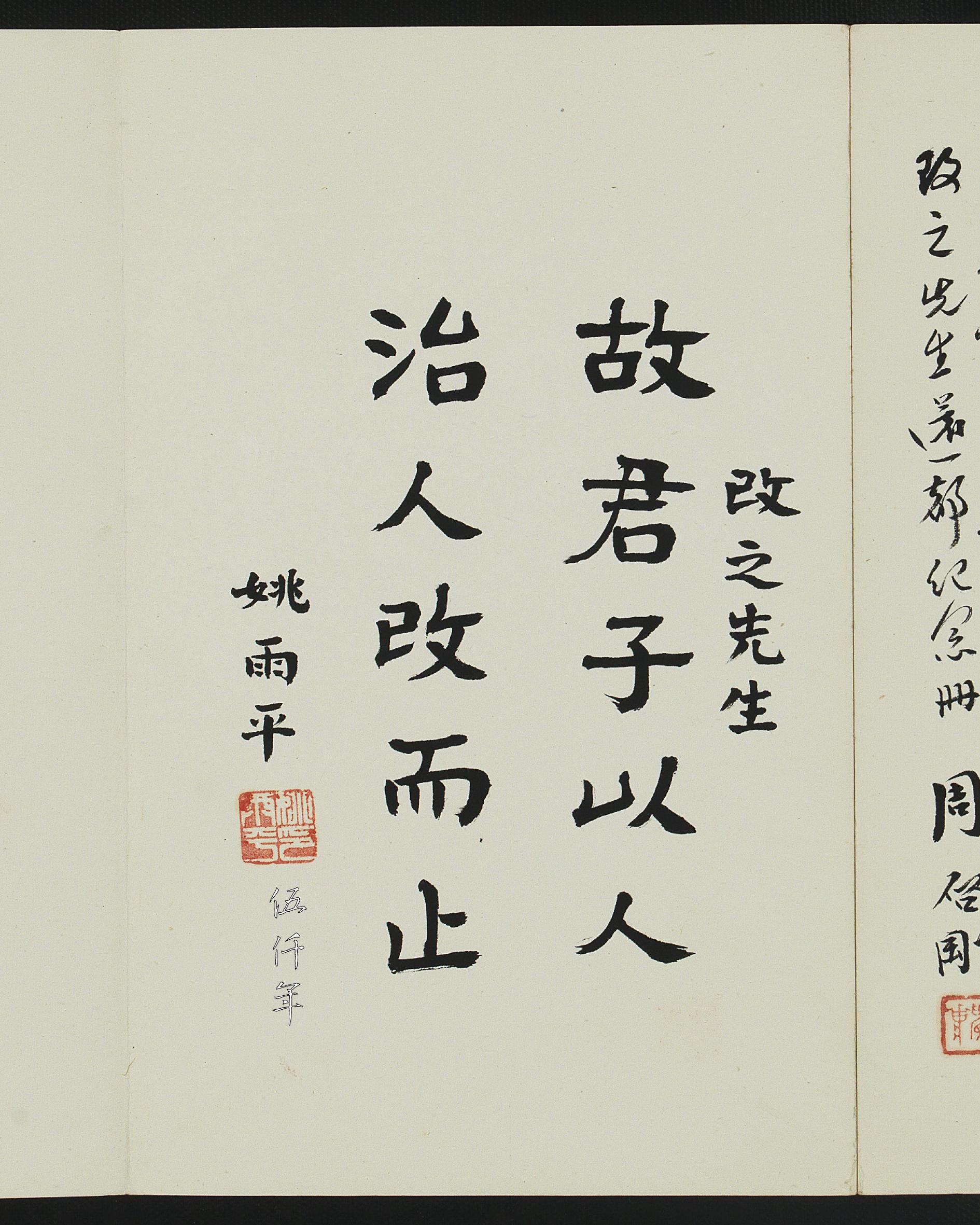
Calligraphy by Yao Yu-p’ing
Inscription reads:
“For Mr. Kai-chih (改之).
Therefore, the superior man governs men, according to their nature, with what is proper to them, and as soon as they change what is wrong, he stops.
Yao Yu-p’ing (姚雨平).”
Seal impression: “Seal of Yao Yu-p’ing”.
42) Calligraphy by Wu Ch’i-wei (吳奇偉)
A native of Ta-p’u in Kwangtung province. He was born in 1891 and died in 1953.
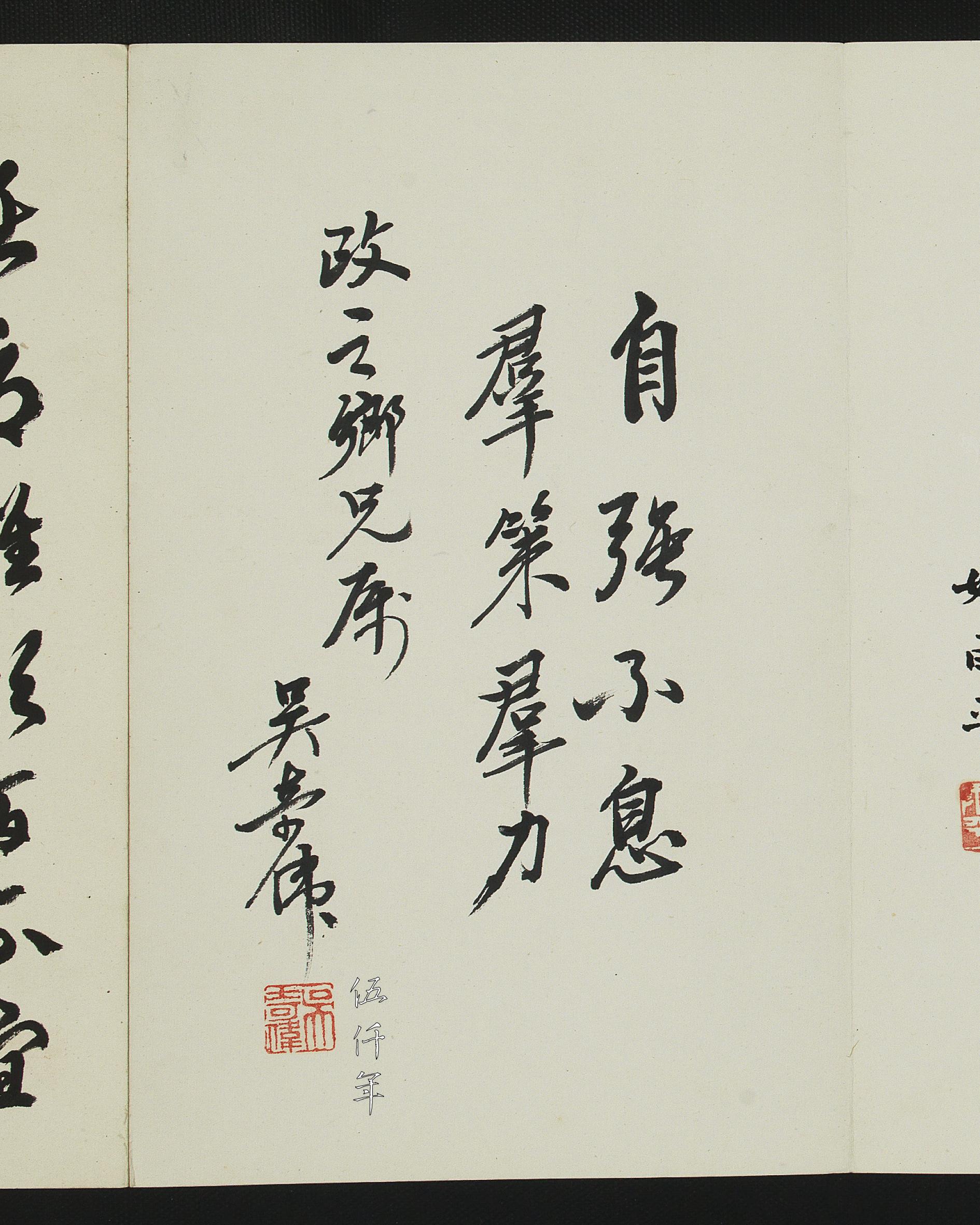
Calligraphy by Wu Ch’i-wei
Inscription reads:
“We strengthen ourselves continuously without repose,
we plan and strive together.
At the request of elder brother Kai-chih (改之) from my home town,
Wu Ch’i-wei (吳奇偉)”.
Seal impression: “Wu Ch’i-wei”.
43) Calligraphy by Major General Wen K’o-kang (溫克剛中將)
His tzu was I-ju (一如), native of Ta-p’u in Kwangtung province. He was born in 1896 and died in 1957.
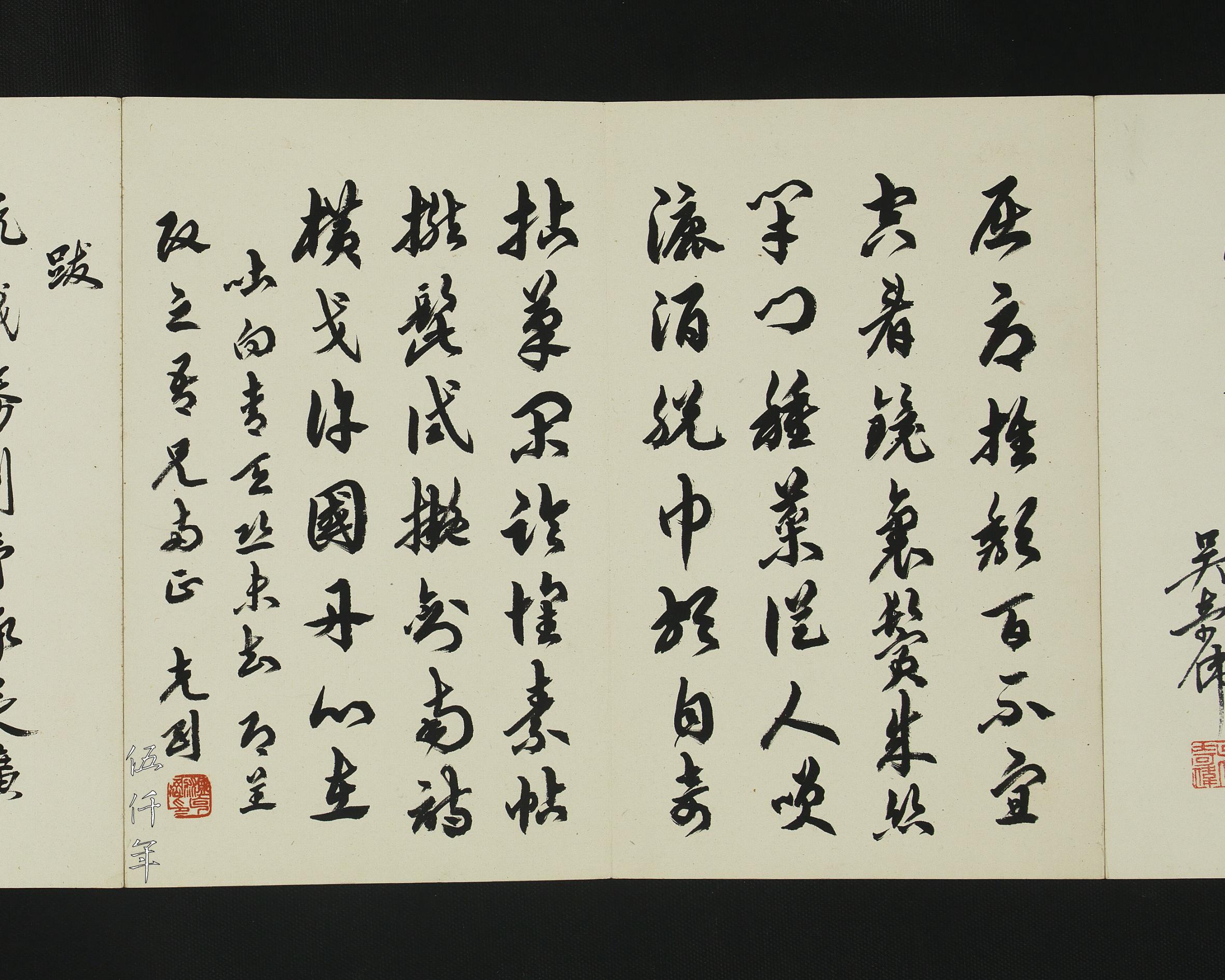
Calligraphy by Major General Wen K’o-kang
Inscription reads:
“To be servile or glum are surely not apt,
In the mirror my sideburns all but white.
A hermit gardener makes my servant laugh,
Amuse myself with a headscarf sieving wine.
Wield a brush to write idly like Huai-su (懷素),
Roll my mustache to mimic a Lu Yu poem (陸游).
I hold the dagger-axe swearing loyalty to country,
Look up towards Heaven I ponder on Fate.
I present this for the double rectifications of elder brother Kai-chih (改之), K’o-kang (克剛)”.
Seal impression: “Seal of Wen K’o-kang”.
44) Calligraphy by Representative Li Chia-mien (李加勉代表) of the Government of Kwangtung Province in the capital of Nanking
His tzu was Kai-chih (改之), native of Ta-p’u, Kwangtung province. He was born in 1901 and died in 1985.
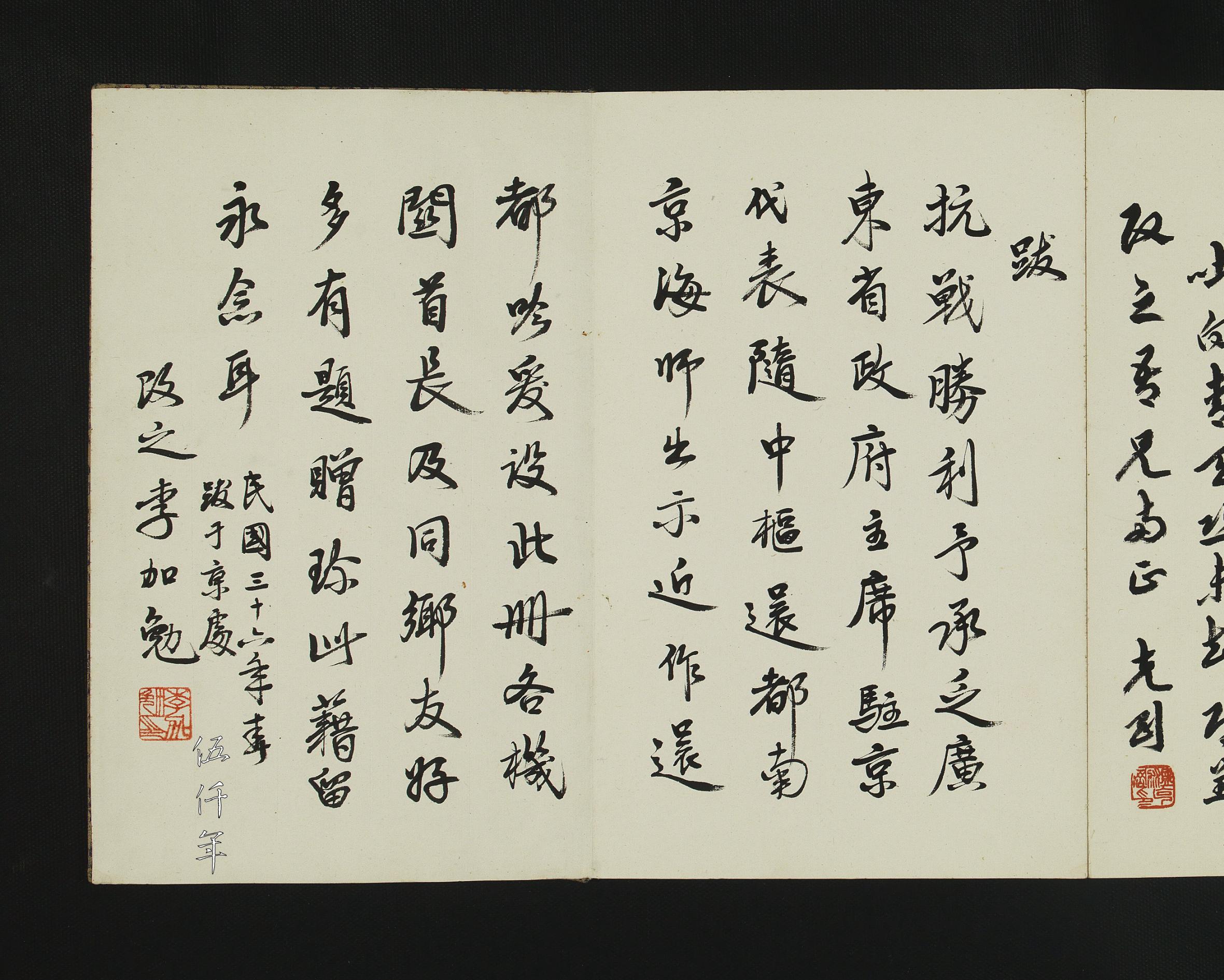
Calligraphy by Representative Li Chia-mien of the Government of Kwangtung Province in the capital of Nanking
Inscription reads:
“After the victory of the War of Resistance Against Japanese Aggression, I was honoured to be appointed representative of the Government of Kwangtung Province in the capital of Nanking. I then followed the Central Government and returned to the capital. My teacher Tsou Hai-pin (鄒海濱) showed me his recent poem titled Return to the Capital of Nanking, hence I assembled this album which includes inscriptions by senior officials of numerous departments and friends from my hometown. I will treasure this album forever in memory of this event.
I wrote this in the capital of Nanking in the spring of the 36th year of the Republic of China.
Kai-chih Li Chia-mien (改之李加勉).”
The 36th year of the Republic of China corresponds to 1947.
Seal impression: “Seal of Li Chia-mien”
The inscriptions and painting by these forty-four individuals offer some insights into their respective temperaments, casts of mind, literary cultivations and artistic expressions. They reveal themes of self-discipline and moral exhortations, considerations for the nation, and apprehensions of the times. Album of Calligraphy and Painting to Celebrate the Triumphant Return to Capital Nanking took shape in the first and second year of the return to Nanking, a fleeting final moment at the height of the National Government’s fortunes, when the communist insurgency was at the brink of full scale eruption.
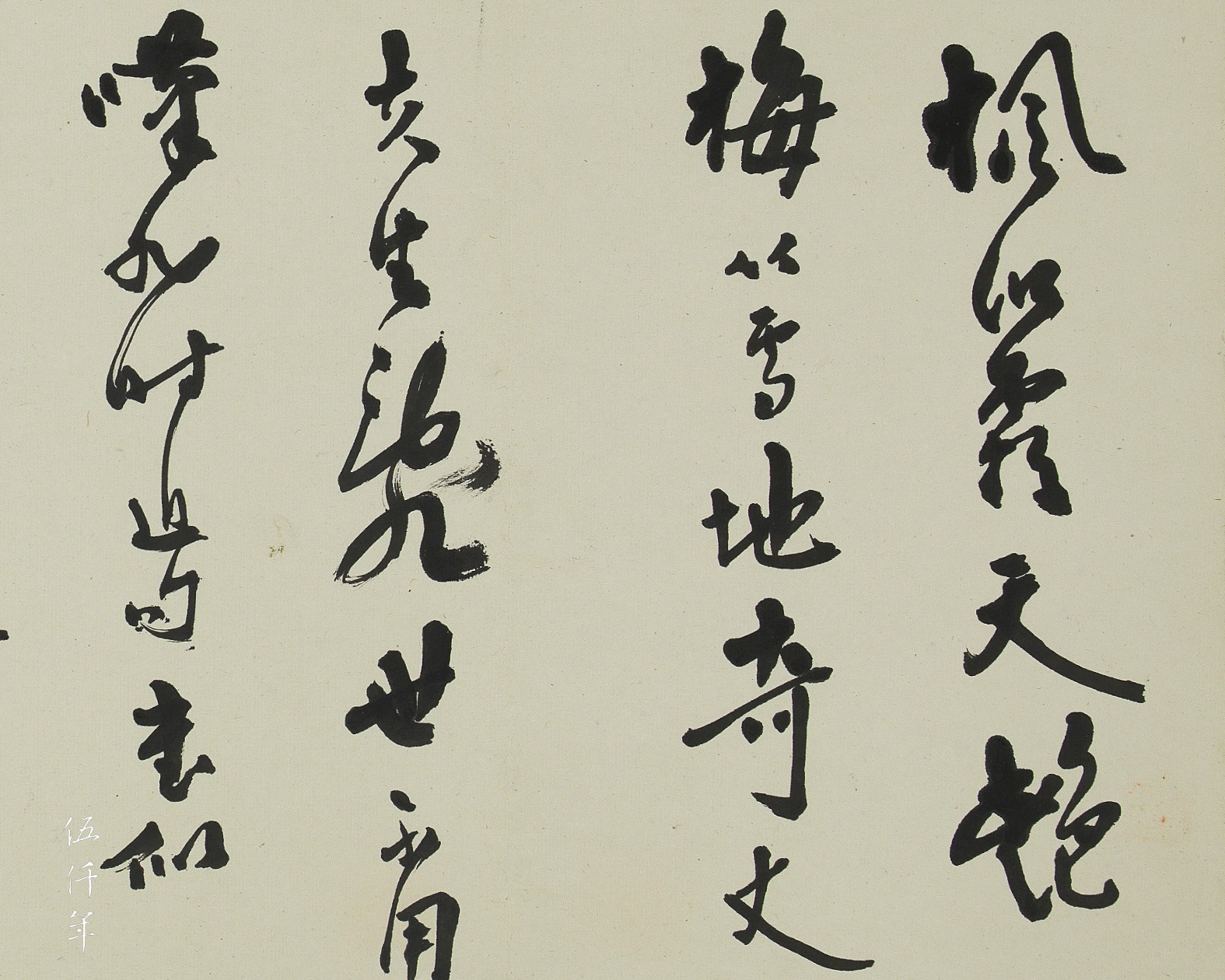
Detail of calligraphy by Minister Liang Han-ts’ao of the Overseas Ministry of the Central Committee of the Chinese Nationalist Party. the last sentence reads: Don’t bemoan you were born in the wrong era.