When the Chinese Heritage Virtual Museum was first founded, twelve virtual rooms were designated to display the visual dispositions of different categories of cultural artefacts. A short introduction is also affixed to each room to elucidate the subject matter. Now rereading the Introduction to the virtual room titled Intimate Stories of Calligraphic and Painterly Engravings, I still consider it an eloquent account of the classical scholars’ passion for engravings. The full Introduction is hereby reiterated:
“Since ancient times, the Chinese educated class has rarely acquired the artisanship to carve statues of spirits, gods, ancestors, sages, emperors, queens, or others. To understand the whole story, Chinese know depictions of physical appearances are ineffectual to form meritorious heritage for future generations; only virtue, deeds and words can reach perpetuity. To impart virtue, deeds and words, they rely on the written word to transmit them across millennia. That is why scholars clutch the written word as if they can outshine the sun and the moon. They exalt calligraphy to become the pinnacle of artistic refinement. Notably they undertake engravings on stone to create memorial stelae for posterity.
During the Ming and Ch’ing dynasties, scholars indulged in carving words on seals, the space can be as small or even smaller than a square inch. Subsequently the art of seal engraving achieved equal recognition as calligraphy and painting. The devotion of the scholars was indeed fervent, they popularized the carvings of calligraphy and painterly images on inkstones, teawares, fan guards, brush pots, wrist rests, other writing accoutrements and various desk objects. They applied carving knives on materials such as bamboo, wood, stone, ivory, porcelain, ceramics, bronze, pewter, being skillful in all. Even though these objects are small in size, they are embodiments and composites of literature and art, no less than any other rare art treasures.
I privately reflect on the encounter of unworldly objects in this world, to come across a piece with a single engraved word or a single engraved sentence is sufficient cause for savoring. Like the spirit stone in The Dream of Red Chamber (紅樓夢), the mystery of its past, the emotions aroused, are hastened and instigated by traces of the engraved words. With this in mind, I inspected those engraved objects in my collection, and scrutinized the meanings of their incised characters. I allocated them into eight categories, and abandoned the confinements of traditional classifications based on usages or materials. Instead I organized them according to the spiritual or semantic contexts of the engravings, forging a novel approach. The Eight Categories are: In Memoriam, Veneration, Endearment (Uncle and Nephew, Cousins, Partners, Confidants), Collaboration, Friendship, Self-Amusement, Fellowship (Vestige of Poetry, Vestige of Calligraphy, Vestige of Painting) and Reclamation. Together they are grouped under the title: Intimate Stories of Calligraphic and Painterly Engravings, Part One.”
The last sentences in the Introduction are the earliest articulation of the concept of Eight Categories. However in subsequent years, I have not given any additional explanation regarding the definitions of Eight Categories, nor have I proposed actual cultural objects to elucidate the intrinsic meanings. I am afraid one may be accused of empty words without substance, or blamed for being opaque and ambiguous. Hence I am now motivated to curate a virtual exhibition titled Intimate Stories of Calligraphic and Painterly Engravings: Part One, with a selection of fourteen engraved or inscribed cultural objects from different historic periods. After analyzing and determining the original creative impulse of each object, it is then allocated to one of the applicable categories.
The physical characteristics of the objects have been intentionally subdued, the emotional qualities have been purposefully accentuated, so that the spirits of past scholars, the sentiments of bygone times, can leave the domain of oblivion and be connected to contemporary hearts and minds. The world has long been altered beyond recognition, however, if the emotions of past and present can be aligned, if the hearts of past and present can beat alike, certainly the beauty and refinement of Chinese Classical Culture will not be eradicated from our world. As for the Eight Categories, they represent the perpetual spiritual and ethical cultivations of the human mind and human relationships. If we hope the beauty and refinement of Chinese Classical Culture can prevail till the end of time, by allocating cultural objects under the Eight Categories, profound emotional connections may be nurtured, freshly acquired sensibilities may refresh and invigorate, perhaps it can be a worthwhile effort towards the revival of Chinese Classical Culture.
Intimate Stories of Calligraphic and Pictorial Engravings: Part One.
Catalogue of Artefacts from the Eight Categories:
A.In Memoriam:
- County Map of Kuei-an (歸安) and Wu-ch’eng (烏程).
- Photograph of Ch’ao-yin Bridge (潮音橋) in Wu-ch’eng county of Chekiang province.
- Seal carved by Mr. Wang P’ei-yüeh (王北岳), dedicated to Soong Shu Kong (宋緒康).
B.Veneration:
- Seal carved by Wan Shou-ch’i (萬壽祺), dedicated to Monk Fa-yü (法雨), Ming dynasty.
C.Endearment:
a) Uncle and Nephew
1.Bamboo wrist rest with prunus carved by Wang I (王玘) and regular script calligraphy carved by his nephew Wang Heng (王恆), Ch’ing dynasty.
b) Cousins
1.Seal carved by Ch’en Ts’u-wang (陳祖望), dedicated to his cousin Yüeh-ch’ing (月卿), Ch’ing dynasty.
c) Partners
1.Seal carved by T’an Yüeh-se (談月色).
2.Painting of Prunus by T’an Yüeh-se.
3.Seal of Ts’ai Shou (蔡守), husband of T’an Yüeh-se.
d) Confidants
1.Gift of jade lotus root from Aunt Chou Lien-hsia (周鍊霞) to Mr. Soong Hsün-leng (宋訓倫), inscribed by Mr. Soong.
2.Letter by Aunt Chou Lien-hsia to Mr. Soong Hsün-leng.
D.Collaboration:
1.Pewter wine cup with ceramic lining, drawing by Kai Ch’i (改琦), running script calligraphy by Wang Su (王涑), clerical script calligraphy and carvings by Chu Chien (朱堅), Ch’ing dynasty.
E.Friendship:
1.Bamboo fan guards with calligraphy and carving by Yang Hsieh (楊澥), dedicated to Lien-t’ang (蓮塘), Ch’ing dynasty.
F.Self-Amusement:
1.Inkstone in the form of broad bean with calligraphy by Ch’en Shu (陳書), Ch’ing dynasty.
G.Fellowship:
a) Vestige of Poetry
1.A bronze paperweight in the form of a ruler, with calligraphy and carving by Ch’en Yin-sheng (陳寅生), Ch’ing dynasty.
b) Vestige of Calligraphy
1.Bamboo fan guards with calligraphy by Ch’ang T’ing-chi (張廷濟), Ch’ing dynasty.
2.A set of ink rubbings of Engravings of Archaic Vessels in the Collection of Huai-mi Shan-fang (懷米山房吉金圖) on Stone Stelae.
c) Vestige of Painting
1.Bamboo wrist rest with drawing and carving by Wen Ting (文鼎), Ch’ing dynasty.
H.Reclamation:
1.Triangular Dragon Flag of the Ch’ing dynasty.
2.Metal shell casing captured by the armies of the Eight-Nation Alliance during the siege of Tientsin in 1900, Ch’ing dynasty.
Intimate Stories of Calligraphic and Pictorial Engravings: Part One.
Illustrations of Artefacts from the Eight Categories:
A.In Memoriam
My ancestors migrated from northern China to Wu-ch’eng county in Chekiang province at the end of the Ming dynasty. They lived adjacent to Ch’ao-yin Bridge, and the registered address in early 20th century during the early Republican period was No. 73 Wu-hsing South Street. Ch’ao-Ying Bridge was first built in the 18th year of the Chia-ching reign in the Ming dynasty, 1539. It was then rebuilt in the 33rd year of the Wan-li reign in the Ming dynasty, 1605. It is fifty meters long, five meters wide, and is still intact. After the fall of mainland China in 1949, our old house was reduced to dust. I then asked Mr. Wang P’ei-yüeh to carve a seal to preserve traces of the past.
1.County Map of Kuei-an (歸安) and Wu-ch’eng (烏程), former property of Bibliotheca Zi-ka-wei.
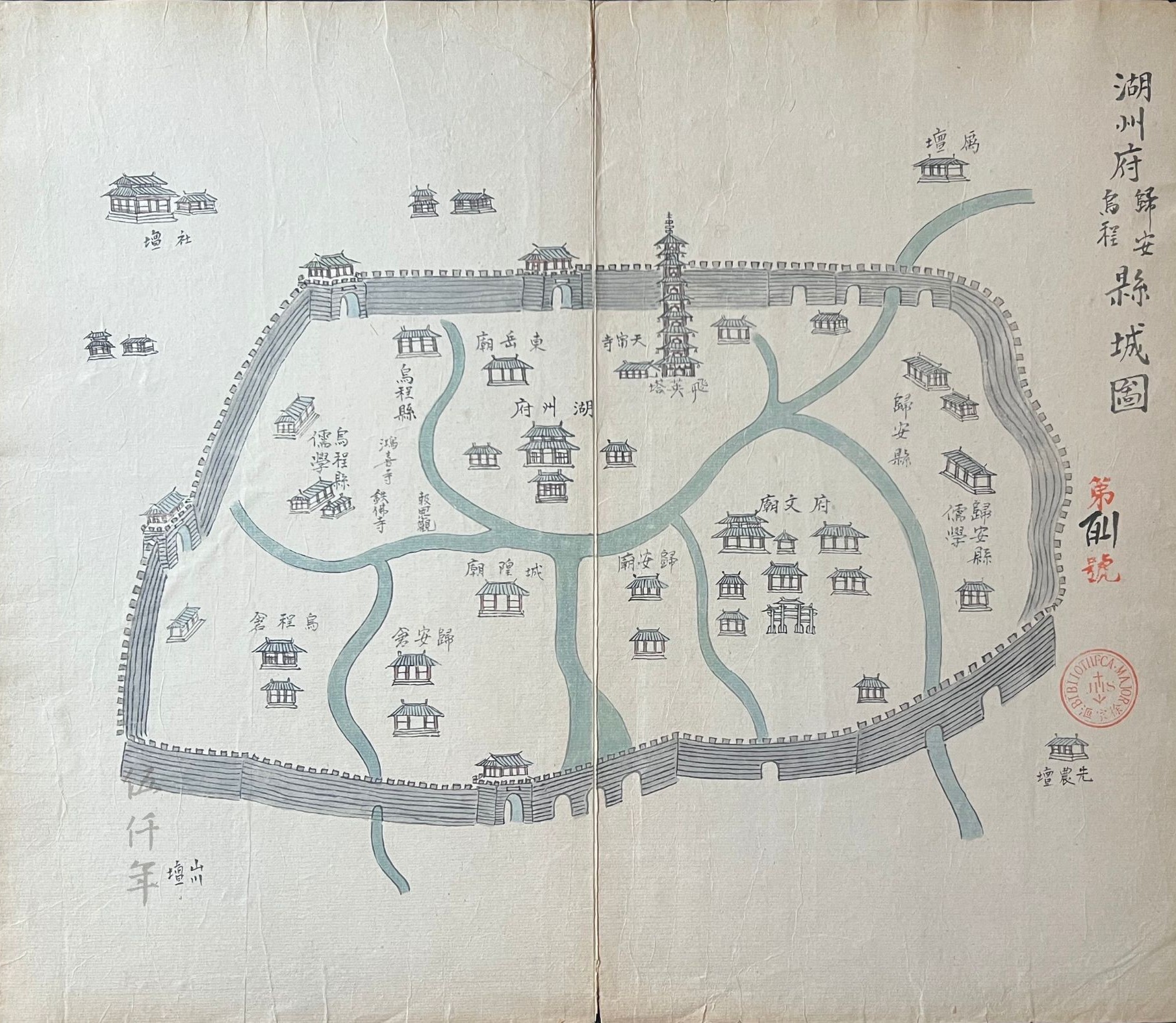
County Map of Kuei-an and Wu-ch’en
2.Photograph of Ch’ao-yin Bridge (潮音橋) in Wu-ch’eng county of Chekiang province, 1982.
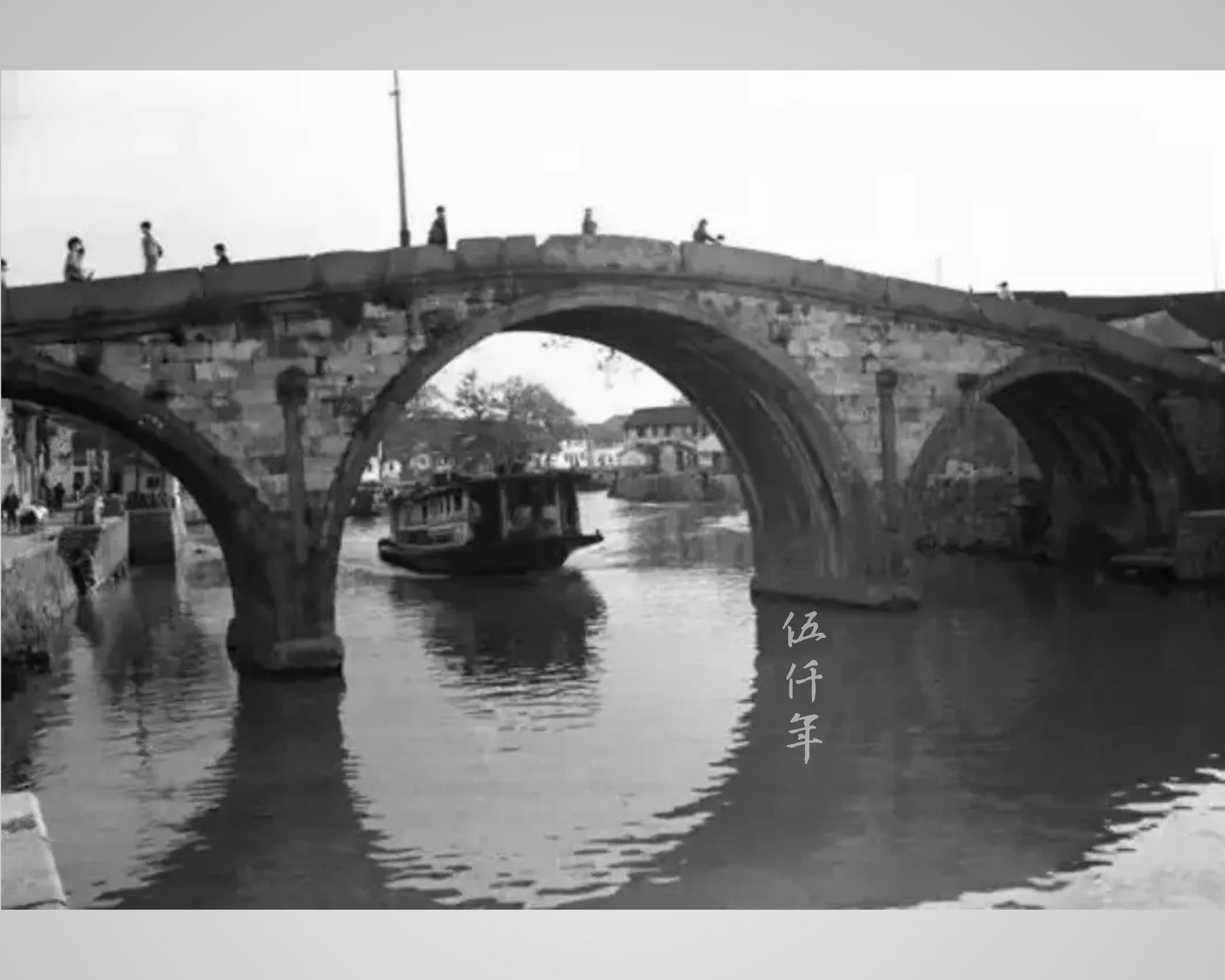
Photograph of Ch’ao-yin Bridge in Wu-ch’eng county, 1982
3.Seal carved by Mr. Wang P’ei-yüeh (王北岳), dedicated to Soong Shu Kong (宋緒康).
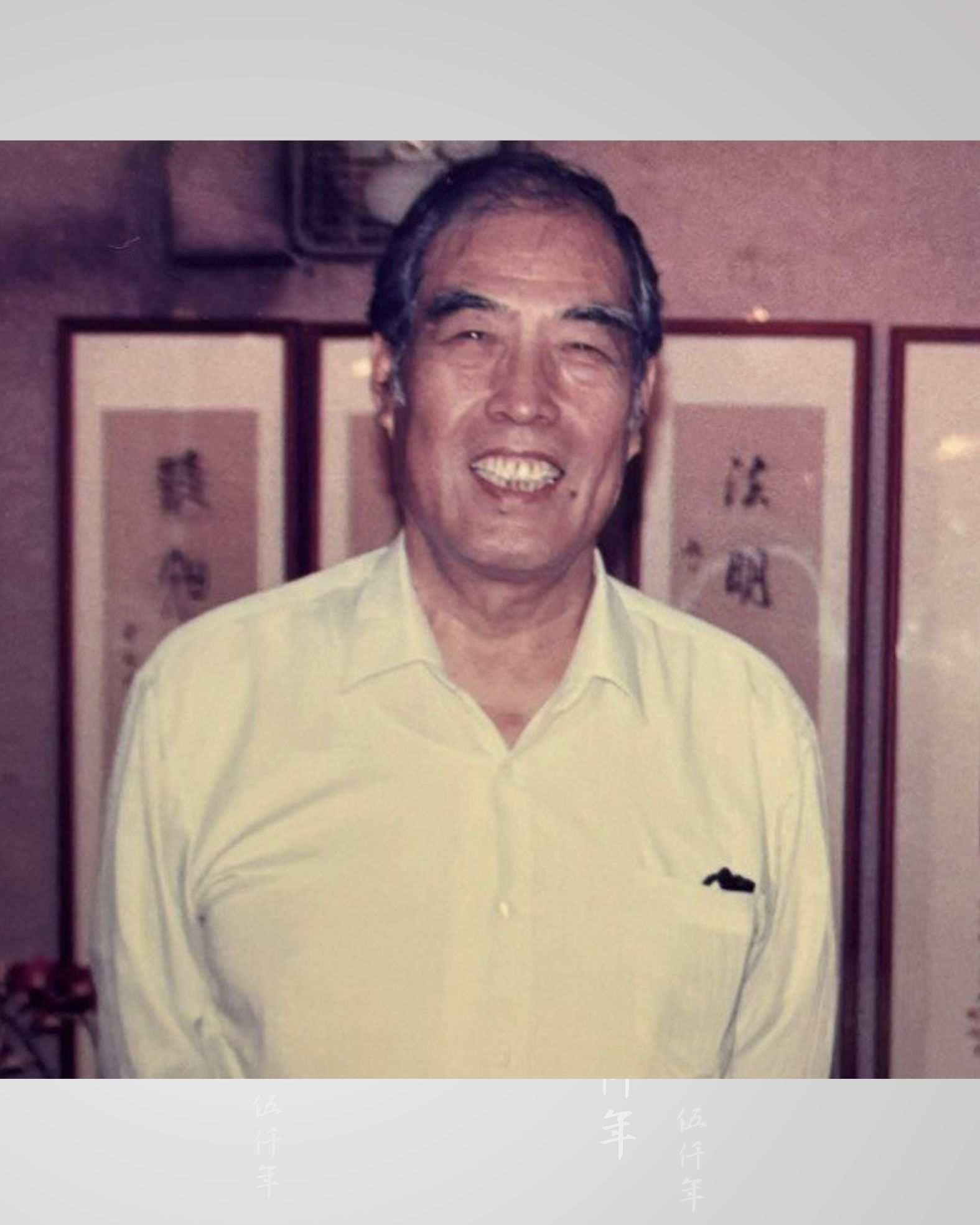
Portrait of Mr. Wang P’ei-yüeh
Wang P’ei-yüeh (王北岳) was born in the 15th year of the Republic 1926, and died in the 95th year of the Republic 2006.
His original name was Tse-heng (澤恒), his hao was Tzu-ts’ang (子蒼), he was a native of Wen-an in Hopeh province. He graduated from the Department of Agriculture at the National Peking University. He studied the art of seal engraving in Hopeh province under Chang Tiao-sun (張釣孫) from Nan-p’i and Ho P’ei-hsin (賀培新 1903-1951) from Wu-ch’iang. With the fall of mainland China to the communists in the 38th year of the Republic 1949, he left for Taiwan. In the 50th year of the Republic 1961, he founded Hai-chiao Seal Society (海嶠印社) with Wang Chuang-wei (王壯為 1909-1998), later on, he also founded Chung Hua Seal Engraving Society (中華民國篆刻學會). He was successively appointed professor of art at the National Taiwan Normal University and the Chinese Culture University. He was instrumental in popularizing seal engraving in Taiwan. His writings include The Art of Seal Engraving (篆刻藝術), Record of Observations on the World of Seal Carving (印林見聞錄).
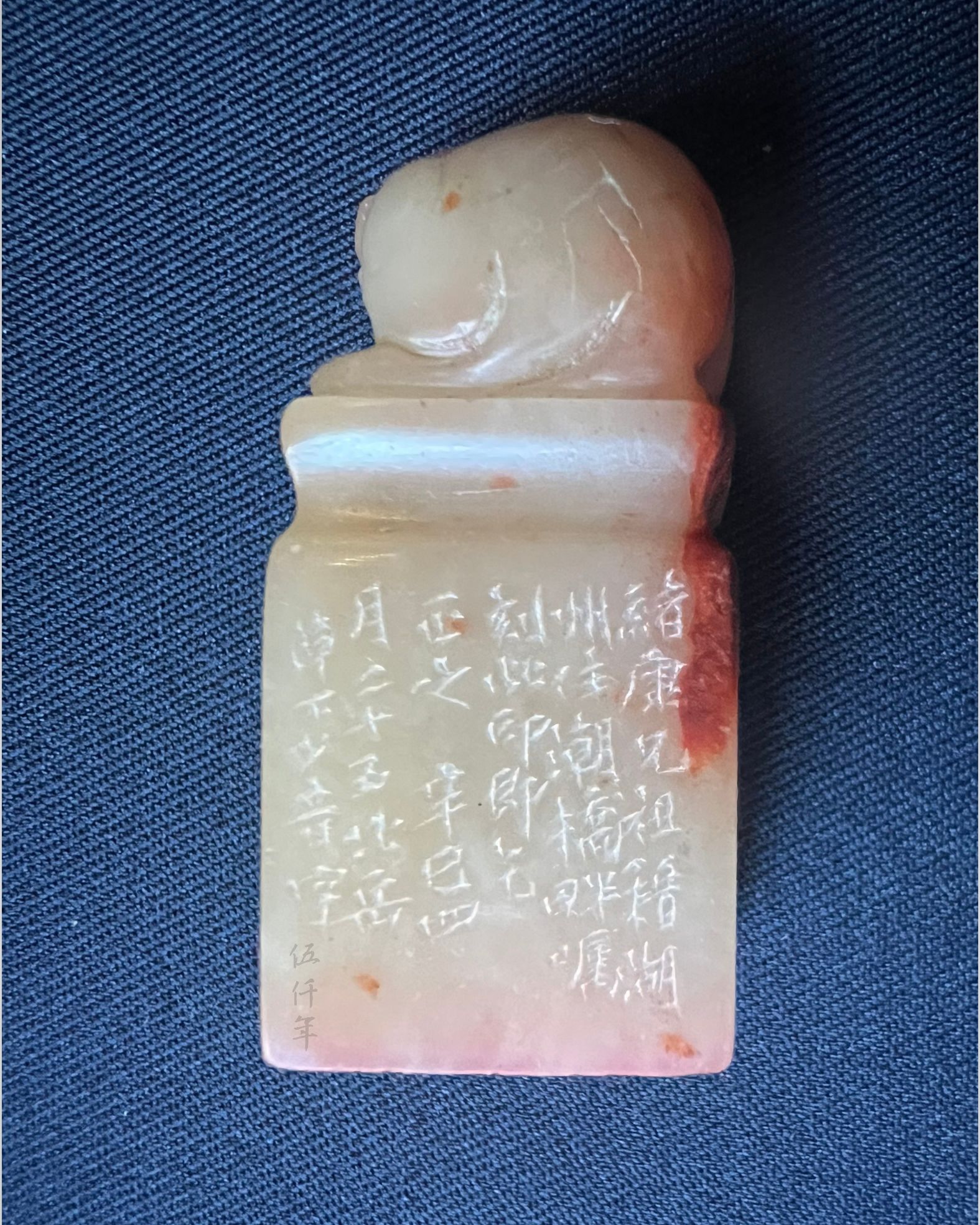
Inscription on side of seal engraved by Mr. Wang P’ei-yüeh
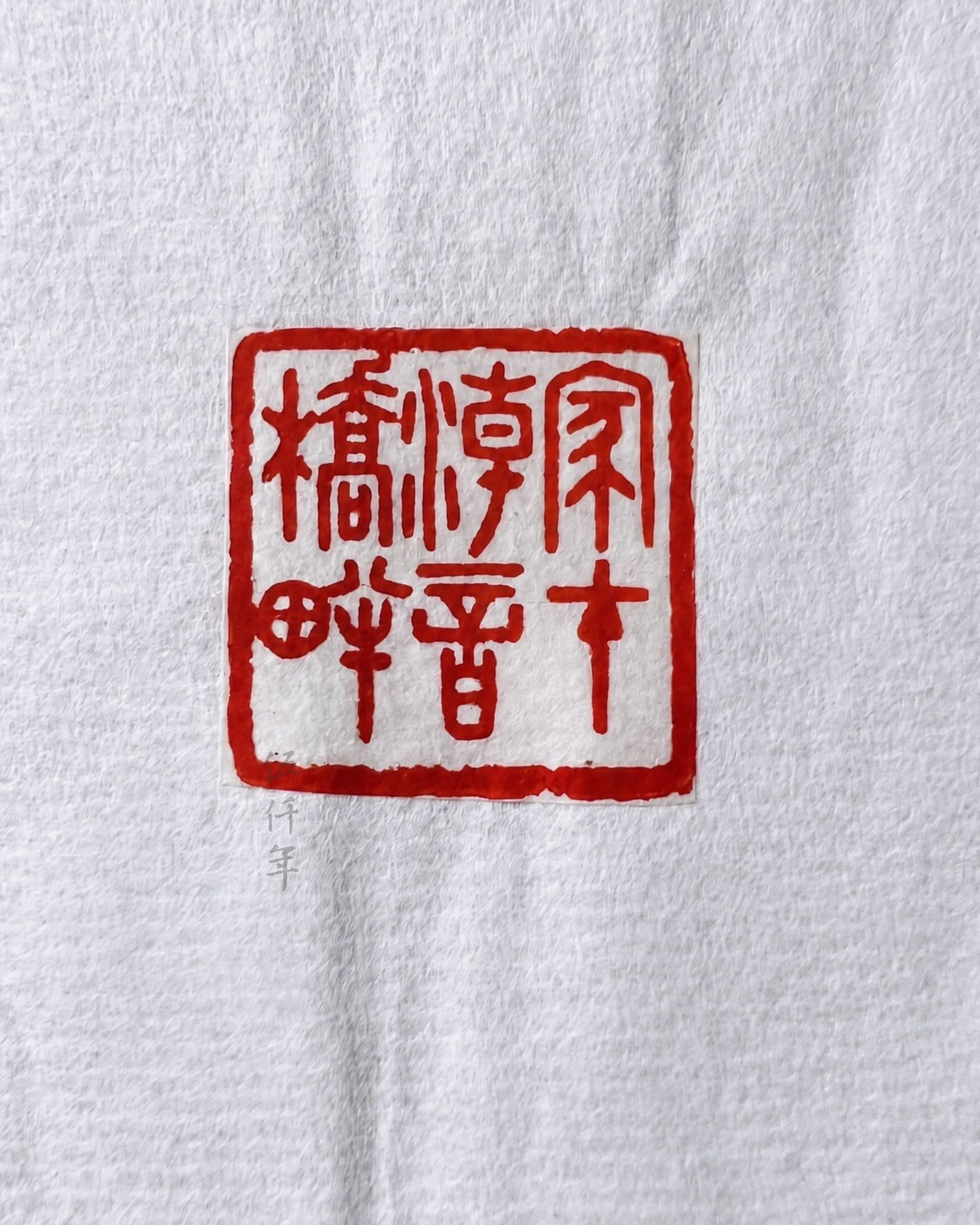
Relief seal impression with the words “My home is adjacent to Ch’ao-yin Bridge”, carved by Mr. Wang P’ei-yüeh
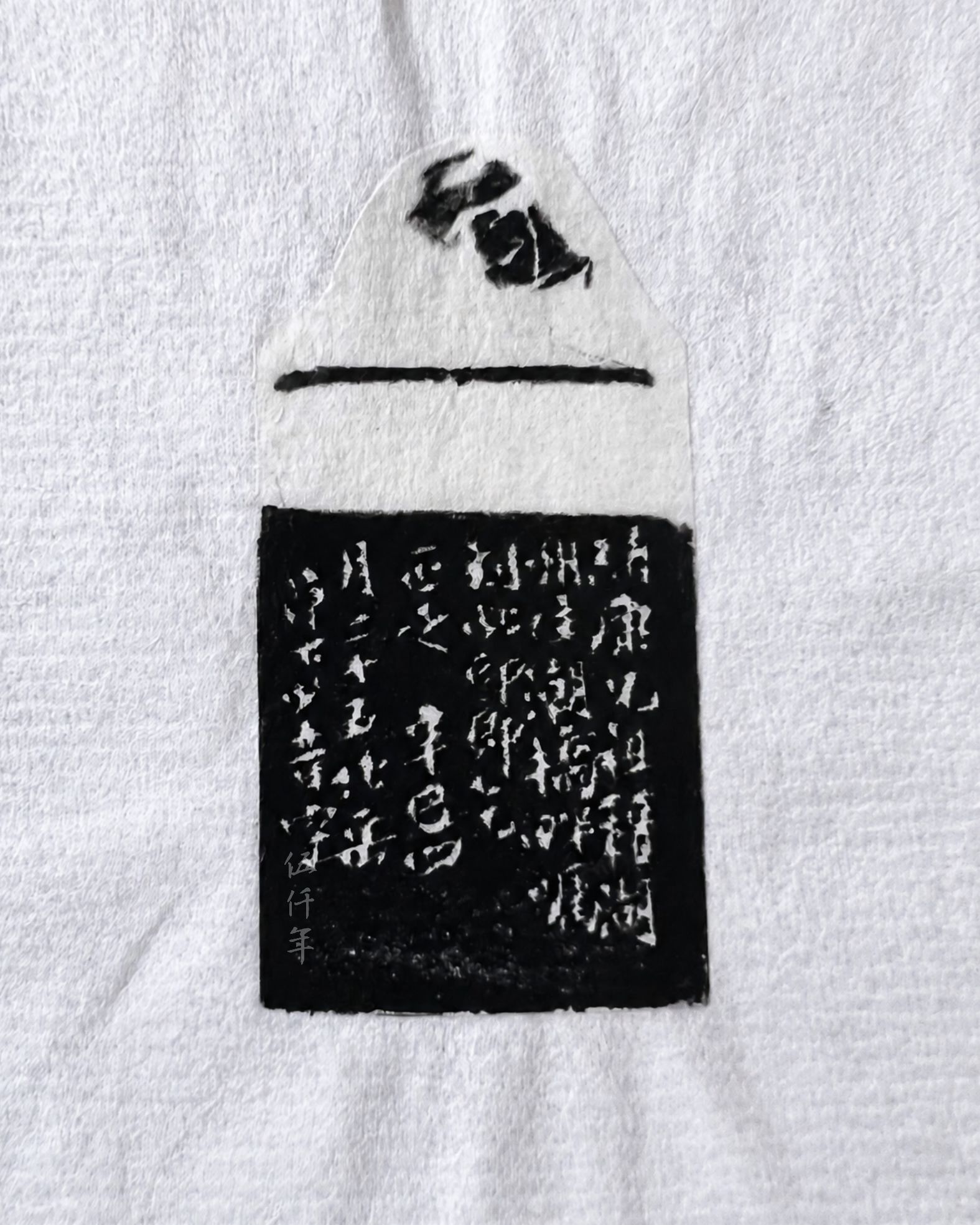
Ink rubbing of inscription engraved on side of seal by Mr. Wang P’ei-yüeh
Relief seal impression: “My home is adjacent to Ch’ao-yin Bridge (家在潮音橋畔)”.
Calligraphy inscription engraved on one side of the seal:
“The ancestral home of elder brother Shu Kong is located adjacent to Ch’ao-yin Bridge in Wu-chou county. He requested me to carve this, and I humbly seek his rectification. On the 25th day of the fourth month, hsin-ssu (辛巳) year, P’ei-yüeh.”
The seal was carved in hsin-ssu year, corresponding to 2001. Wang P’ei-Yüeh was seventy six years old.
Publication:
The Cultural World of a Ci Poet, page 139, edited by Soong Dennie and Soong Shu Kong. University Museum and Art Gallery, The University of Hong Kong, 2006.
B.Veneration
The moral character of the Loyalists of Ming Dynasty is deemed to be as glorious as the luminance of the moon and the sun. They have been role models for youths in the last four centuries.
1. Seal carved by Wan Shou-ch’i (萬壽祺), dedicated to Monk Fa-yü (法雨), Ming dynasty.
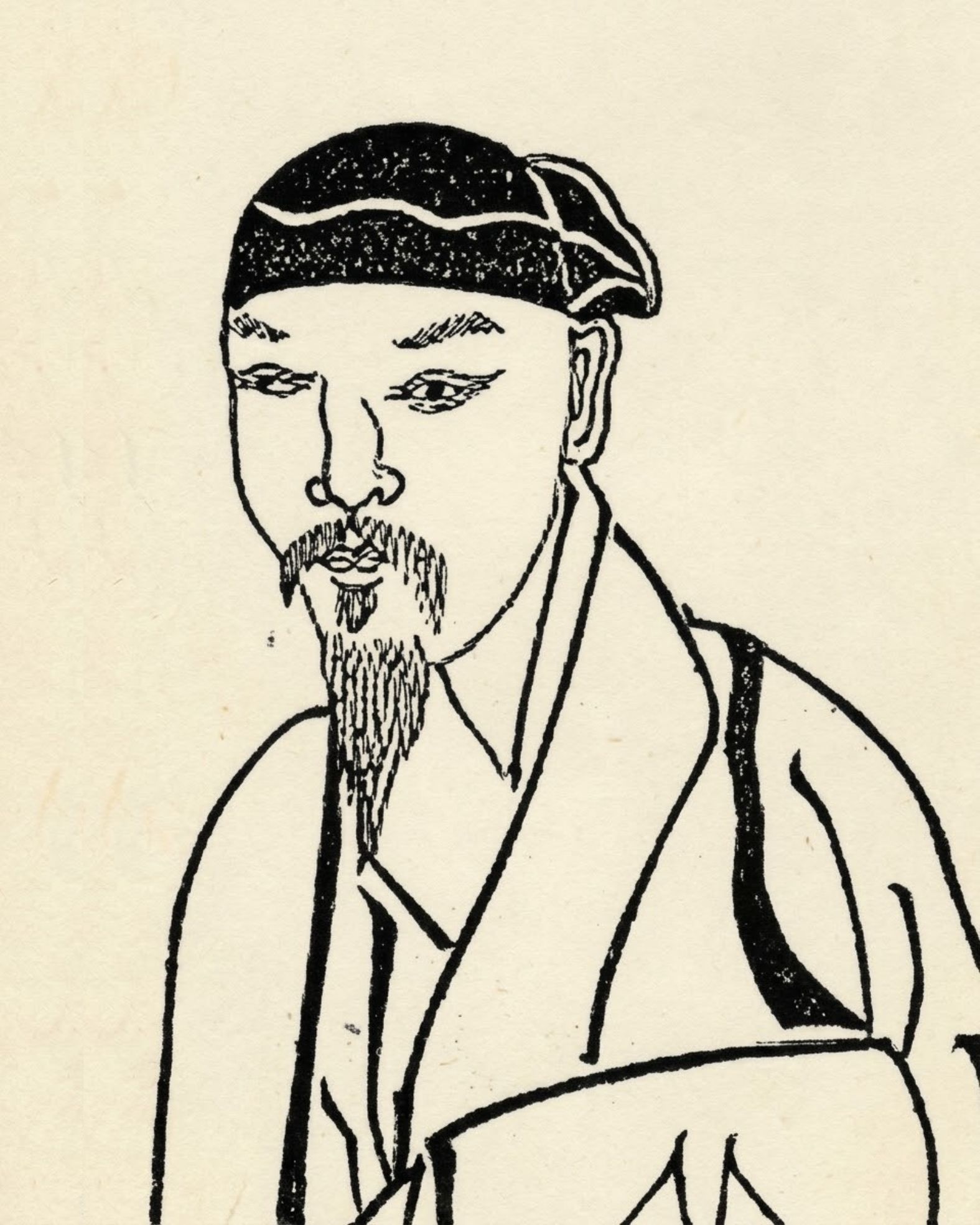
Portrait of Wan Shou-ch’i
Wan Shou-ch’i was born in the 31st year of the Wan-li reign 1603 and died in the 6th year of the Yung-li reign 1652. His tzu (字) were Nien-shao (年少), Chieh-jo (介若), Jo (若), Nei-Ching (內景). He was also called Wan Tao-jen (萬道人). He was a native of Nan-ch’ang in Kiangsi province, but lived in Hsü-chou of Kiangsu province. In the 3rd year of the Ch’ung-chen reign 1630, he attained the chü-jen (舉人) degree, or provincial graduate. In the 1st year of the Hung-kuang reign 1645, he raised a private army to fight against the invading Manchus. He was captured but managed to escape just before his execution. In the following year, he shaved his head and became a monk, acquiring the dharma name of Hui-shou (慧壽), and the hao of Ming-chih Tao-jen (明志道人). Two years later, he moved to P’u-hsi, and built a studio named Hsi-hsi Ts’ao-t’ang (隰西草堂). He excelled in poetry, calligraphy, painting and seal carving. His writings were published under the title Poems from Hsi-hsi Ts’ao-t’ang (隰西草堂詩集).
In Expanded Biographies of Seal Carvers, compiled by Yeh Wei-ming (葉為銘), it says:
“Wan Shou-ch’i, tzu Nien-shao (年少), native of P’eng-ch’eng. He was charming and gregarious, very much celebrated in his time. After the change of dynasty, he wore the hat and robe of a monk, calling himself Ming-chih Tao-ren (明志道人), meaning Taoist Priest with High Ideal, or Sha-men Hui-shou (沙門慧壽), meaning Hui-shou of Buddhist Sect. He was besotted by seal-engraving and well-versed in the Six Principles of Chinese Characters. His engraving of jade seals even excelled those by Wen P’eng (文彭) and Ho Chen (何震), every one of them was exquisite. He would caress his seals in front of his friends, cherishing them like great treasures.”
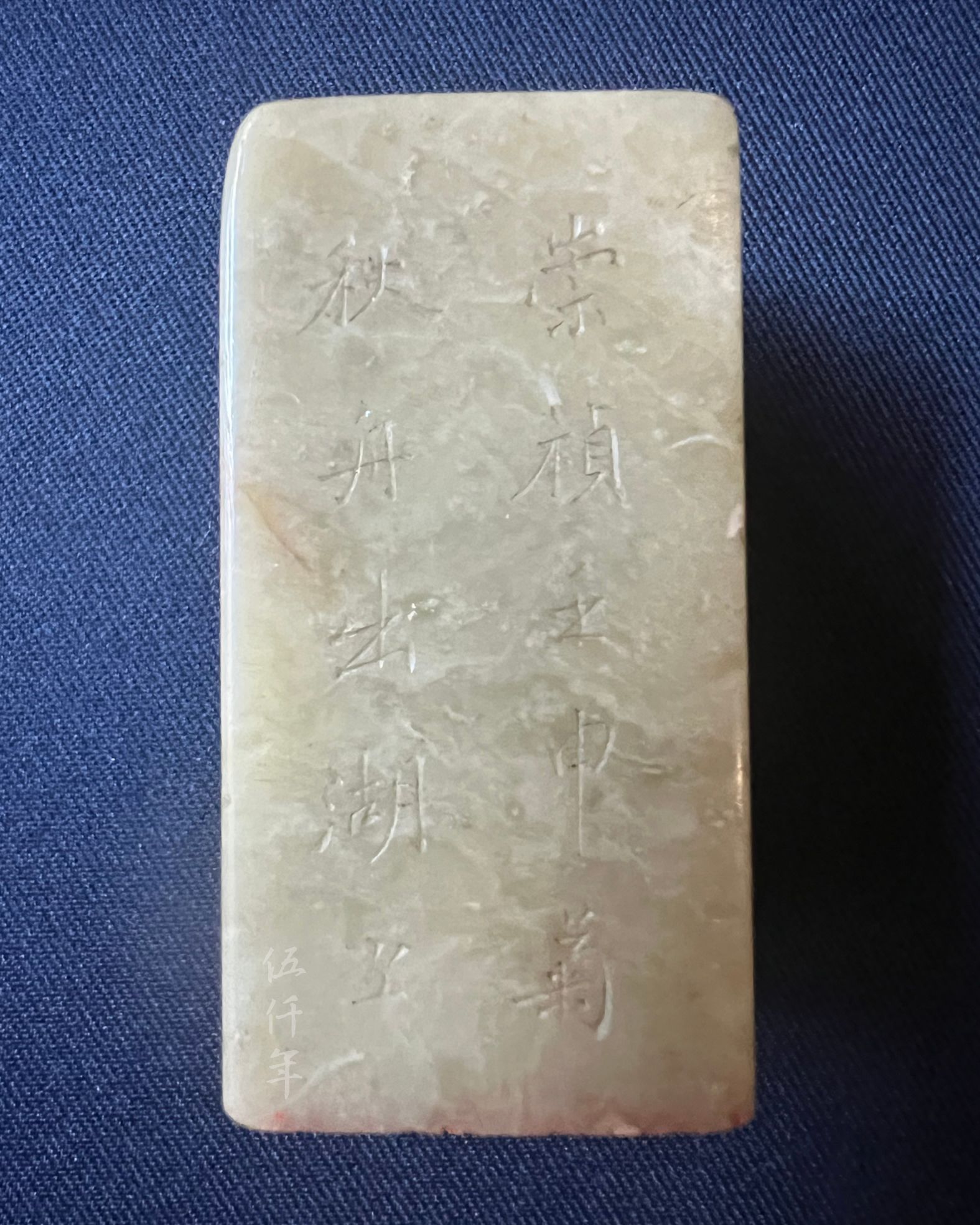
Inscription engraved on first side of seal by Wan Shou-ch’i
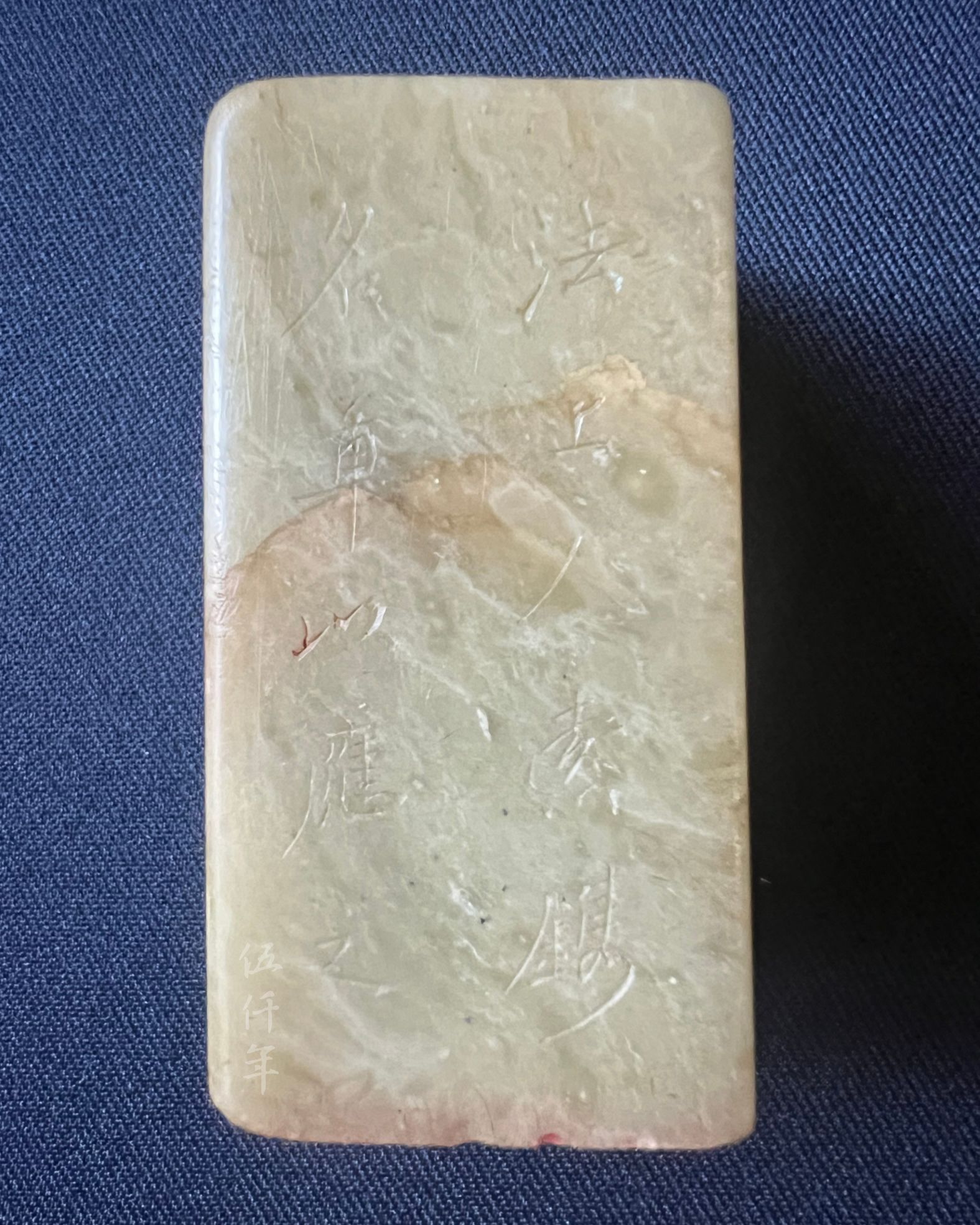
Inscription engraved on second side of seal by Wan Shou-ch’i
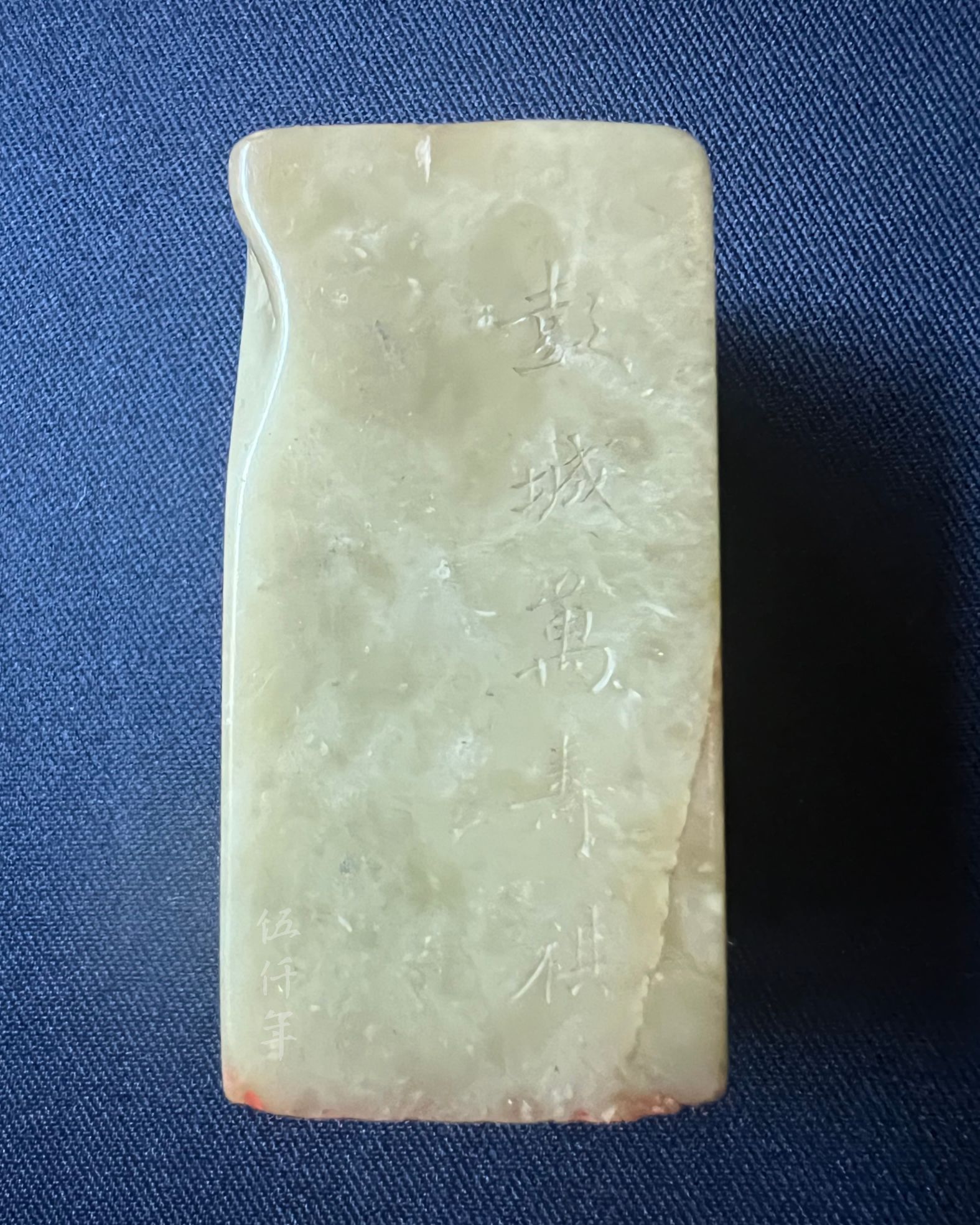
Inscription engraved on third side of seal by Wan Shou-ch’i
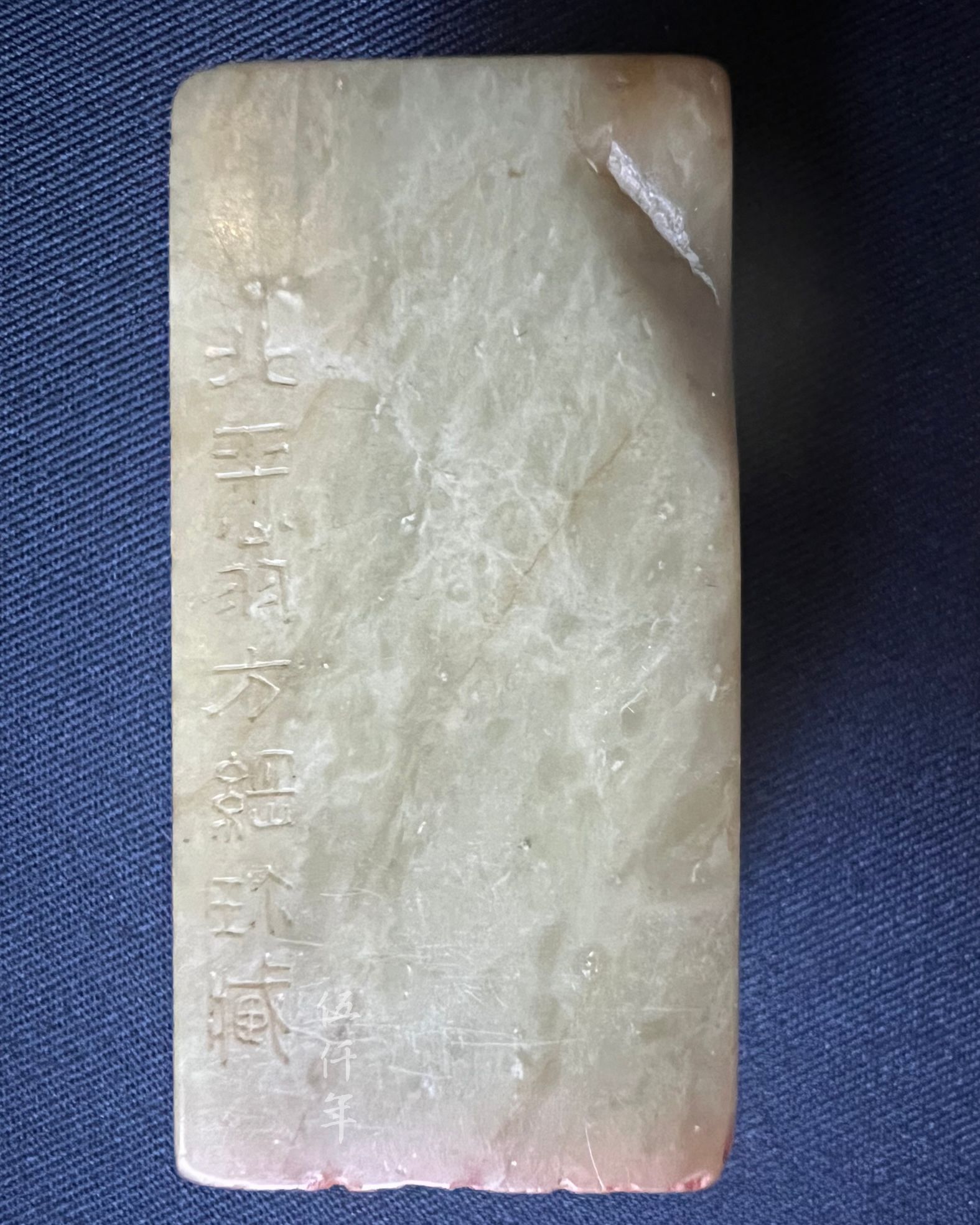
Inscription engraved on fourth side of seal written by Weng Fang-kang
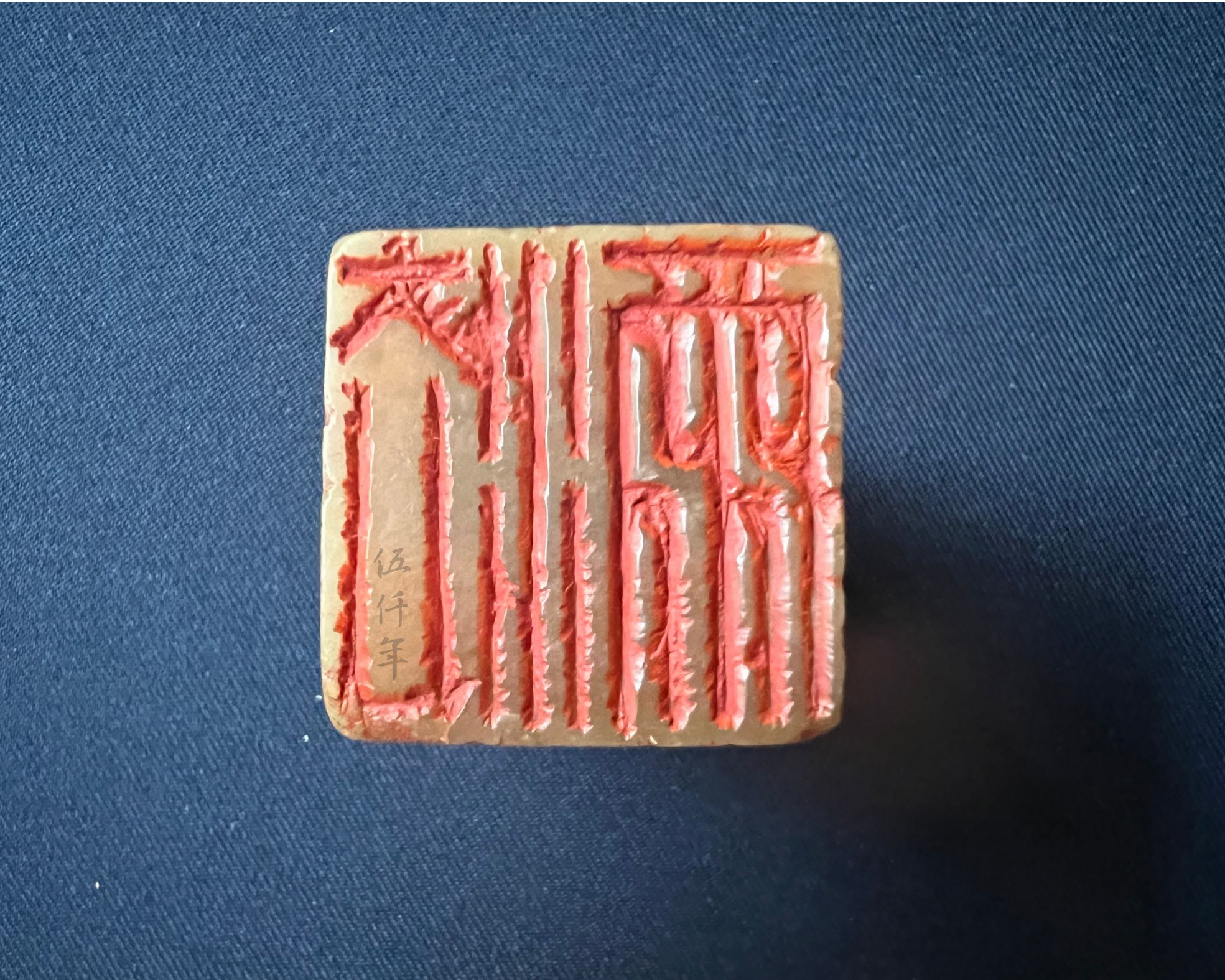
Engraved words on surface of seal: “Fa-yü”, carved by Wan Shou-ch’i
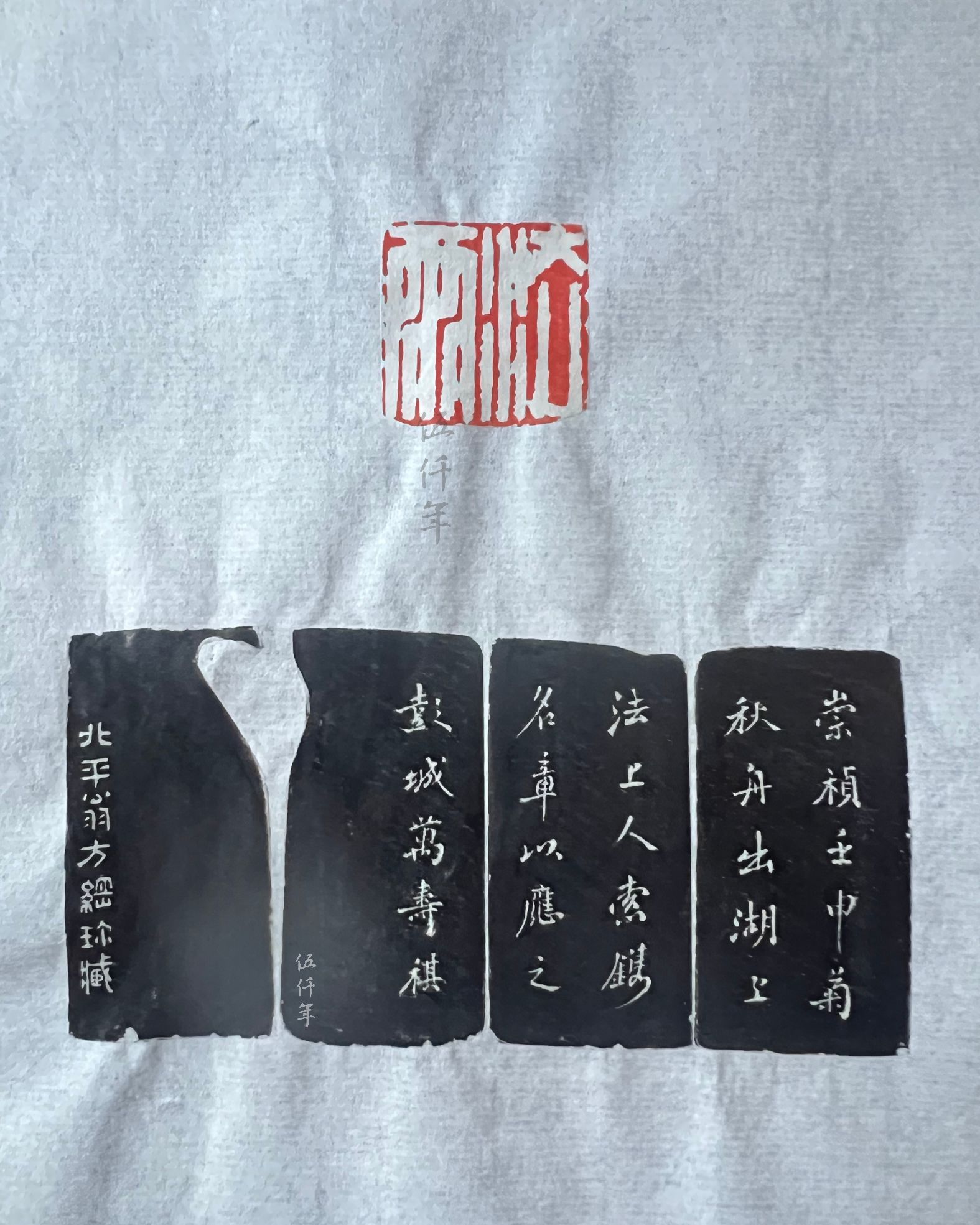
Impression of seal and ink rubbings of inscription engraved on three sides of seal by Wan Shou-ch’i, one side written by Weng Fang-kang
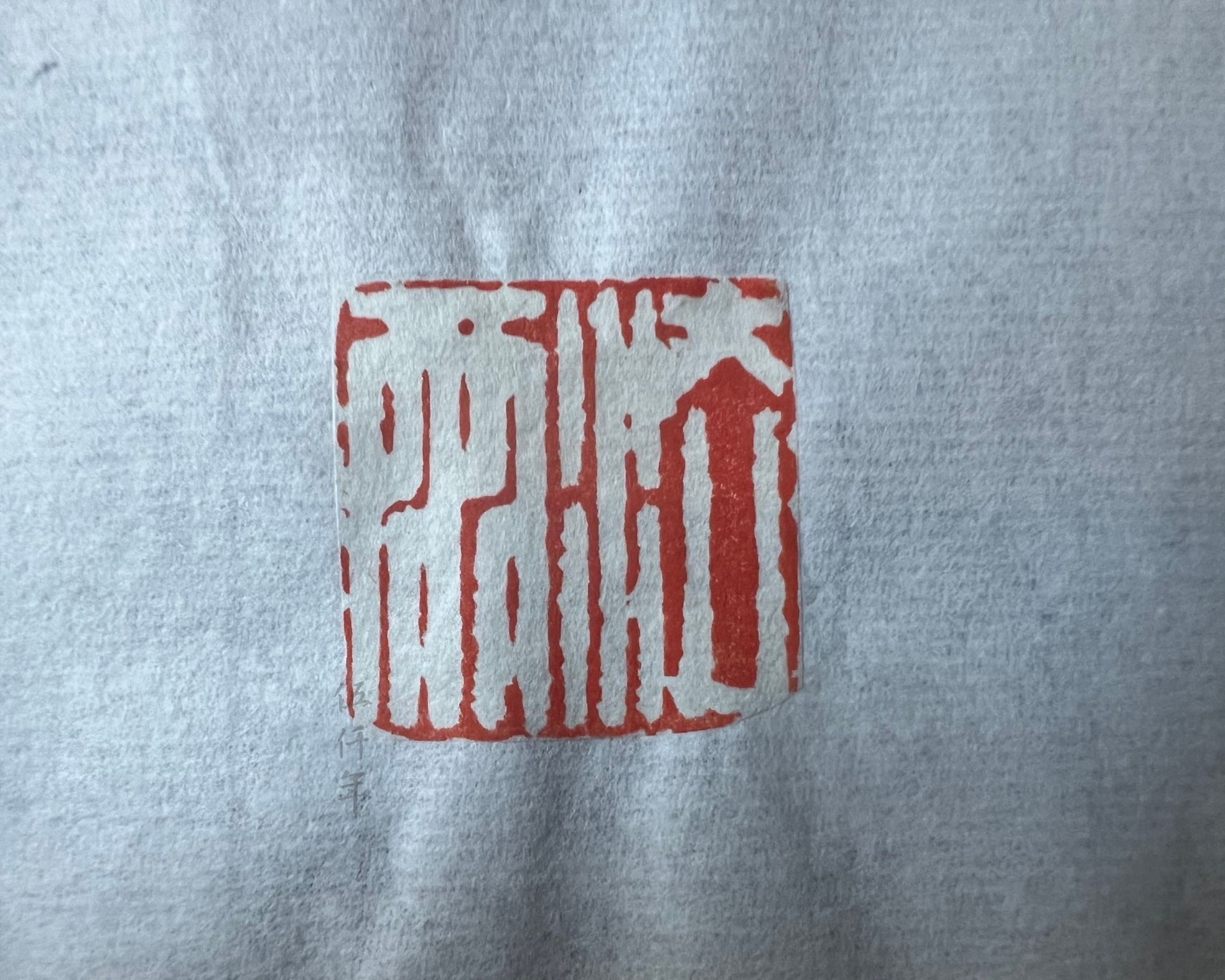
Intaglio seal impression with the words “Fa-yü”, carved by Wan Shou-ch’i
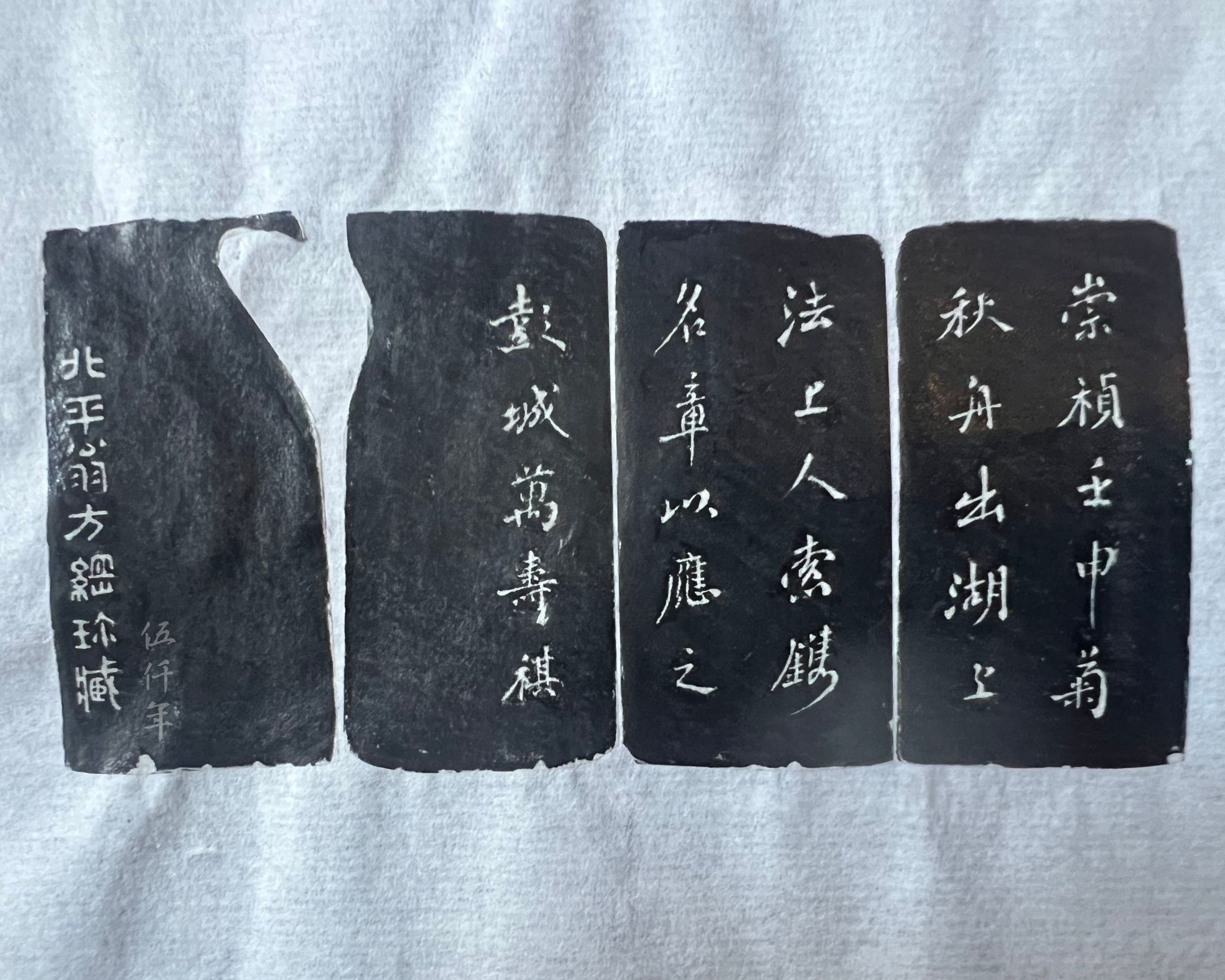
Ink rubbings of inscription engraved on three sides of seal by Wan Shou-ch’i, one side written by Weng Fang-kang
Intaglio seal impression: “Fa-yü (法雨)”.
Calligraphy inscription engraved on three sides of the seal by Wan Shou-ch’i:
“In jen-shen (壬申) year of the Ch’ung-chen reign, during the chrysanthemum bloom in Autumn, I was on board a boat in the middle of the river when Monk Fa requested me to carve a personal seal for him. Wan Shou-ch’i from P’eng-ch’eng.”
Calligraphy inscription engraved on one side by previous collector to document provenance:
“Treasured by Weng Fang-kang (翁方綱) of Pei-p’ing.”
The seal was carved in jen-shen year of the Ch’ung-chen reign, corresponding to the 5th year of the Ch’ung-chen reign 1632. Wan Shou-ch’i was thirty years old at the time. The capital of Ming dynasty fell in the 17th year of the Ch’ung-chen reign, 1644. The seal was carved twelve years before the beginning of the Southern Ming.
Weng Fang-kang (翁方綱) was born in the 11th year of the Yung-cheng reign 1733 and died in the 23rd year of the Chia-ch’ing reign 1818. His tzu were Cheng-san (正三), Chung-hsü (忠敘), his hao (號) were T’an-hsi (覃谿), T’an-hsi (覃溪). Late in life he adopted the hao of Su-chai (蘇齋). He was a native of Ta-hsing in Shun-t’ien prefecture. In the 17th year of the Chien-lung reign 1752, he attained the chin-shih (進士) degree, or metropolitan graduate. He served as sub-chancellor of the Grand Secretariat. He was proficient in textual criticism and calligraphy, and was known as an avid art collector. His writings include Record of Epigraphic Engravings from the Western and Eastern Han Periods (兩漢金石記), Writings from Fu-ch’u T’ang (復初堂集). This seal was once in the collection of Weng Fang-kang.
My late friend Mr. Kuo Jo-yü (郭若愚 or Guo Ruoyu) was the custodian of this seal for over fifty years. In 2000, S. K. Soong Design Co. Ltd. of Taipei published The Art of Seal Engraving in China: Biographies of Selected Artists (篆刻史話) by Guo Ruoyu. The chapter from page 65 to page 68 is titled The Seal Engraving of Wan Shou-ch’i (萬壽祺的篆刻), and this seal has been chronicled in great detail. To quote a few selected passages:
“According to Foreword to Compilation of Seal Impressions by Monk Hui-shou (「書沙門慧壽印譜前」)written by Chou Li-yüan (周櫟園, original name Chou Liang-kung 周亮工1612-1672), published in Biographies of Seal Carvers (「印人傳」), Wan Shou-ch’i carved very few seals. Chou Liang-kung wrote:’Jo (若, tzu of Wan Shou-ch’i) was very proud of his seal carving, he went so far as to decline requests for his work. I have managed to acquire only one seal.’ If we try to find publications of seals carved by Wan Shou-ch’i in old and rare compilations of seal impressions, it is occasionally possible to find one or two, but despite their resemblances, the grace and vigour are missing. Consequently, I came to the conclusion that it was no longer possible to find any authentic carving by him. However, to my surprise, among the chaotically piled carved stones in the market place, I found a seal carved by Wan Shou-ch’i. The intaglio seal was carved with two incised characters Fa-yü (法雨), the three sides of the stone seal were engraved with these words:
‘In jen-shen (壬申) year of the Ch’ung-chen reign, during the chrysanthemum bloom in Autumn, I was on board a boat in the middle of the river when Monk Fa requested me to carve a personal seal for him. Wan Shou-ch’i from P’eng-ch’eng.’
The expression of the intaglio seal characters is expansive and calm, confident and natural. The engraved inscription on the side was fine-tuned with repeated knife works. The calligraphy engraving is exactly the same style as the calligraphy brushwork of Wan Shou-ch’i. It is masterful and proficient.
At this stage, It is not possible to compare this seal with any other work or impression by Wan. One can only research and investigate the background of this seal through existing writings.
As for the two characters of Fa-yü (法雨), they were carved exclusively in the style of Han dynasty seal, archaic and charming, complying with the advocations of Wan Shou-ch’ih. The seal was dated with these engraved words on the side: ‘In jen-shen (壬申) year of the Ch’ung-chen reign, during the chrysanthemum bloom in Autumn, I was on board a boat in the middle of the river.’ Jen-shen corresponds to the 5th year of the Ch’ung-chen reign under Ssu-tsung Emperor (思宗). Wan Shou-ch’ih was in his prime, likely when he was most passionate about seal carving. The river mentioned in the side engraving refers to West Lake in Ch’u-chou (楚州) of Kiangsu province, Ch’u-chou is now known as Huai-an (淮安). The poems by Wan Shou-ch’i frequently referred to this river.”
C.Endearment
When the world is devoid of love, wicked plots are hatched for gain. When the world is endowed with love, compassion and righteousness are nurtured. When the world is filled with love, robust social order and sturdy human relationships lend support to civilization.
a) Uncle and Nephew
1.Bamboo wrist rest with prunus carved by Wang I (王玘) and regular script calligraphy carved by his nephew Wang Heng (王恆), Ch’ing dynasty.
The Biography of Wang I was compiled in Documentation of Bamboo Engravers (竹人錄) by Chin Yüan -yü (金元鈺) of the Ch’ing dynasty. Biography of Wang I says:
“(Wang) I (王玘), tzu Hsi-chen (席珍), hao Ch’un-chiang (春江), grandson of Wang Wei-shao (王謂韶) and son of Wang Ts’un-su (王存素). His face is plump and wears a beard. Even when over seventy, he does not use a walking stick. He lives in an old house in the west of the city, planting rare and exotic flora in the garden plot in front of the house. Visiting him on leisure days, he will be seen roasting taros and cooking bamboo shoots, talking randomly on anecdotes about old Su-chou city. There is nothing vulgar in his heart. He will talk enthusiastically about literature, as if the unworldly elegance of Chin dynasty is here again. He excels in carving pictures of flora, especially that of a single stalk of orchids, appearing light and serene. Just by looking at his carving of a flower or a leaf, the body seems to be faintly caressed by ephemeral fragrance. The orchid is considered to be the deity of fragrance, if it is not for someone with a magnanimous heart, how can the lofty nature of orchid be portrayed. Old Wang is pure and untainted, he quietly observes the nature of things, engaging them even in the dark, hence his hands and his heart are in unison. He is comparable to people like Ch’en Lin (陳琳, also known as Ch’en Chung-mei 陳仲美 1260-1320) and Cheng Ssu-hsiao (鄭思肖, also known as Cheng So-nan 鄭所南 1241-1318). His nephew Wang Mei-lin (王梅鄰), tzu Mao-lin (茂林), excels in carving small regular script calligraphy.
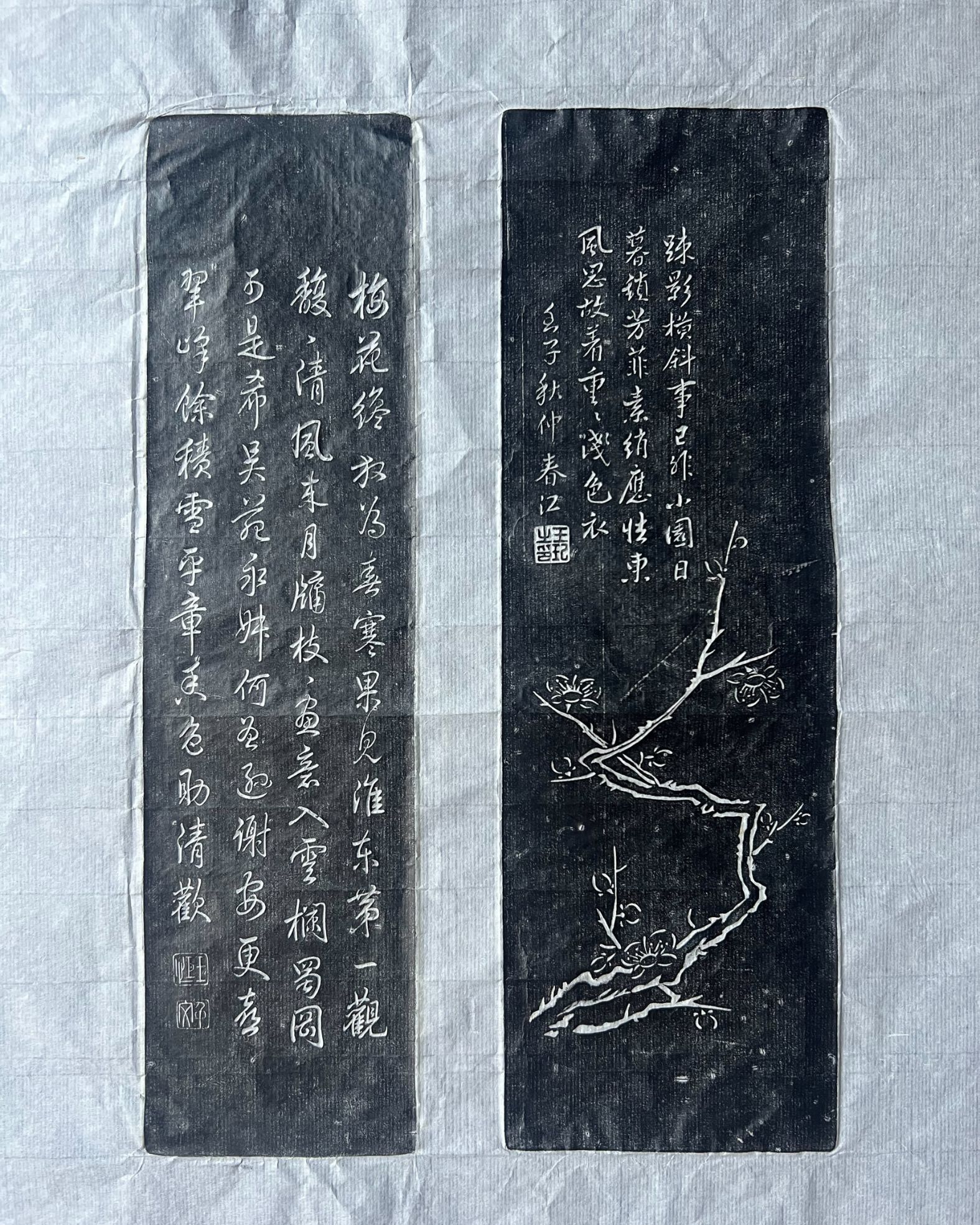
Ink rubbings of front and back of wrist rest engraved respectively by Wang I and Wang Heng
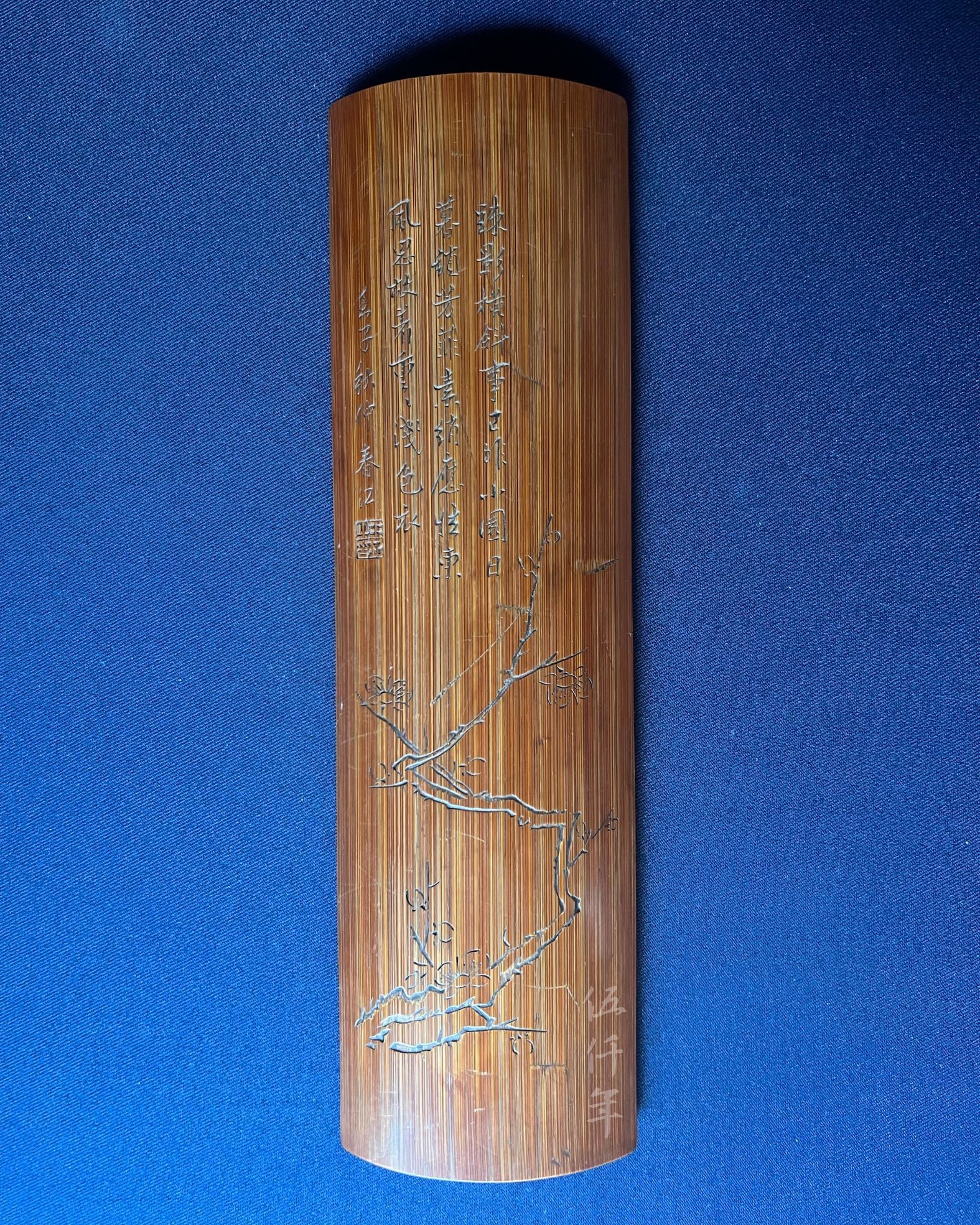
Front of bamboo wrist rest with prunus drawn and engraved by Wang I
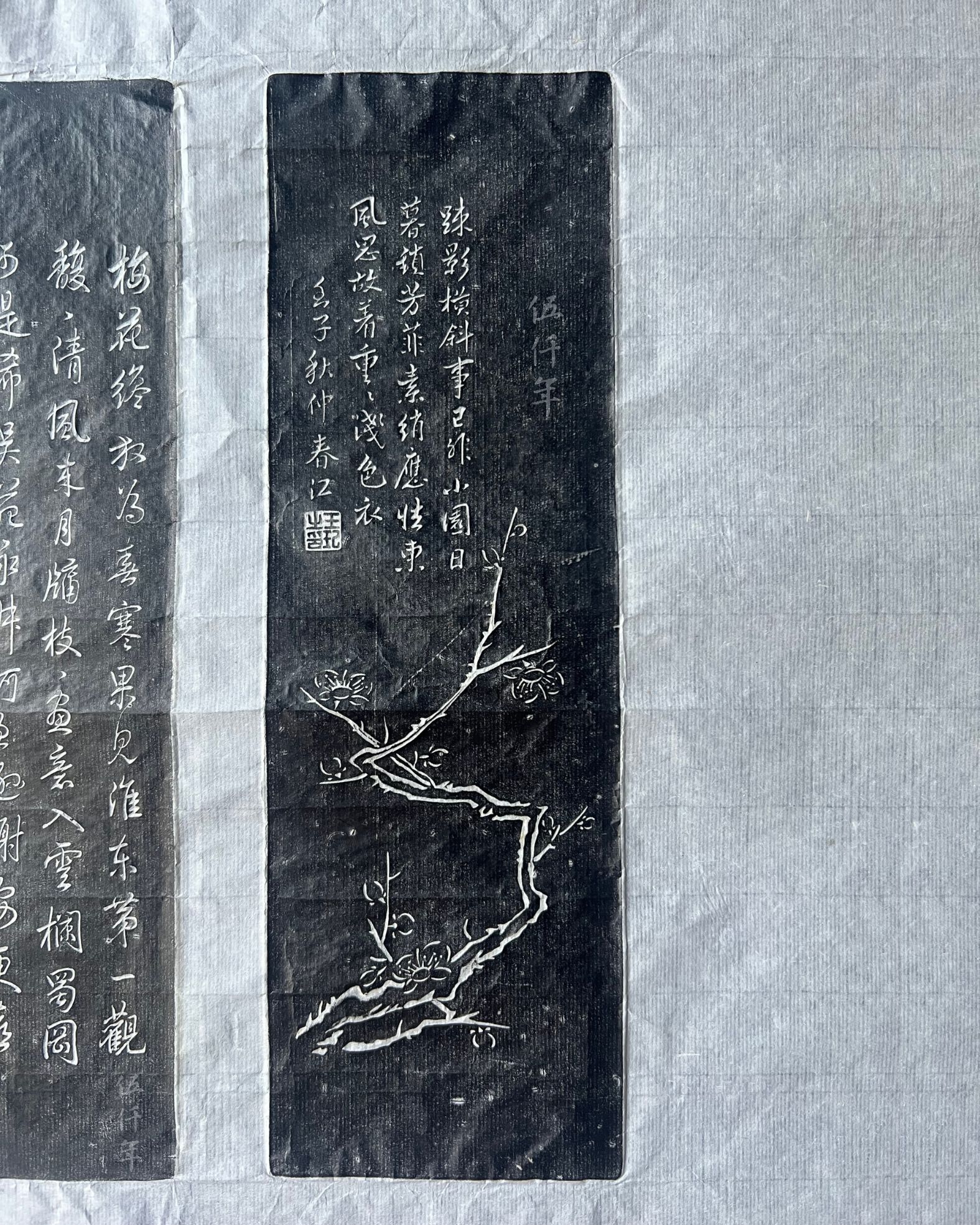
Ink rubbing of front of bamboo wrist rest with prunus drawn and engraved by Wang I
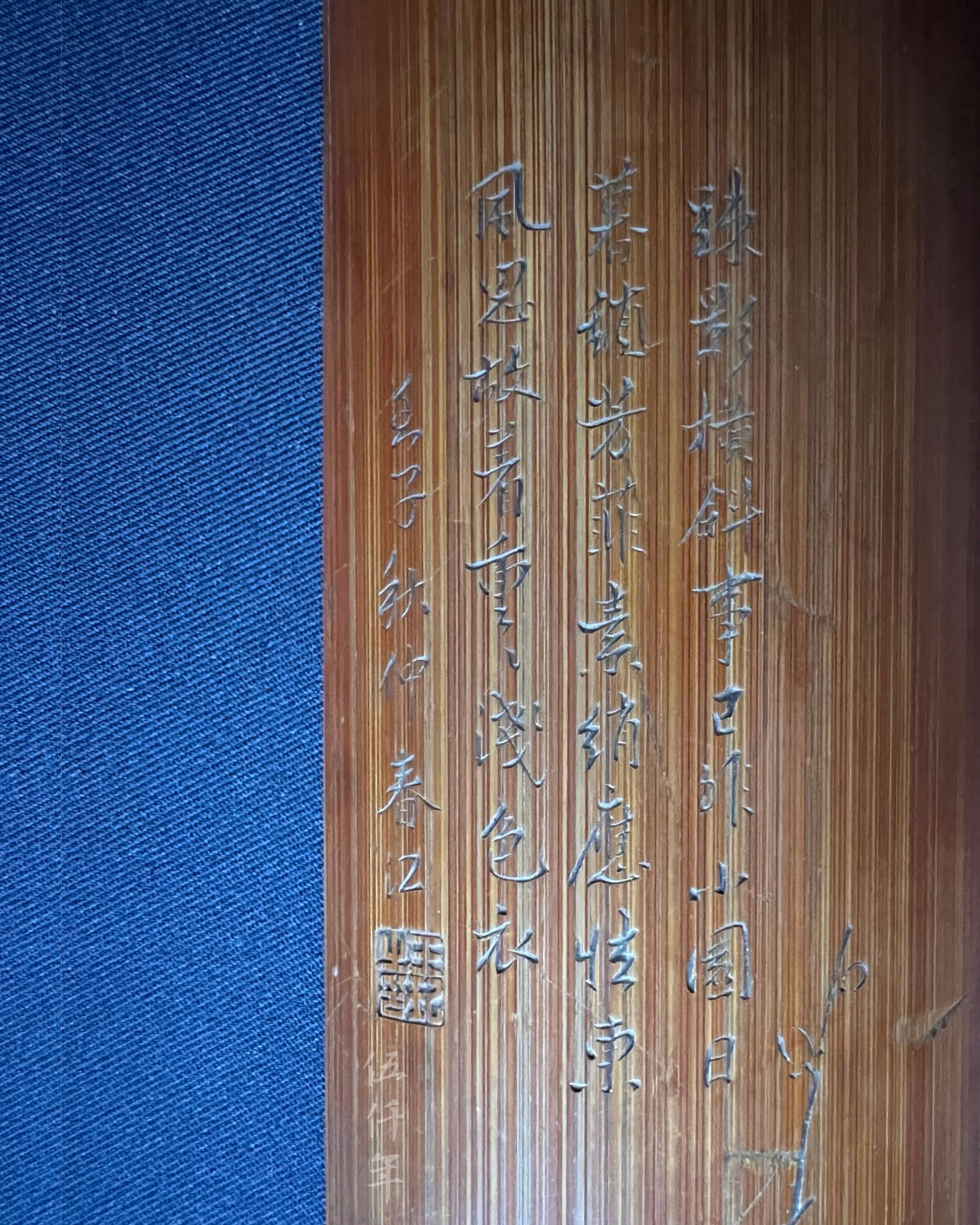
Detail of inscription written and engraved by Wang I
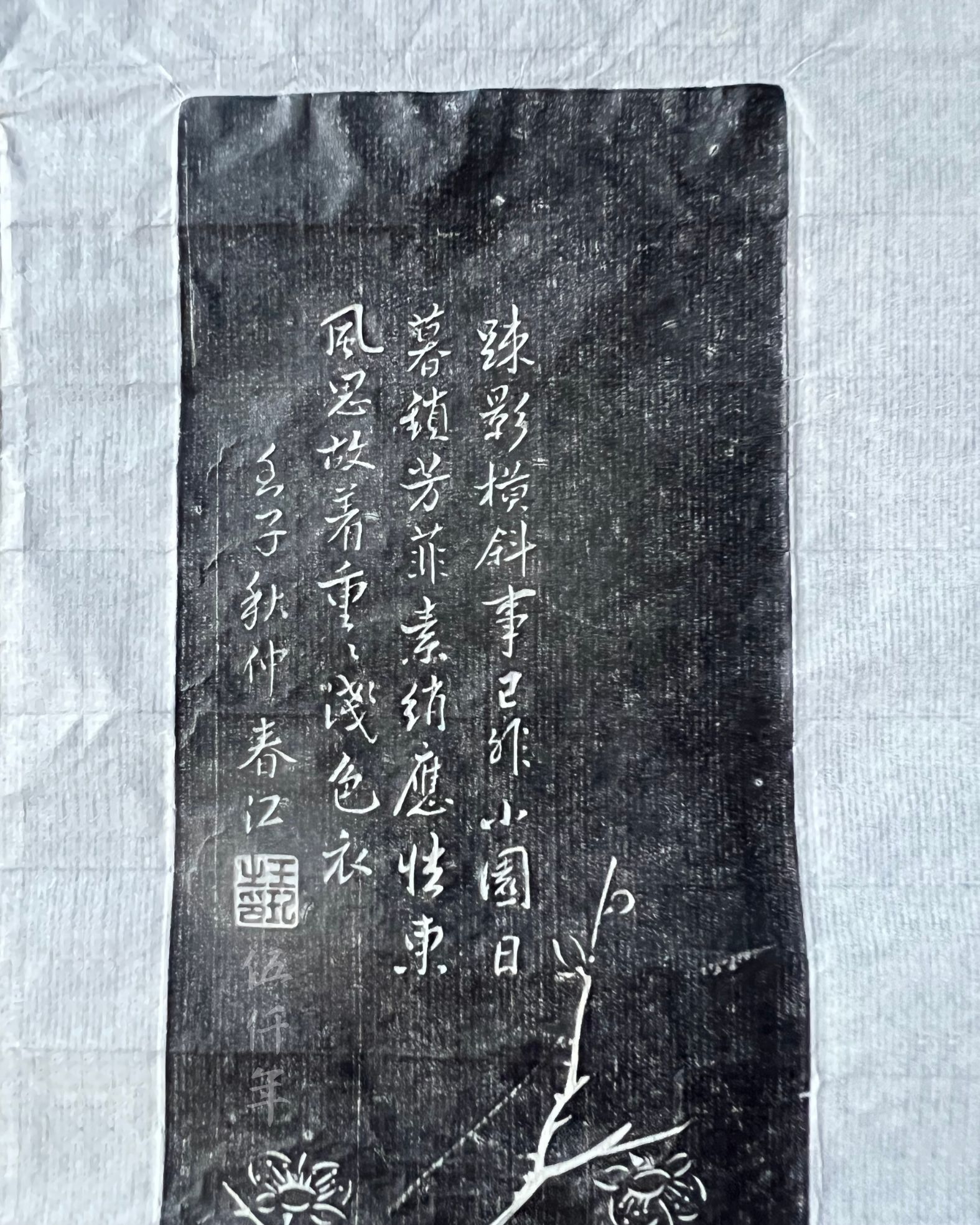
Ink rubbing of inscription written and engraved by Wang I
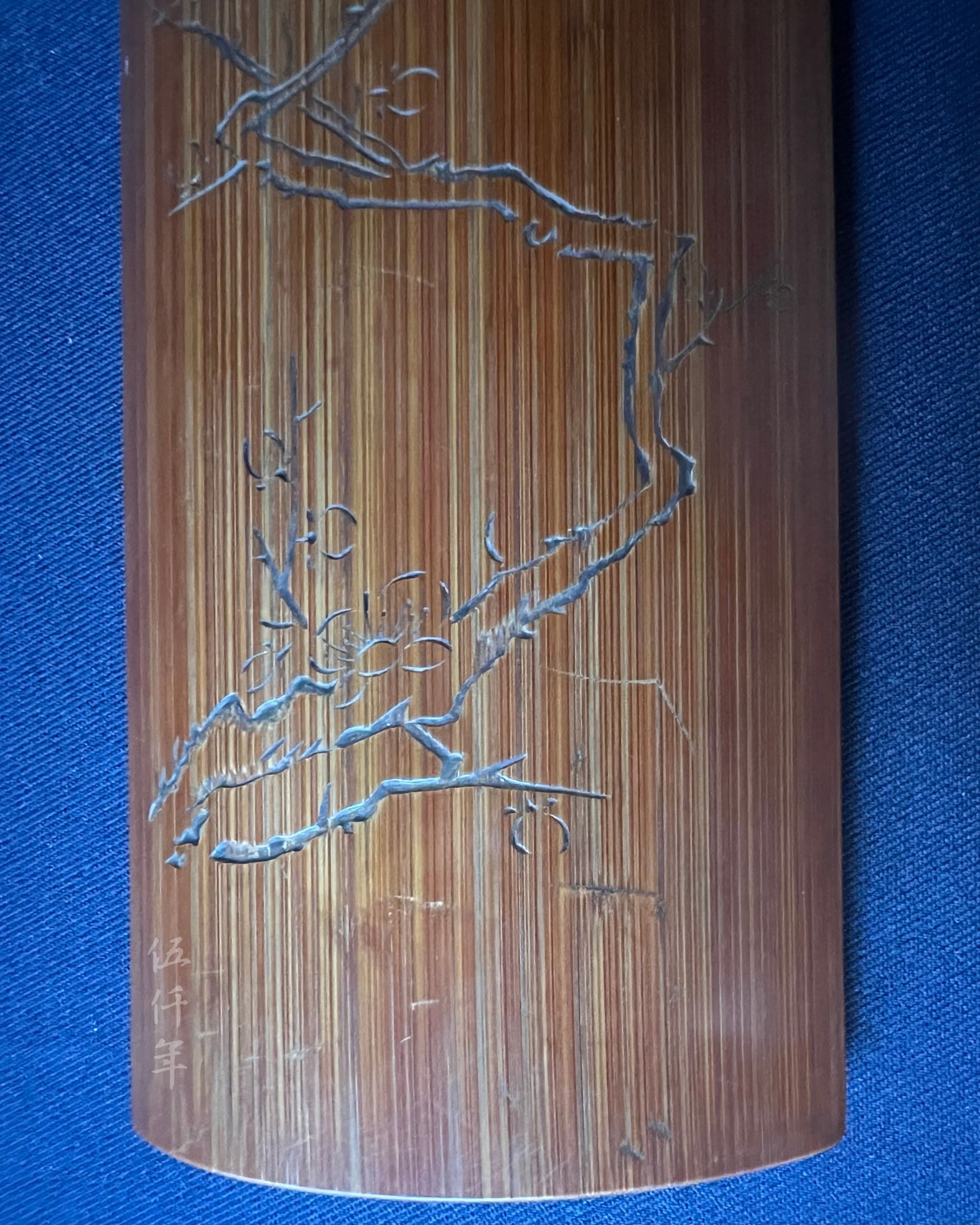
Detail of prunus drawn and engraved by Wang I
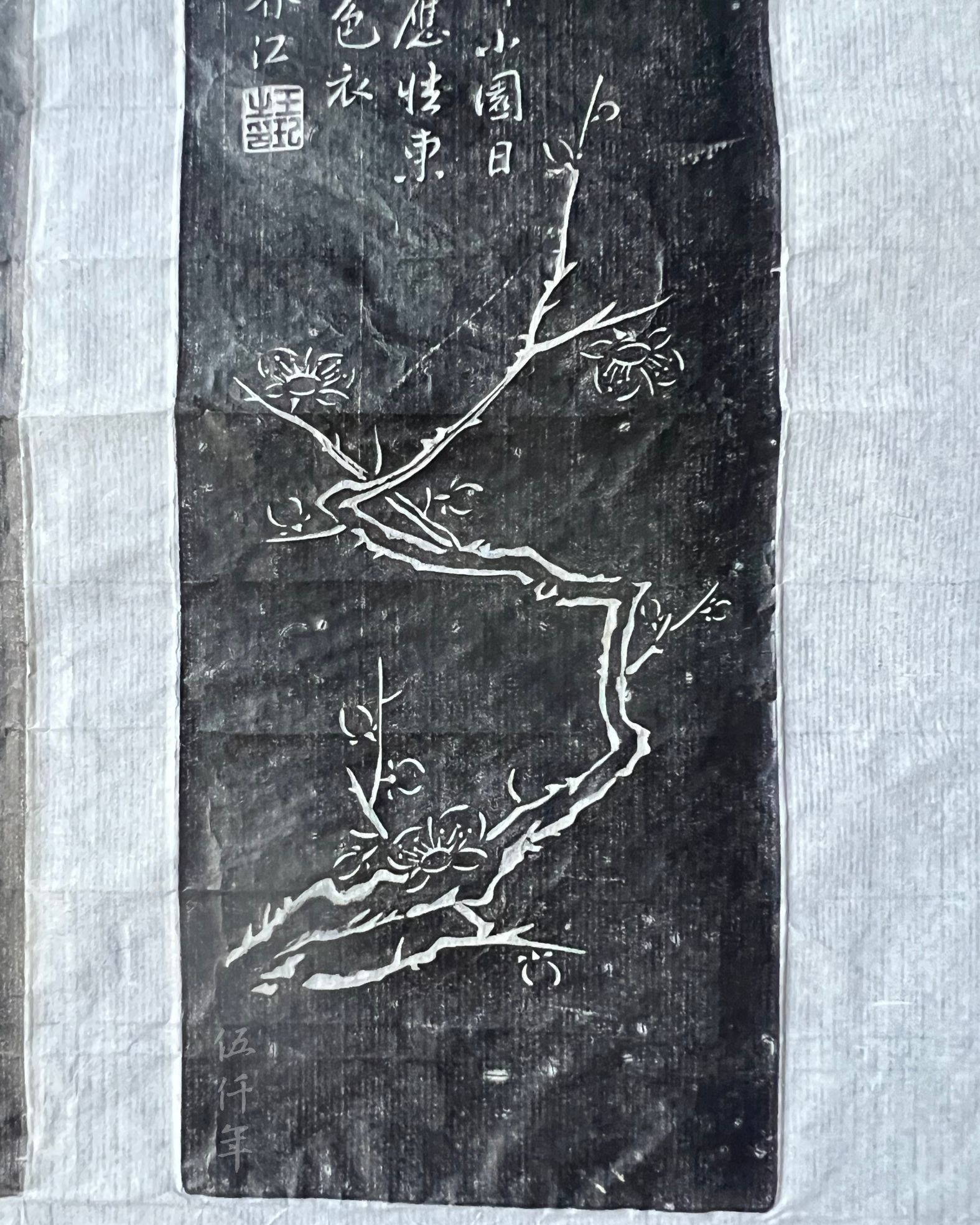
Ink rubbing of prunus drawn and engraved by Wang I
The front of the bamboo wrist rest was decorated with slanted branches of prunus, drawn and carved by Wang I. A poem was engraved on the upper left side:
“Sparse shadows of slanted branches,
All things shift and change.
A small garden basks in sunset,
Floral fragrance dwells within.
Plain petals of plum blossoms,
Anxious of wilful east wind.
So they wear a few more coverings
Of attire stained pretty yellow.
In the eighth month of jen-tzu (壬子) year, Ch’un-chiang (春江).”
Carved relief seal: “Seal of Wang I (王玘之印)”.
The wrist rest was carved in jen-tzu year, corresponding to the 57th year of the Ch’ien-lung reign, 1792.
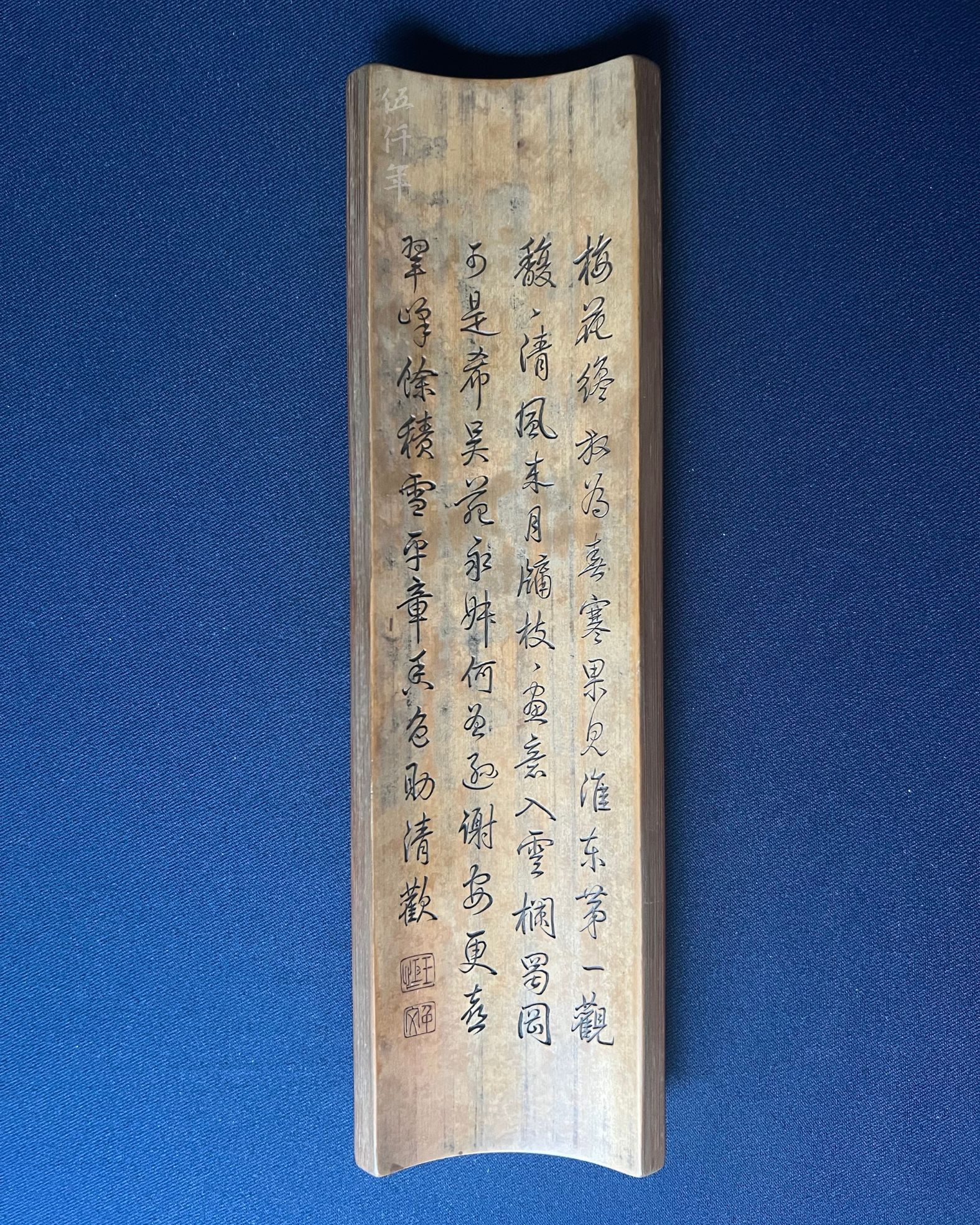
Back of bamboo wrist rest with calligraphy written and engraved by Wang Heng
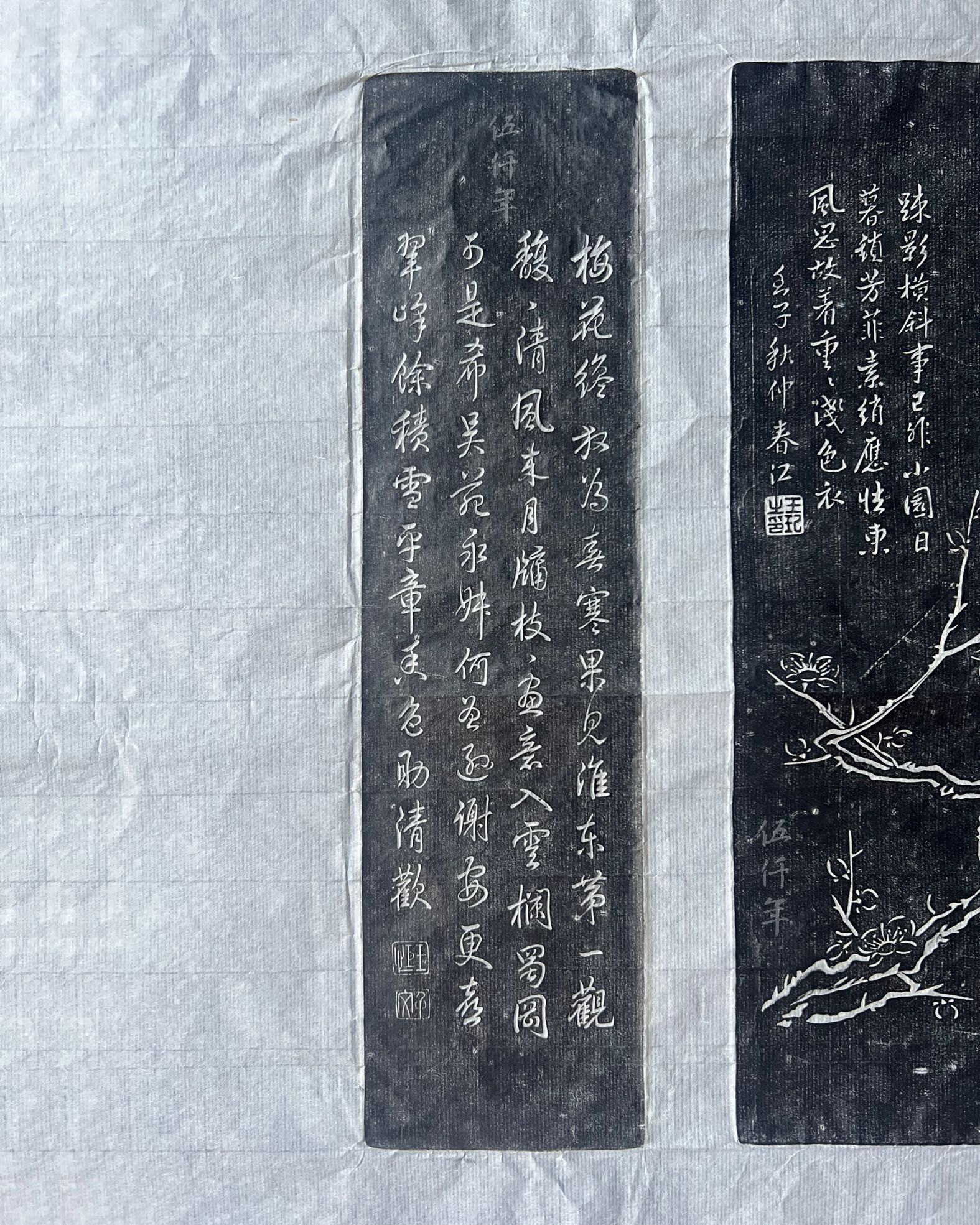
Ink rubbing of back of bamboo wrist rest with calligraphy written and engraved by Wang Heng
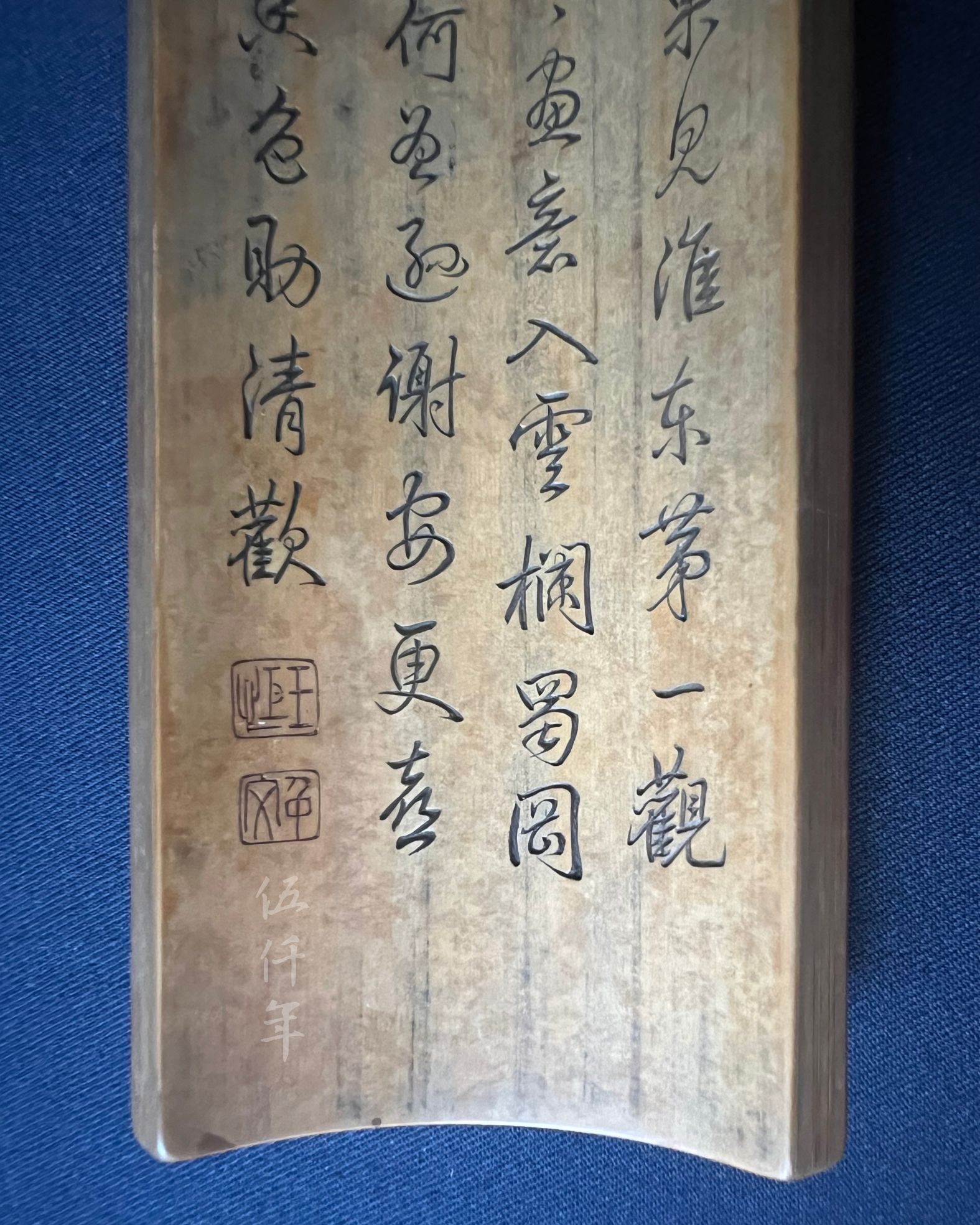
Detail of calligraphy written and engraved by Wang Heng
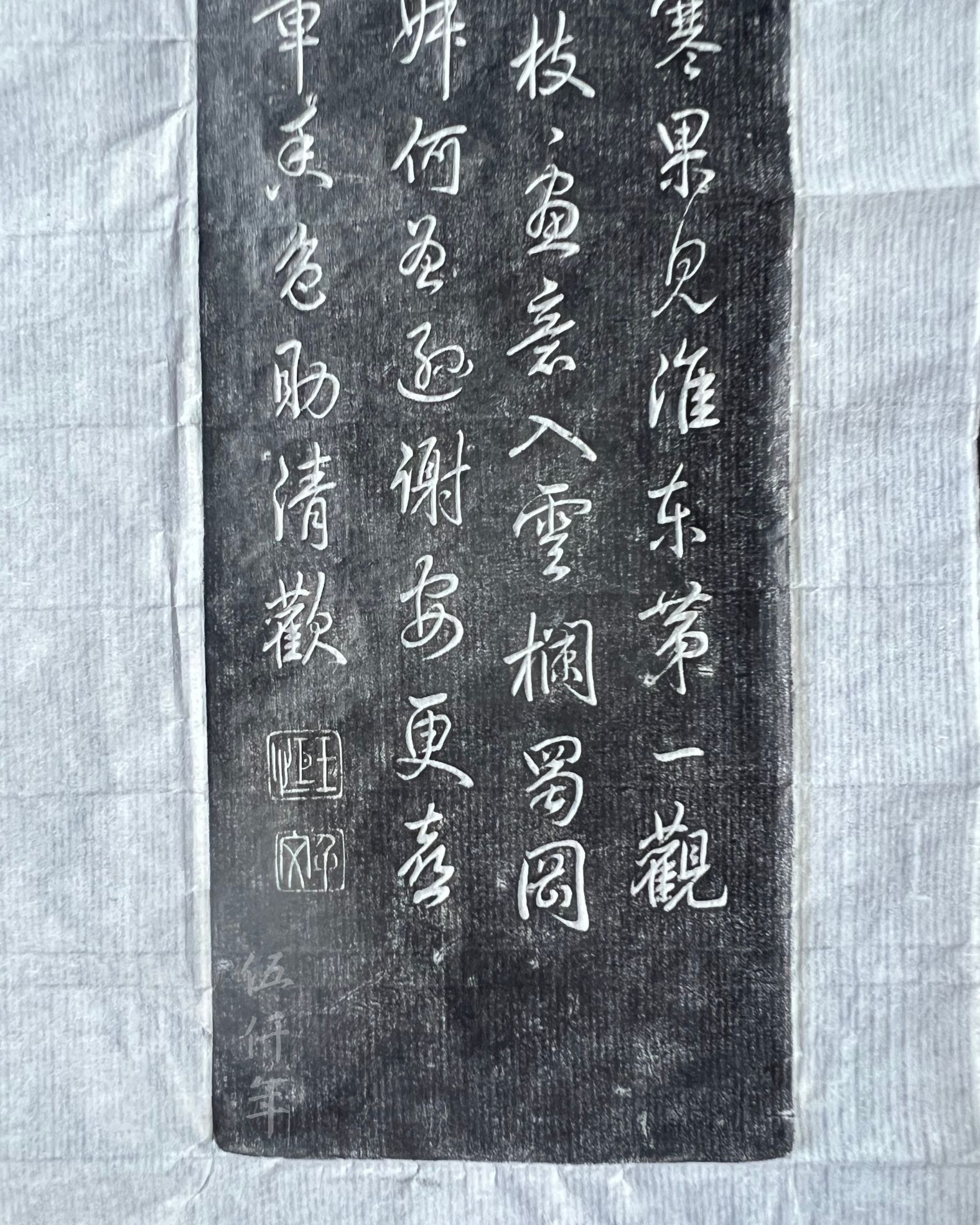
Ink rubbing of calligraphy written and engraved by Wang Heng
The back of the bamboo wrist rest was decorated with a poem in regular script calligraphy, carved by nephew Wang Heng (王恆). The text reads:
Prunus blossoms for cold spring alone,
Clear in a distance is Ta-ming Temple.
Scented breeze through moon shape window,
Each branch a painting framed by railings.
Compare this town to Royal Park of old,
As Ou-yang Hsiu no less than Hsieh An.
I adore snow residue on green mountain peak,
Critical essays and springtime offer simple joy.
Carved intaglio seals : “Wang Heng (王恆)”, “Chung-wen (仲文).”
Ou-yang Hsiu (歐陽修 1007-1072) was a statesman and essayist of Northern Sung dynasty. Hsieh An (謝安 320-385) was statesman and military strategist of Eastern Chin dynasty.
Wang Mei-lin (王梅鄰), original name Heng (恆), tzu Mao-lin (茂林), Chung-wen (仲文), hao Mei-lin (梅鄰), Yün-ku (筠谷). He was active in bamboo engraving during the Chia-ch’ing and Tao-kuang reigns.
b) Cousins
1.Seal carved by Ch’en Ts’u-wang (陳祖望), dedicated to his cousin Yüeh-ch’ing (月卿), Ch’ing dynasty.
Ch’en Ts’u-wang (陳祖望), tzu Tsuang-ssu (纘思), native of Ch’ien-t’ang in Chekiang province. He excelled in seal engraving and inherited the artistic lineage of the Chekiang School. He was proficient in carving stone stelae, his works can often be found in Taoist and Buddhist temples.
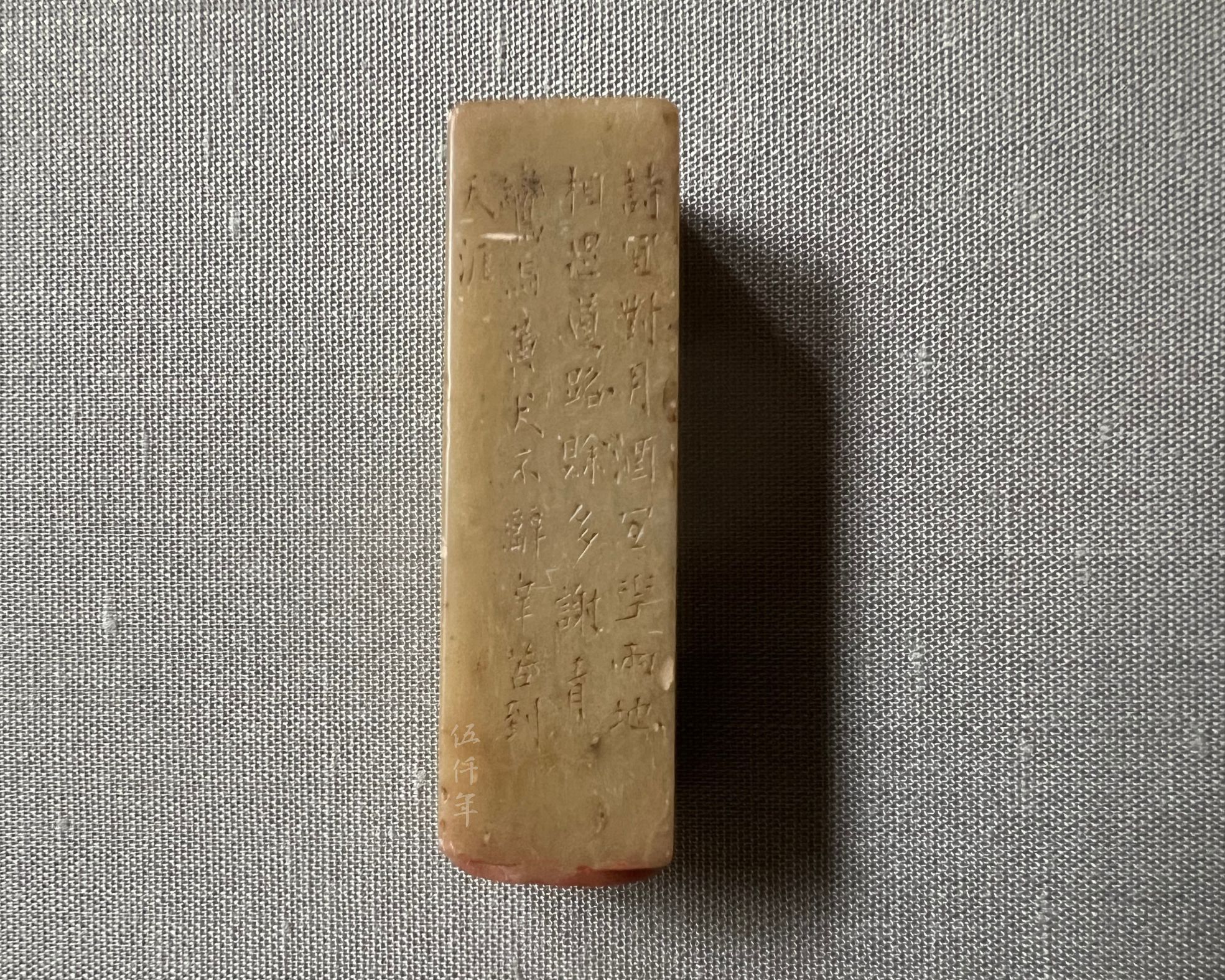
Inscription engraved on first side of seal by Ch’en Ts’u-wang
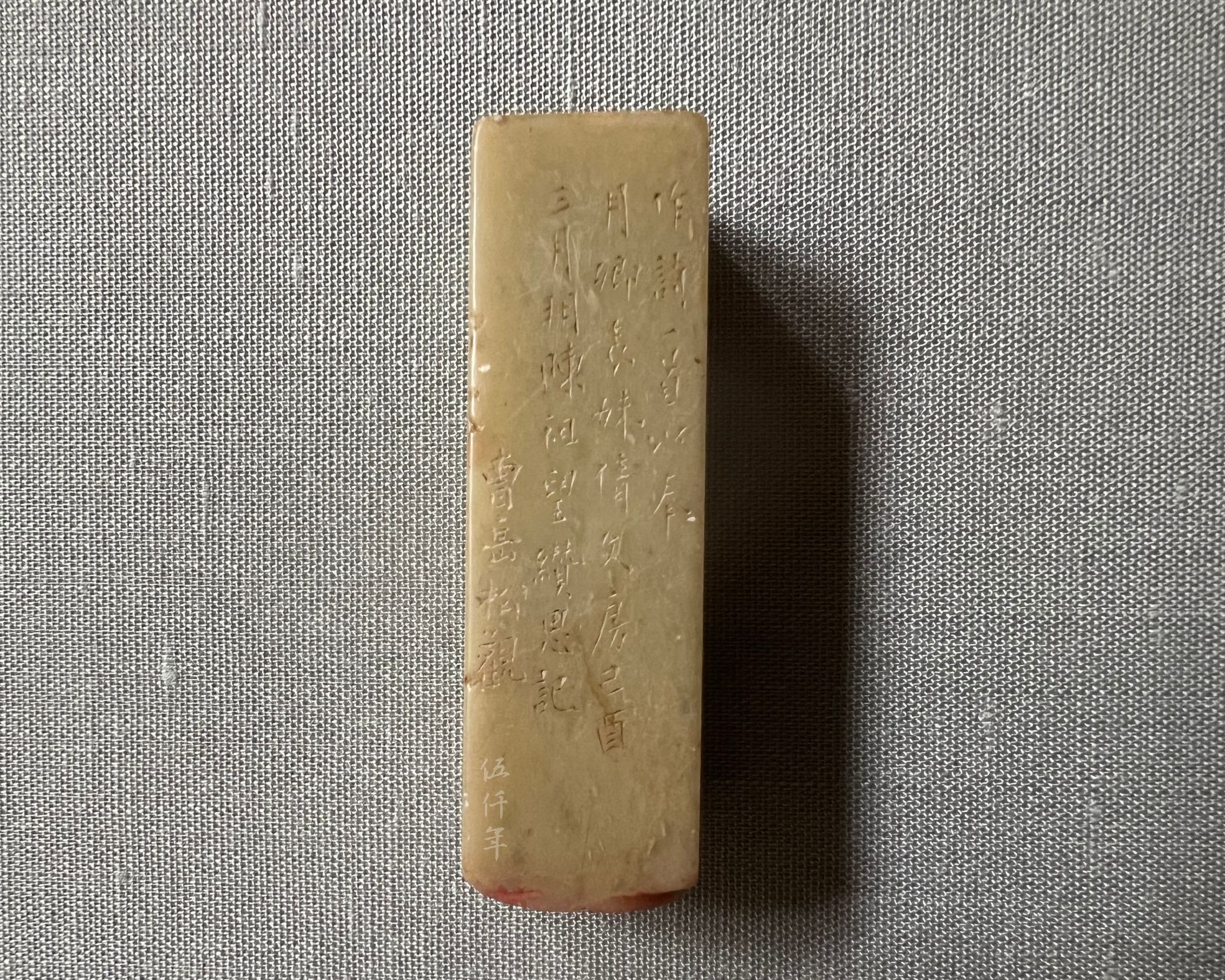
Inscription engraved on second side of seal by Ch’en Ts’u-wang
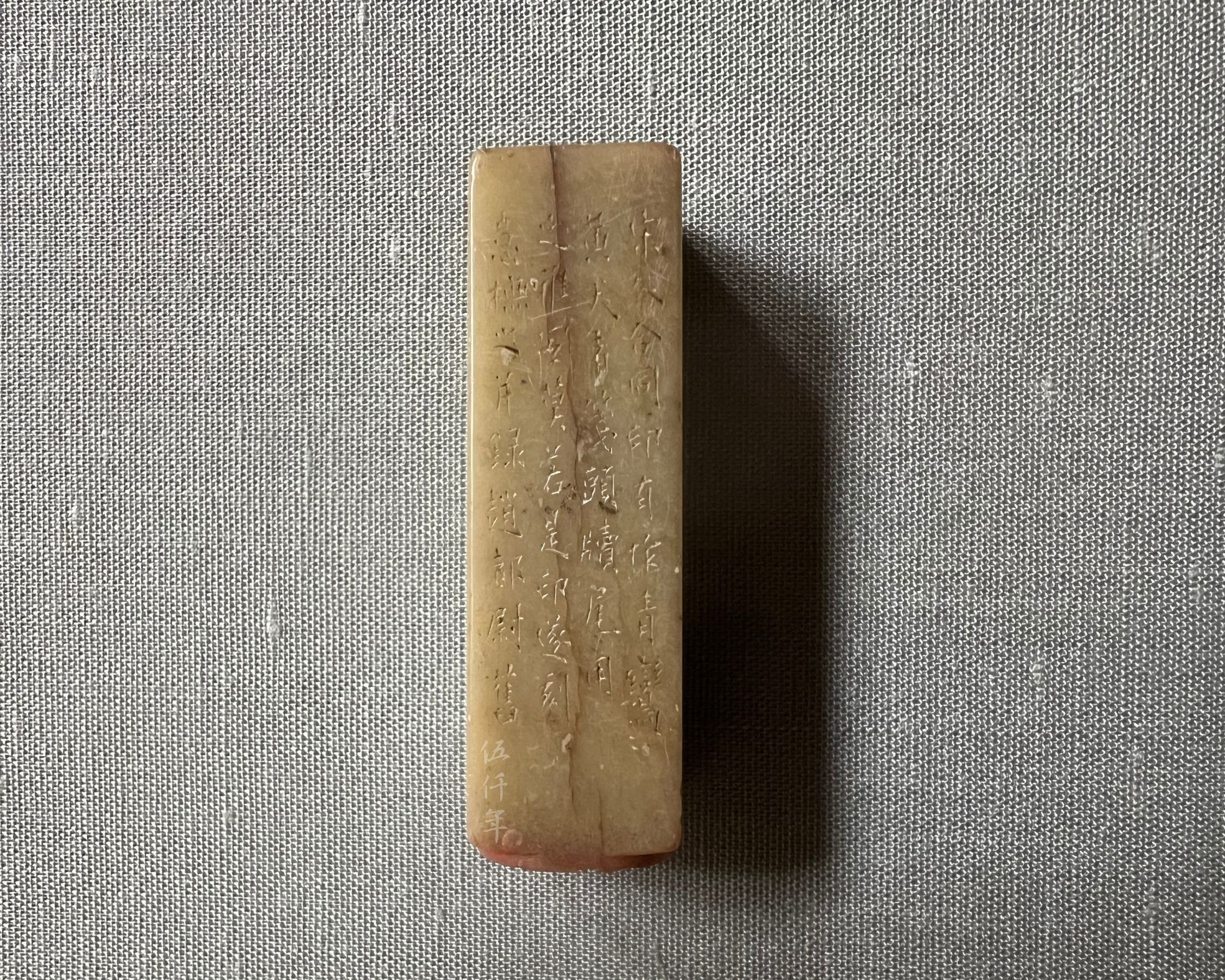
Inscription engraved on third side of seal by Ch’en Ts’u-wang
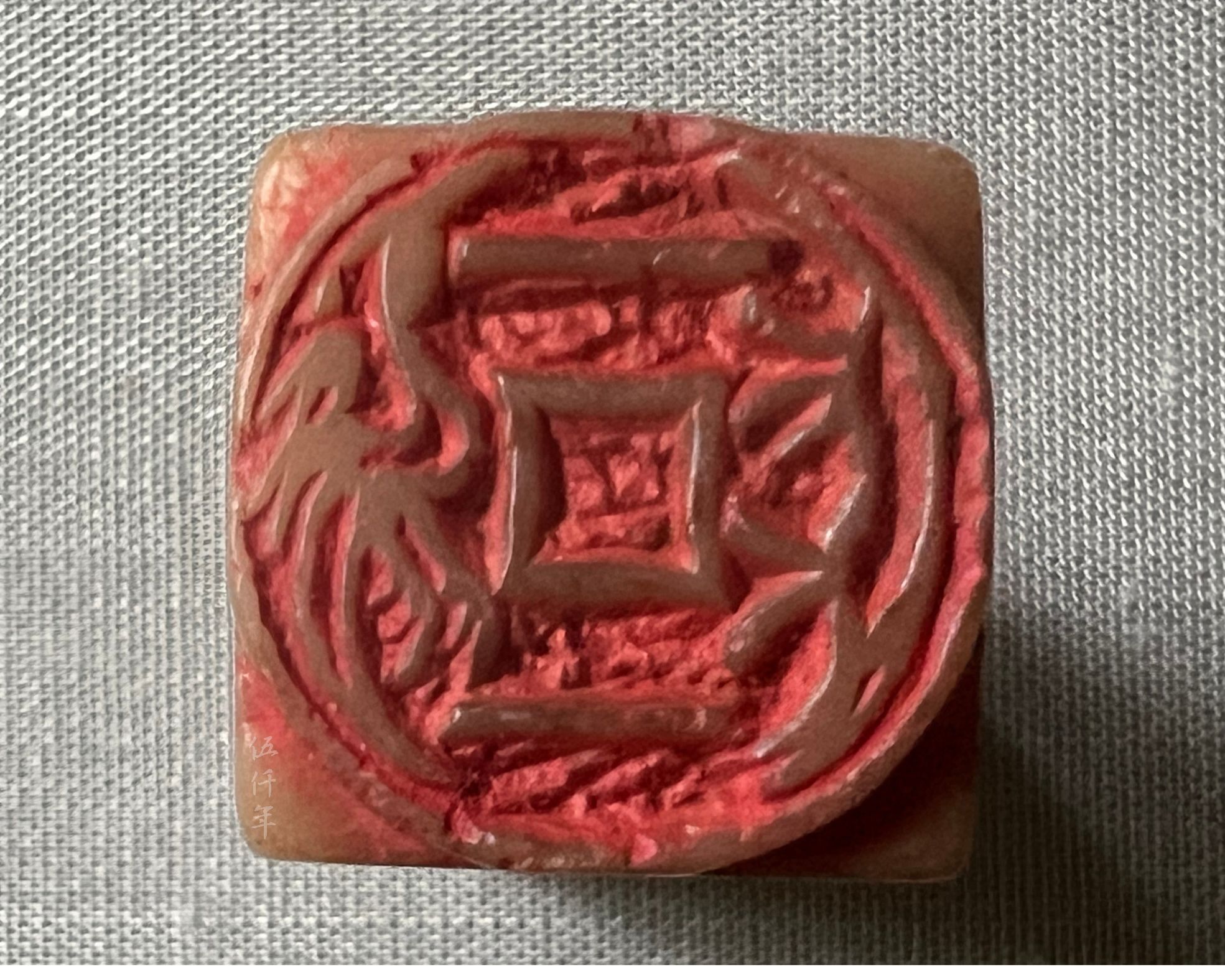
Engraved image on surface of seal: Blue Argus and Yellow Dog, carved by Ch’en Ts’u-wang
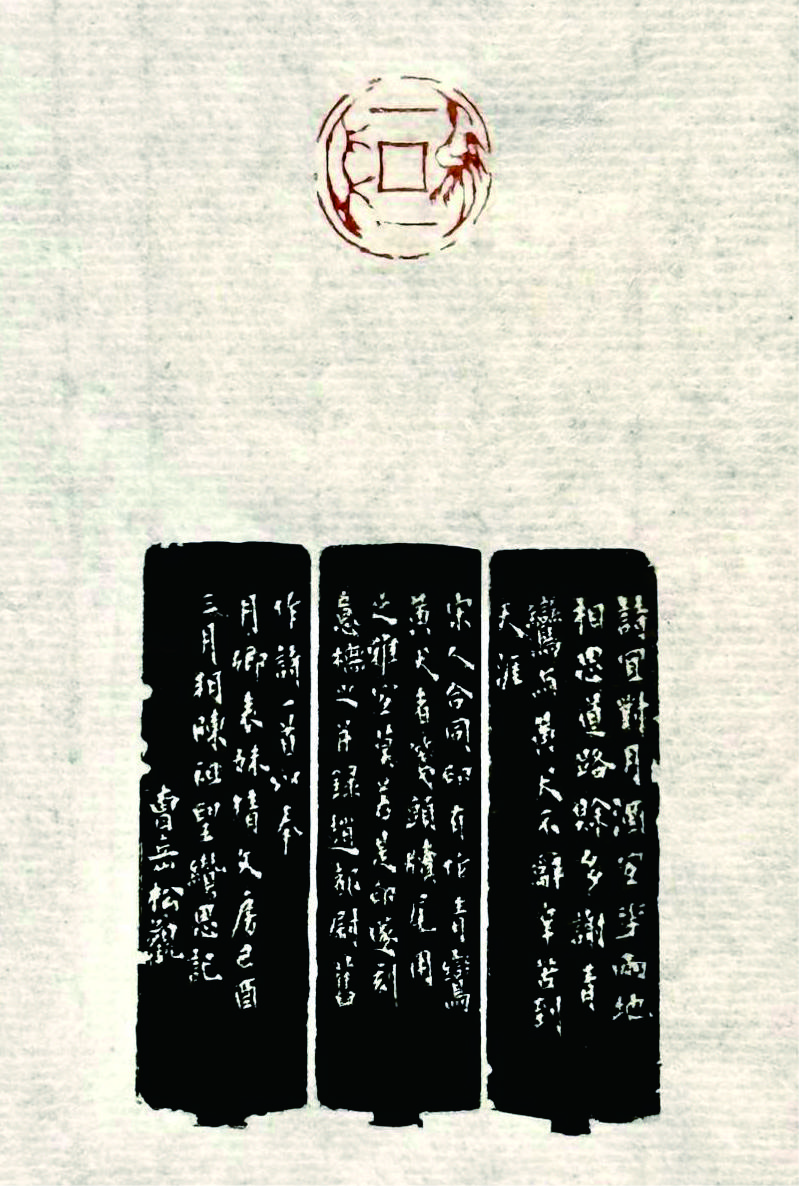
Impression of seal and ink rubbings of inscription engraved on three sides of seal by Ch’en Ts’u-wang
Relief seal impression: Pictogram of blue argus and yellow dog (both ancient symbols of messenger).
Calligraphy inscription engraved on three sides of the seal:
“Poetry is for the moon,
Wine is apt for flowers.
Thinking of each other,
Though so far apart.
Thank you blue agar,
My yellow dog too.
You shun not hard labour
Travel to world’s end.
Seals for legal contracts in the Sung dynasty employed pictograms of blue agar and yellow dog. They were used to stamp the top or bottom of a sheet of paper. The refinement and appropriateness of these seals are unrivaled. So I deliberately emulate them, and reproduce an old poem by Commandant Chao (Chao Chih-ch’en 趙之琛), to be presented to my younger cousin Yüeh-ch’ing as a fitting accoutrement on her writing table. In the morning of the third month of chi-yu (己酉) year, Ch’en Ts’u-wang (陳祖望) Tsuang-ssu (纘思).”
This seal was carved in chi-yu (己酉) year, corresponding to the 29th year of the Tao-kuang reign, 1849.
Ch’en Tz’u-wang studied under Chao Chih-ch’en (趙之琛1781-1852), tzu Tz’u-hsien (次閑), one of the eight masters of the Chekiang School of Seal Engraving. In ping-tzu (丙子) year, the 21st year of the Chia-ch’ing reign, 1816, Chao Chih-ch’en also carved a blue angus and yellow dog pictogram seal. The engraved inscription reads:
“Contract envelope to be sealed,
Auspicious words for solace.
Trust blue angus and yellow dog,
To world’s end with no grouse.
I carved this contract seal using the pictorial images from Han dynasty and casually composed twenty eight words, Tz’u-hsien (次閑).
In the ninth month of ping-tzu year, I present this as a parting gift for my elder brother P’an Hsiao-k’un (潘小崑). Wishing no ill befalls the blue angus and the yellow dog remains steadfastly sentimental, correspondences will be regular and postings frequent. Tz’u-hsien posted this from the Studio of Pu-lo-chia.”
Chao Chih-ch’en and Chen Tz’u-wang, the teacher and student duo, each carved a blue angus and yellow dog seal thirty three years apart.
Publications:
The Extant Seals from Ting-ch’ou Year Calamity (丁丑劫餘印存), Volume 13 page 35. Produced in 1939.
The Cultural World of a Ci Poet, page 112, edited by Soong Dennie and Soong Shu Kong. University Museum and Art Gallery, The University of Hong Kong, 2006.
c) Partners
1. Seal carved by T’an Yüeh-se (談月色).
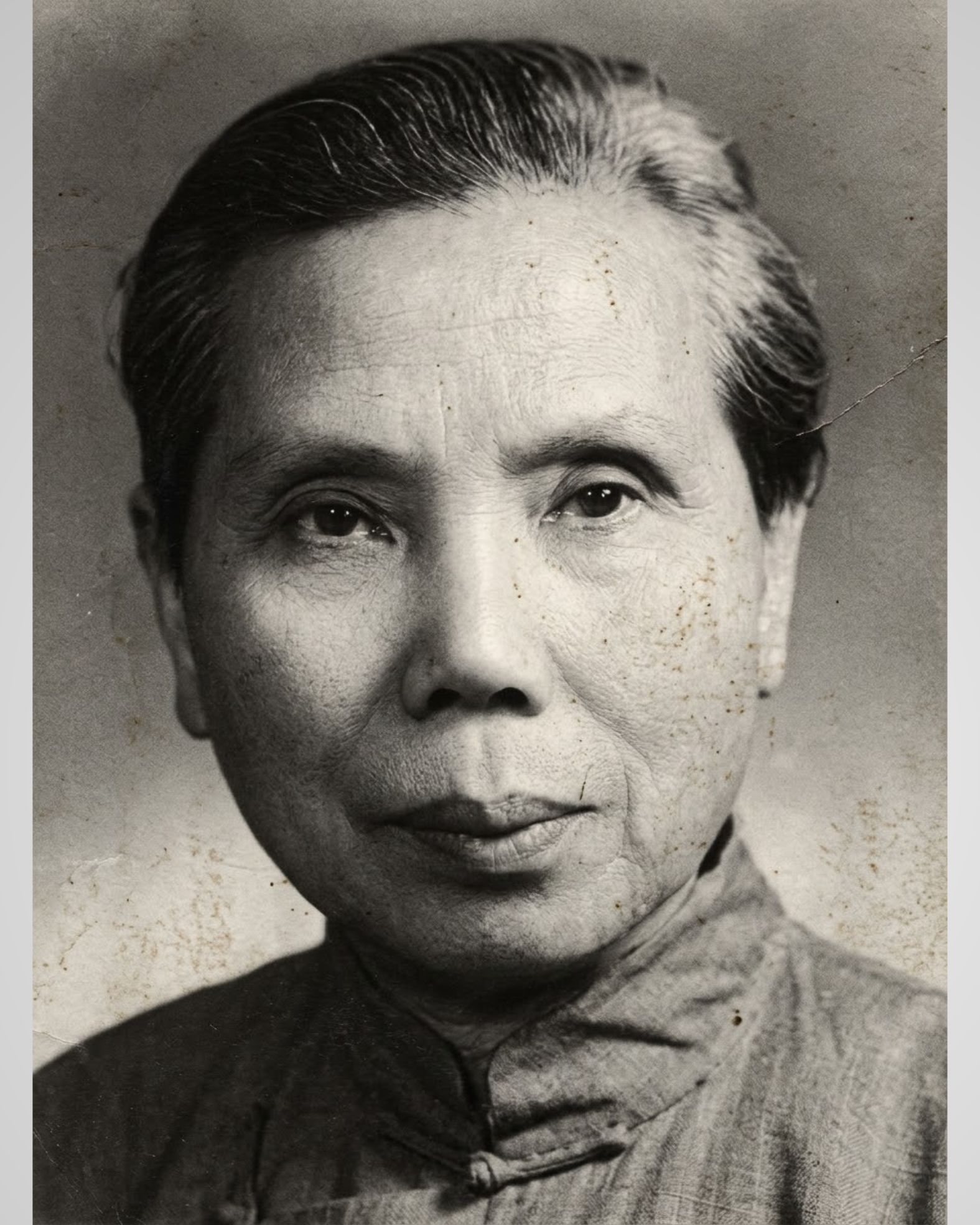
Portrait of T’an Yüeh-se
T’an Yüeh-se (談月色) was born in the 17th year of the Kuang-hsü reign 1891 and died in 1976. Her original name was Ku-jung (古溶), Jung-jung (溶溶), tzu Yüeh-se (月色), the hao she used in her old age was Old Lady of Pearl Harbour (Chu-chiang Lao-jen 珠江老人). Her studio names were Courtyard of Pear Blossom (Li-hua Yüan-lo 梨花院落), Pavilion of Four Subtle Tea (Ch’a-ssu-miao T’ing 茶四妙亭), Tower of Bygone Moon Colour (Chiu-shih Yüeh-se Lou 舊時月色樓), Studio of Han Dynasty Jade Mandarin Duck Pond (Han-yü-yüan-yang Ch’ih-kuan 漢玉鴛鴦池館). She was a native of Shun-te in Kwangtung province. She was ordained a nun at a young age, and her dharma name was Wu-ting (悟定). At thirty-one, she married Ts’ai Che-fu (蔡哲夫), and lived in Nanking in her old age. She was proficient in painting and seal engraving.
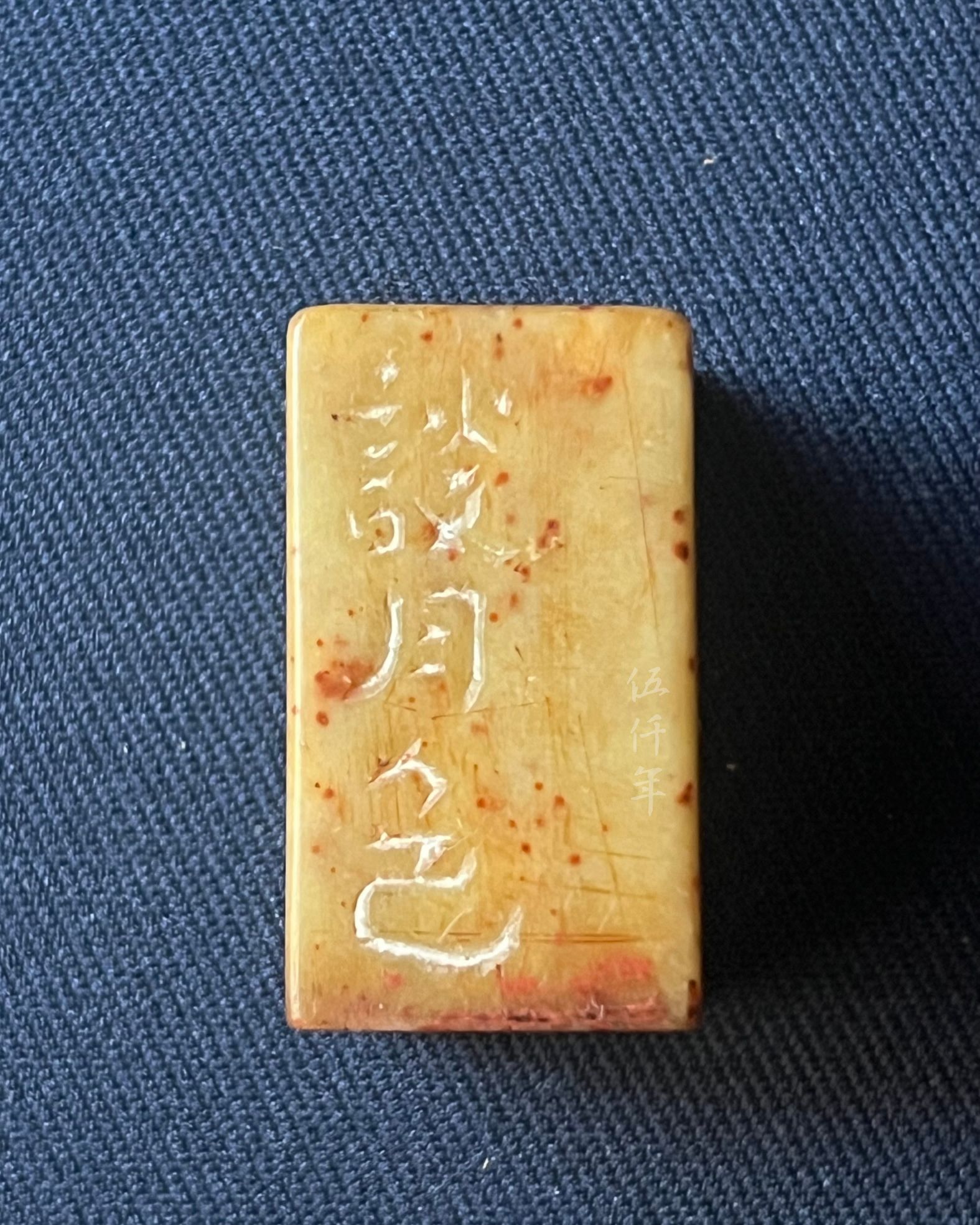
Inscription engraved on first side of seal by T’an Yüeh-se
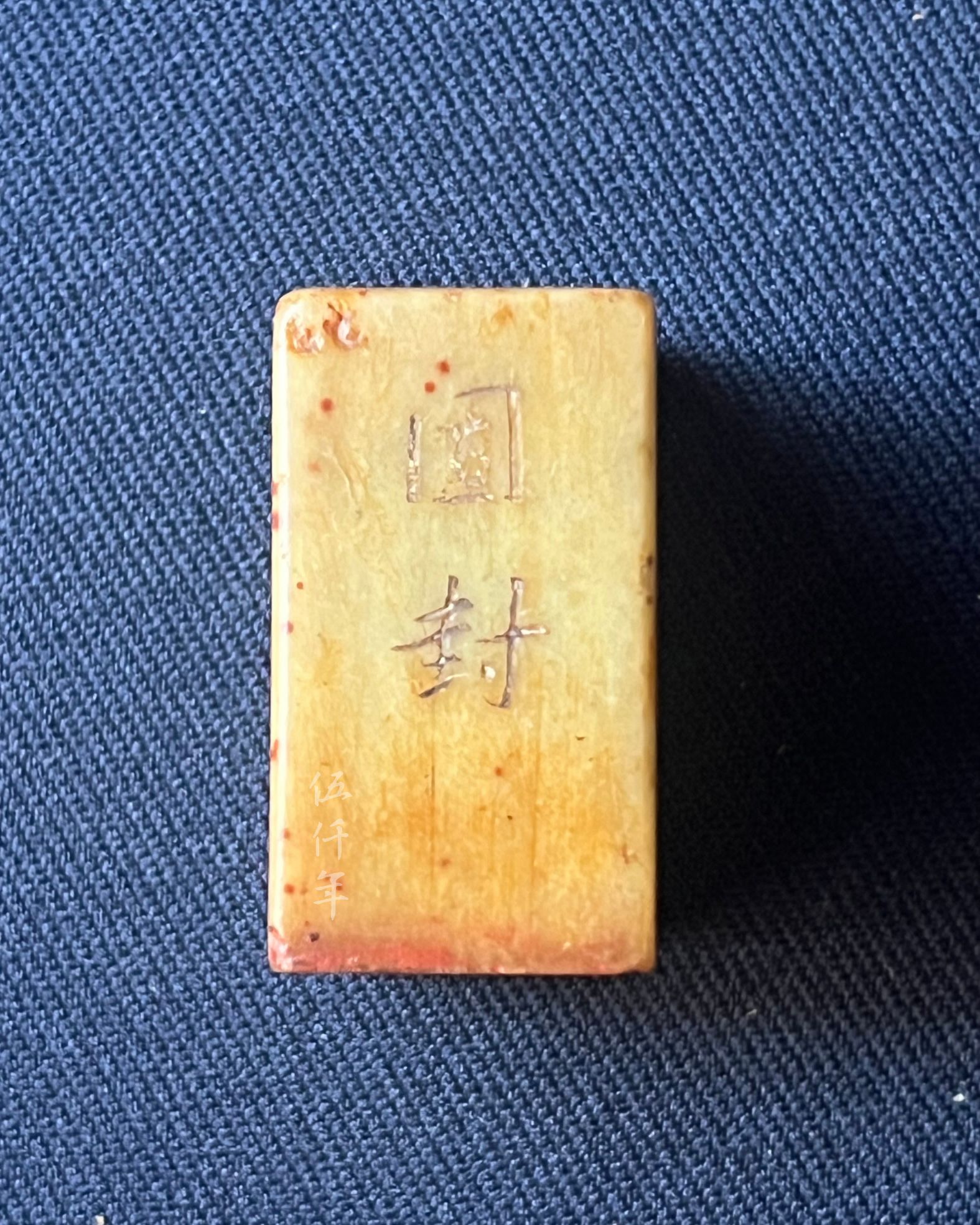
Inscription engraved on second side of seal
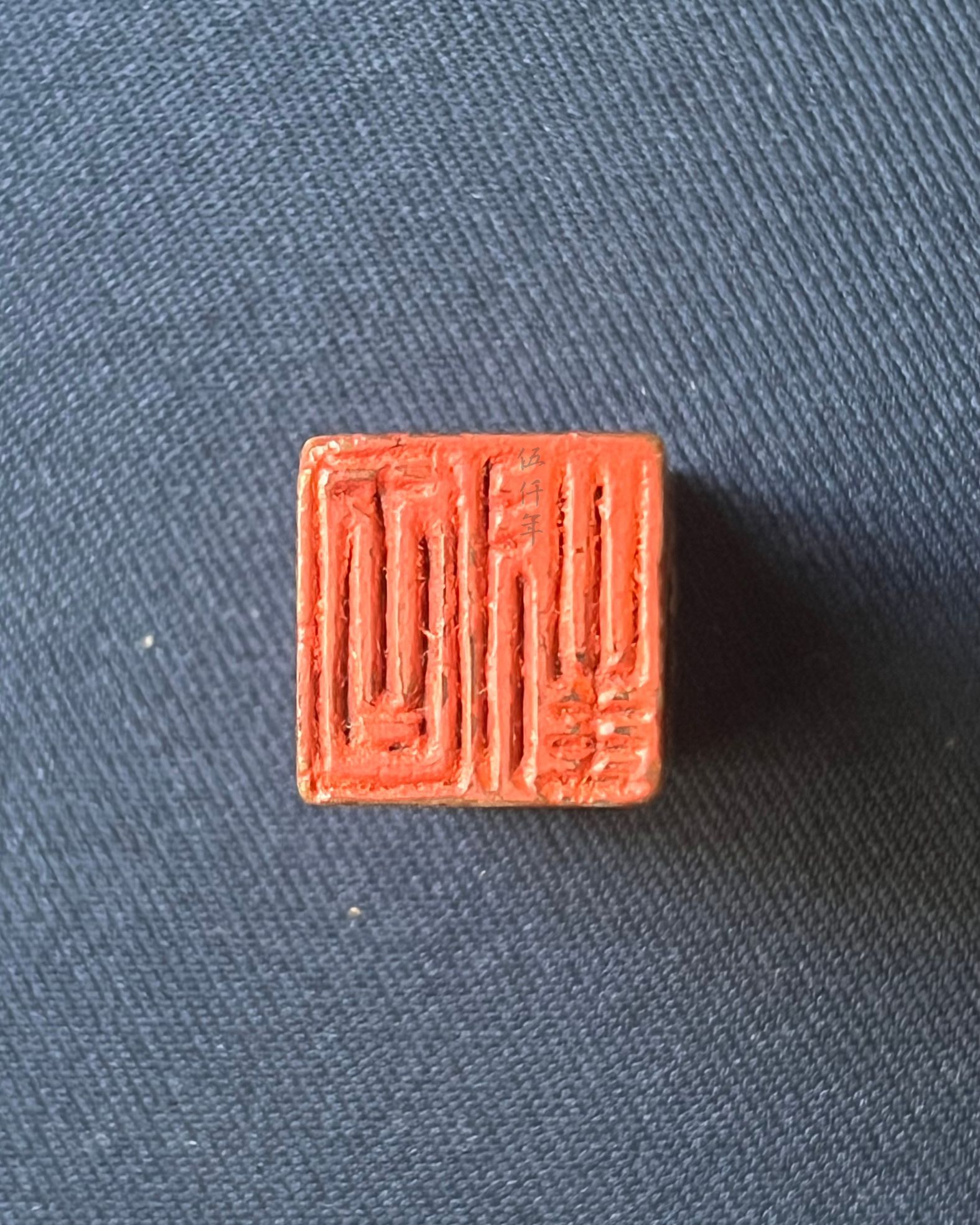
Engraved words on surface of seal:”Ku-feng (To seal firmly)”, carved by T’an Yüeh-se
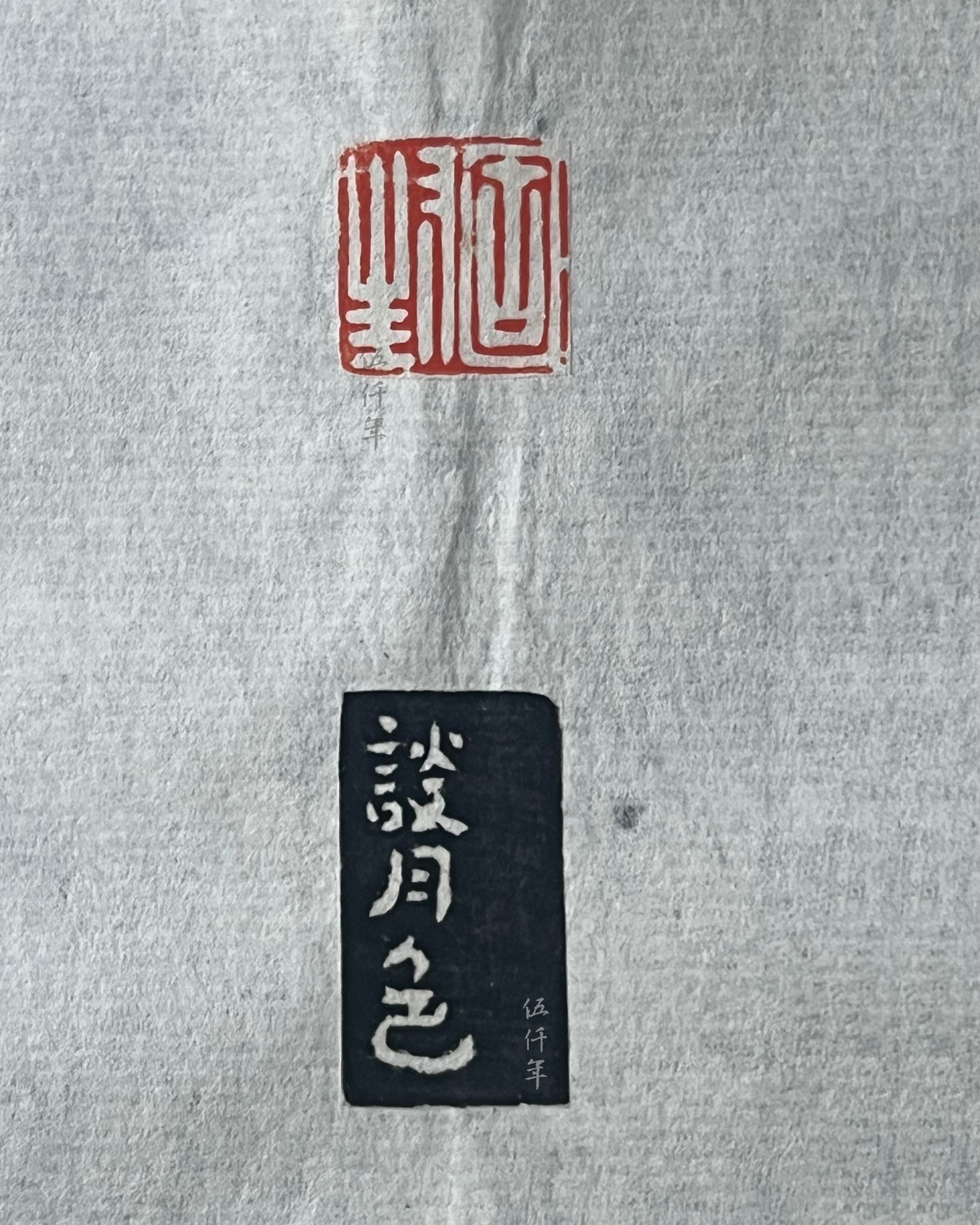
Impression of seal and ink rubbing of inscription engraved on side of seal by T’an Yüeh-se
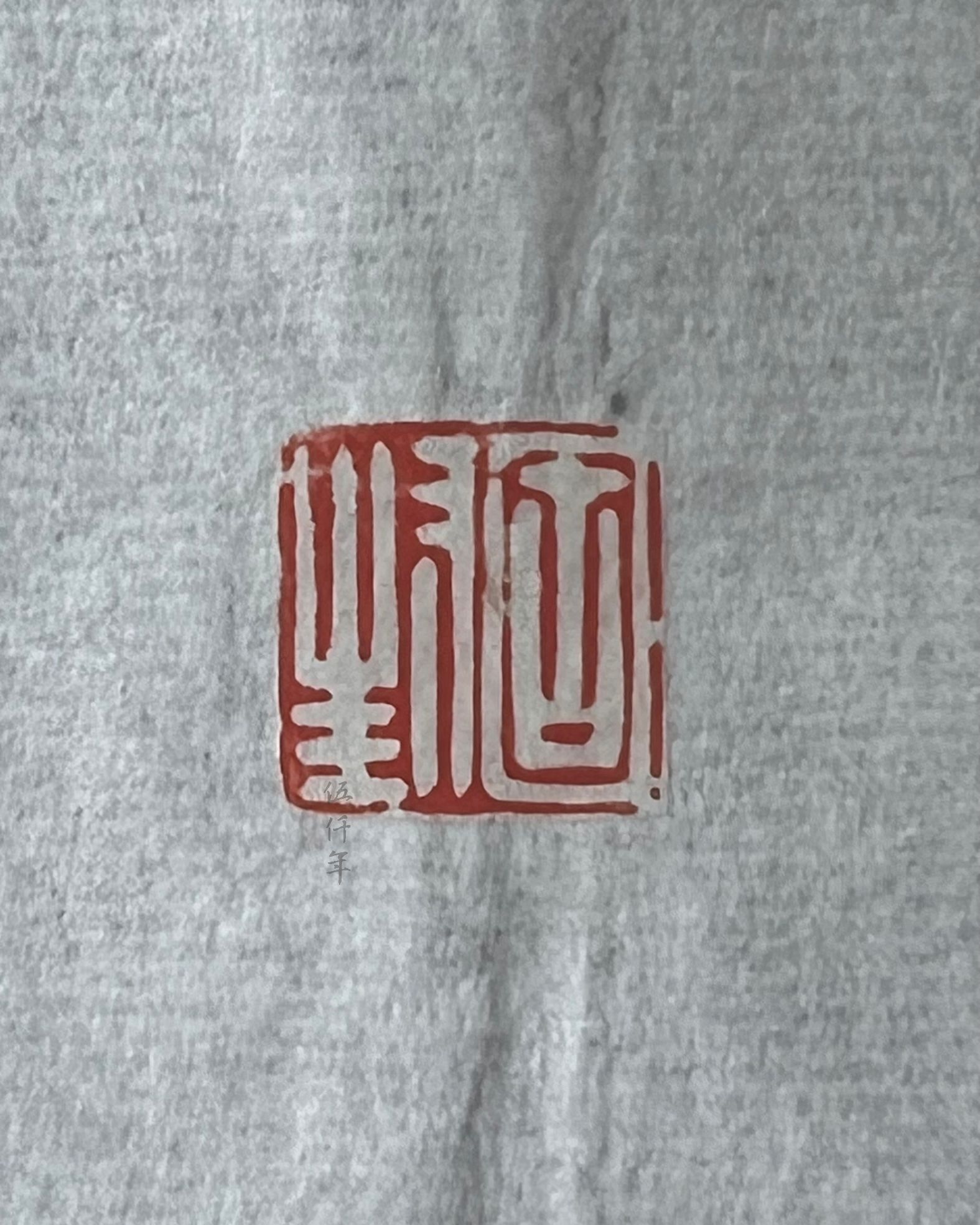
Intaglio seal impression with the words “Ku-feng (To seal firmly)”, carved by T’an Yüeh-se
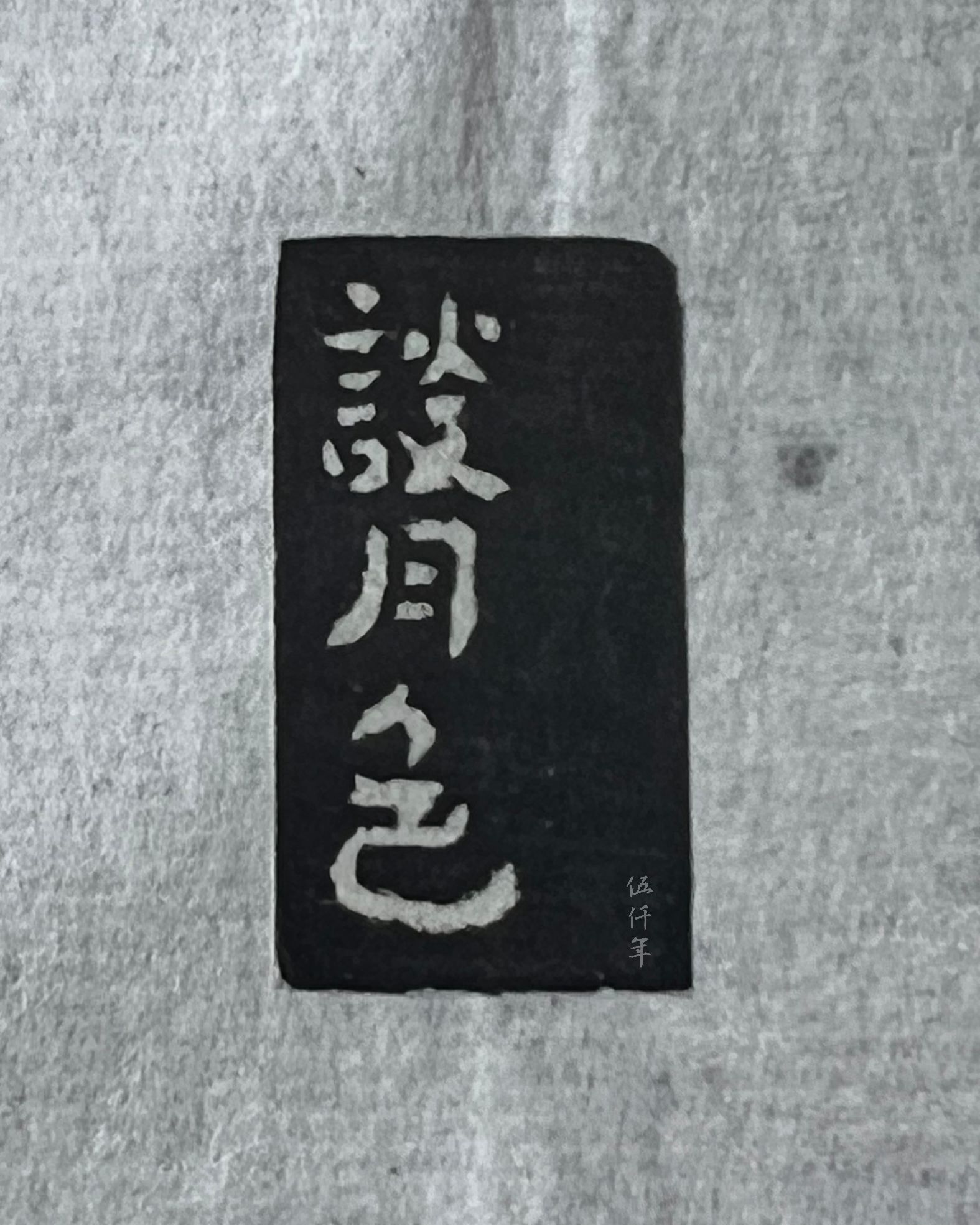
Ink rubbing of inscription engraved on side of seal by T’an Yüeh-se
Intaglio seal impression: “Ku-feng (固封 To seal firmly)”. This seal is used to stamp envelope.
Calligraphy inscription engraved on two sides of the seal:
“Ku-feng (固封).
T’an Yüeh-se.”
2. Painting of Prunus by T’an Yüeh-se.
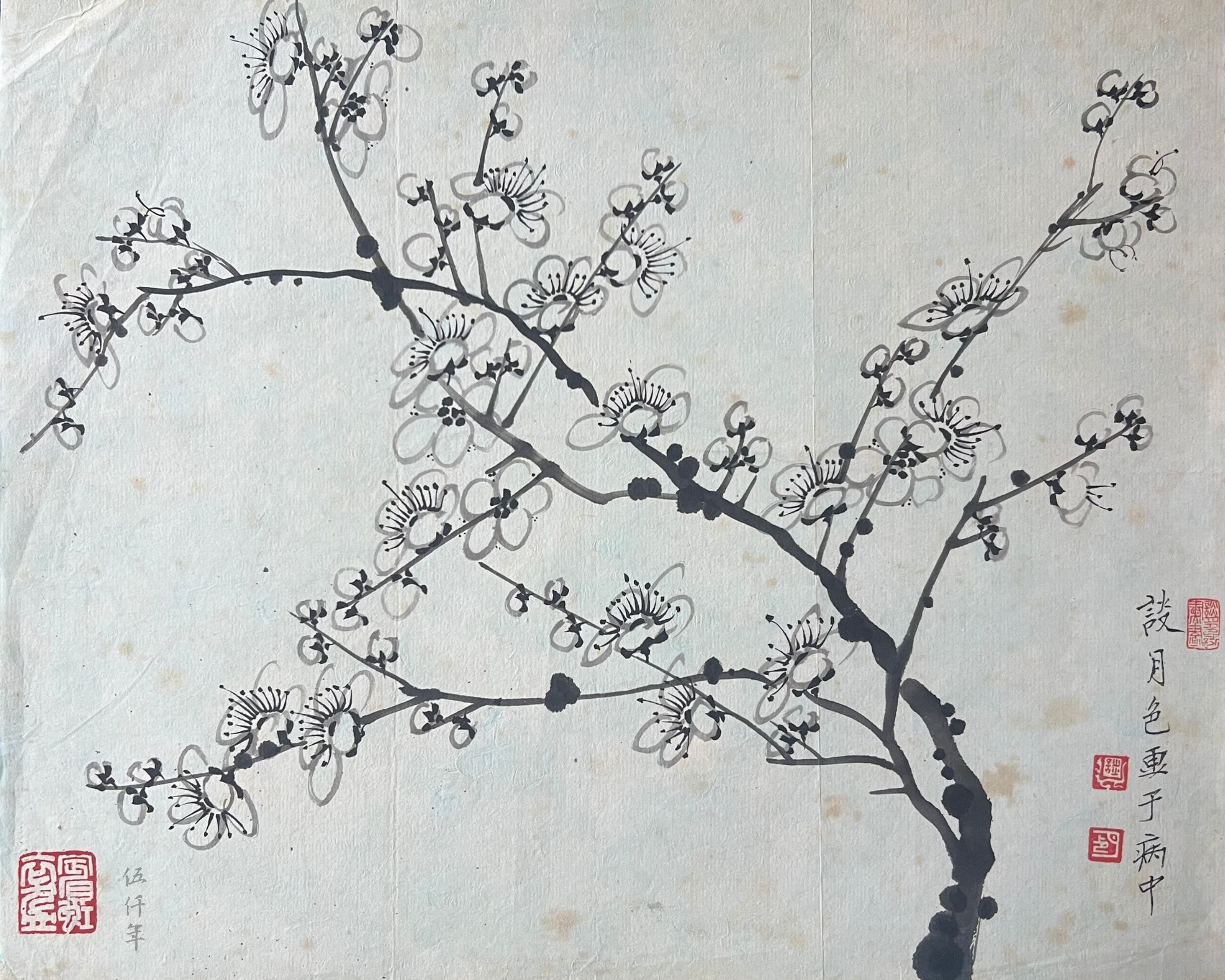
Painting of Prunus by T’an Yüeh-se
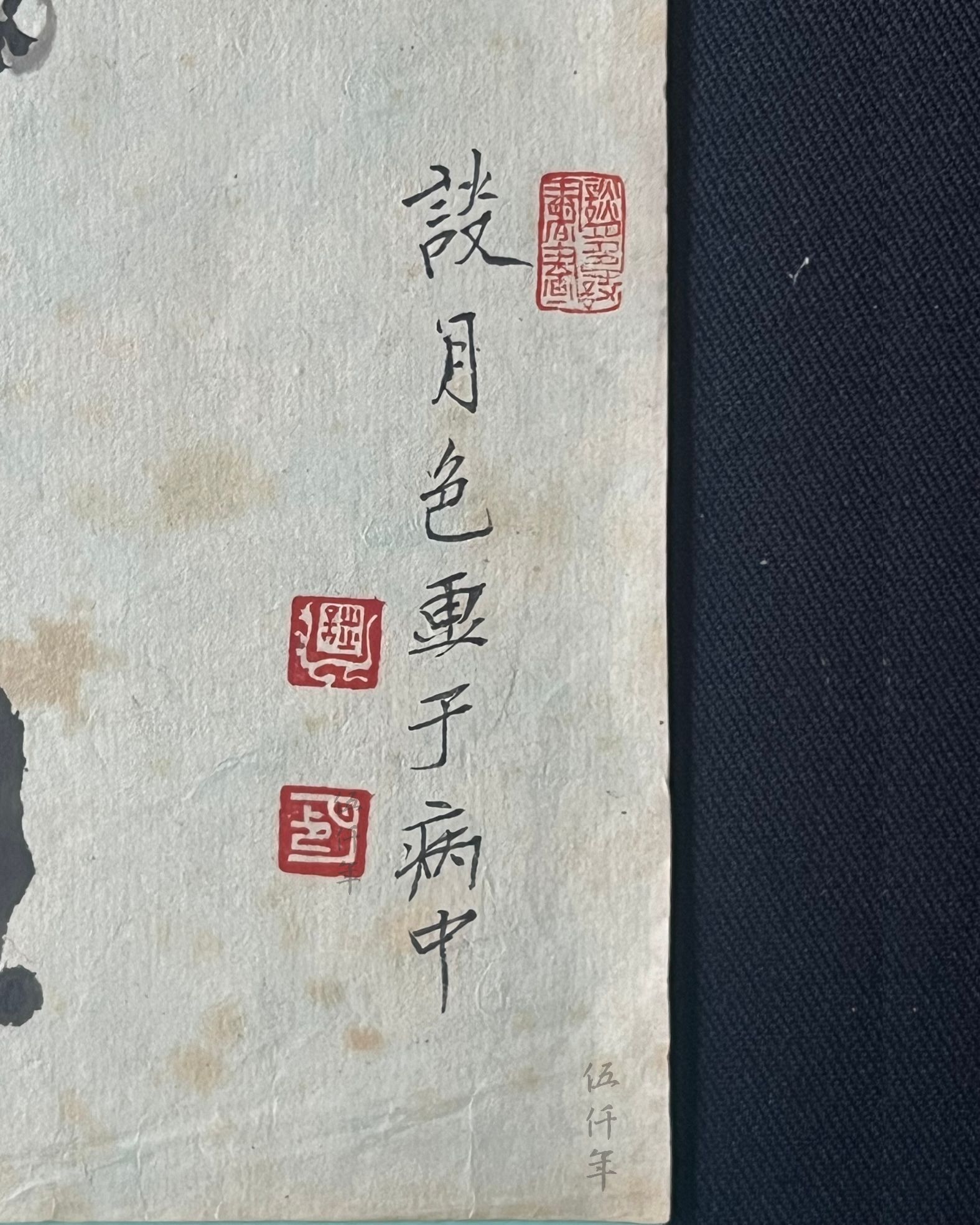
Inscription on painting by T’an Yüeh-se
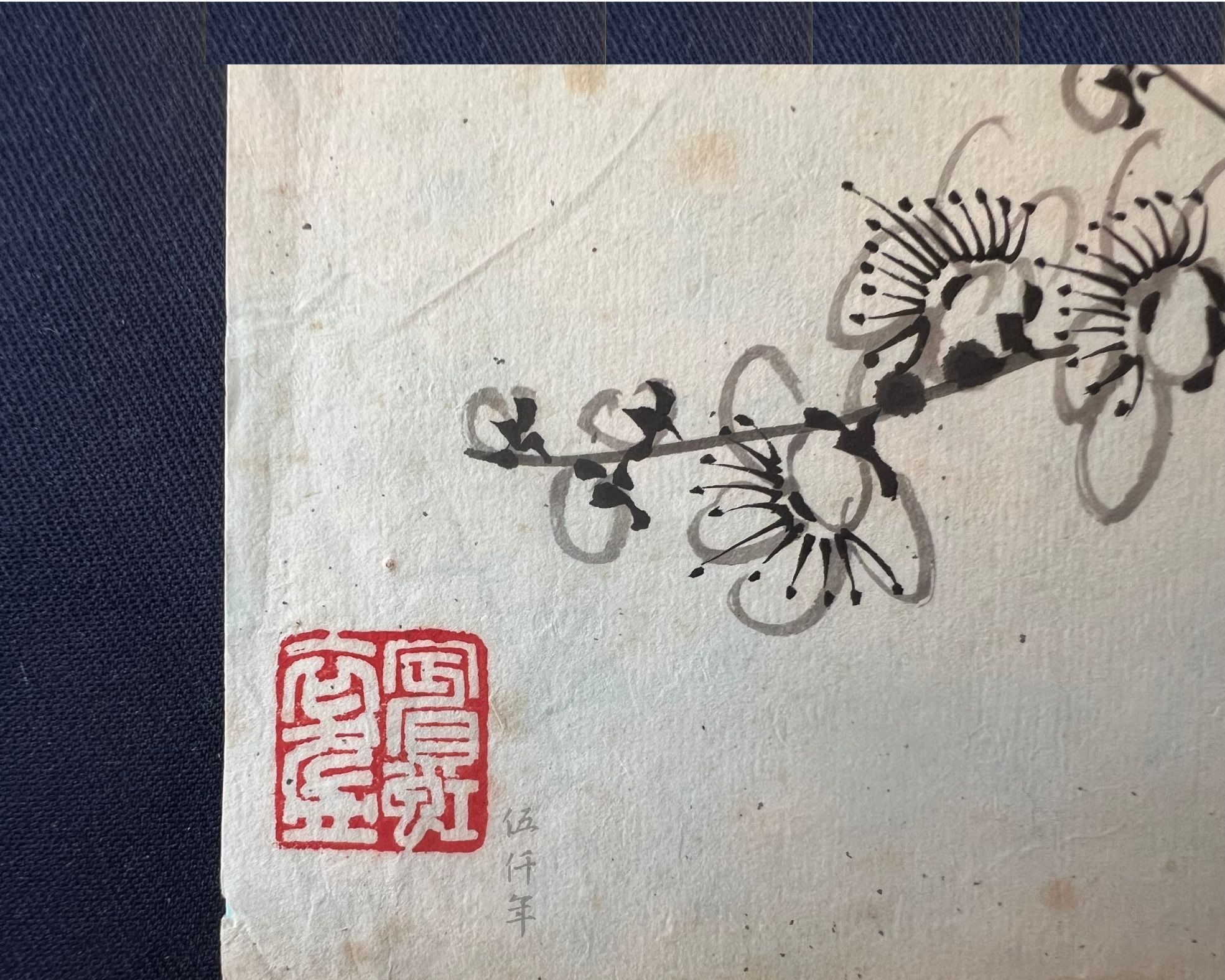
Seal impression with the words “Pin-hung i-po (The mantle of Huang Pin-hung)”
Inscription on painting reads:
“T’an Yüeh-se painted this in illness”.
Seal impressions: “T’an (談)”, Yüeh-se (月色)”, “T’an Yüeh-se tso-shih-shu-hua (譚月色作詩書畫 Poetry, calligraphy and painting by T’an Yüeh -se)”, “Pin-hung i-po (賓虹衣缽 The mantle of Pin-hung)”.
3.Seal of Ts’ai Shou (蔡守), husband of T’an Yüeh.
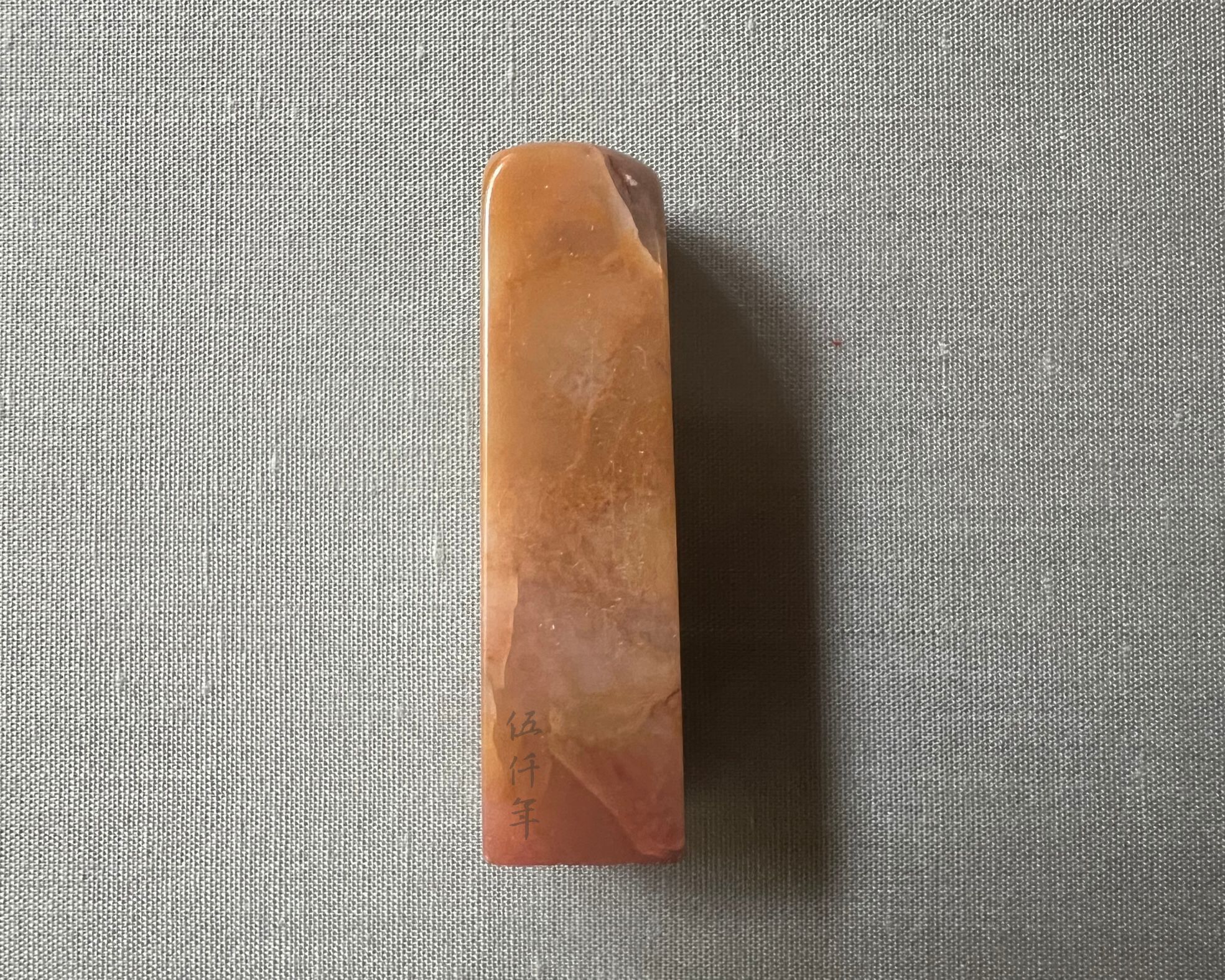
Seal of Ts’ai Shou, also carved by himself
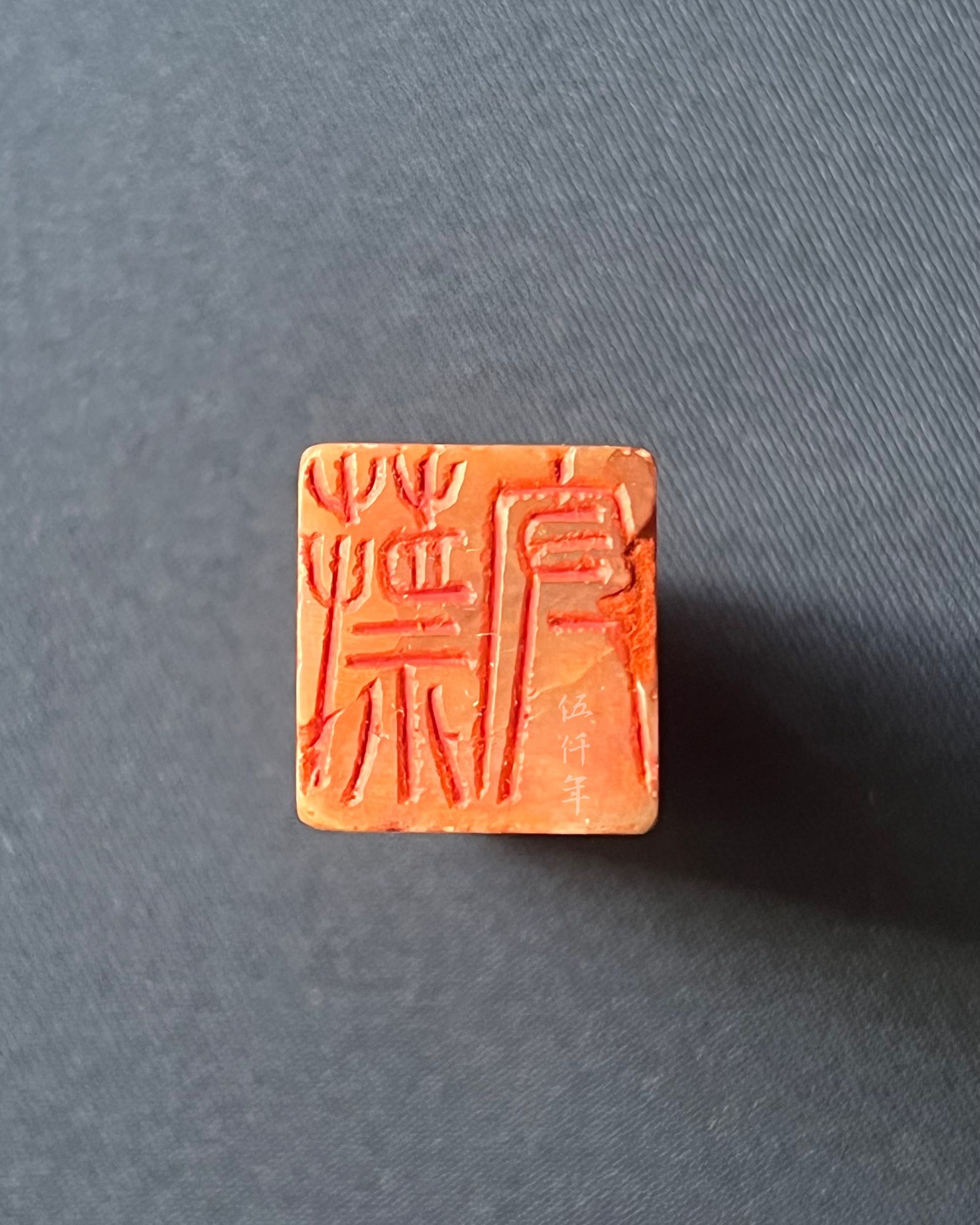
Engraved words on surface of seal: “Ts’ai Shou”, carved by Ts’ai Shou
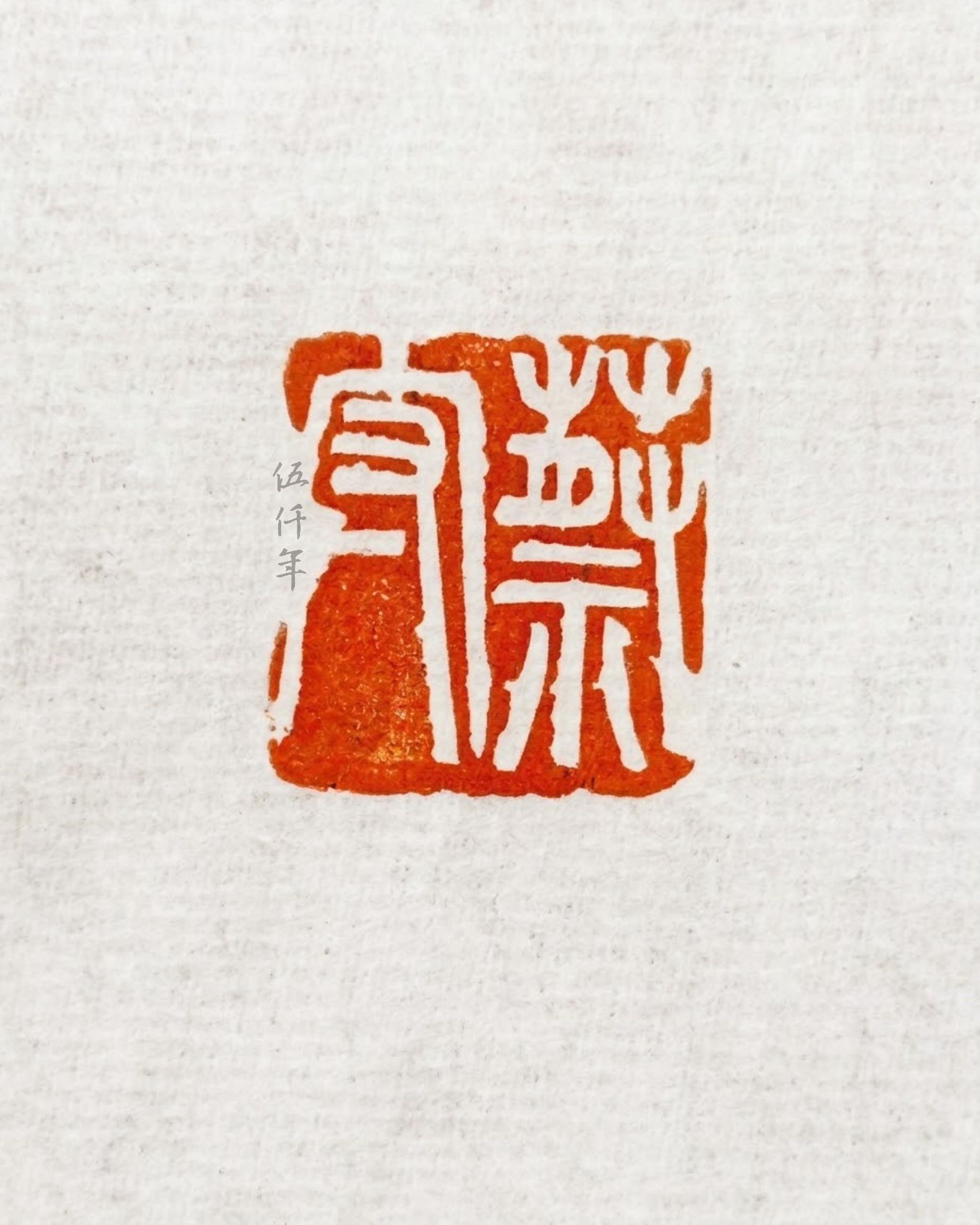
Intaglio seal impression with the words “Ts’ai Shou”, carved by Ts’ai Shou
Intaglio seal impression: “Ts’ai Shou (蔡守)”.
This seal was previously in the collection of my late friend Mr. Chang Shou-p’ing (張壽平). In 1995, he published A Precious Collection of Seals (印章藏珍), and it was chronicled on page 62. It reads:
“This seal, with the engraved characters of Ts’ai Shou, has no engraving on the side. The appearances of the characters are quite archaic, they were carved by holding the knife at a low angle against the stone. I suspect it was carved by Han-ch’iung (寒瓊, hao of Ts’ai Shou) himself.
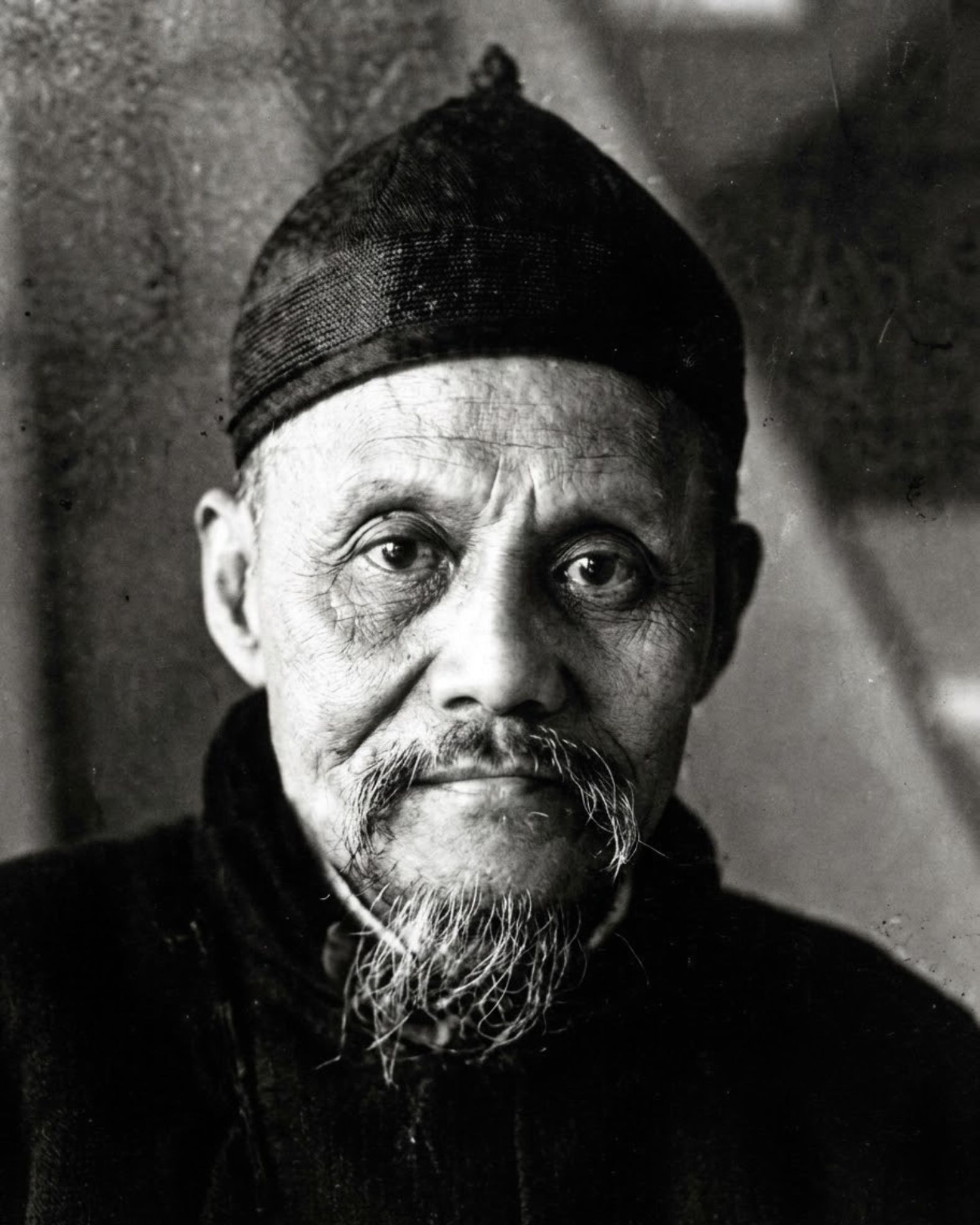
Portrait of Ts’ai Shou
Ts’ai Che-fu (蔡哲夫), original name Hsüan (絢), later changed to Shou (守), tzu Che-fu (哲夫), he was then known as Che-fu. His hao were Han-ch’iung (寒瓊), Ch’eng-ch’eng (成城), Han-tao-jen (寒道人). He was born in the 5th year of the Kuang-hsü reign 1879, a native of Shun-te in Kwangtung province. He was a member of the literary organization South Society. He was fond of calligraphy, paintings, seal engravings, ink rubbings and poetry. His friends include Su Man-shu (蘇曼殊 1884-1918), Huang Chieh (黃節 1873-1935), Yi Ju (易孺 1873-1941), Li Ming-k’o (李茗柯 1882-1945) and the painter Huang Pin-hung (黃賓虹 1865-1955). He was a well-known literatus of his time. In the 30th year of the Republic 1941, he passed away in Nanking. His works include Hua-hsi Lu (畫璽錄), Yin-ya (印雅), Han-ch’eng Pei-mu (寒宬碑目) and Han-ch’iung I-kao (寒瓊遺稿). He married T’an Yüeh-se, also known as Jung-jung. She excelled in carving small seals using slender gold script, and was proficient in painting prunus.
In the 32nd year of the Republic of China 1943, I was attending university in Nanking. When I was not studying, I frequently visited the home of the painter Tuan Wu-jan (段無染) to talk about art.He introduced me to Mrs. Ts’ai, T’an Yüeh-se. At that time, Han-ch’iung (Ts’ai Shou) had already passed away for more than a year, but his coffin was not yet buried. Mrs. Ts’ai was still in mourning. She wore a grey dress and her shoes were made of cloth. She did not put on any makeup. She looked like forty something, elegant and friendly. She invited me to her house to enjoy the calligraphy, paintings, ink rubbings, and rare books left by Han-ch’iung. She recounted the past graphically and at length. There was a writing desk on the left side of the drawing room, above the desk was a hanging scroll of prunus by T’ang I-fen (湯貽芬, also known as T’ang Yü-sheng 湯雨生). On the lower right corner of the painting, there was a seal with the characters: “Han (寒) and Yüeh (月)enjoy this together”. (Han for Han-ch’iung (寒瓊) and Yüeh for Yüeh-se (月色)). The characters were carved by Mrs. Ts’ai in the style of slender gold calligraphy. I was full of admiration for these two kindred spirits who managed to share such refined pleasures together, for this reason the scenes in the house were deeply imprinted in my mind till this very day. At one time Mrs. Ts’ai offered to sell a painting album by Su Man-shu, saying: ‘When I acquire a substantial sum, I will buy a burial plot so that we can be buried together one day.’ Painting by Su Man-shu was unseen and unheard of, there were twelve leaves in this album, each leaf was drenched by the ingenuous inkwork of the artist, as if it belonged to another world! Even though I knew how precious it was, I was only a poor student, I did not dare to ask the price!
Some time afterwards, Tuan Wu-Jan said to me: ‘Mrs. T’sai was a nun when young, she was well-known for her talents. She met Tsai Shou at the age of thirty-one, she returned to secular life and married him. It was a beautiful story from Kwangtung province. I also learned from my teacher Lung Mu-hsun (龍沐勛) that he helped her land a job in the Research Institute for Culture and History, she was then able to make ends meet. She held on dearly to what Ts’ai Shou bequeathed her.
Last year, I came across this seal in the Guangzhou Cultural Relics Store. It reminded me of Madame Yüeh-se and I bought it. That generation of theirs has passed away so fast, who will follow their steps? I then composed a poem:
Huang Chieh gone and Huang Pin-hung too,
Long I remember Ts’ai Shou’s southern home!
Who will look after his wife T’an Yüeh-se,
Watch her paint prunus in a frosty night? “
Huang Chieh (黃節 1873-1935) was a distinguished poet from Kwangtung province. Huang Pin-hung (黃賓虹 1865-1955) was an eminent painter from Anhui province.
d) Confidants
1.Gift of jade lotus root from Aunt Chou Lien-hsia (周練霞) to Mr. Soong Hsün-leng (宋訓倫).
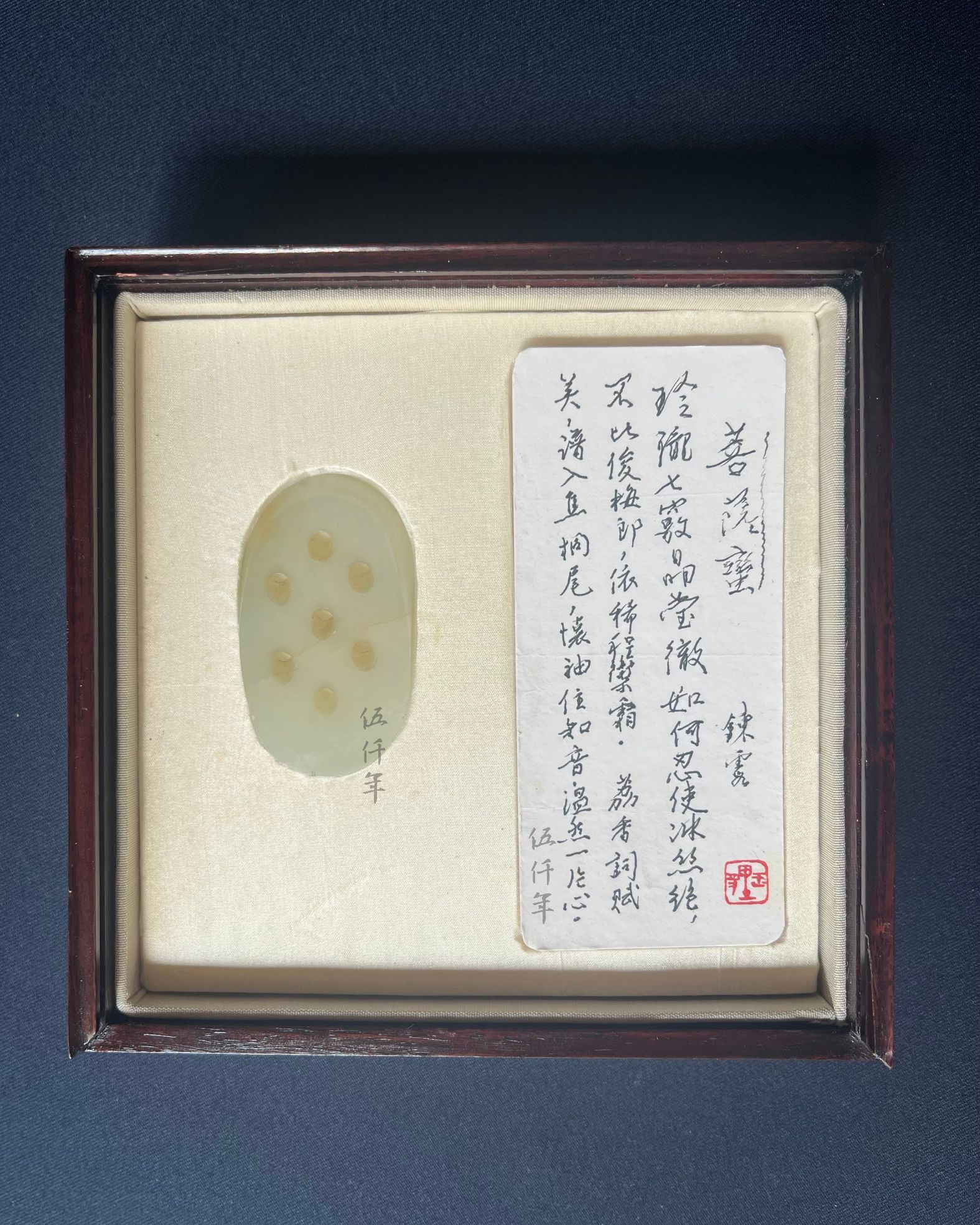
Gift of jade lotus root from Aunt Chou Lien-hsia and an inscription of the tz’u lyric To the tune P’u-as-man, composed by Aunt Chou Lien-hsia and copied by Mr. Soong Hsün-leng
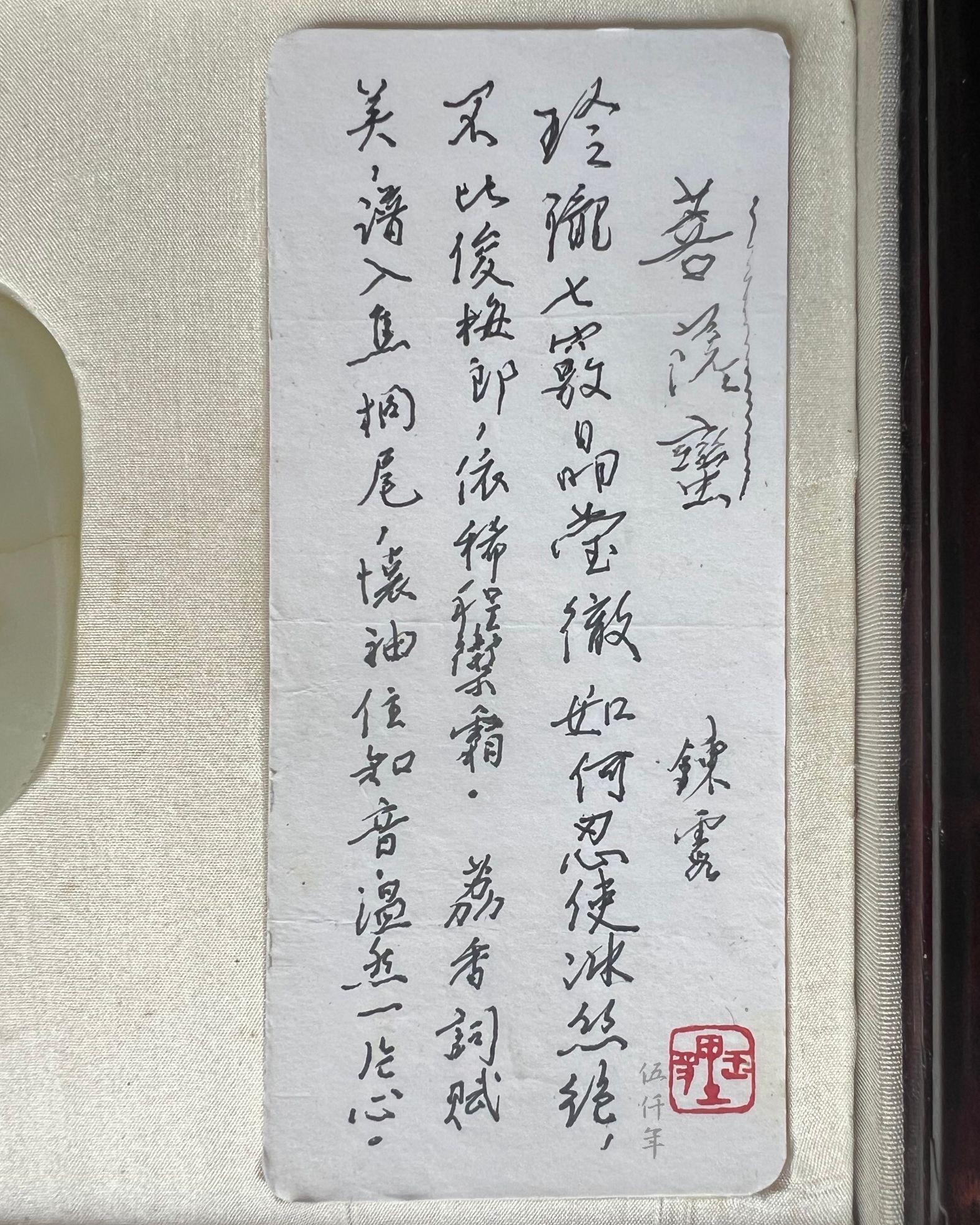
Detail of the tz’u lyric To the tune P’u-as-man, composed by Aunt Chou Lien-hsia and copied by Mr. Soong Hsün-leng
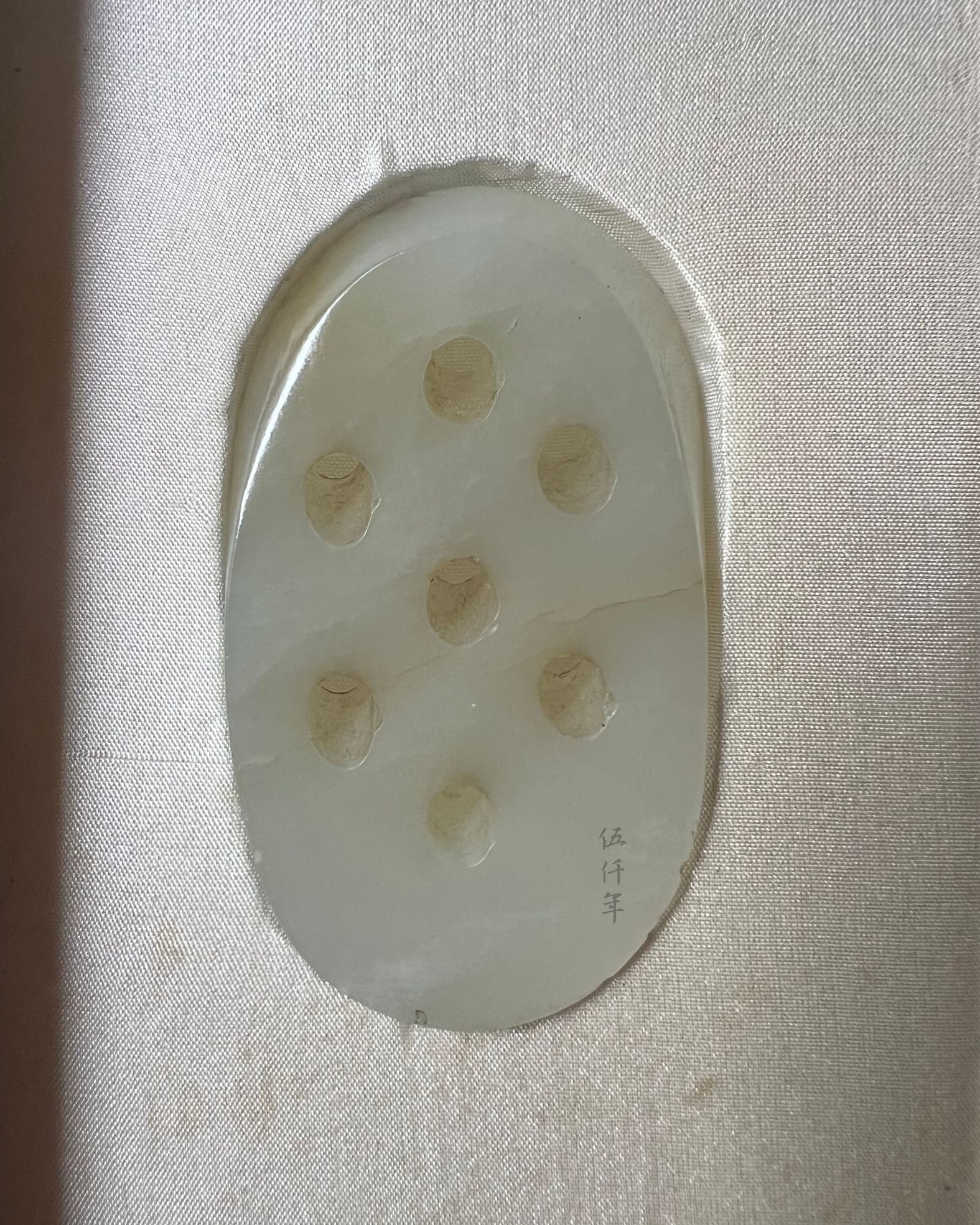
Detail of jade lotus root gifted by Aunt Chou Lien-hsia
My father, Mr. Soong Hsün-leng, was born in the 2nd year of the Hsüan-t’ung reign 1910 and died in the 99th year of the Republic 2010. His tzu was Hsin-an (馨菴), hao Hsin-leng (心冷), or Yü-li (玉貍). He was a native of Wu-hsin in Chekiang province, but he was born in Fu-chou of Fukien province. His tz’u lyrics were compiled into The Fragrant Hermitage.
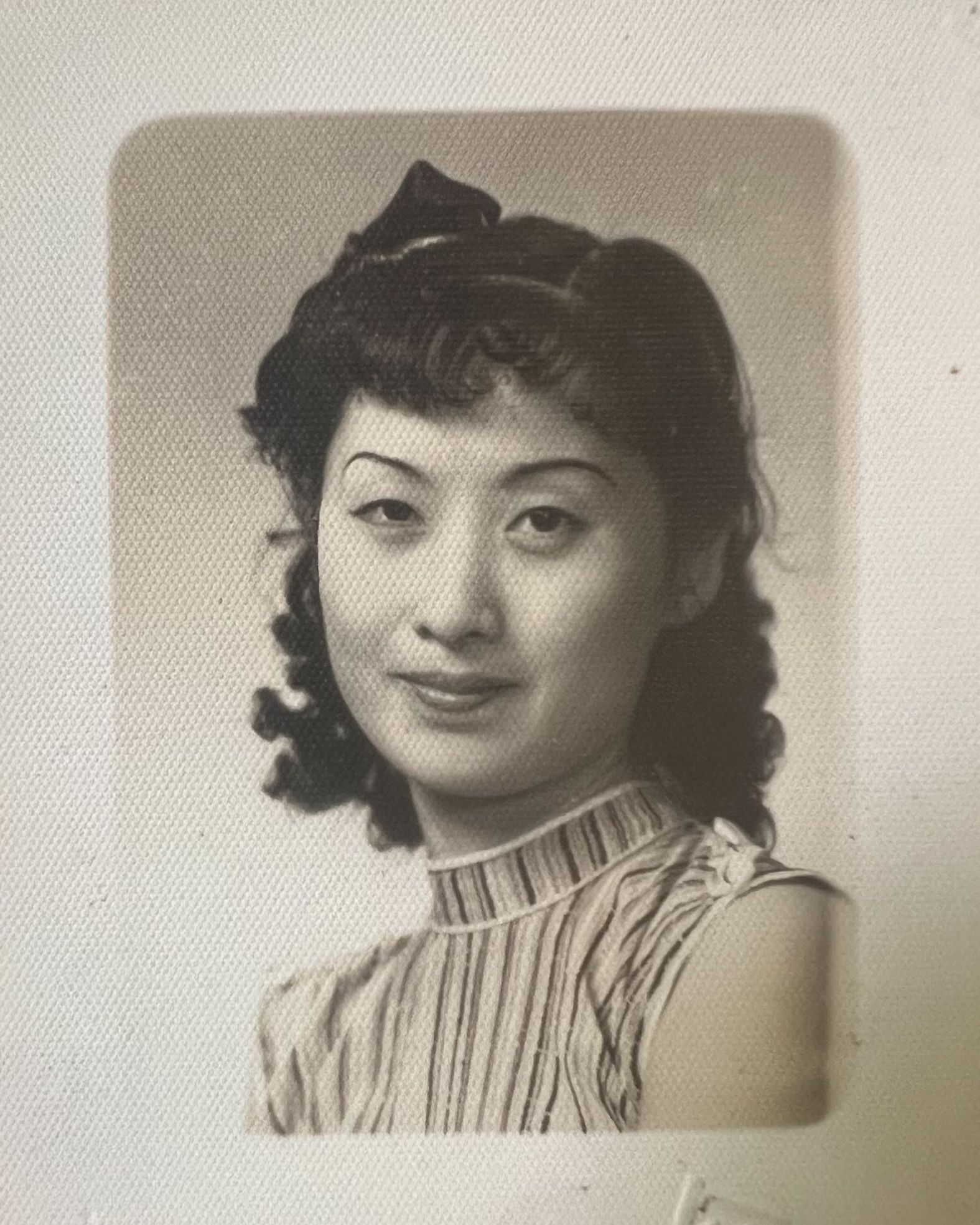
Portrait of Aunt Chou Lien-hsia
Chou Lien-hsia (周鍊霞) was born in the 1st year of the Hsüan-t’ung reign 1909 and died in 2000. Her original name was Ch’ai (茝), Yü (霱), Tzu-i (紫宜), her tzu were Lien-hsia (煉霞), Lien-hsia (鍊霞), Lo-ch’uan (螺川), Lo-ch’uan-tzu (螺川子). Her studio names were Ch’an-hung Hsüan (懺紅軒), Lo-ch’uan Shih-wu (螺川詩屋). She was a native of Chi-an in Kiangsi province. Her father was Chou Shou-ch’i (周壽祺), tzu Ho-nien (鶴年). He attained the title of provincial graduate and was appointed prefectural magistrate of Ch’ang-sha in Hunan province. In the 23rd year of the Republic of China 1934, she joined the Chinese Women’s Calligraphy and Painting Association and made a living as a painter. She excelled in poetry, tz’u lyrics, calligraphy and painting. Her writings were compiled into Lo-ch’uan Yun-yü (螺川韻語).
Mr. Soong Hsün-leng inscribed the tz’u lyric To the tune P’u-sa-man, composed by Aunt Chou Lien-hsia, onto a mounted piece of card inside the wooden box. The lines are:
“To the tune P’u-sa-man. Lien-hsia.
Lotus root of seven holes,
Jade so fine and clear.
How hard it is to bear
When fiddler’s music ends.
Its not quite the tune
Of dashing Mei Lan-fang.
Vaguely comes to mind
That of Cheng Yen-ch’iu.
A cultivar of lychee,
Also called Soong-Fragrance,
This poet of ravishing lyrics.
He weaves them into music
And plays them with his zither.
Beneath silk layers and sleeves,
The spirit of my bosom friend.
I can still feel warmth of wear
With this sliver of my heart.”
Seal impression: “Yü-li (玉貍)”.
Mei Lan-fang (梅蘭芳) was born in the 20th year of the Kuang-hsü reign 1894 and died in 1961. He was an eminent Peking Opera singer. Ch’en Yen-ch’iu (程硯秋) was born in the 30th year of the Kuang-hsü reign 1904 and died in 1958. Both Mei and Ch’en are regarded as two giants in Peking Opera.
Publication:
The Cultural World of a Ci Poet, page 250, edited by Soong Dennie and Soong Shu Kong. University Museum and Art Gallery, The University of Hong Kong, 2006.
2.Letter by Aunt Chou Lien-hsia (周鍊霞) to Mr. Soong Hsün-leng (宋訓倫).
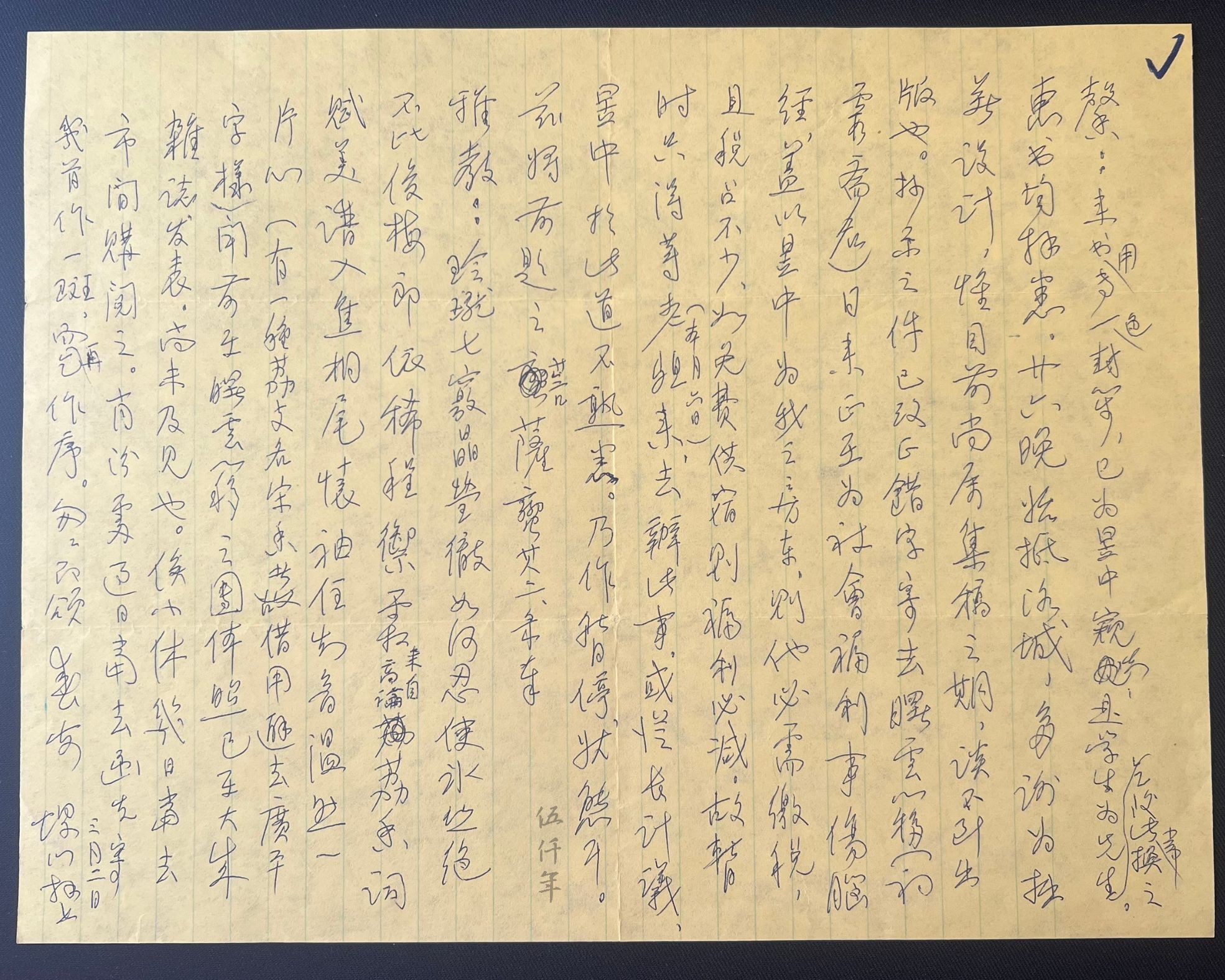
Letter from Aunt Chou Lien-hsia to Mr. Soong Hsün-leng
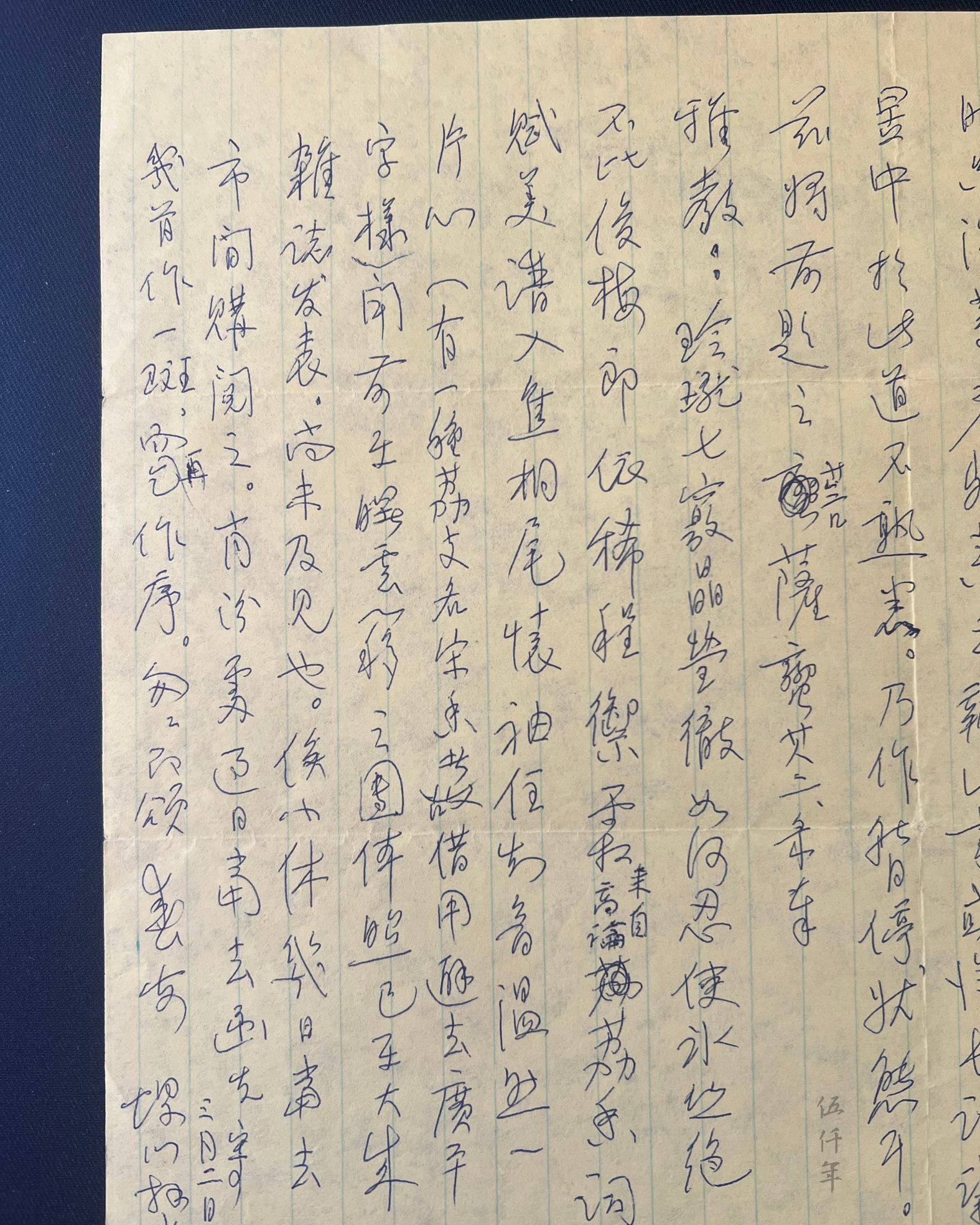
Detail of letter from Aunt Chou Lien-hsia to Mr. Soong Hsün-leng
The letter reads:
“Hsin (馨):
Your letter used colour envelope, and this was uncovered by Yü-chung (昱中, son of Chou Lien-hsia who forbade his mother from corresponding with Mr. Soong). My student begged you to regularly change envelope after this. I have read your letters. I arrived in Los Angeles on 26. Thank you for your book design, but I am still in the process of compiling my writings, far from ready for publication. I have corrected the writing mistakes in the draft copy I showed you. I then posted it to the Studio of Shu-yün (曙雲簃 studio of P’ing Ch’u-hsia 平初霞). Recently I have been agonizing over the issue of social security. Yü-chung is my landlord, he must pay taxes, and the taxes are substantial. If he provides free accommodation, social security will certainly be reduced, so for the moment I can only wait for the Old Villain to come (on 6 this month) to deal with this matter, or I have to consider this at length. Yü-chung is not familiar with this, so he has stopped dealing with it. I now present another early tz’u lyric To the tune P’u-sa-man for your rectification. It reads:
Lotus root of seven holes,
Jade so fine and clear.
How hard it is to bear,
When fiddler’s music ends.
Its not quite the tune
Of dashing Mei Lan-fang.
Vaguely comes to mind
That of Cheng Yen-ch’iu.
(This was what you told me).
A cultivar of lychee
Also called Soong-Fragrance,
This poet of ravishing lyrics.
He weaves them into music,
And plays them with his zither.
Beneath silk layers and sleeves
The spirit of my bosom friend.
I can still feel warmth of wear
With this sliver of my heart.
There is a cultivar of lychee named Soong-hsiang (宋香), meaning Soong-Fragrance. I used this as an allusion to yourself, whereby I avoided quoting Soong Kuang-ping (宋廣平). I heard the group photograph taken at the Studio of Shu-yün was published in Ta-ch’eng Magazine (大成雜誌), though I have not seen it yet. After a few days of rest, I will go and buy a copy. I should write a letter to Hsiao-fen (吳肖汾) in the coming days, enclose a few poems, and then beseech him to write a foreword. I wrote this in haste. Wishing you a peaceful spring.
Lo-ch’uan pays respects.
2 March.”
D.Collaboration:
Hearts and minds of friends in accord, calligraphy and painting in unison, collaborative works to become art lores.
1.Pewter wine cup with ceramic lining, drawing by Kai Ch’i (改琦), running script calligraphy by Wang Su (王涑), clerical script calligraphy and carvings by Chu Chien (朱堅), Ch’ing dynasty.
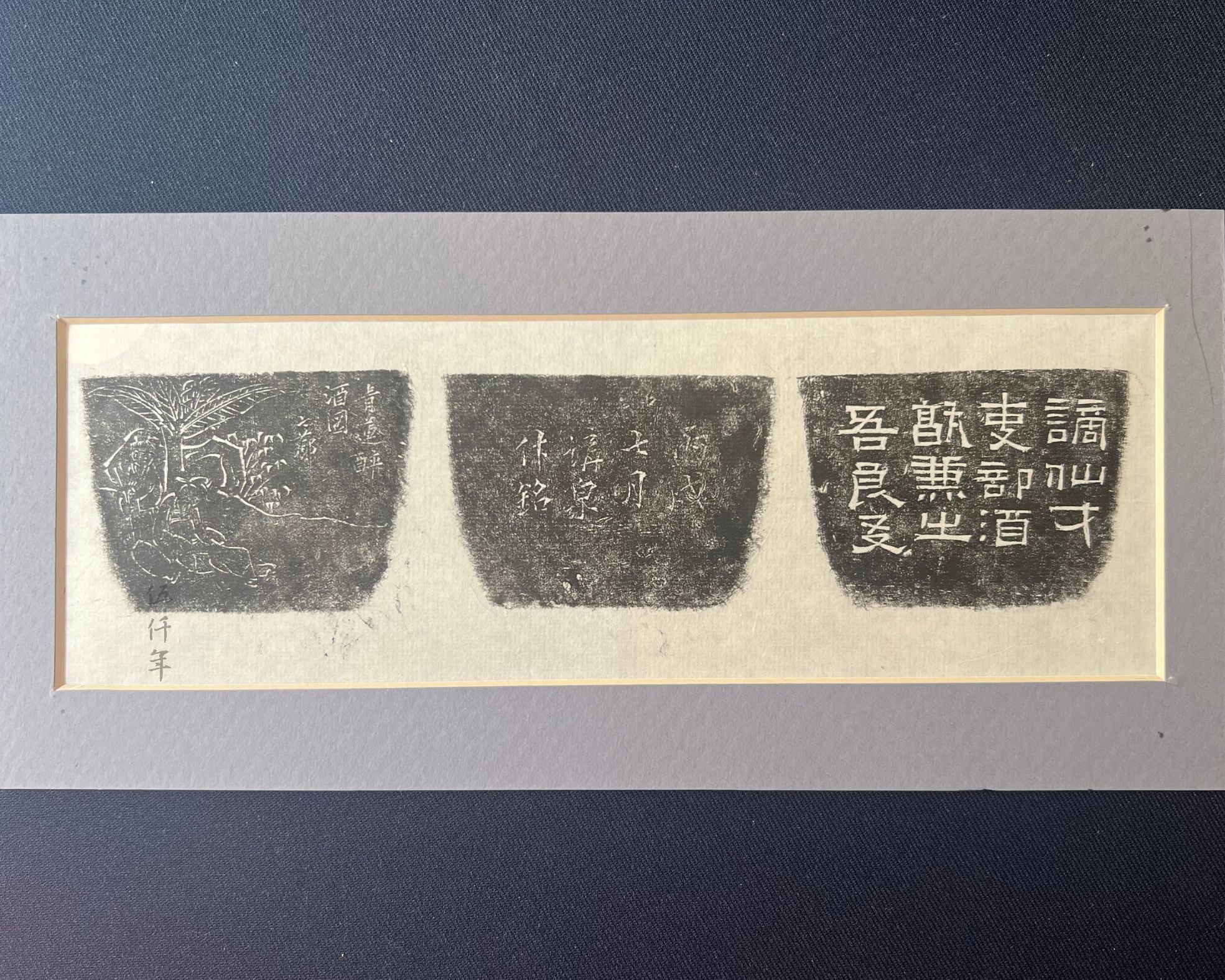
Ink rubbings of three sides of pewter wine cup by Kai Ch’i, Wang Su and Chu Chien
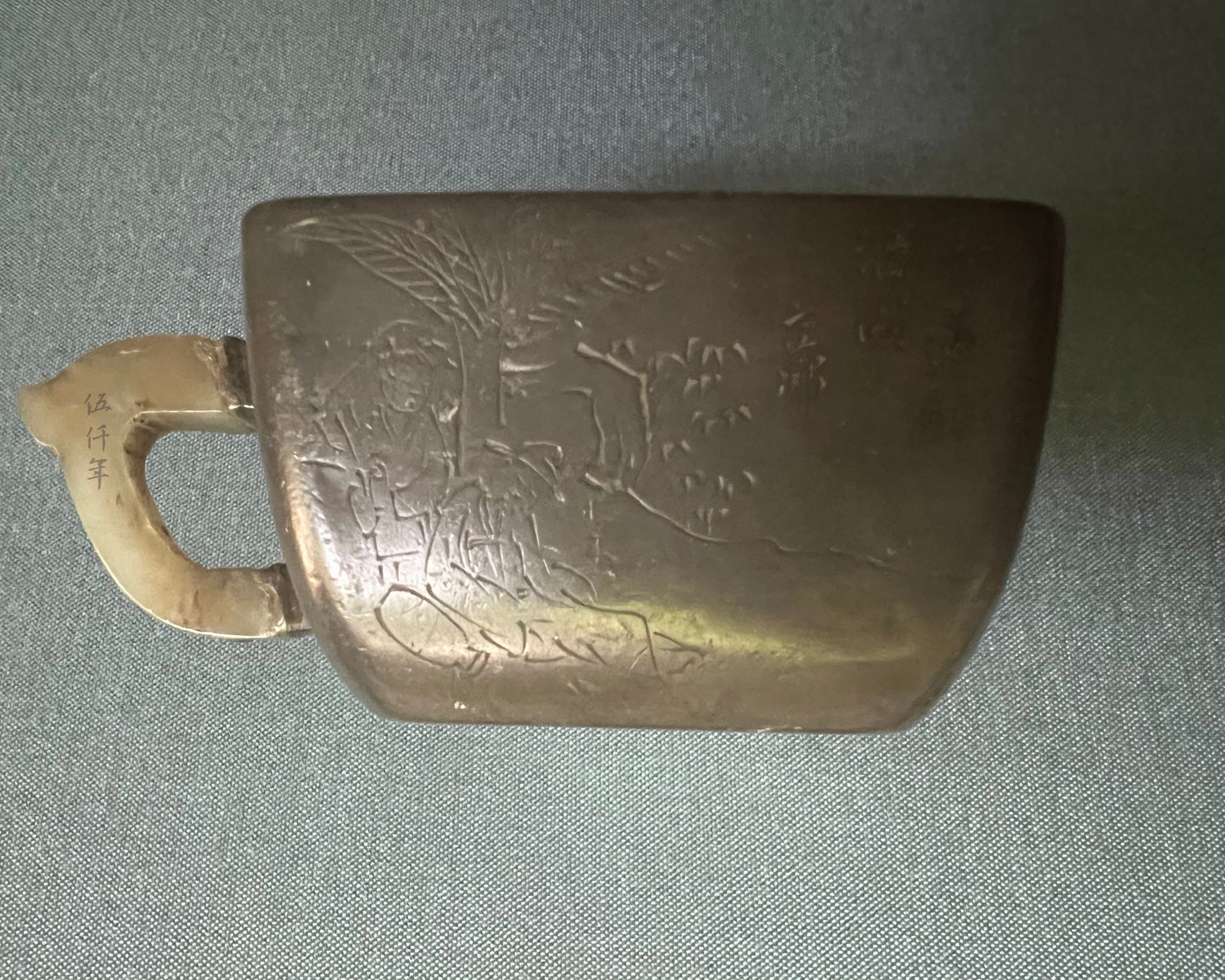
Engraved picture of Ch’ing-lien Getting Drunk by Kai Ch’i on first side of pewter cup
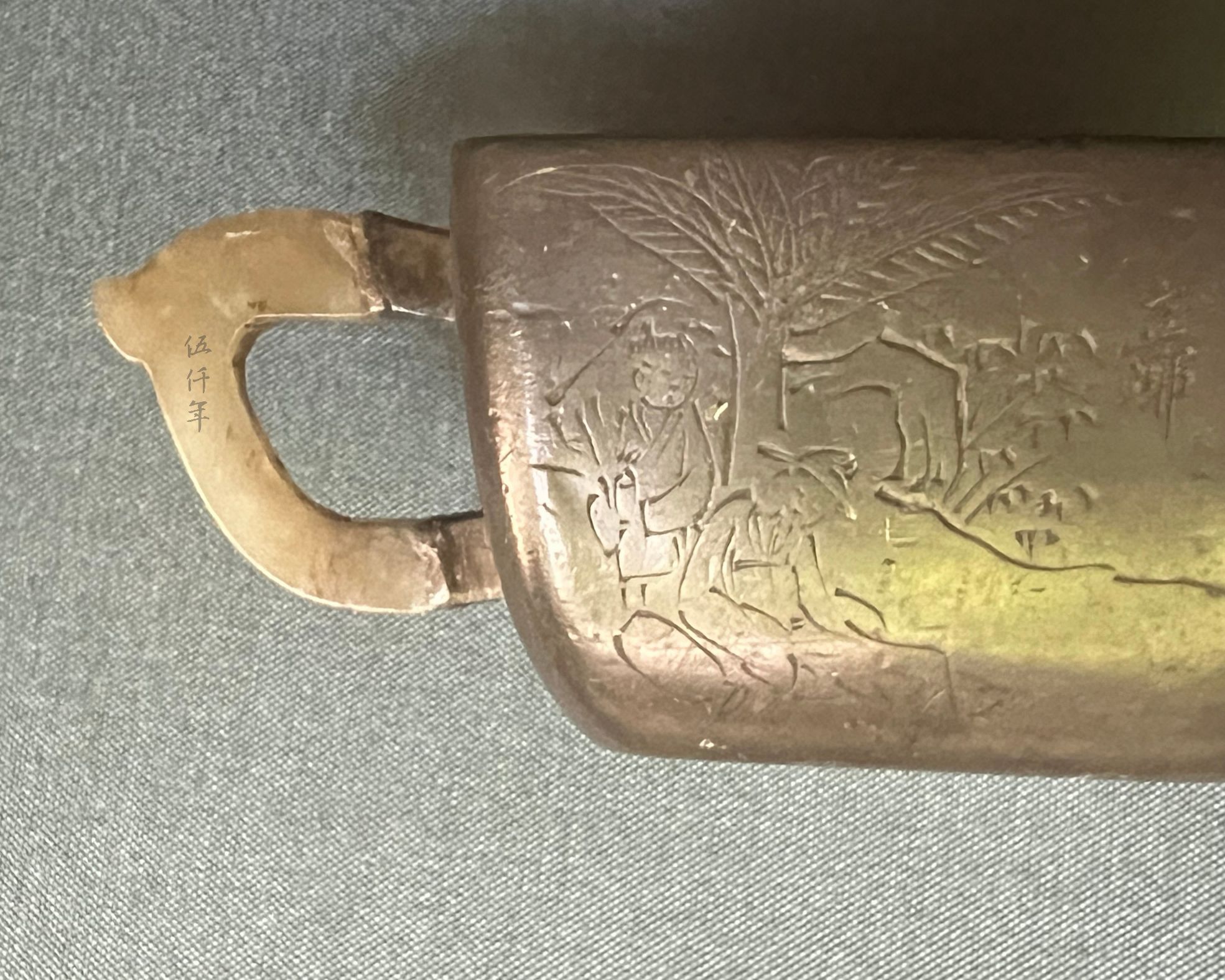
Detail of engraved picture of Ch’ing-lien Getting Drunk by Kai Ch’i
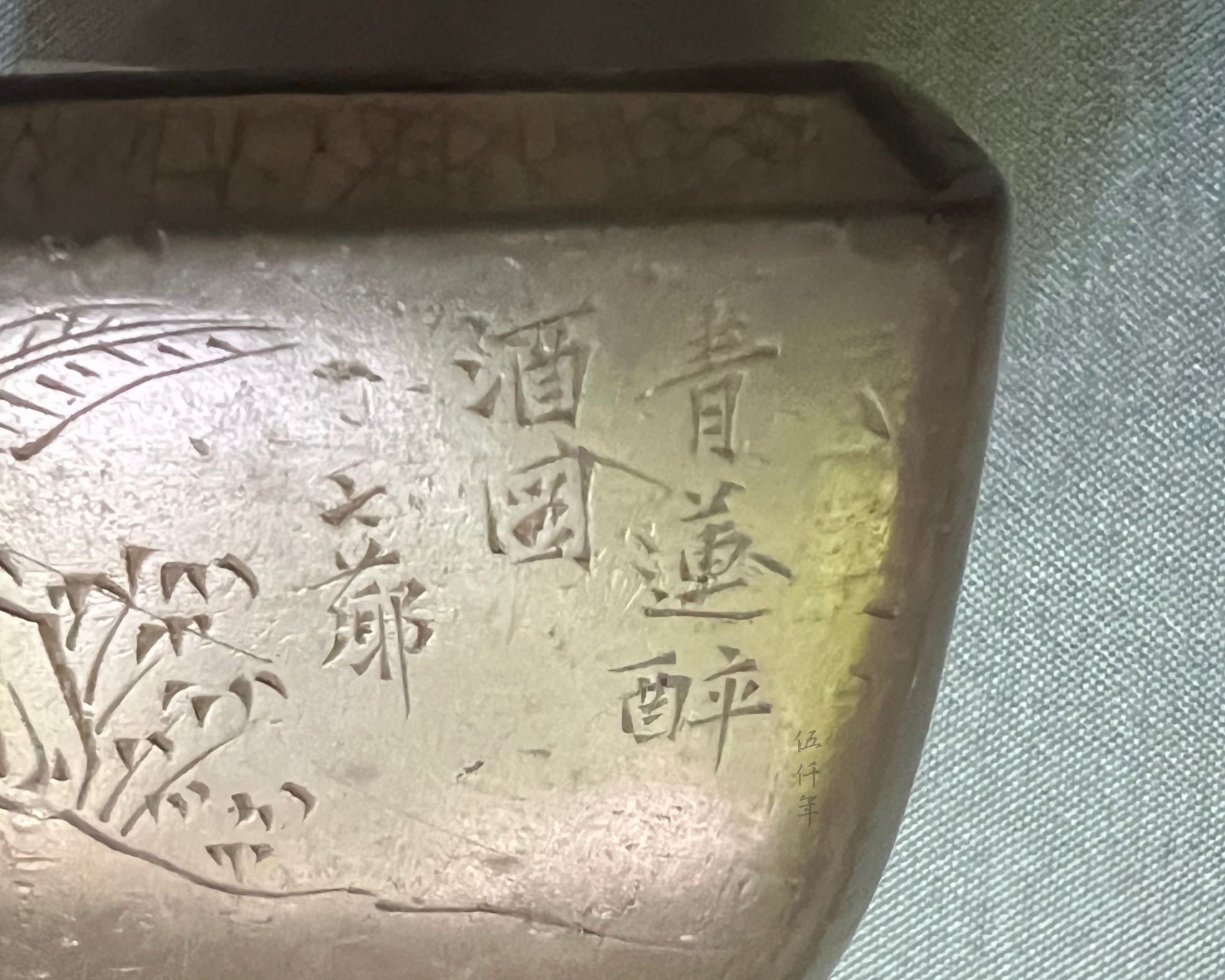
Another detail of engraved picture of Ch’ing-lien Getting Drunk by Kai Ch’i
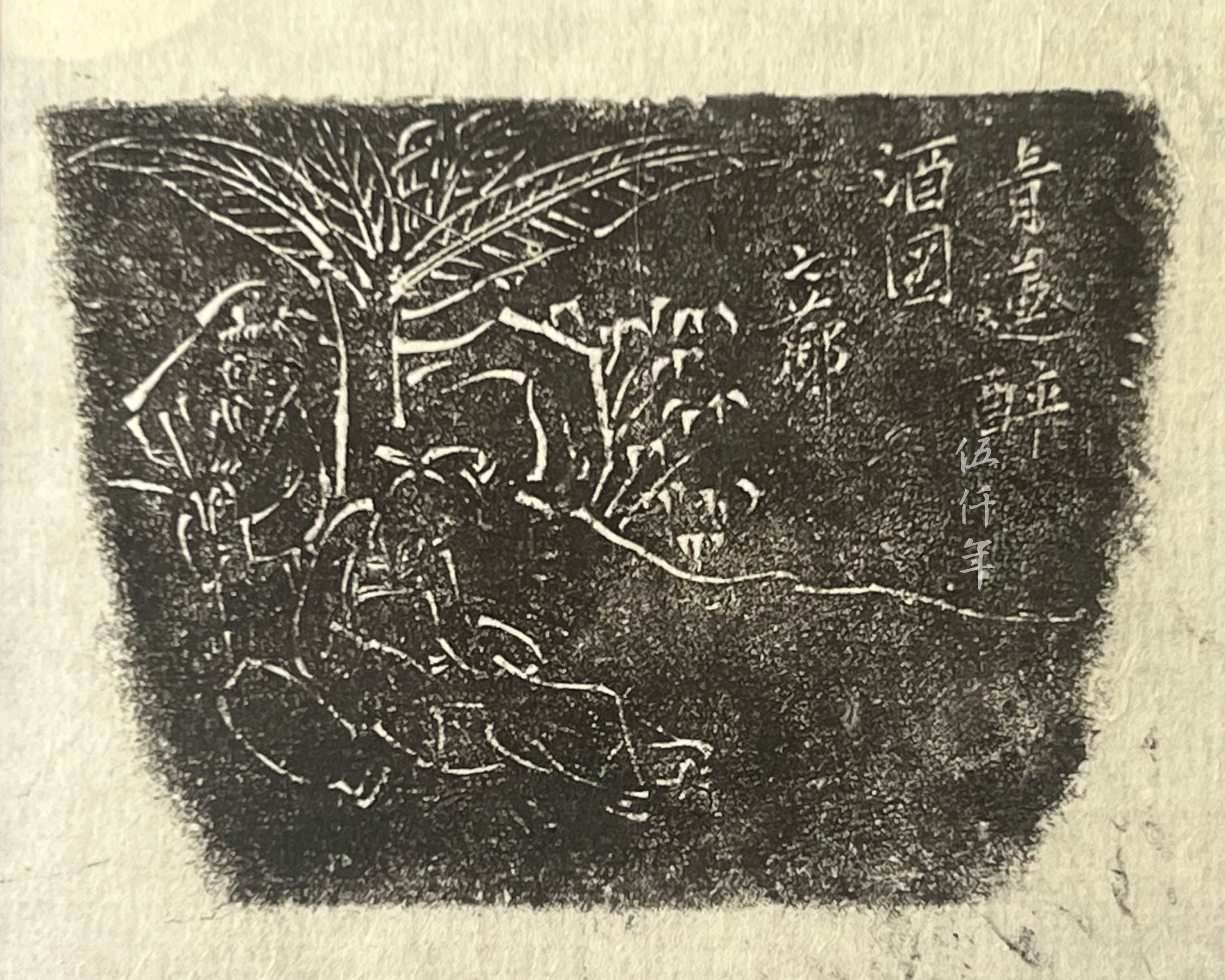
Ink rubbing of engraved picture of Ch’ing-lien Getting Drunk by Kai Ch’i
Drawing of Ch’ing-lien Getting Drunk by Kai Ch’i (改琦) incised on the first side of the cup. Calligraphy engraving above the drawing reads:
“Ch’ing-lien Getting Drunk, Kai Ch’i.”
Ch’ing-lien was the hao of Li Pai (李白 701-762), an eminent poet in the T’ang dynasty.
Kai Ch’i was born in the 38th year of the Ch’ien-lung reign 1773, and died in the 8th year of the Tao-kuang reign 1828. His tzu was Po-yün (伯蘊), his hao were Hsiang-pai (香白), Ch’i-hsiang (七薌), Yü-hu Wai-shih (玉壺外史). He was a native of the Western Regions, but lived in Hua-t’ing of Kiangsu province. He was gifted in poetry and calligraphy, and excelled in figure painting. His writings were compiled into Yü-hu Shan-jen Chi (玉壺山人集).
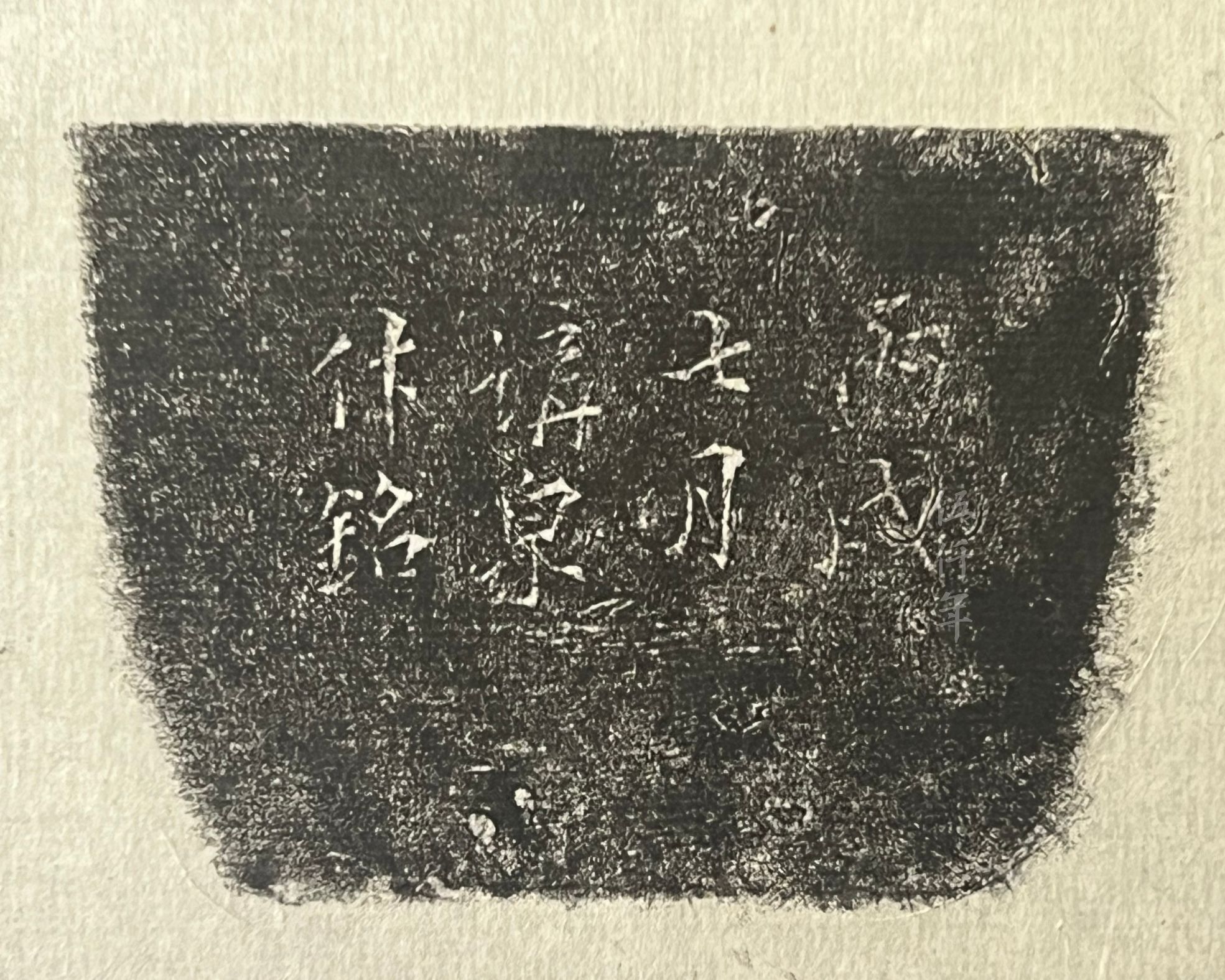
Ink rubbing of running script calligraphy written by Wang Su on second side of pewter cup
Running script calligraphy by Wang Su (王涑) engraved on the second side of the cup. The words are:
“In the seventh month of ping-hsü (丙戌) year, Chiang-ch’üan (講泉) wrote this inscription.”
Ping-hsü year corresponds to the 6th year of the Tao-kuang reign, 1826.
Wang Su (王涑), tzu Chiang-ch’uan (講泉), native of Kuei-an in Hu-chou, but lived in T’o-shui. He was department magistrate of Ho-ch’ih in Kwangsi province. His whole family was proficient in calligraphy, acquiring the skills of Ouyang Hsün (歐陽詢 557-641) and Liu Kung-ch’uan (柳公權 778-865). He was as esteemed as Kao K’ai (高塏 1769-1839) of Ch’ien-t’ang, and was celebrated in the north and south of the Yangtze River. However he spent most of his time in the capital. He was skilled in painting prunus, his style somewhere between those of Cheng Ssu-hsiao (鄭思肖 1241-1318) and Chao Meng-chien (趙孟堅 1199-1295).
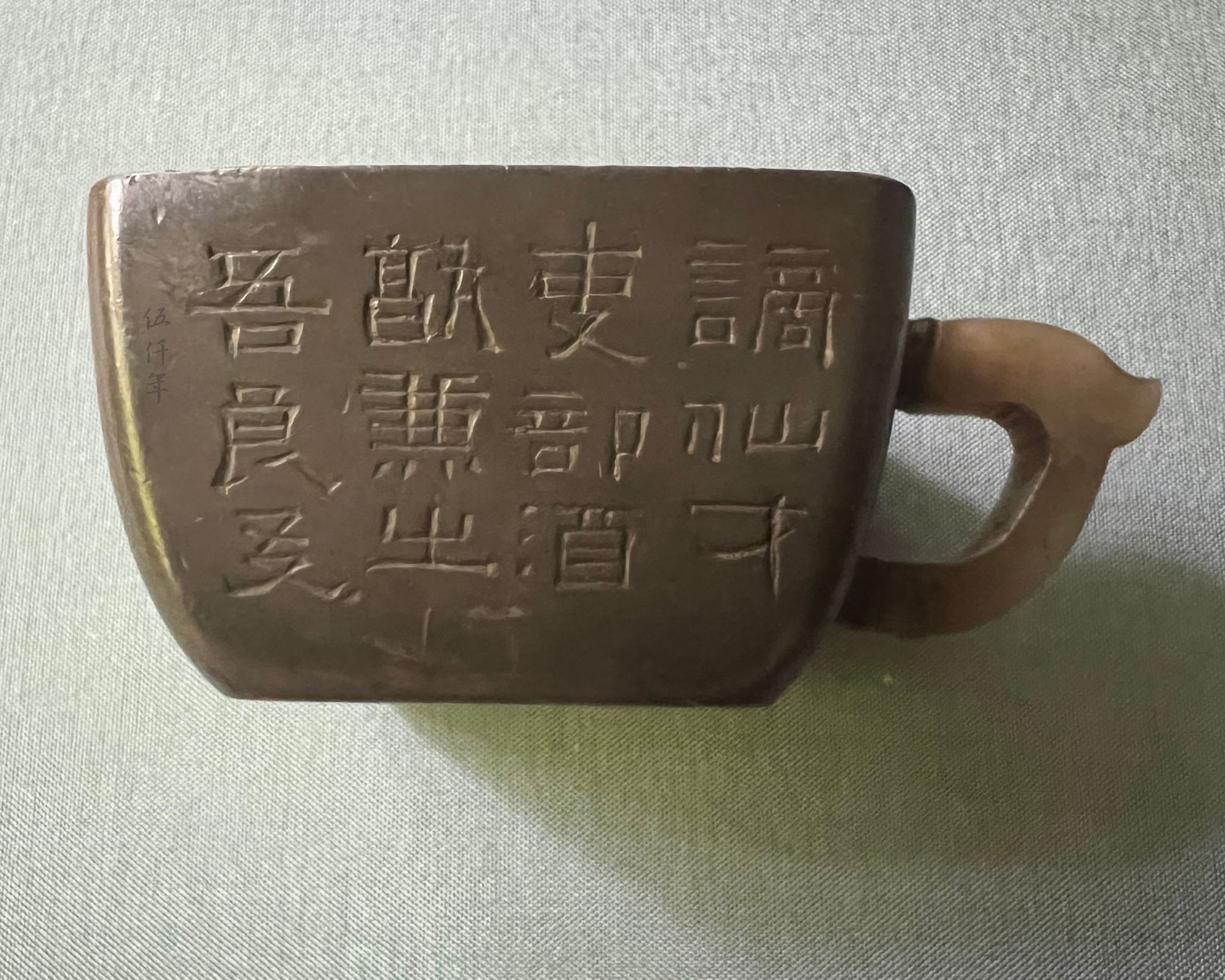
Clerical script calligraphy written and engraved by Chu Chien on third side of pewter cup
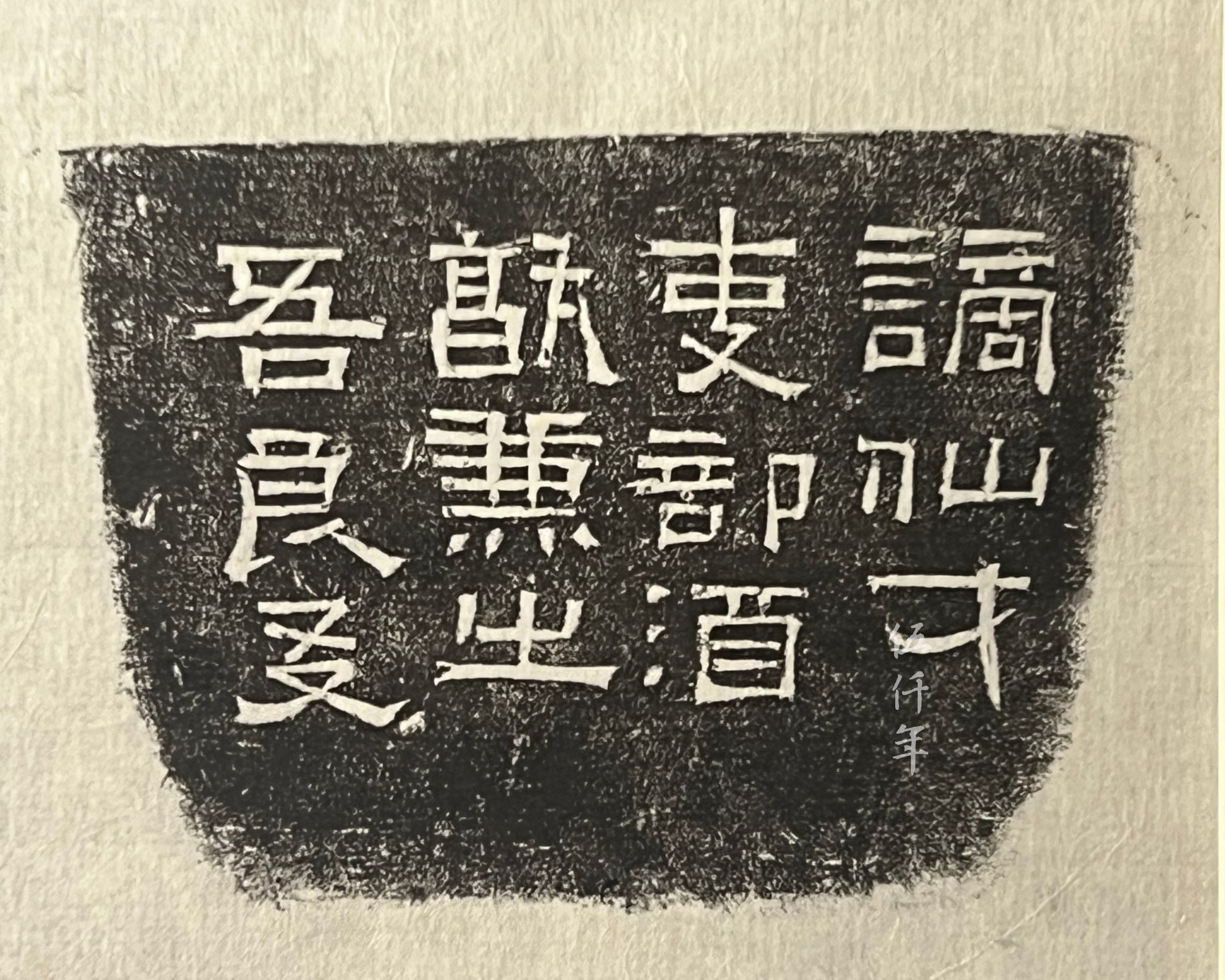
Ink rubbing of clerical script calligraphy written and engraved by Chu Chien
Clerical script calligraphy by Chu Chien (朱堅) on the third side of the cup. Chu Chien would have carved these words, in addition to the drawing and the calligraphy by Kai Ch’i and Wang Su. The words are:
Unworldly talent,
Wine aficionado,
Who claims both,
My good friend.
Chu Chien (朱堅) was born in the 55th year of the Ch’ien-lung reign 1790, his year of death unknown. His tzu was Shih-mei (石梅), or Shih-mei (石楳), his hao were Ho Tao-jen (鶴道人), Mei Tao-jen (梅道人), Lao-mei (老梅), his studio name was Po-ya Chai (博雅齋). He was a native of Shan-yin in Chekiang province, but he lived in Sung-chiang. He was proficient in calligraphy, painting and seal engraving. He excelled in making teapots, and was known for his creative forms. He invented the pewter wrapped clay teapot, and was known as one of the great teapot masters. His wrote The History of Teapot (壺史) which is now lost.
Publication:
Tea, Wine and Poetry: Qing Dynasty Literati and Their Drinking Vessels, page 152 and 153, edited by Soong Shu Kong. University Museum and Art Gallery, The University of Hong Kong, 2006.
E.Friendship:
Kindred spirits who knoweth each other, carved words on objects for each other. Words are kept for posterity, to enchant those to come.
1.Bamboo fan guards with calligraphy and carving by Yang Hsieh (楊澥), dedicated to Lien-t’ang (蓮塘), Ch’ing dynasty.
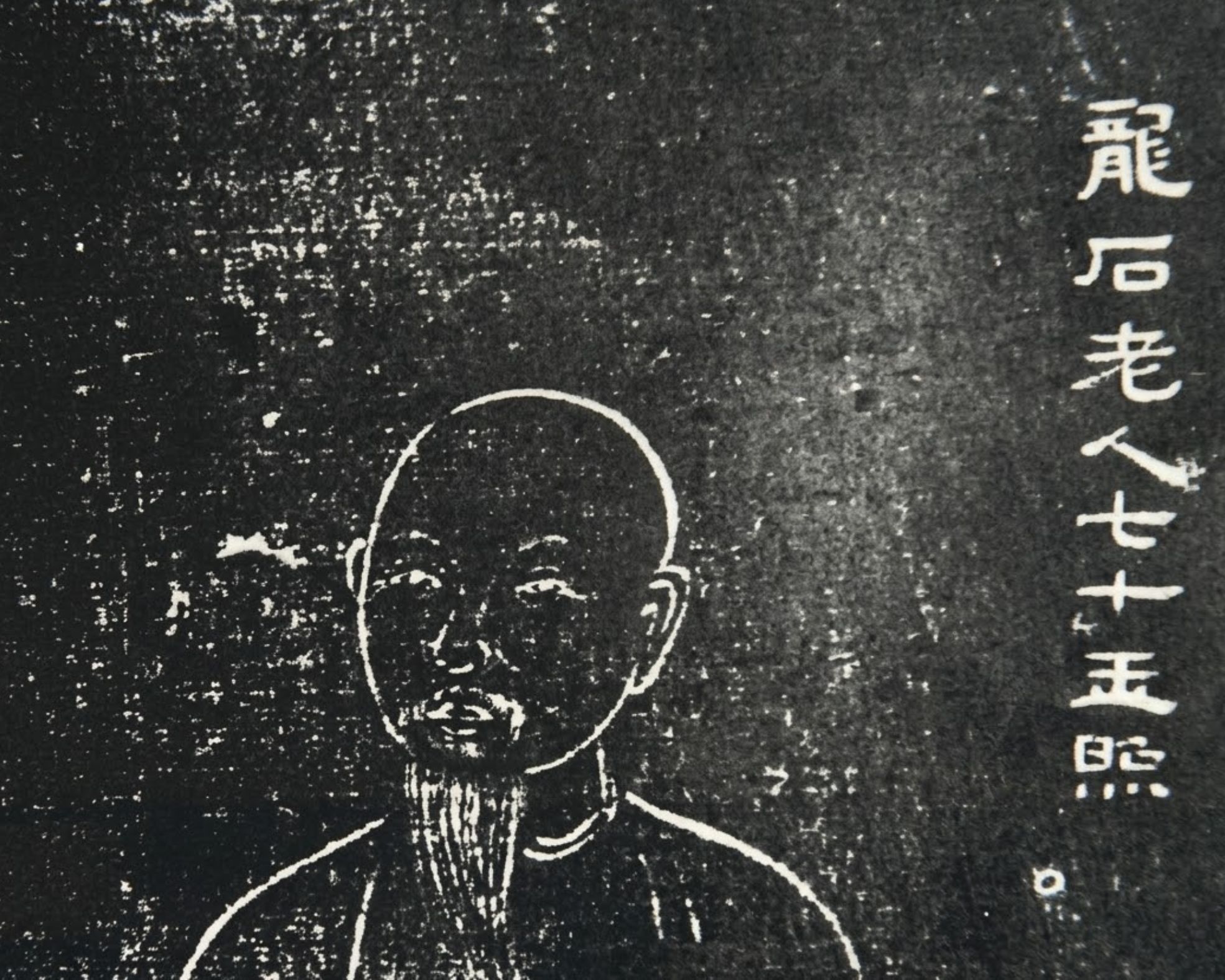
Portrait of Yang Hsieh
Yang Hsieh (楊澥) was born in the 46th year of the Ch’ien-lung reign 1781 and died in the 30th year of the Tao-kuang reign 1850. His original name was Hai (海), tzu Chu-t’ang (竹唐), hao Lung-shih (龍石), Lung-shih (聾石), Lung-shih Tao-jen (龍石道人). He was a native of Wu-chiang in Kiangsu province. He was proficient in archaic scripts, seal engraving and bamboo engraving. He was lauded by Contemporary Tales from the World of Ink (Mo-lin Chin-hua 墨林今話) as “The most prestigious engraver south of the Yangtze River.” His seal carvings were compiled into Works Executed in Chia-shen Year by Lung-shih Tao-jen (龍石道人甲申之作) and Impressions of Seals by Yang Lung-shih (楊龍石印存).
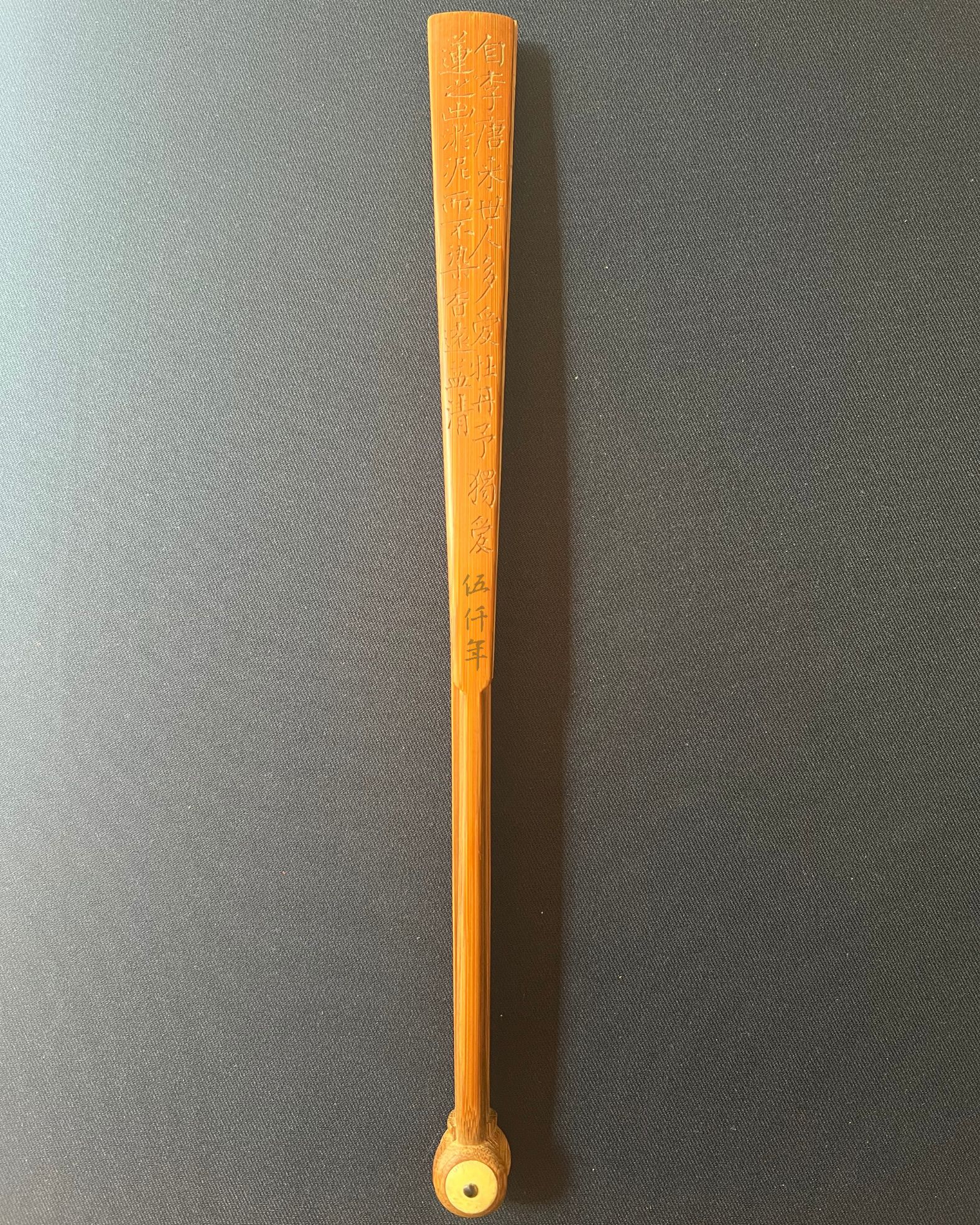
Regular script calligraphy written and engraved by Yang Hsieh on first bamboo fan guard
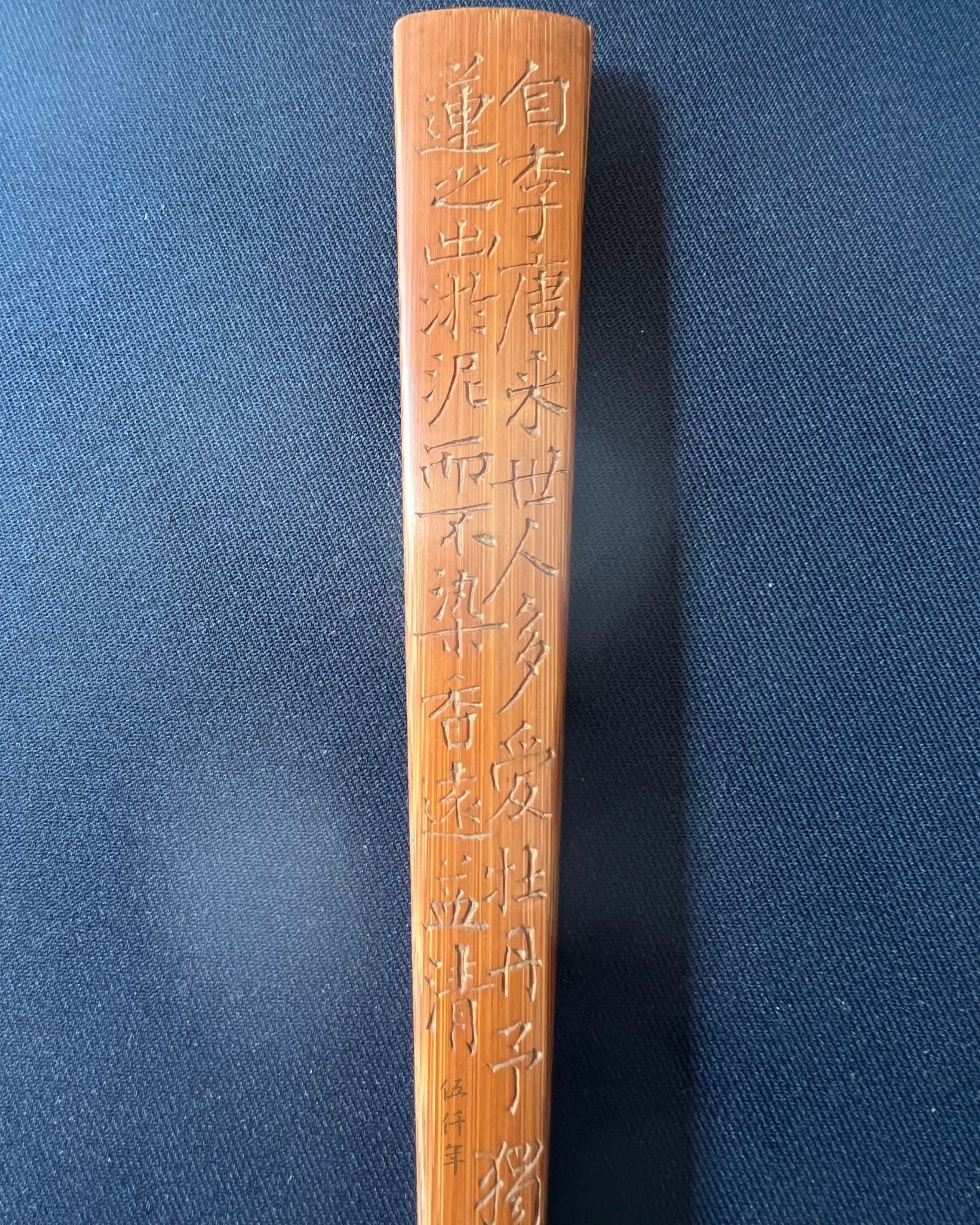
Detail of regular script calligraphy written and engraved by Yang Hsieh on first bamboo fan guard
Regular script calligraphy written and carved by Yang Hsieh (楊澥) on both fan guards.
Words engraved on the first fan guard reads:
“People have adored peony since the time of Li T’ang (李唐). I only love lotus for being untainted by the mud that sustained its growth. Its fragrance is far and pure.”
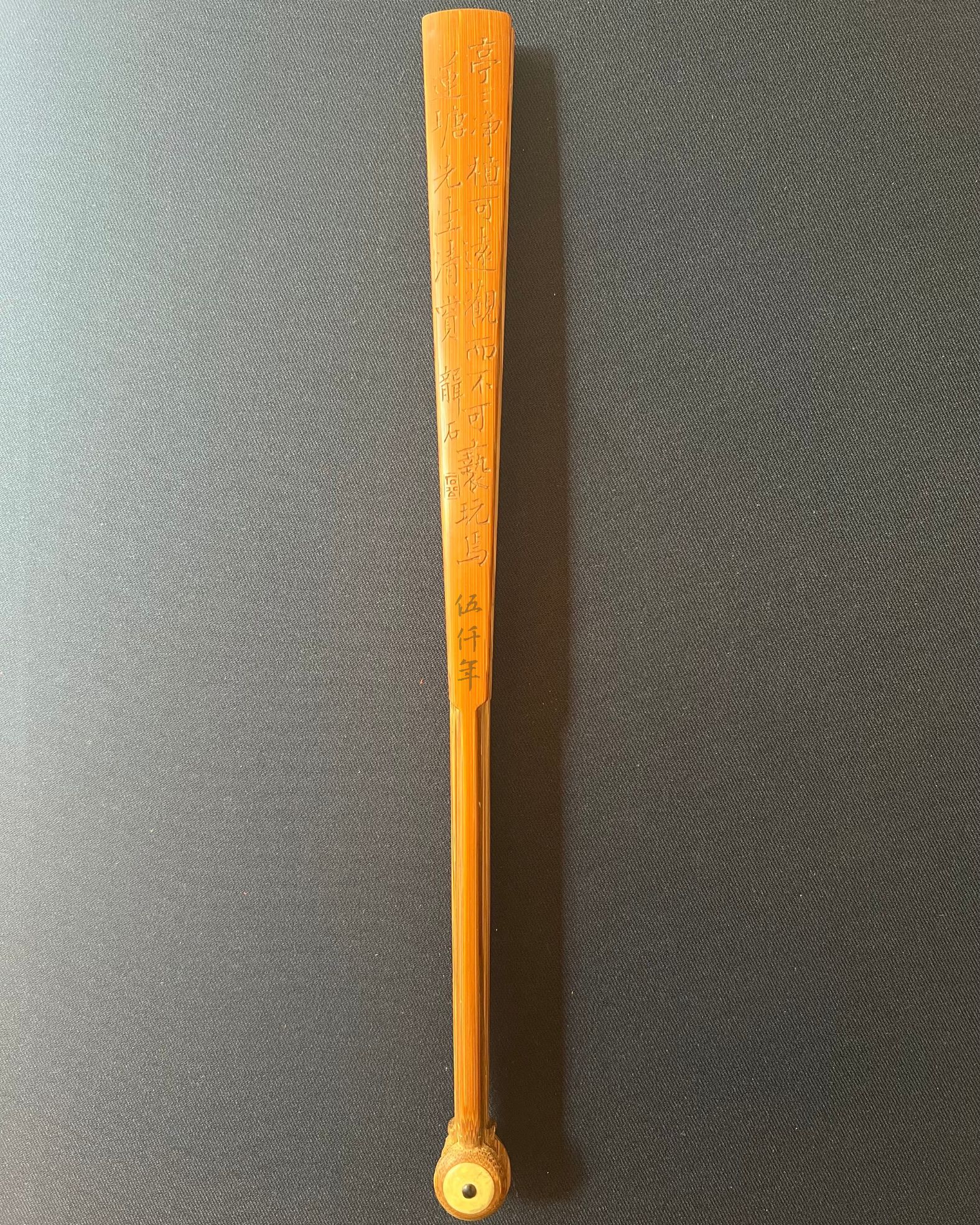
Regular script calligraphy written and engraved by Yang Hsieh on second bamboo fan guard
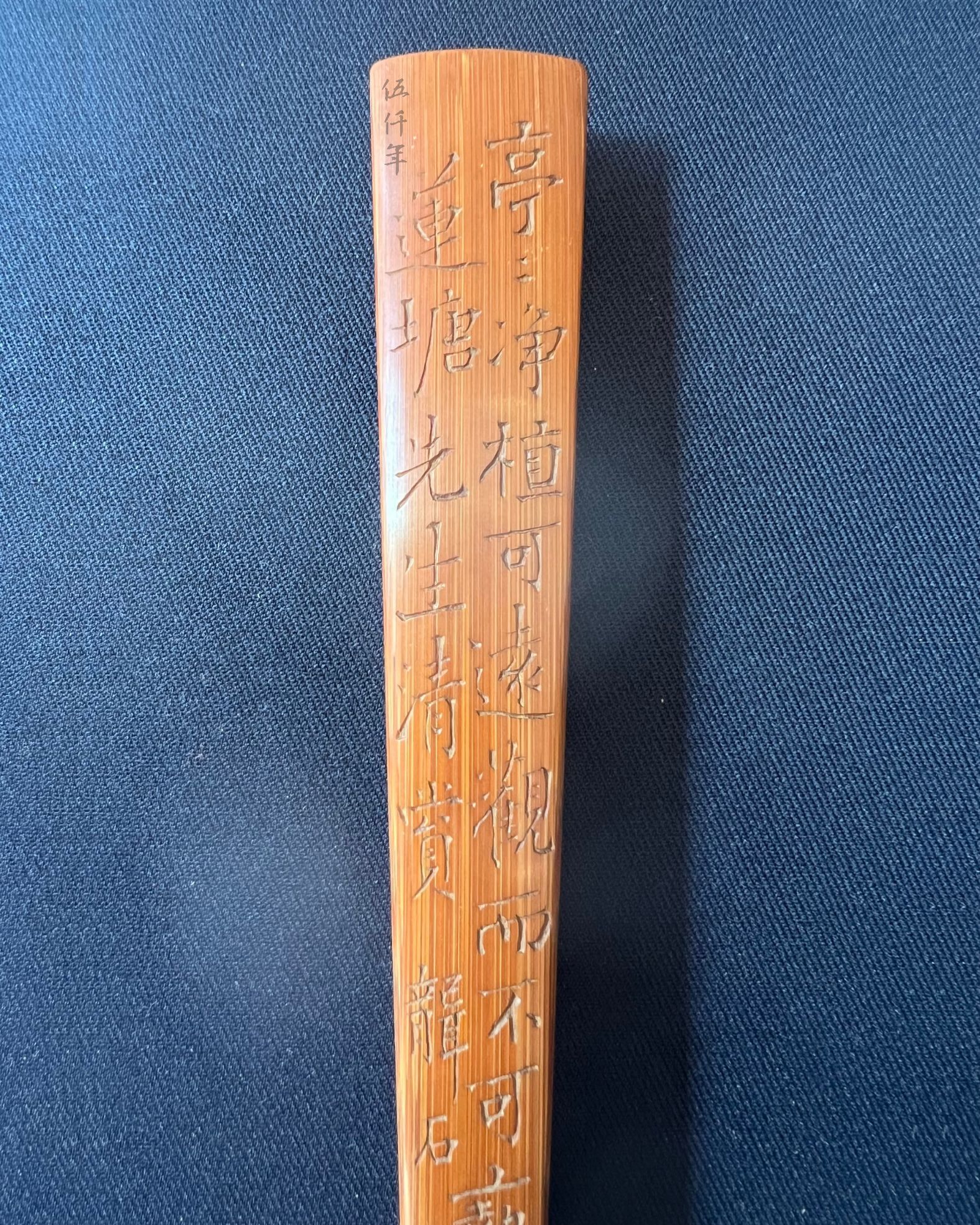
Detail of regular script calligraphy written and engraved by Yang Hsieh on second bamboo fan guard
Words engraved on the second fan guard reads:
“Its posture is neat and upright. It can be enjoyed from a distance, but not to dally with in close proximity. For the refined pleasure of Lien-t’ang, Lung-shih (聾石).”
Carved intaglio seal: “Shih-kung (石公)”
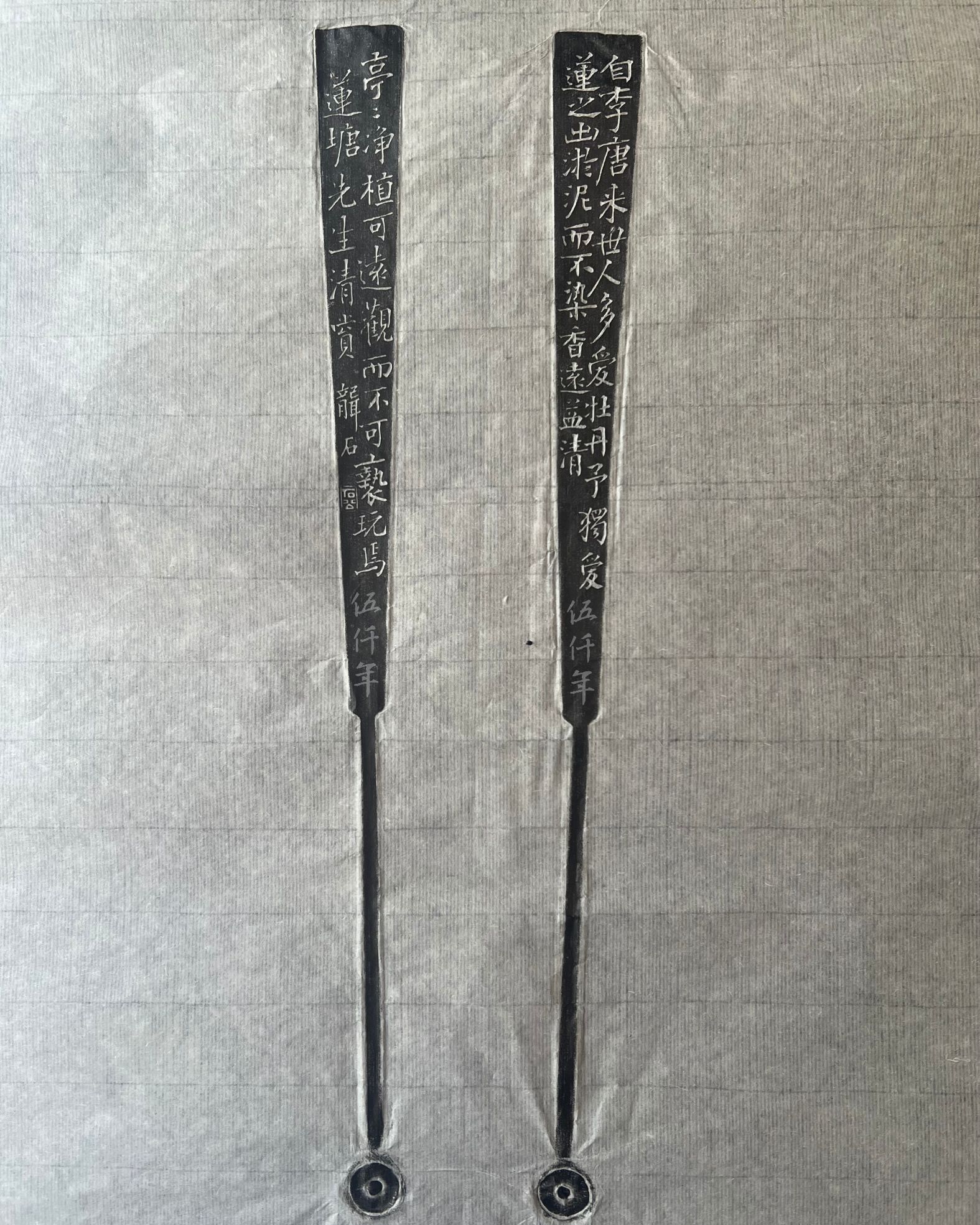
Ink rubbings of calligraphy written and engraved by Yang Hsieh on fan guards
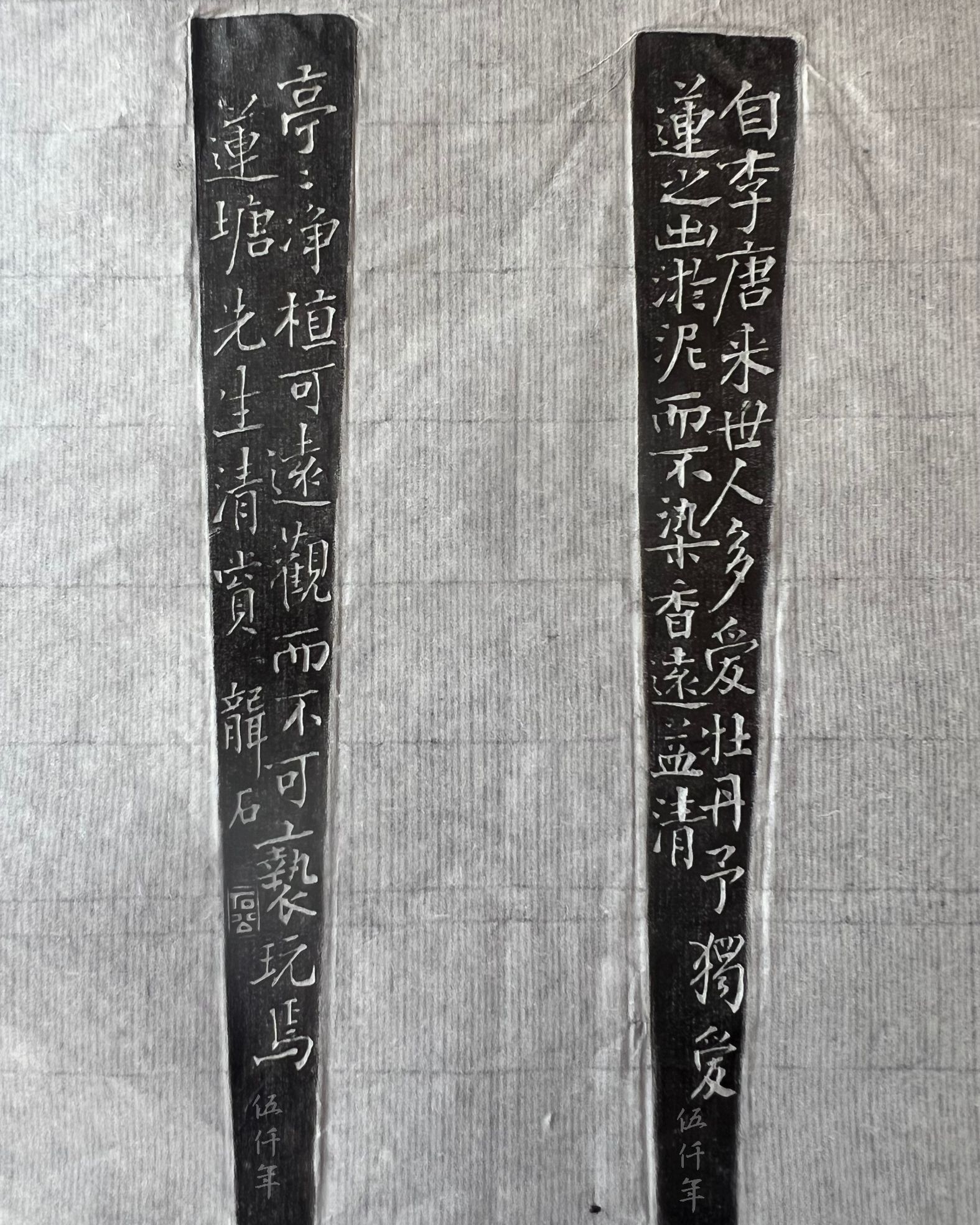
Ink rubbings of calligraphy written and engraved by Yang Hsieh on fan guards
Li T’ang (李唐), a painter from the Sung dynasty.
F.Self-Amusement:
No need to impress the world, only wish to self-amuse. Lofty breeze is the former self.
1.Inkstone in the form of broad bean with calligraphy by Ch’en Shu (陳書), Ch’ing dynasty.
Ch’en Shu (陳書) was born in the 14th year of the Yung-li reign of Southern Ming dynasty, or the 17th year of the Shun-chih reign of Ch’ing dynasty, 1660. She died in the 1st year of the Ch’ien-lung reign, 1736. Her tzu was Nan-lou (南樓), hao Shang-yüan Ti-tzu (上元弟子), late in life she adopted the hao of Nan-lou Lao-jen (南樓老人). She was a native of Hsiu-shui in Chekiang province, and married Ch’ien Lun-kuang (錢綸光) from Hai-yen, son of Ch’ien Ch’en-ch’un (錢陳羣). He became an important official in the court, Ch’en Shu was then bestowed the honorific title of Madame T’ai-shu (太淑夫人). She was proficient in painting flowers, birds, insects, landscape and figures. Her brushwork was robust, the manner simple and archaic. Her writings were published under the title Draft Poems of Fu-an (復庵吟稿).
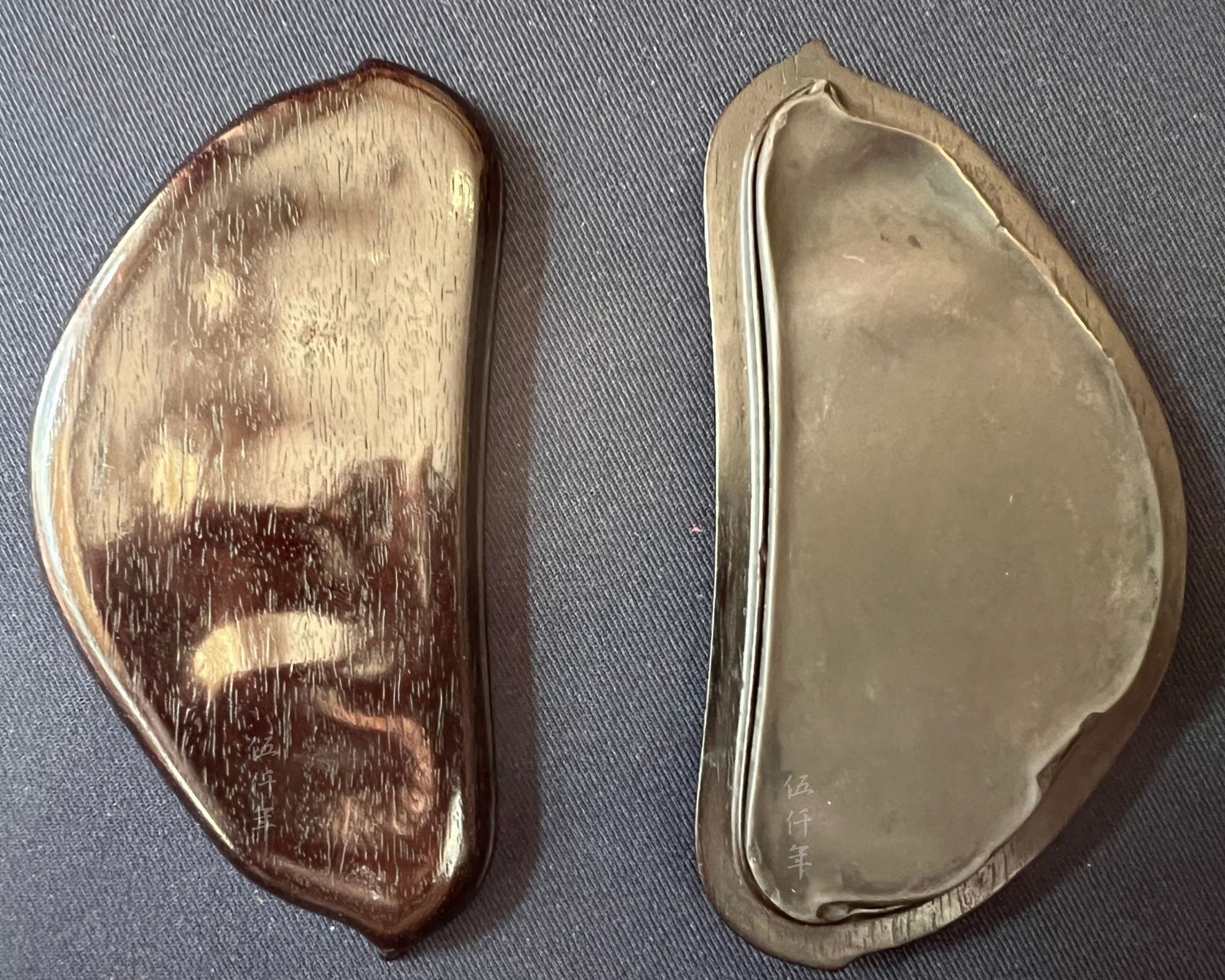
Inkstone in the form of broad bean with calligraphy written by Ch’en Shu
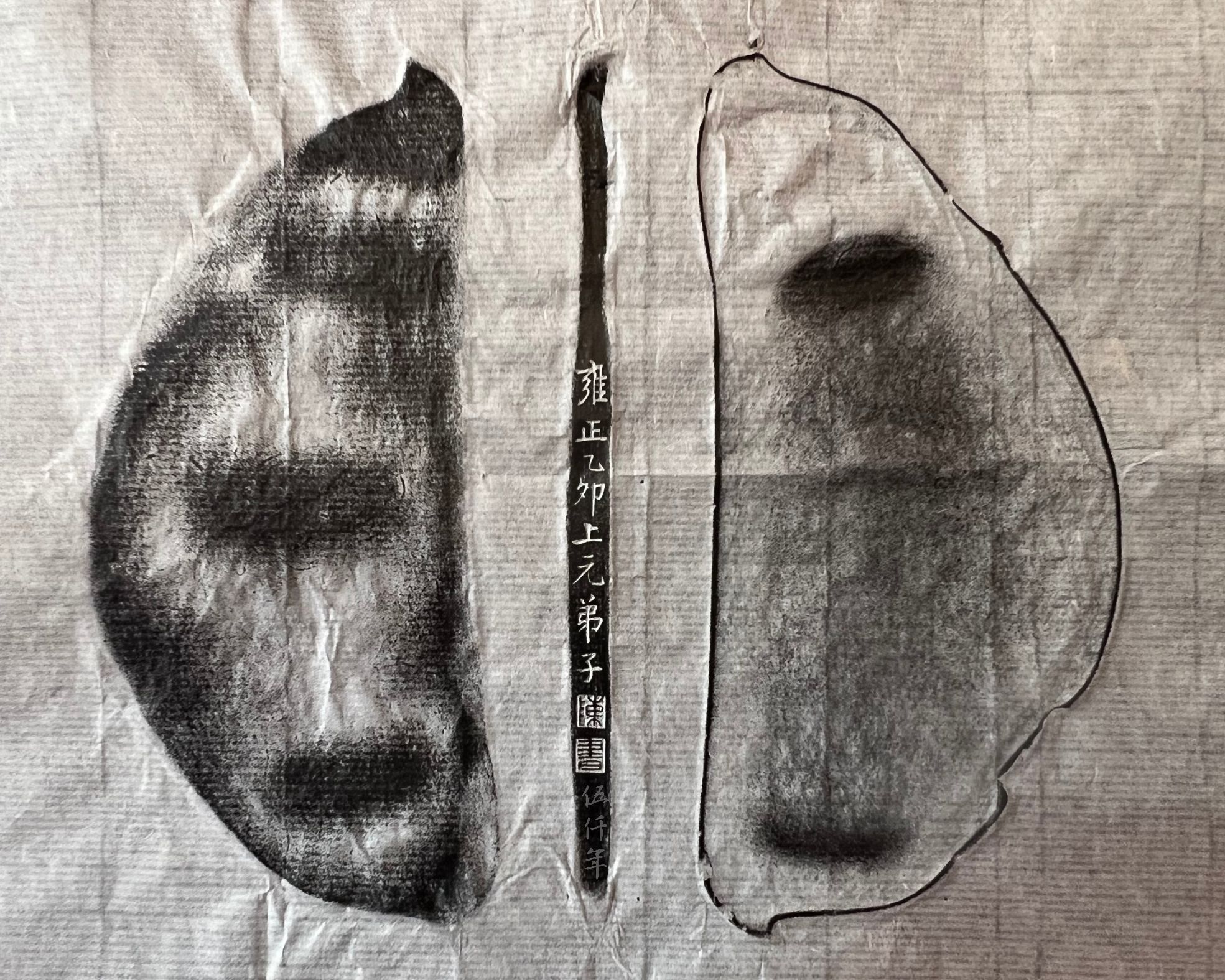
Ink rubbing of inkstone in the form of broad bean with calligraphy written by Ch’en Shu
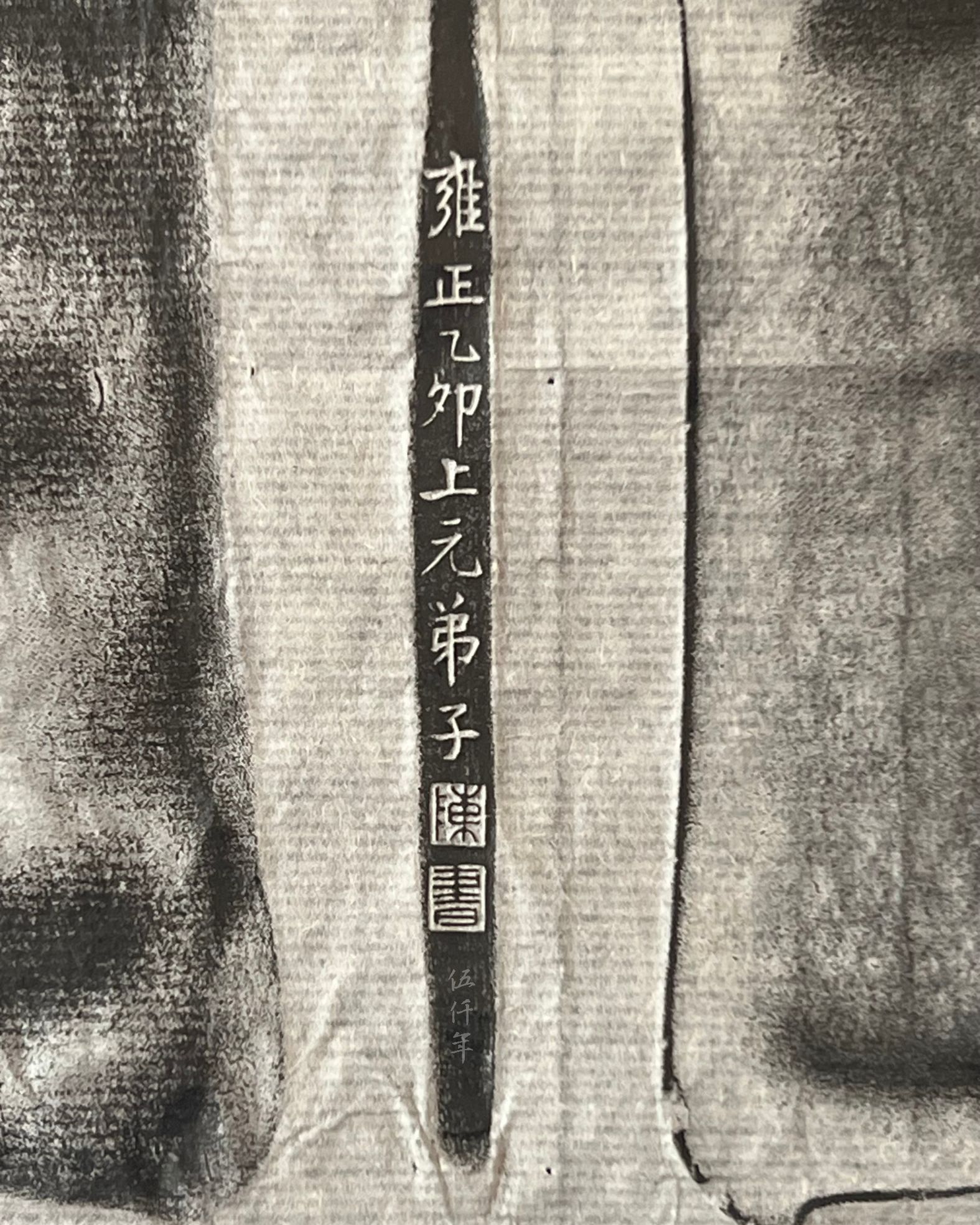
Ink rubbing of side wall of inkstone with calligraphy written by Ch’en Shu
Regular script calligraphy by Ch’en Shu (陳書) engraved on the side wall of the inkstone. The words are:
“In i-mao (乙卯) year of the Yung-cheng reign, Shang-yüan Ti-tzu (上元弟子)”.
Carved relief seals: “Ch’en (陳)”, “Shu (書)”.
The seal was engraved in i-mao year, which corresponds to the 13th year of the Yung-cheng reign.
G.Captivation
Travelers through the prosaic world are compelled to deal with the clamour of human affairs. Literary and artistic pursuits are here to pacify hearts and minds.
a) Vestige of Poetry
1.A bronze paperweight in the form of a ruler, with calligraphy and carving by Ch’en Yin-sheng (陳寅生), Ch’ing dynasty.
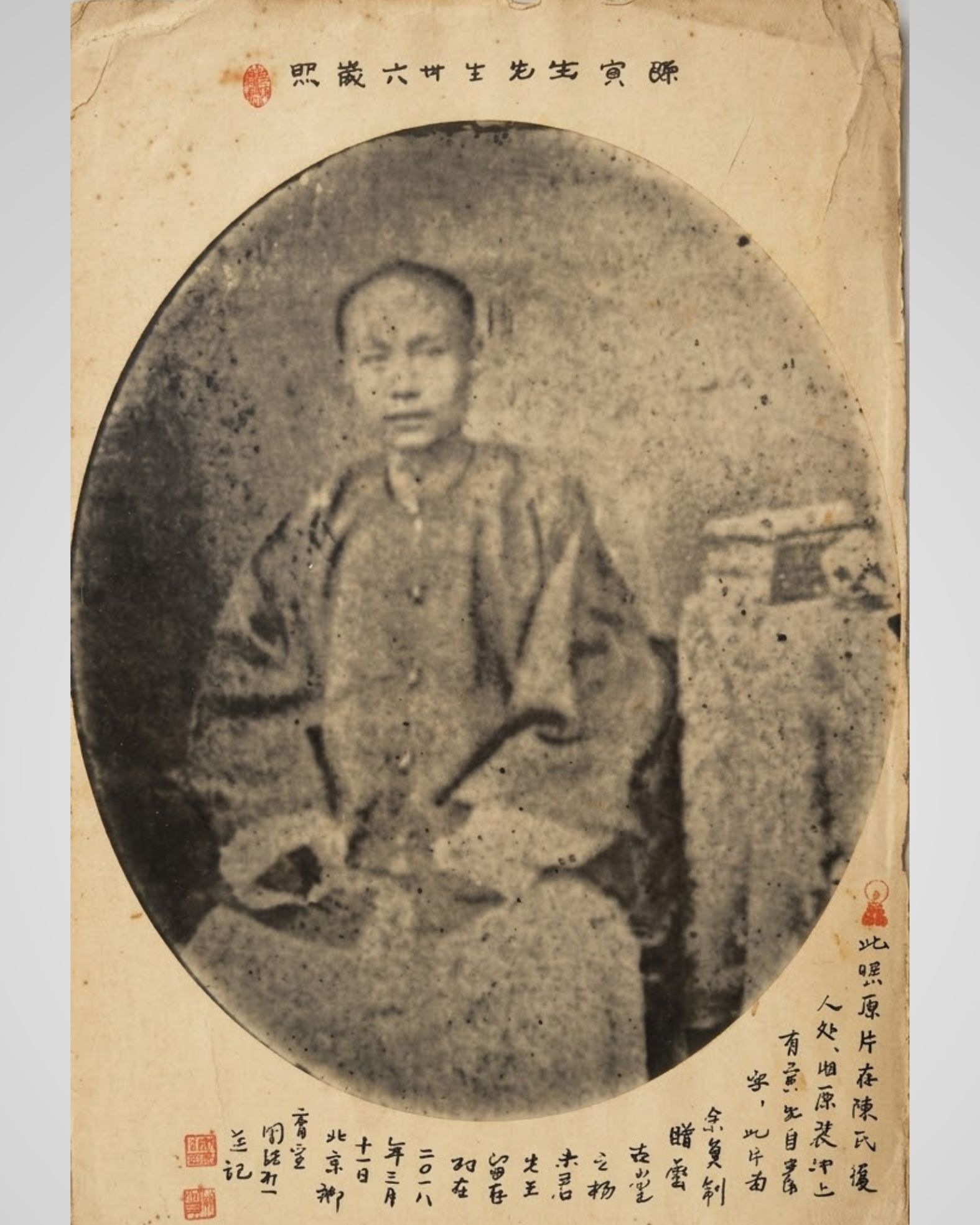
Portrait of Ch’en Yin-sheng
Ch’en Yin-sheng (陳寅生), original name Lin-pin (麟炳), attained his hsiu-ts’ai (秀才) degree during the T’ung-chih reign. He was the creator of the genre of carved bronze desk accoutrements, and his works are highly sought after. He was proficient in calligraphy, and painted flowers and birds as well.
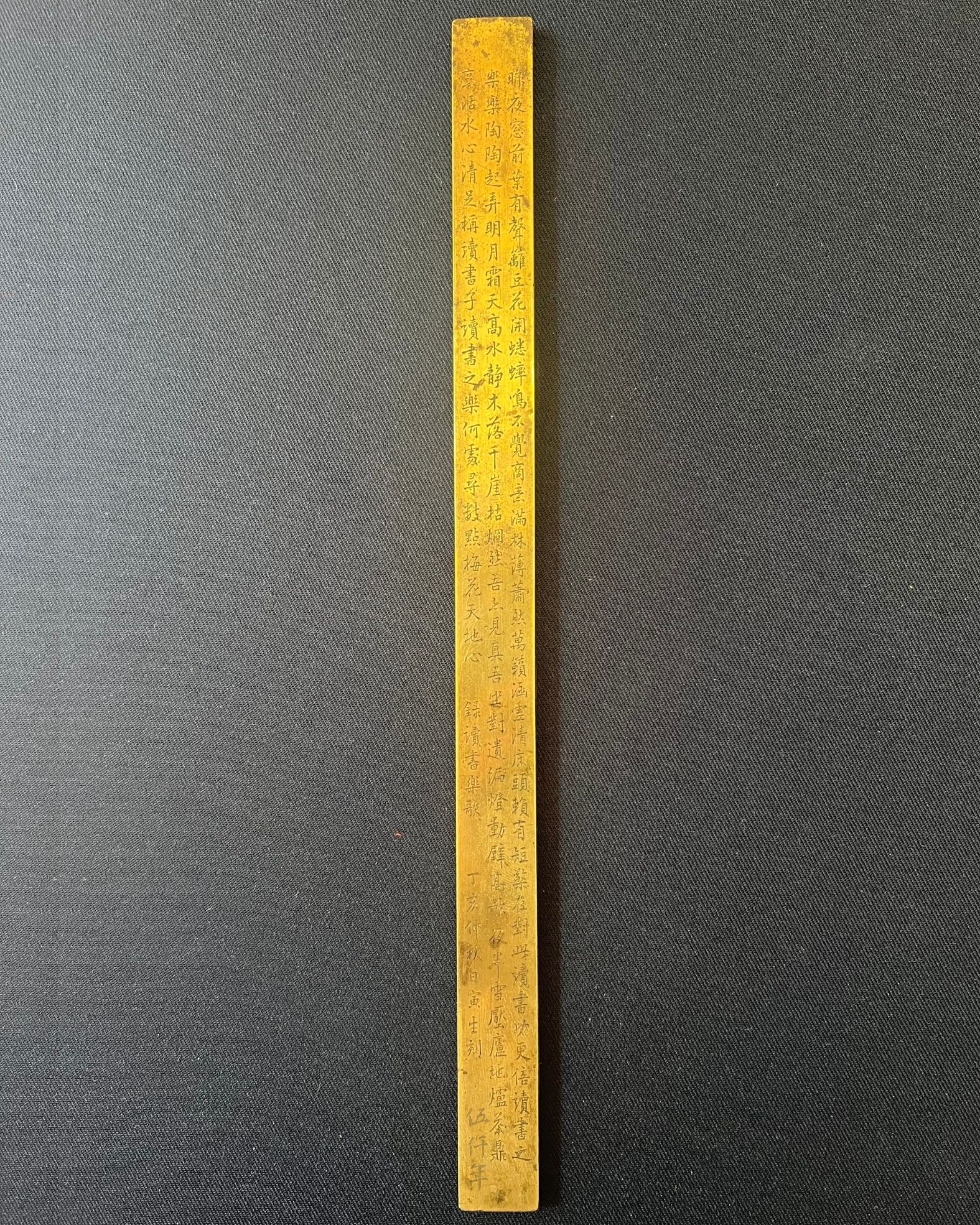
Bronze ruler paperweight with calligraphy written and engraved by Ch’en Yin-sheng
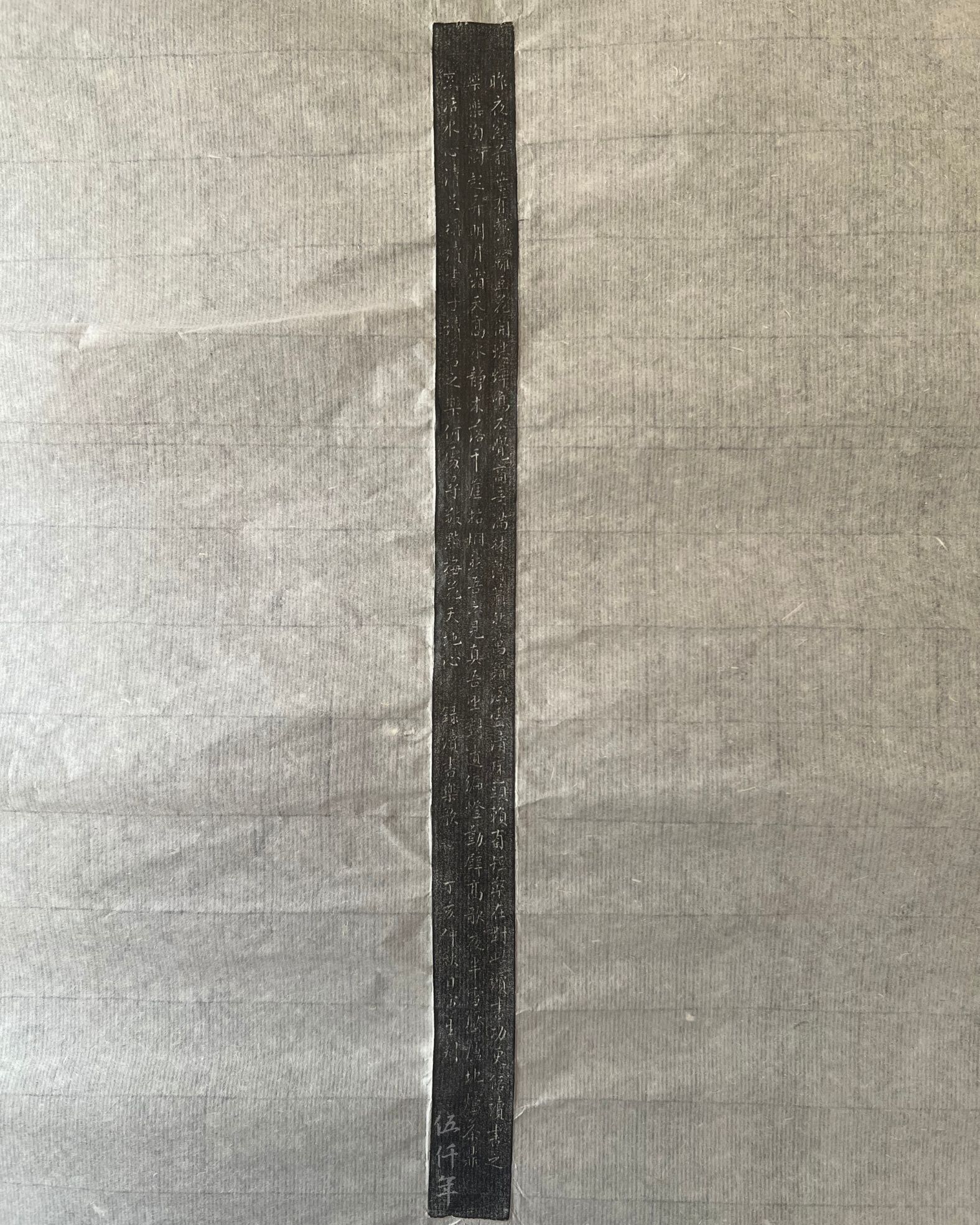
Ink rubbing of bronze ruler paperweight with calligraphy written and engraved by Ch’en Yin-sheng
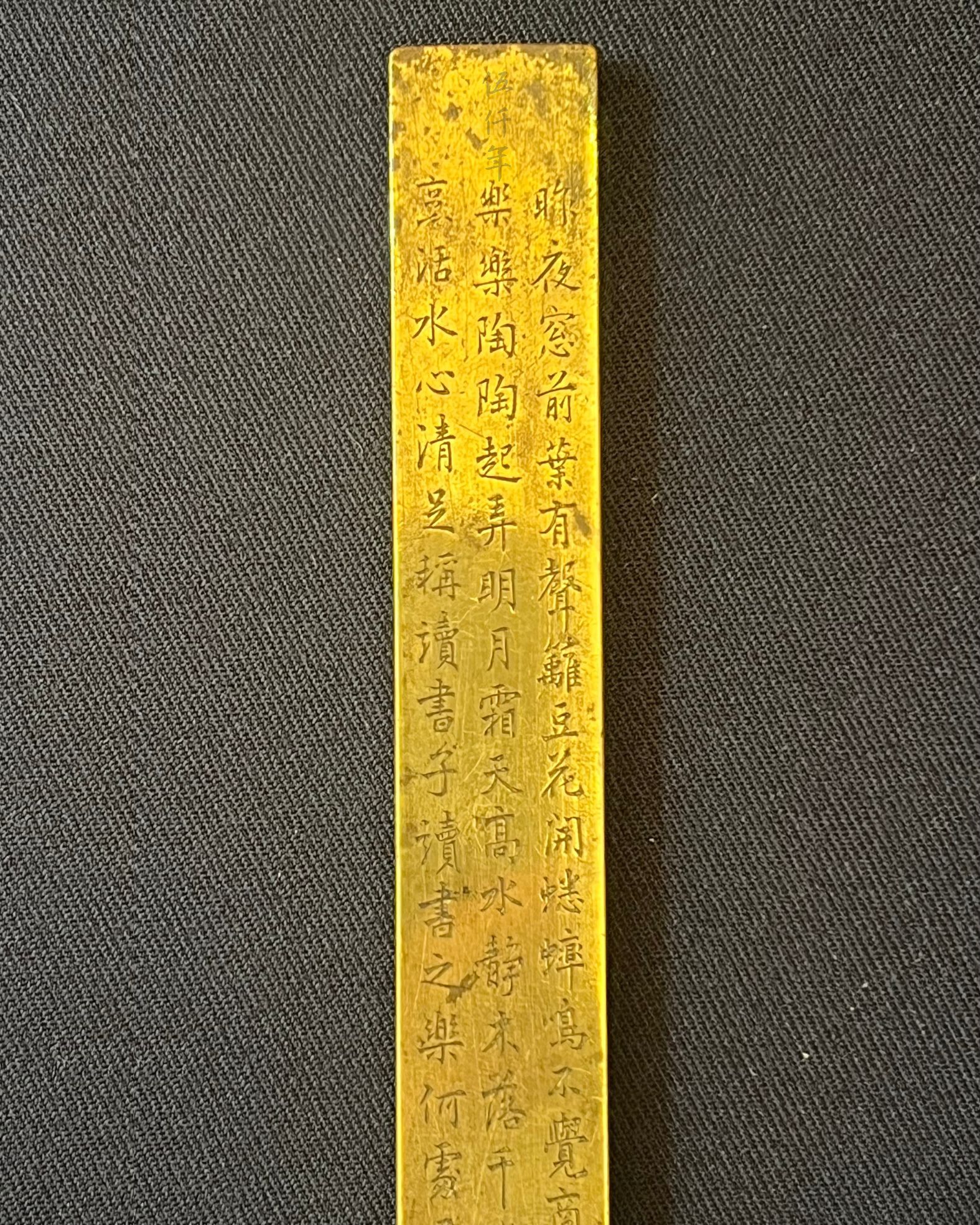
Upper part of bronze ruler paperweight with calligraphy written and engraved by Ch’en Yin-sheng
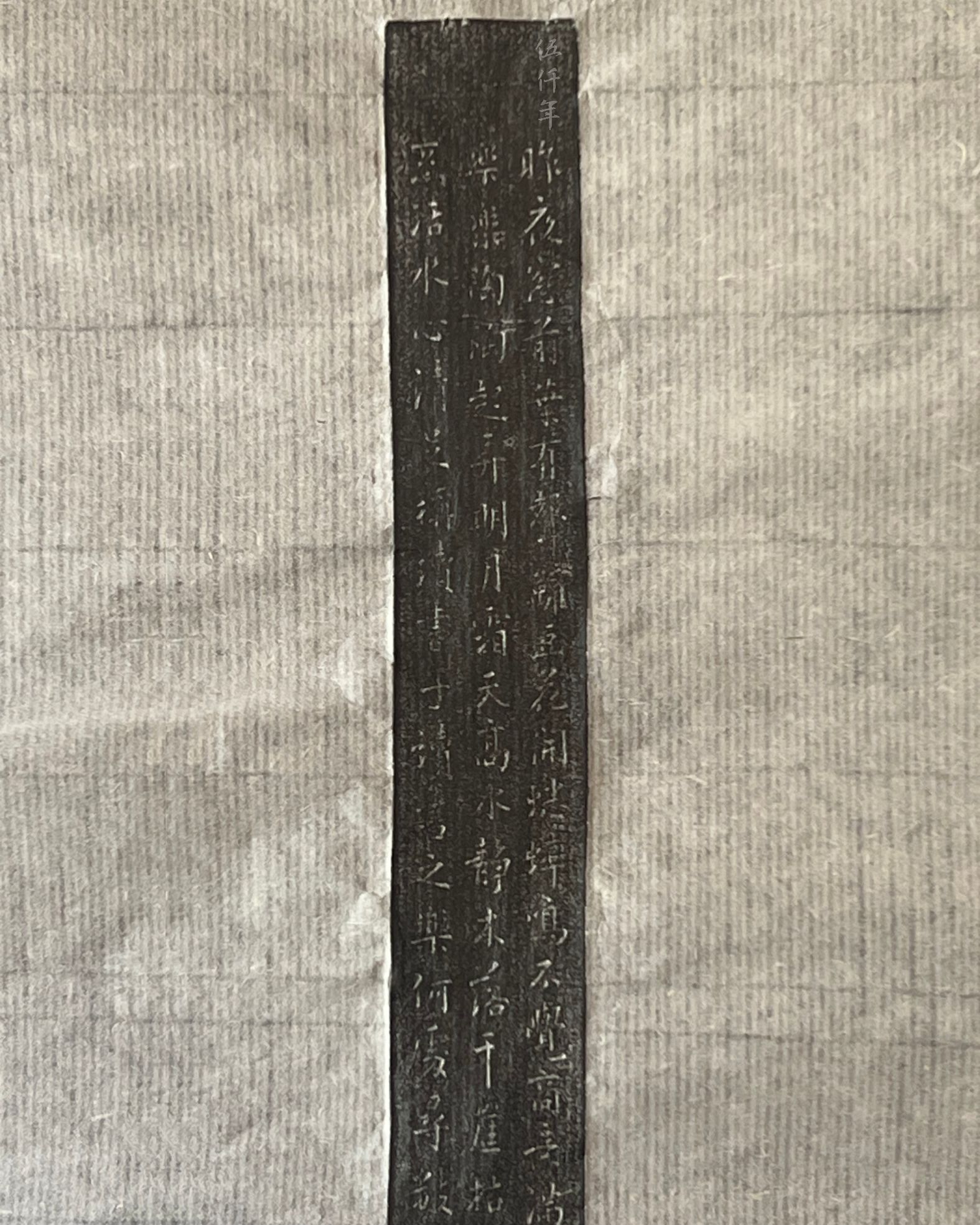
Ink rubbing of upper part of bronze ruler paperweight with calligraphy written and engraved by Ch’en Yin-sheng
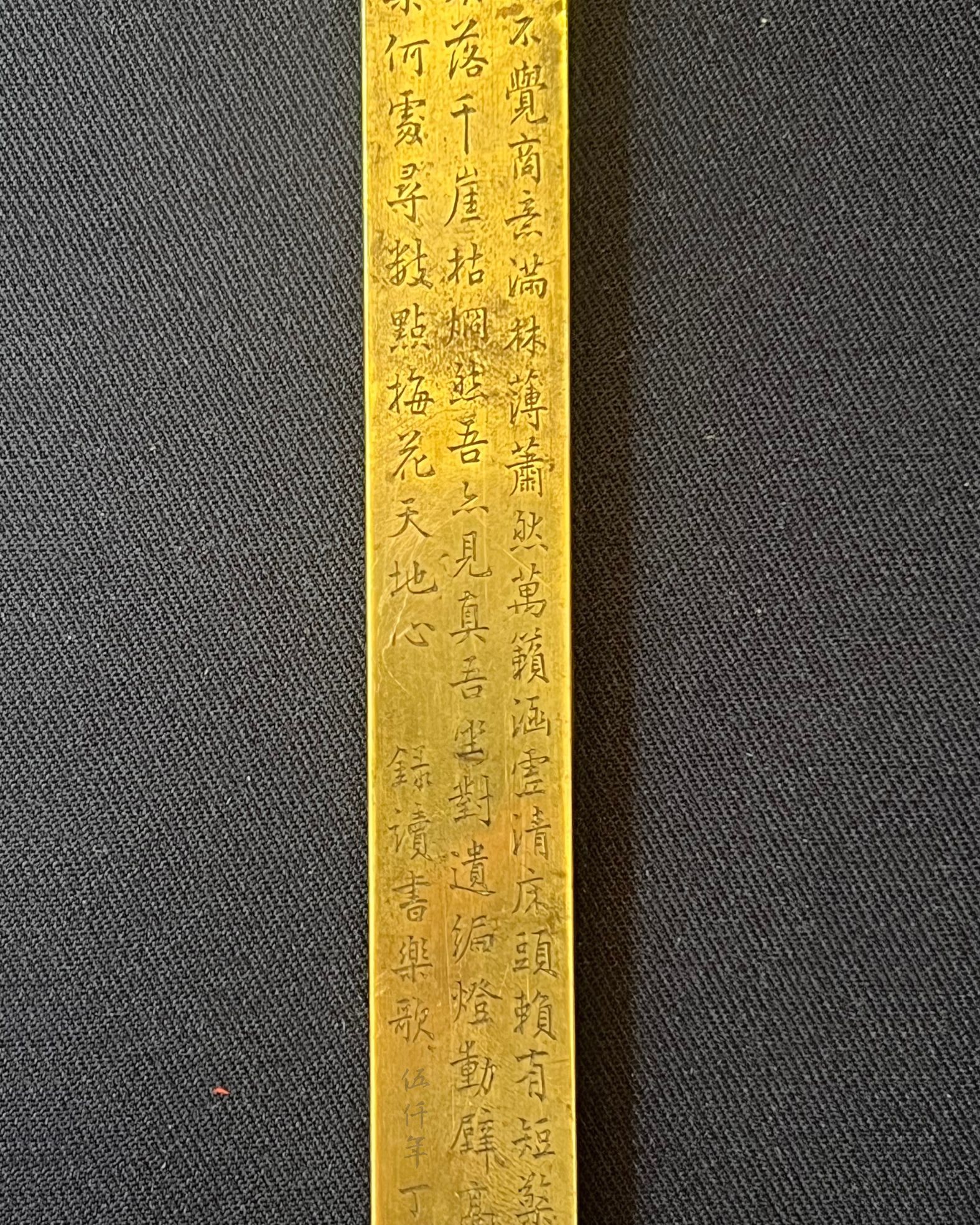
Middle part of bronze ruler paperweight with calligraphy written and engraved by Ch’en Yin-sheng
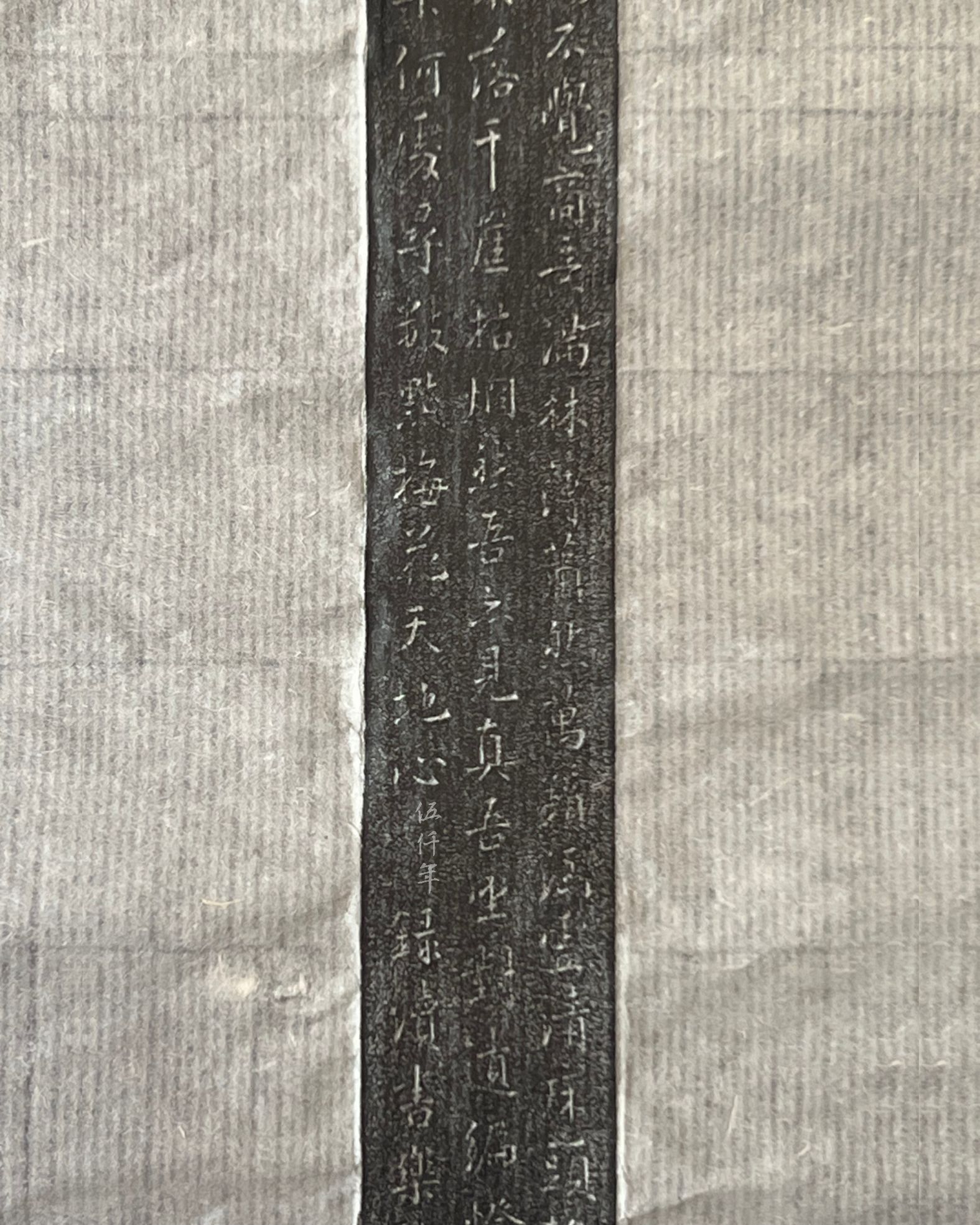
Ink rubbing of middle part of bronze ruler paperweight with calligraphy written and engraved by Ch’en Yin-sheng
Lower part of bronze ruler paperweight with calligraphy written and engraved by Ch’en Yin-sheng
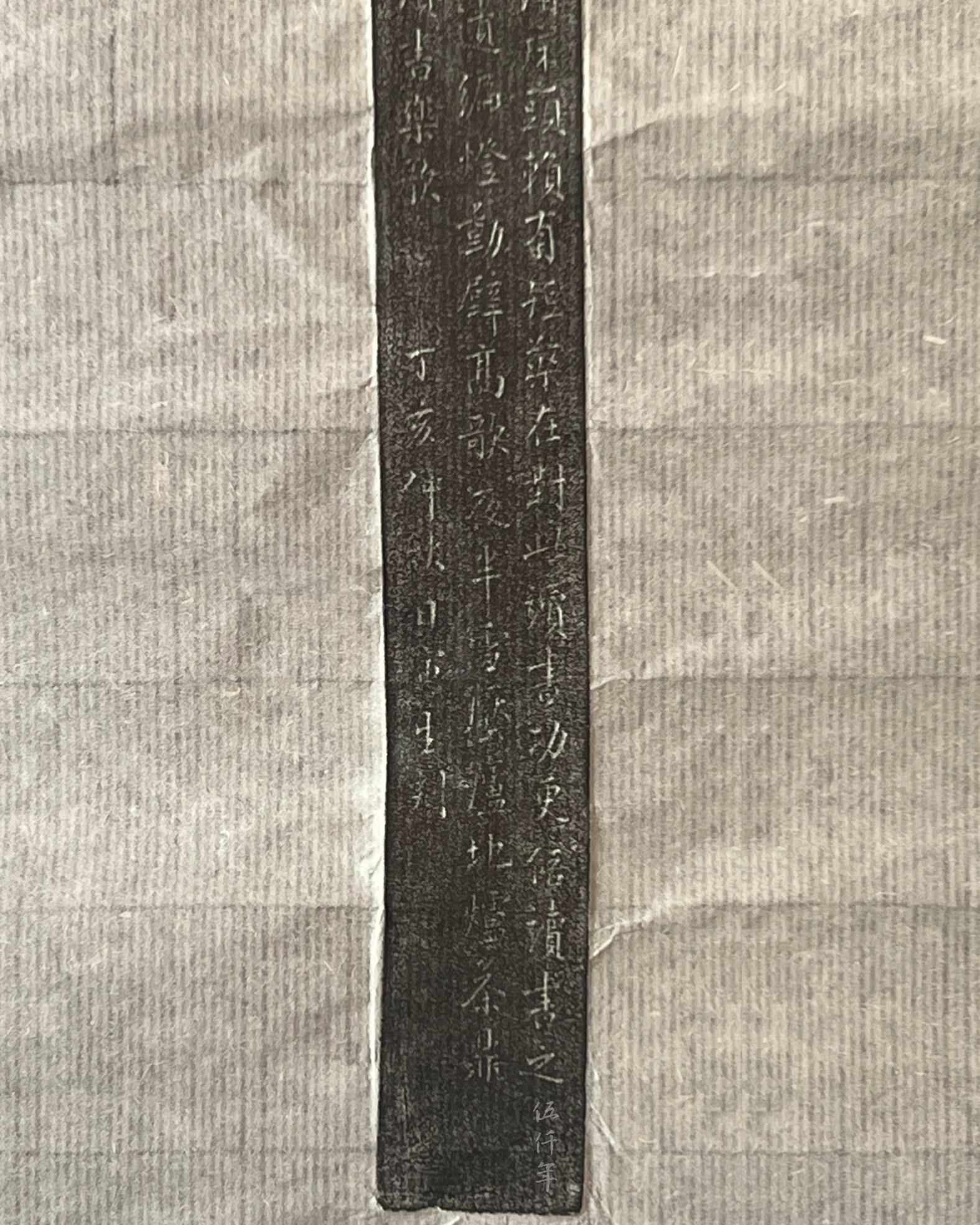
Ink rubbing of lower part of bronze ruler paperweight with calligraphy written and engraved by Ch’en Yin-sheng
Regular script calligraphy of Song of Happy Reading (讀書樂歌), written and carved by Ch’en Yin-sheng (陳寅生). The text reads:
“Before the window last night,
Leaves rustled in the wind.
Broad bean flowers blossomed
And crickets chirped aloud.
Lonesome mood of Autumn,
Saturates groves and woods.
Deep quiet veils the landscape,
In limbo and in nothingness.
There’s an oil lamp I count on,
Placed right next to my bed.
To read a book in front of it,
It makes my effort doubly fast.
This joy received from reading,
A joy deemed too intoxicating.
Rise to tease the luminous moon,
Across a vast frosted sky.
Water muted by fallen leaves,
Bare trees on a thousand cliff.
Suddenly it dawns on me to know,
True heart of my innermost self.
Reading books from time bygone,
Flickering flame cast on wall.
Singing with full voice in midnight,
Snow keeps piling onto rooftop.
Make use of stove and kettle,
Boil water ladled from stream.
When heart is pure and untainted,
Worthy title of scholar earned.
Where can one hope to find,
This joy that comes from reading.
In a few plum blossom petals,
In a heart in tune with universe.
Copying Song of Happy Reading (讀書樂歌) in the eighth month of ting-hai (丁亥) year, carved by Yin-sheng.”
The paperweight was carved in ting-hai (丁亥) year, which corresponds to the 13th year of the Kuang-hsü reign, 1887. Ch’en Yin-sheng copied the texts of the Autumn and Winter passages from Song of Happy Reading by Weng Sen (翁森), a poet from the Yüan dynasty.
b) Vestige of Calligraphy
1. Bamboo fan guards with calligraphy by Ch’ang T’ing-chi (張廷濟), Ch’ing dynasty.
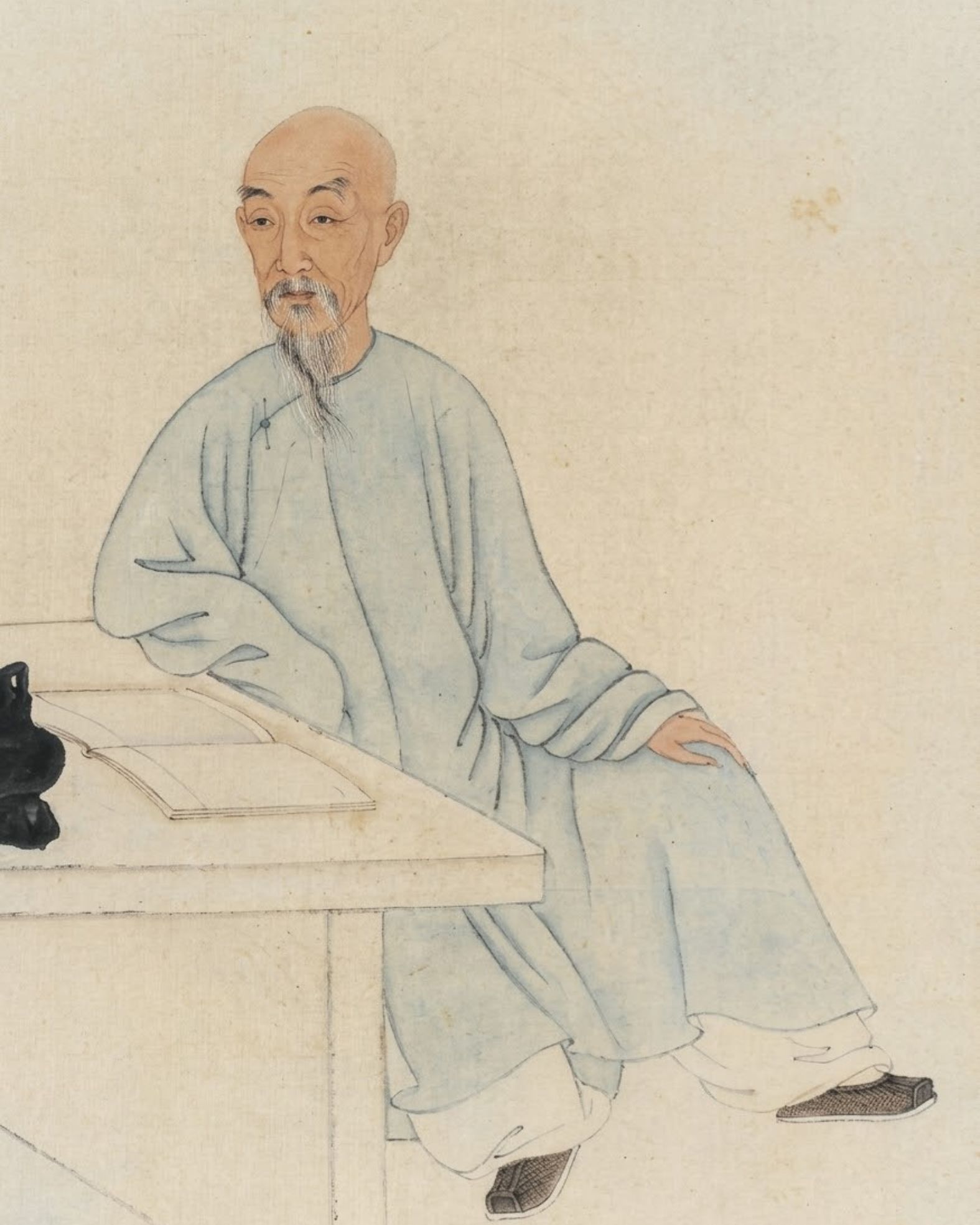
Portrait of Ch’ang T’ing-chi
Chang T’ing-chi (張廷濟) was born in the 33rd year of the Ch’ien-lung reign 1768, and died in the 28th year of the Tao-kuang reign 1848. His original name was Ju-lin (汝林), his tzu was Shun-an (順安), his hao were Shu-wei (叔未), Shou-chou (說舟), Tso-t’ien (作田), Hai-yüeh An Men-hsia-ti-tzu (海岳庵門下弟子), late in life he adopted the hao of Mei-shou Lao-jen (眉壽老人). He was a native of Chia-hsing in Chekiang province. In the 3rd year of the Chia-ch’ing reign, he came first in the provincial examination. He was proficient in poetry, tz’u lyrics and epigraphy. He had an extensive art collection. He also excelled in calligraphy and occasionally painted prunus. His writings include Colophons and Inscriptions from Ch’ing-i Ko (清儀閣題跋), Poetry from Ch’ing-i Ko (清儀閣詩鈔), Impressions of Seals from Ch’ing-i Ko (清儀閣印譜), Writings from Mei-shou T’ang (眉壽堂集), Writings from Kuei-hsin T’ang (桂馨堂集).
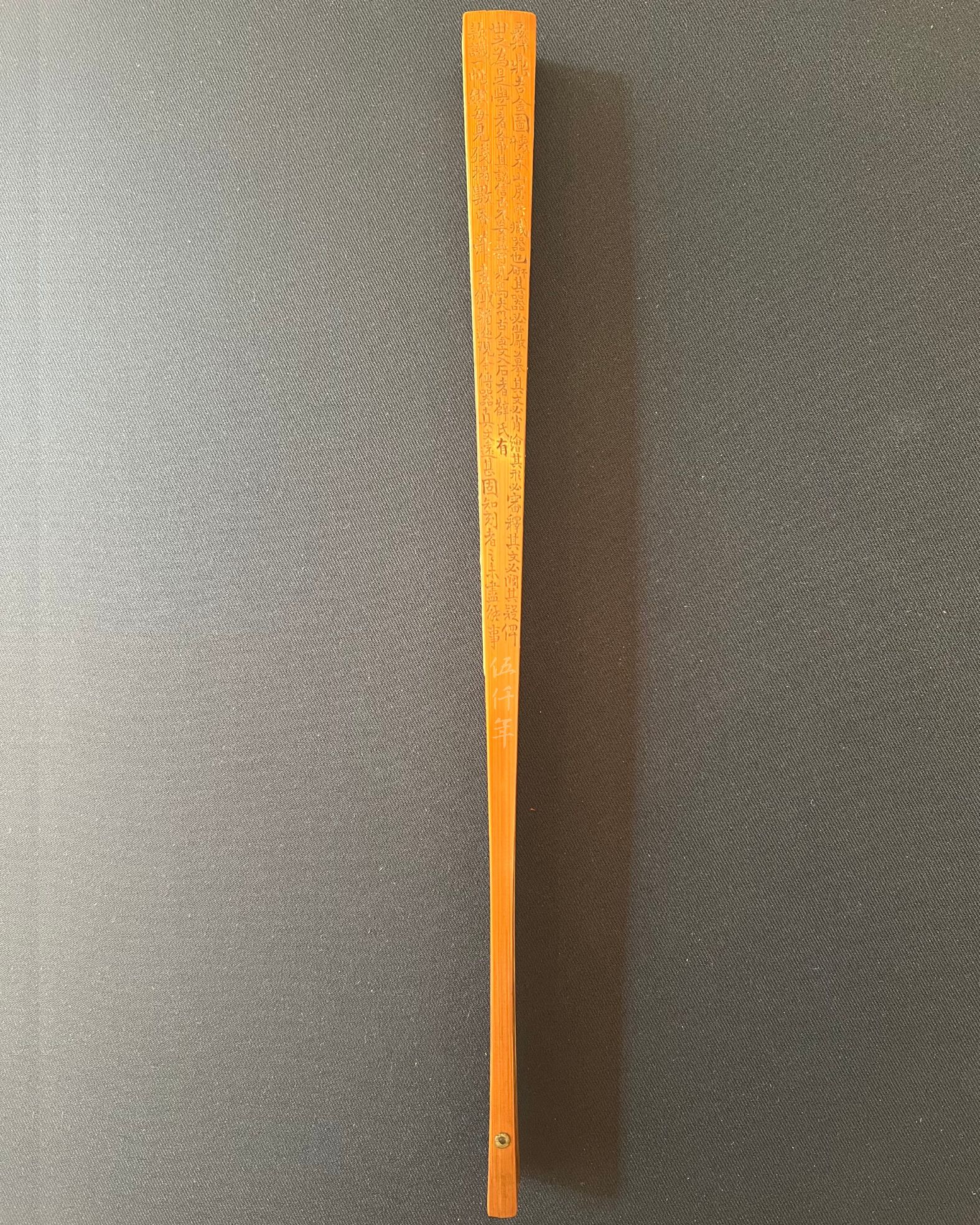
Calligraphy written by Ch’ang T’ing-chi engraved on first bamboo fan guard
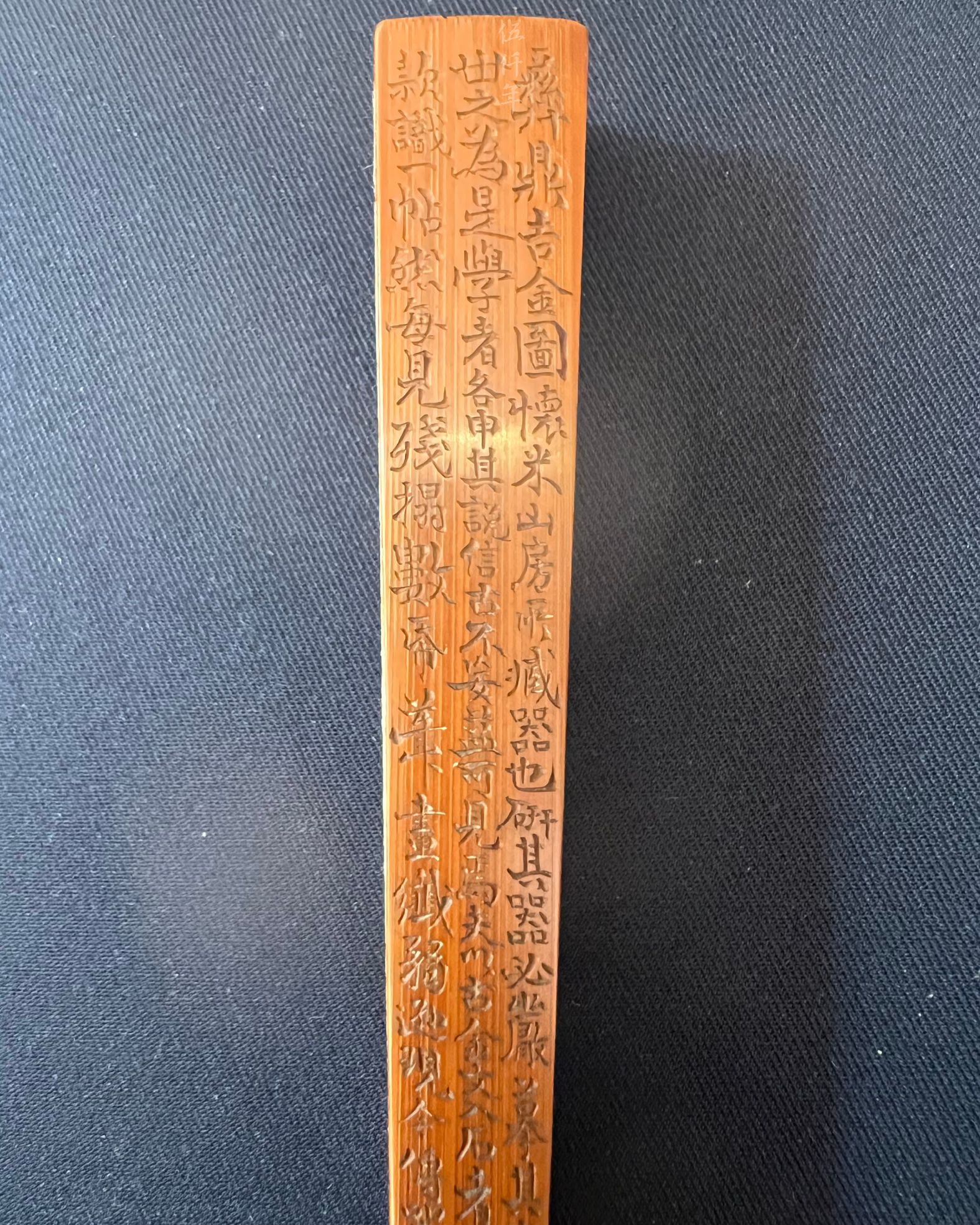
Detail of calligraphy written by Ch’ang T’ing-chi engraved on first bamboo fan guard
Regular script calligraphy of Foreword to Engravings of Archaic Vessels in the Collection of Huai-mi Shan-fang (懷米山房吉金圖序) by Ch’ang T’ing-chi (張廷濟), carved on fan guards.
Calligraphy inscription engraved on the first fan guard reads:
“This set of Engravings of Archaic Vessels relate to the pieces in the Collection of Huai-mi Shan-fang (懷米山房). To study these pieces properly, it is imperative to scrupulously trace the characters, to meticulously draw the forms, to accurately decipher the texts, to rigorously diminish the doubts. For scholars who study this topic, it is ever more apparent that they all have different opinions, they trust the ancients but do not fall prey to untruth. The Hsueh (薜) family commissioned carvings of Ch’in (秦) dynasty archaic script onto stone stelae and produced ink rubbings of them. However every time I come across some of the extant sheets of ink rubbings, the calligraphic strokes appear weak and feeble, far inferior to the archaic script recorded by these vessels. Hence we know that the carver did not apply his full ability.”
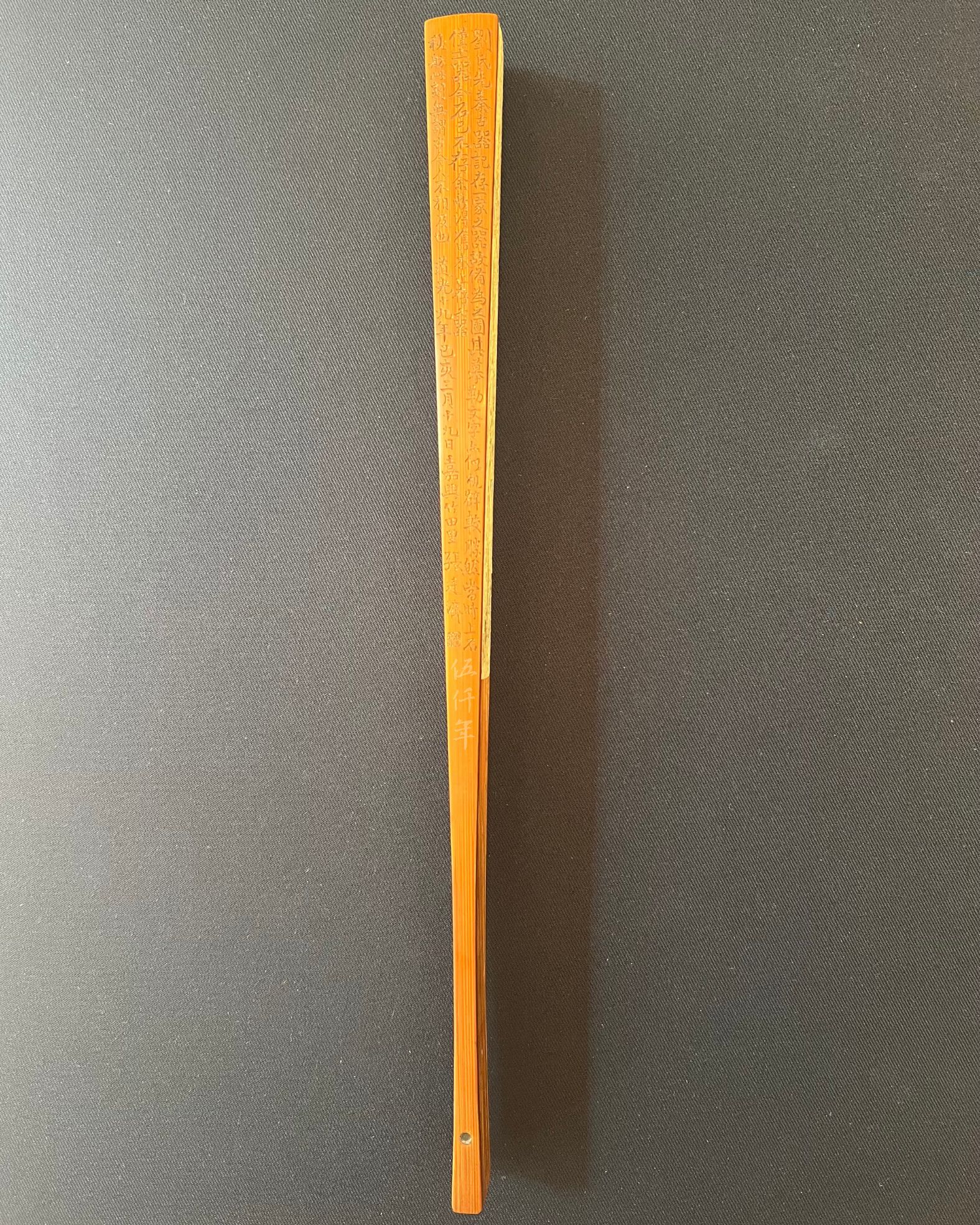
Calligraphy written by Ch’ang T’ing-chi engraved on second bamboo fan guard
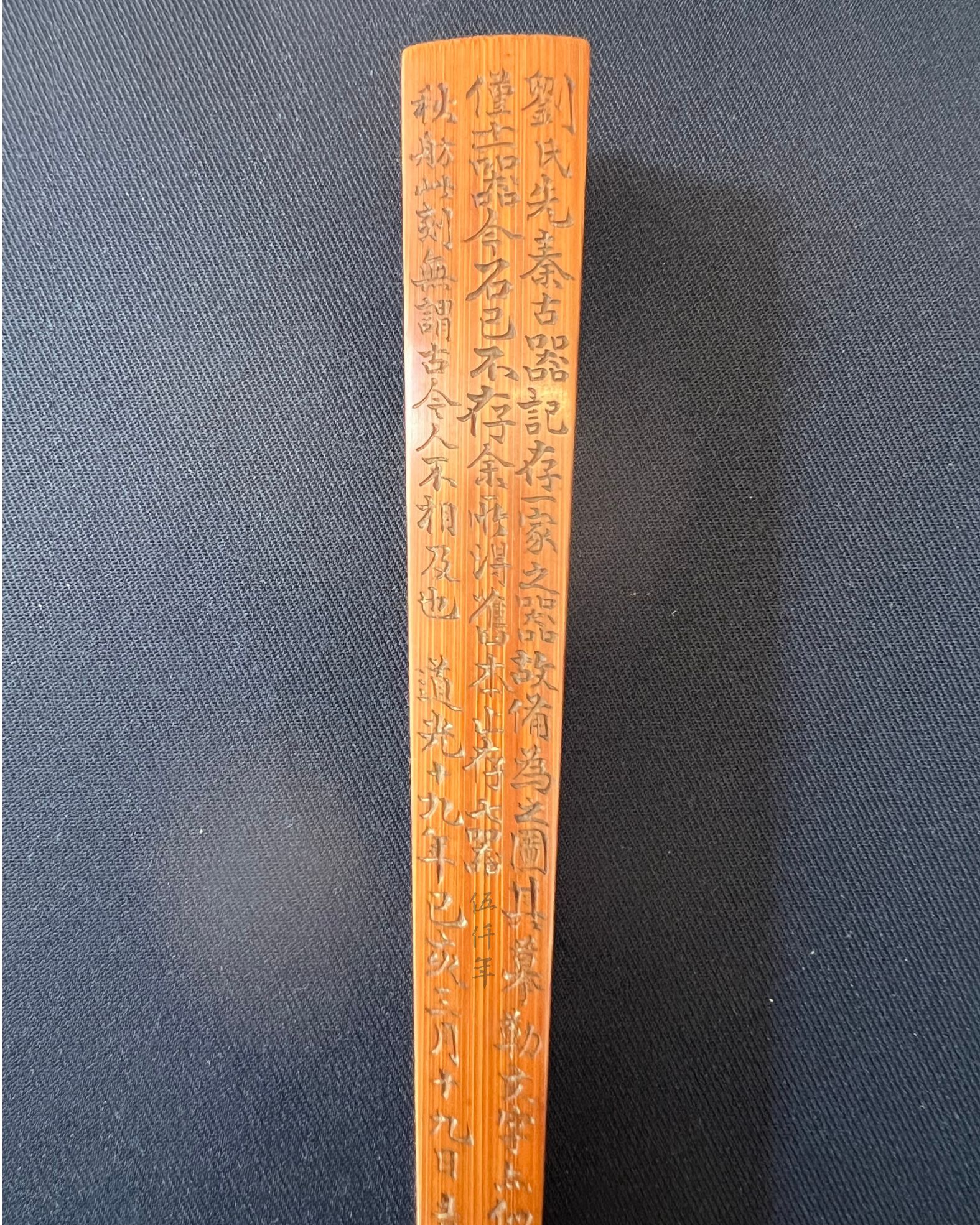
Detail of calligraphy written by Ch’ang T’ing-chi engraved on second bamboo fan guard
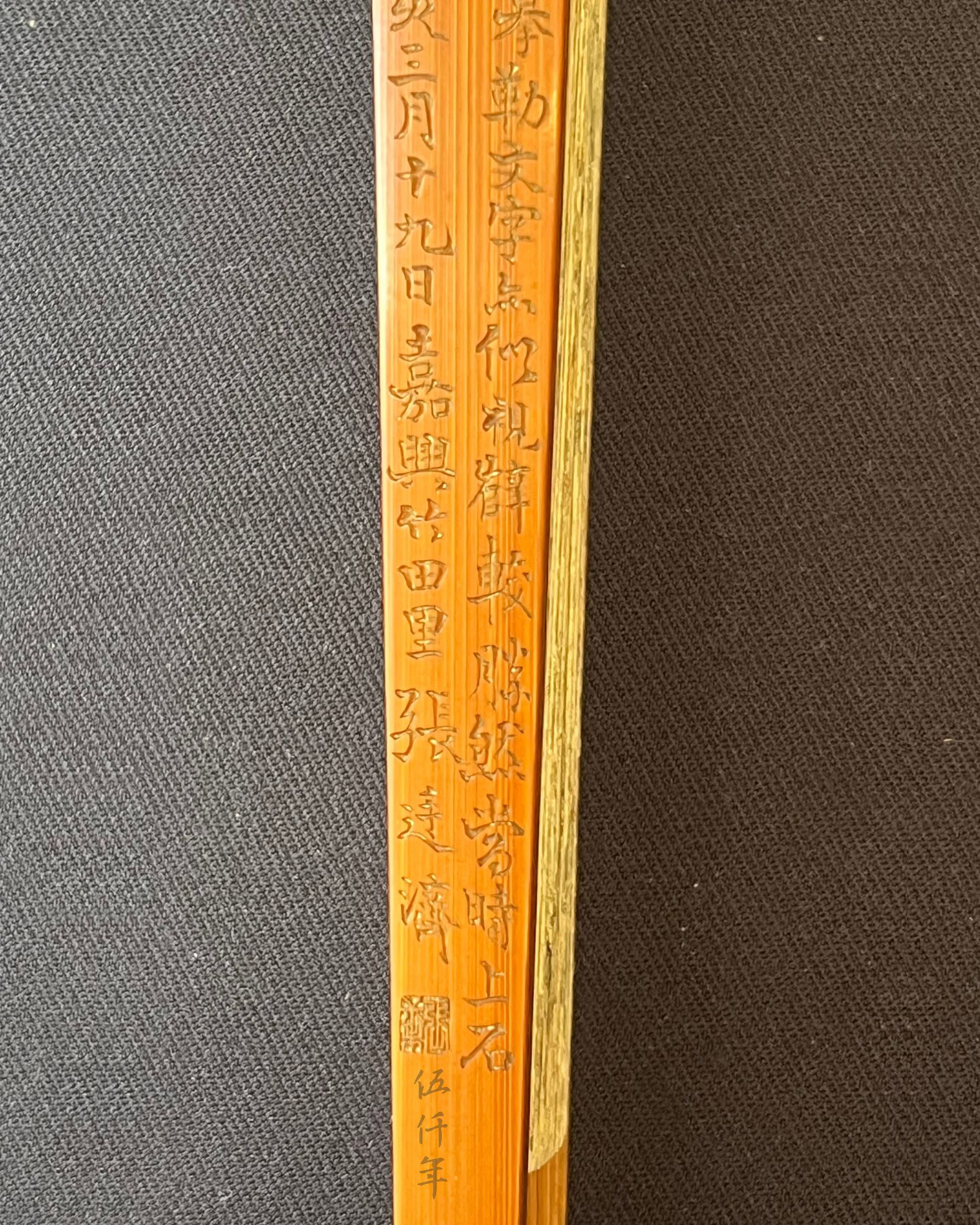
Another detail of calligraphy written by Ch’ang T’ing-chi engraved on second bamboo fan guard
Calligraphy inscription engraved on the second fan guard reads:
“This is a record of a family collection, namely vessels in the Liu family collection from the Ch’in dynasty. Being a pictorial record, the copying and engraving of calligraphy seems to be superior to that of the Hsueh family. Only eleven vessels were engraved onto the stone stelae at the time, now none of the stele exists. The old ink rubbings I acquired consist of seven vessels only.
This set of engravings commissioned by Ch’iu-fang (秋舫) does not concern the superiority of the present or the past. On the 19th day in the third month of chi-hai (己亥) year, the 19th year of the Tao-kuang reign, Chang T’ing-chi (張廷濟) from Chu-t’ien-li in Chia-hsing city.”
Carved relief seal: “Chang Shu-wei (張叔未)”.
This Foreword was written in chi-hai year, the 19th year of the Tao-kuang reign, which corresponds to 1839. Ch’iu-fang (秋舫) was the hao of Ts’ao Tsai-k’uei (曹載奎), he was born in the 47th year of the Ch’ien-lung reign 1782, and died in the 2nd year of the Hsien-feng reign 1852. He was an avid art collector.
2. Ink rubbings of Engravings of Archaic Vessels in the Collection of Huai-mi Shan-fang (懷米山房吉金圖) on Stone Stelae.
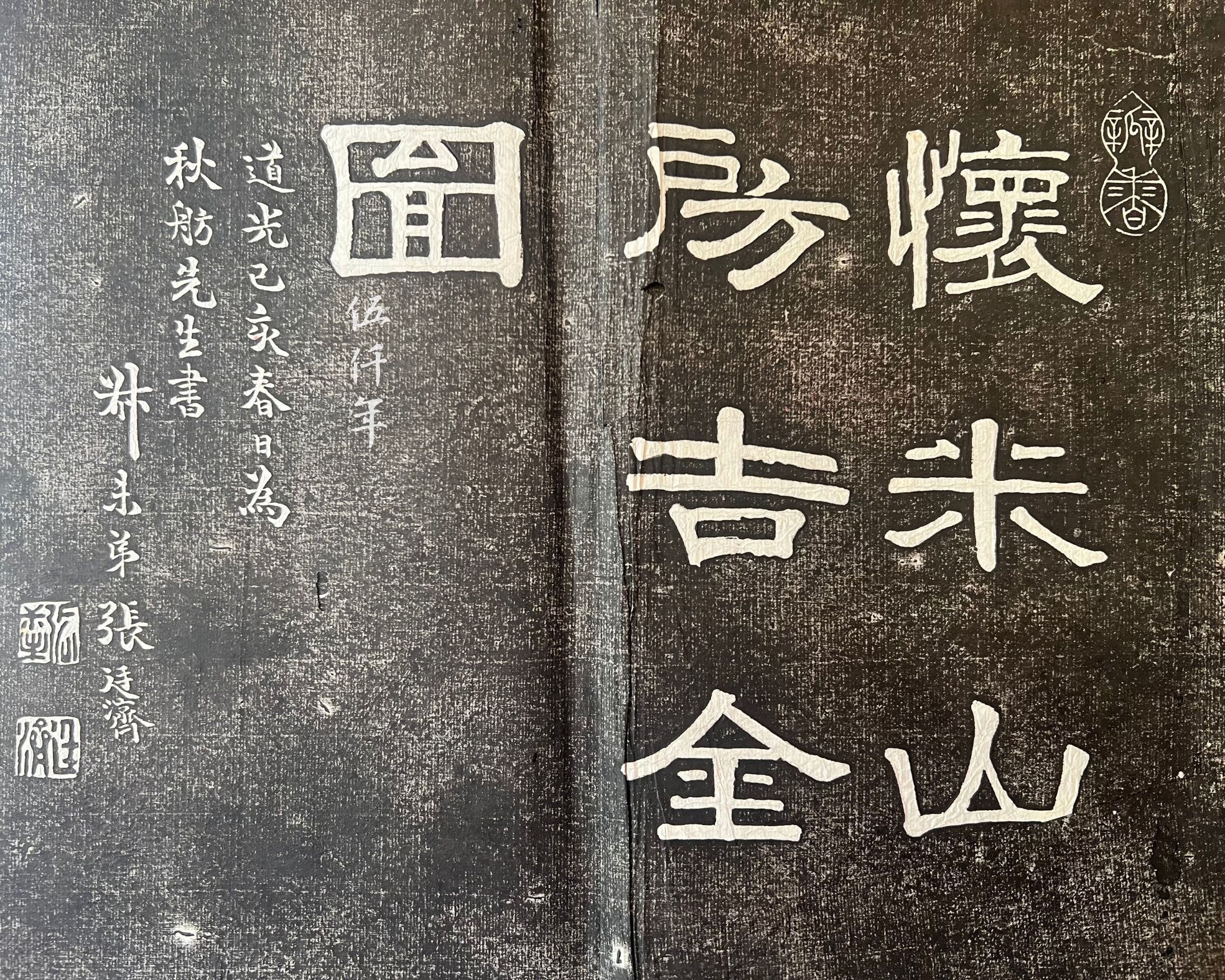
First sheet of ink rubbings of Engravings of Archaic Vessels in the Collection of Huai-mi Shan-fang on Stone Stelae
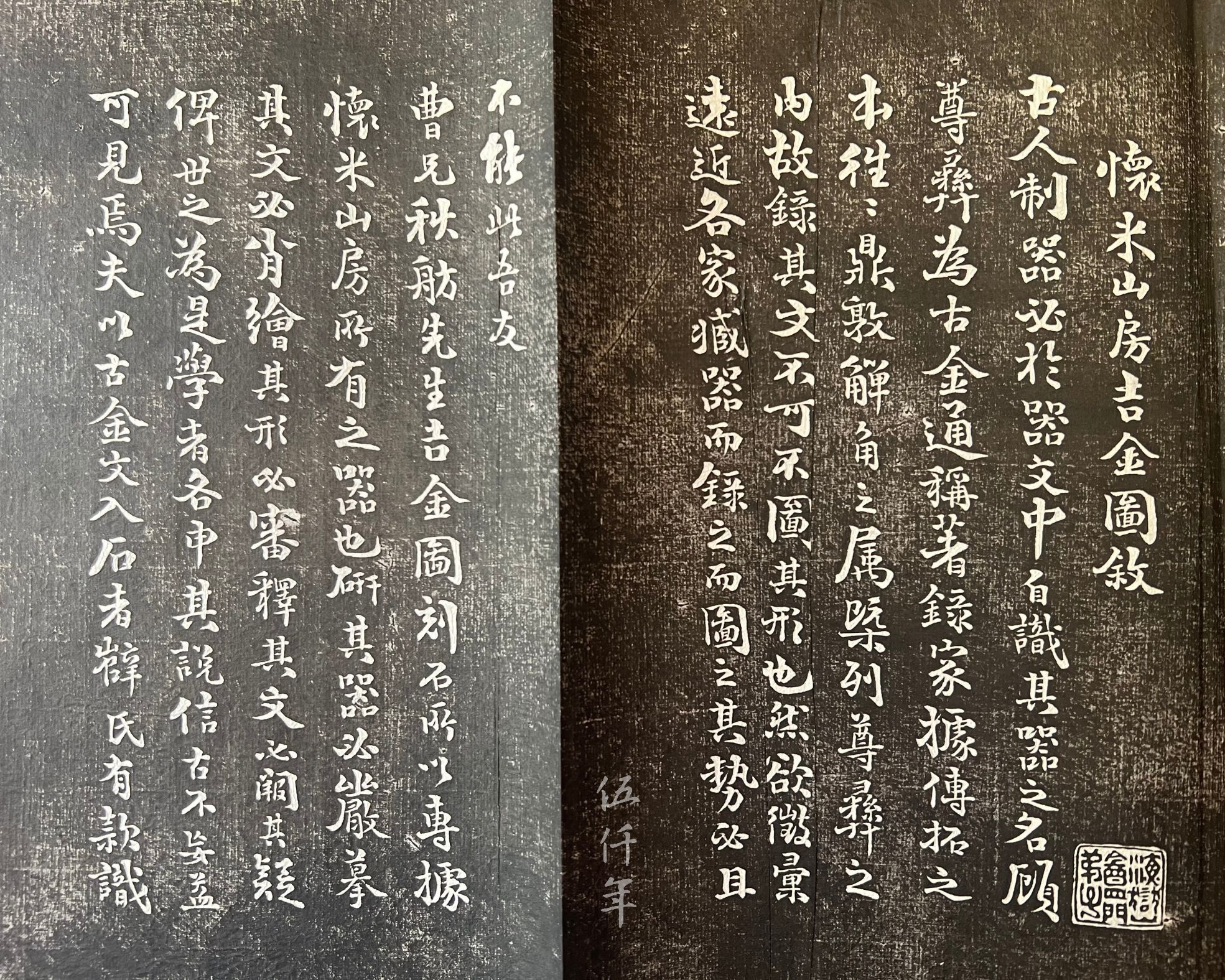
Second sheet of ink rubbings of Engravings of Archaic Vessels in the Collection of Huai-mi Shan-fang on Stone Stelae
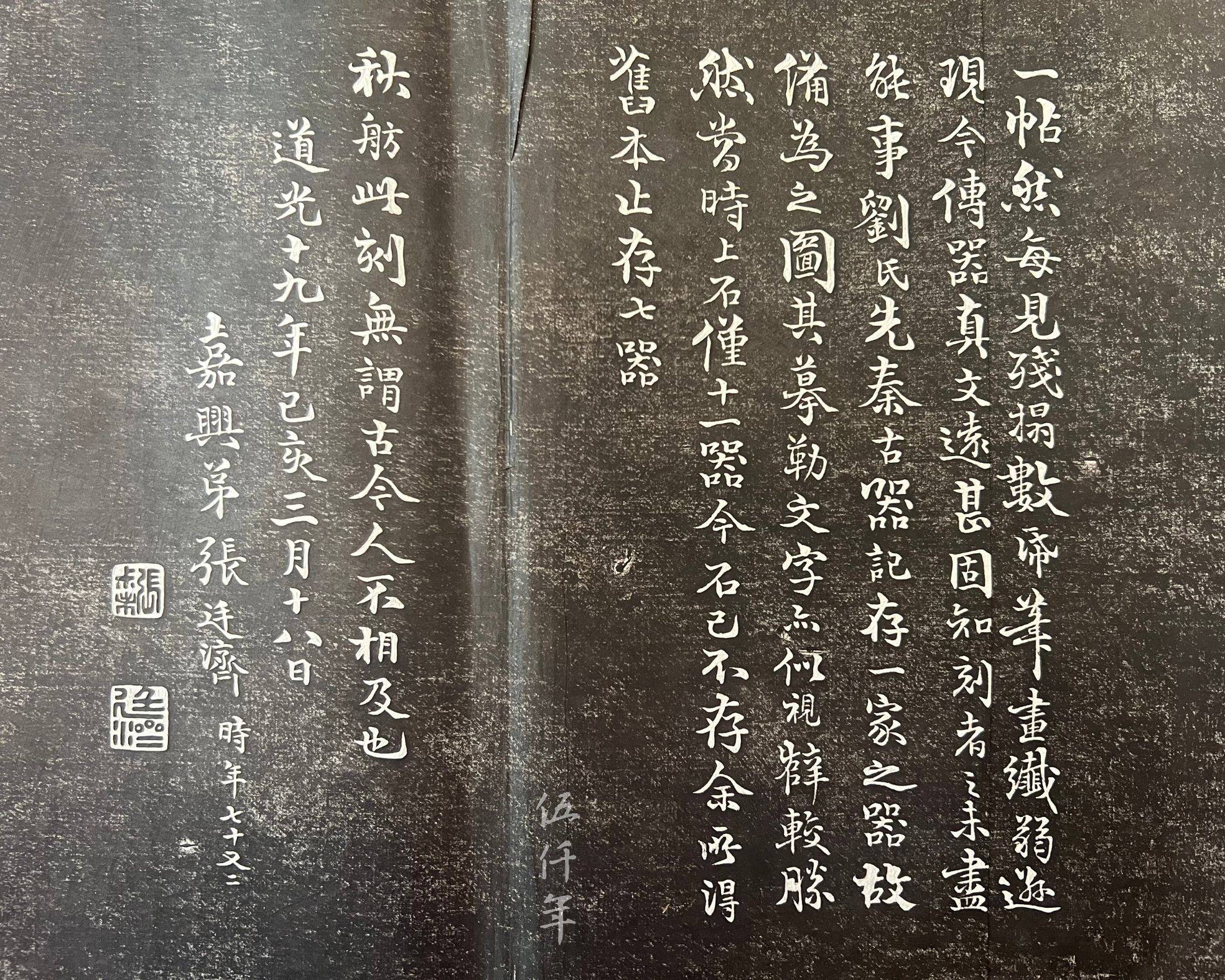
Third sheet of ink rubbings of Engravings of Archaic Vessels in the Collection of Huai-mi Shan-fang on Stone Stelae
In the 19th year of the Tao-kuang reign 1839, Ts’ao Tsai-kuei (曹載奎) commissioned the production of Engravings of Archaic Vessels in the Collection of Huai-mi Shan-fang (懷米山房吉金圖) on Stone Stelae. This is a set of stone engravings of fastidious drawings of archaic vessels selected from his own collection. Chang T’ing-chi wrote the Foreword which was then engraved onto the first stone stele.
C.Vestige of Painting
1.Bamboo wrist rest with drawing and carving by Wen Ting (文鼎), Ch’ing dynasty.
Wen Ting (文鼎) was born in the 31st year of the Ch’ien-lung reign 1766, and died in the 2nd year of the Hsien-feng reign 1852. His original name was Yüan-ting (元鼎), his tzu were Hsüeh-k’uang (學匡), Hsüeh-ting (學鼎), his hao was Hou-shan (後山), his studio name was T’ing-yün Chiu-chu (停雲舊築). He was a native of Hsiu-shui in Chekiang province. Wen Ting was not interested in any worldly position. During the Hsien-feng reign, he adamantly rejected the recommendation to an official position from local government. He was a connoisseur with a substantial art collection. He excelled in calligraphy, painting, seal engraving and bamboo engraving. The bamboo fan guards and wrist rests he used were all drawn and carved by himself, his carved landscape drawings were equal in artistry to the works of the bamboo master carver Chou Hao (周顥 also known as Chou Chih-yen 周芝岩 1685-1773). His poems were compiled into Poetry from Wu-tzu-pu-sun Chamber (五字不損室詩稿).
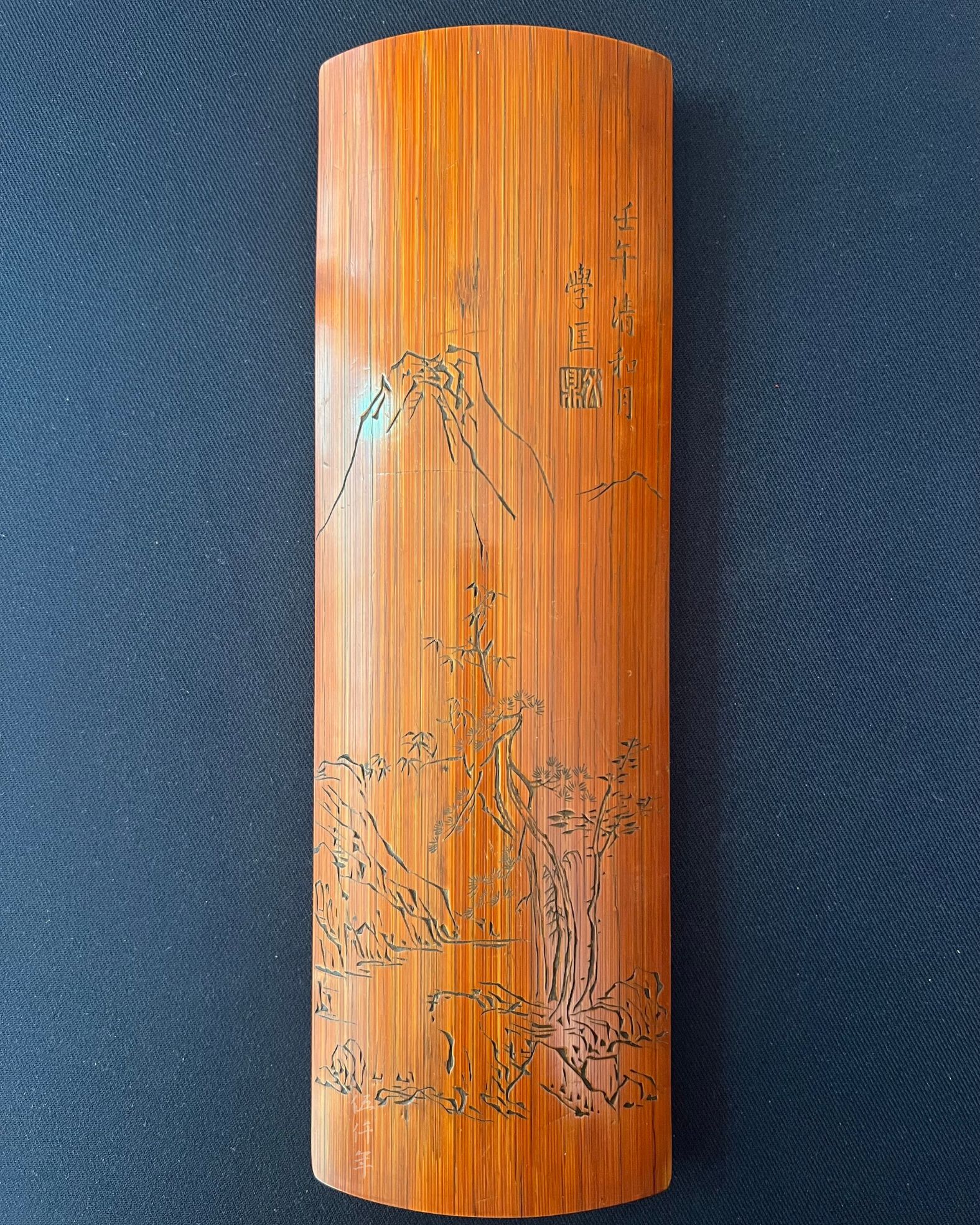
Bamboo wrist rest with landscape drawn and engraved by Wen Ting
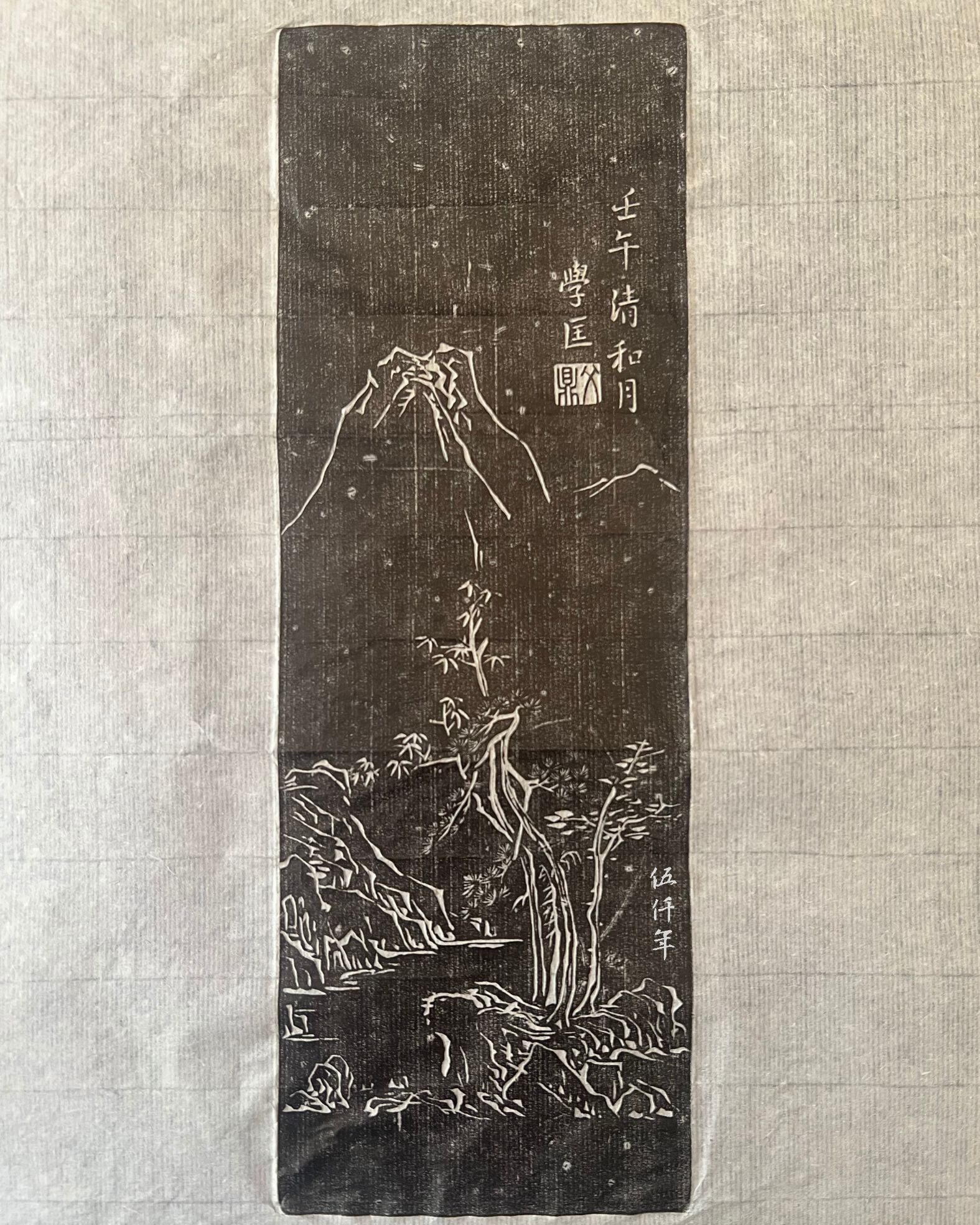
Ink rubbing of bamboo wrist rest with landscape drawn and engraved by Wen Ting
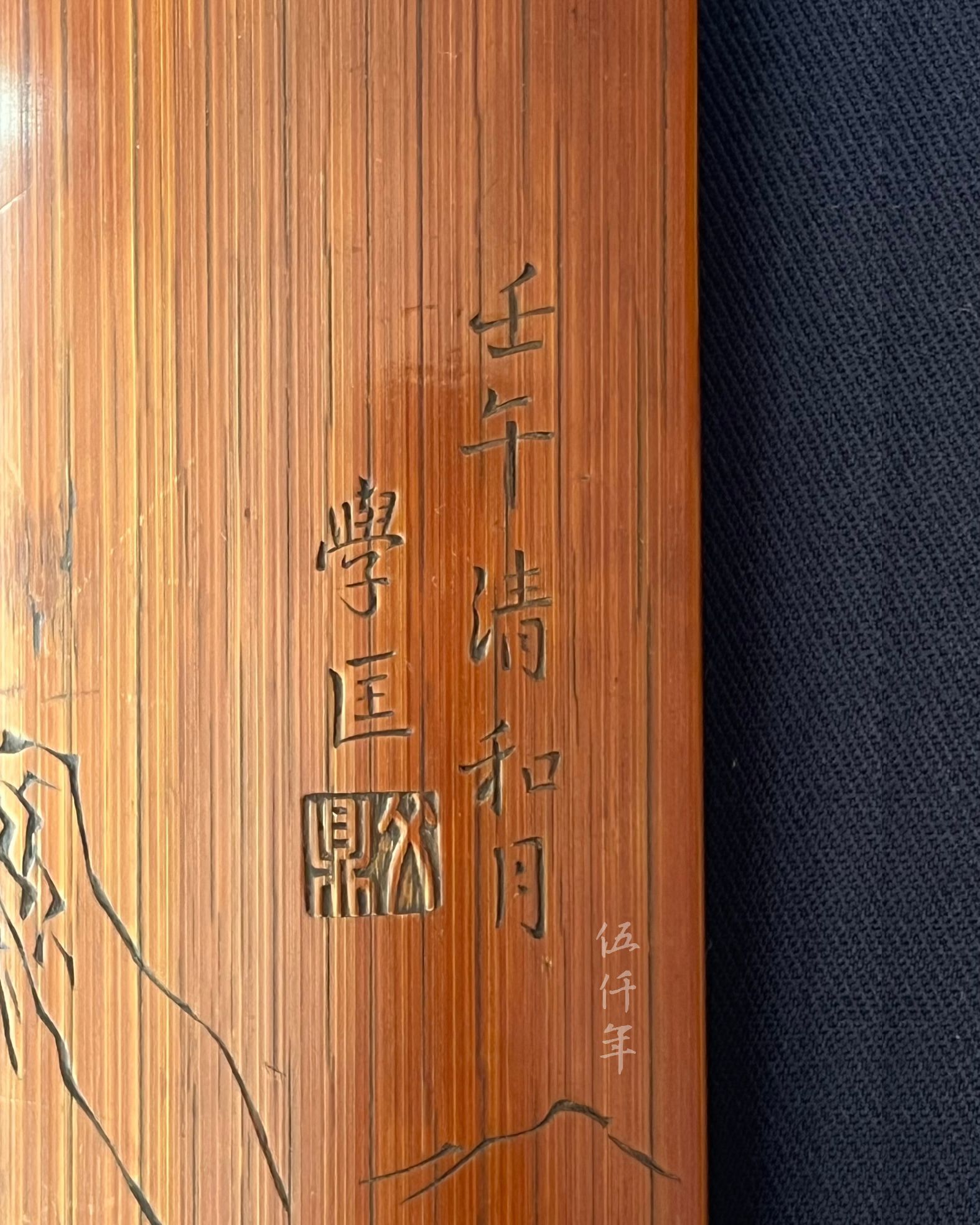
Detail of calligraphy inscription written and engraved by Wen Ting
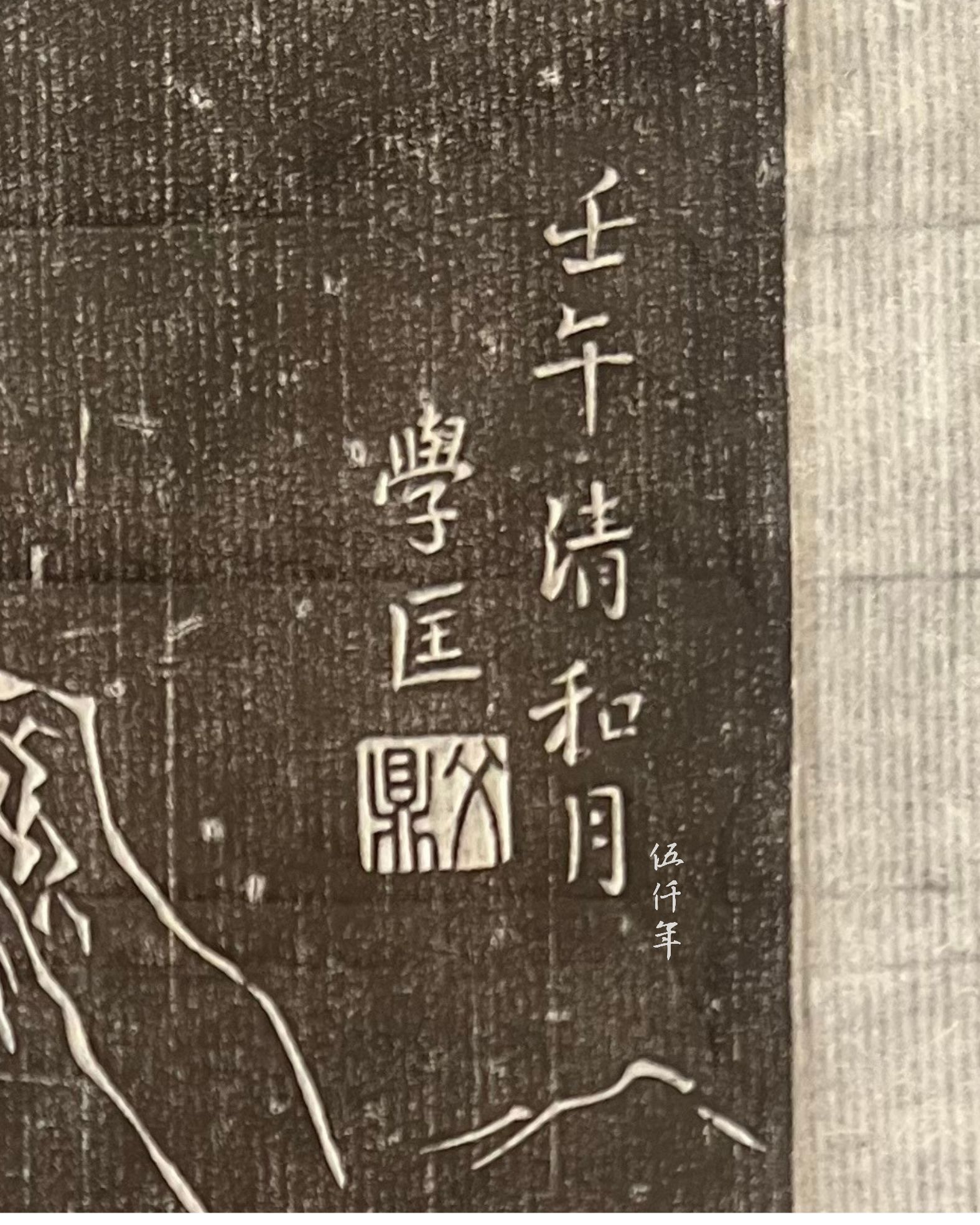
Ink rubbing of calligraphy inscription written and engraved by Wen Ting
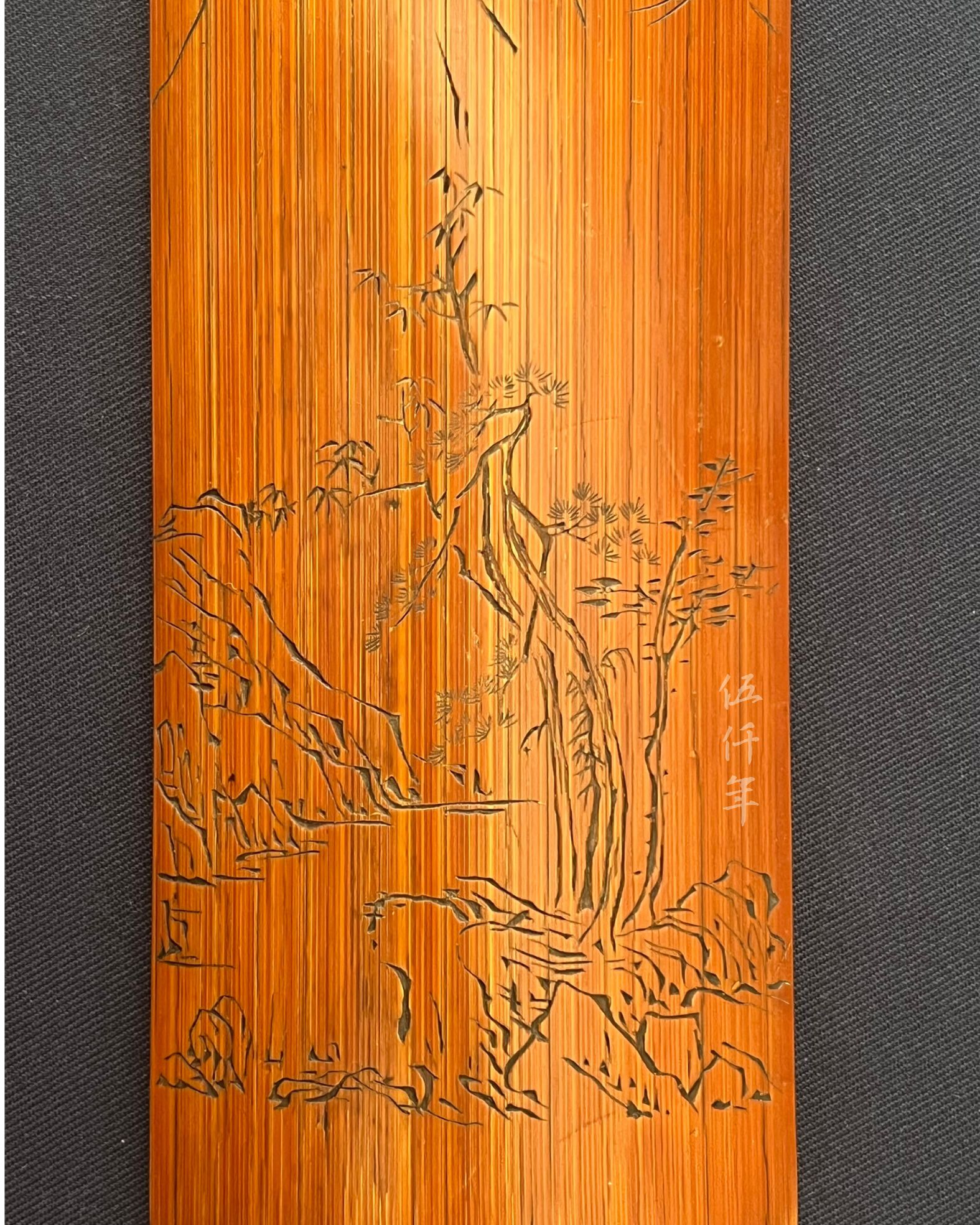
Detail of landscape drawn and engraved by Wen Ting
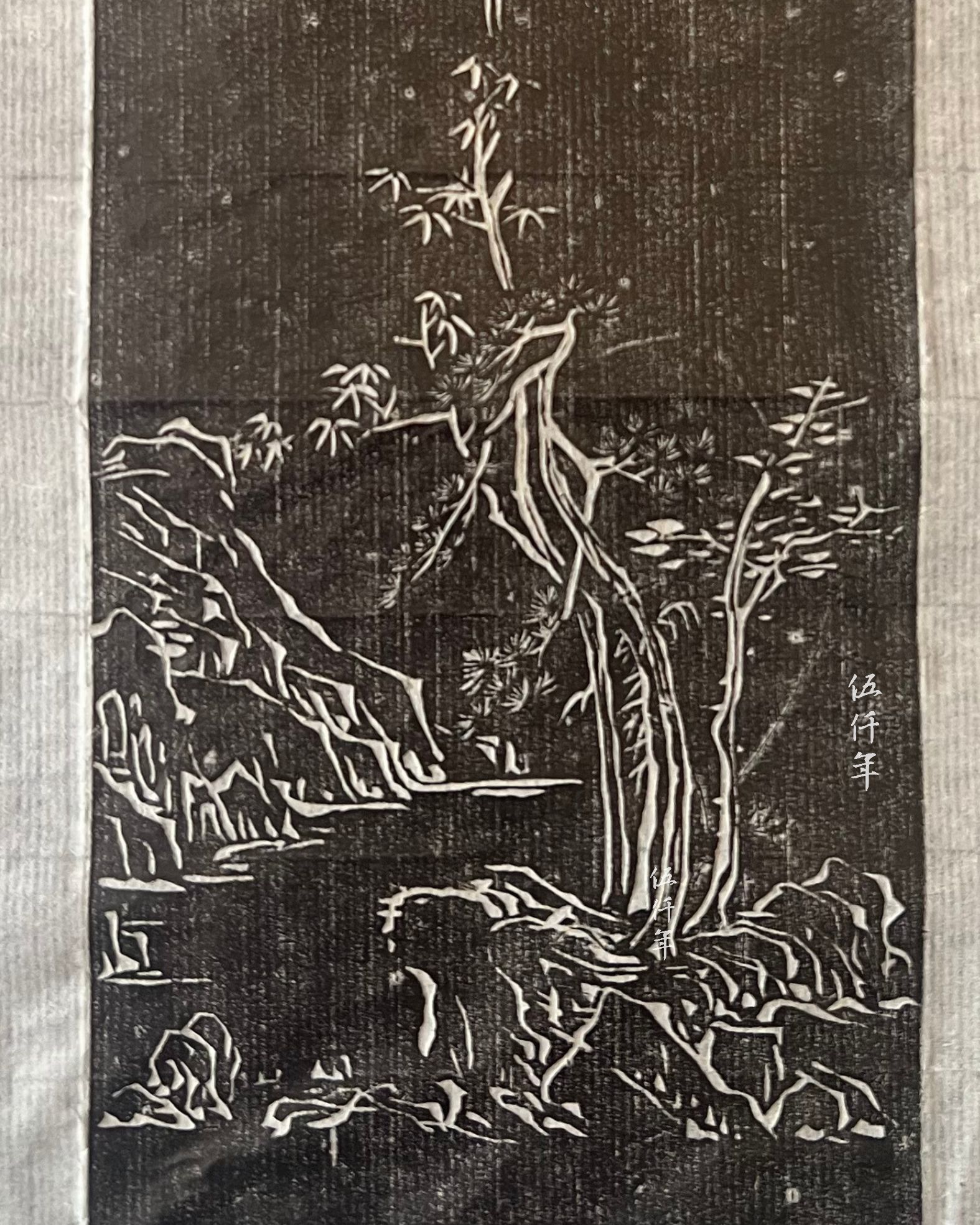
Ink rubbing of landscape drawn and engraved by Wen Ting
Front of bamboo wrist rest with landscape drawing and carving by Wen Ting (文鼎), the engraved calligraphy inscription reads:
“Jen-wu (壬午) year, the fourth month, Hsüeh-k’uang (學匡).”
Carved relief seal: “Wen Ting (文鼎)”.
The wrist rest was carved in jen-wu year, which corresponds to the 2nd year of the Tao-kuang reign, 1822.
H.Reclamation
Wars and mayhems follow in succession. Salvaged artefacts attest to events of the past.
Triangular Dragon Flag of the Ch’ing dynasty.
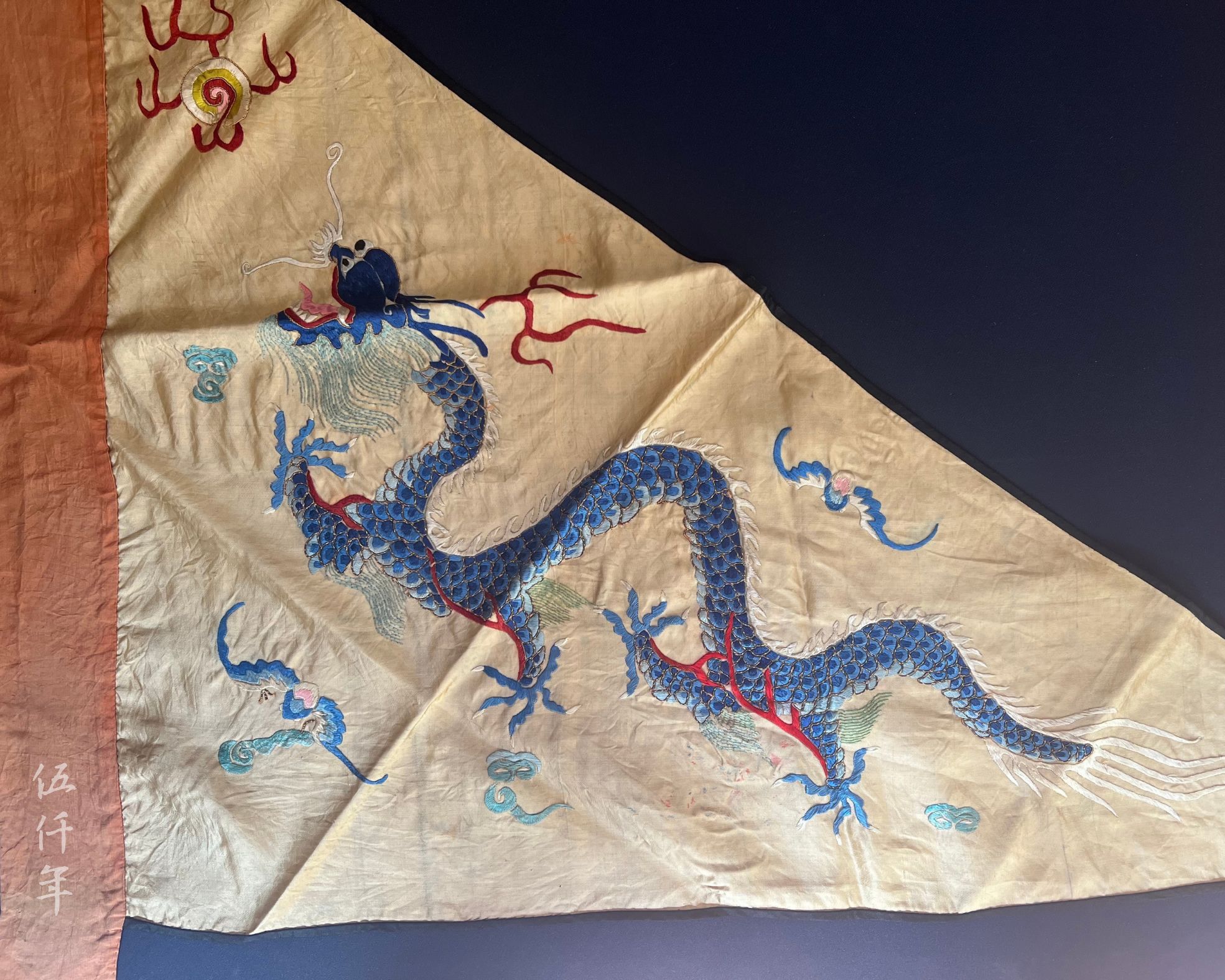
Triangular Dragon Flag of the Ch’ing dynasty
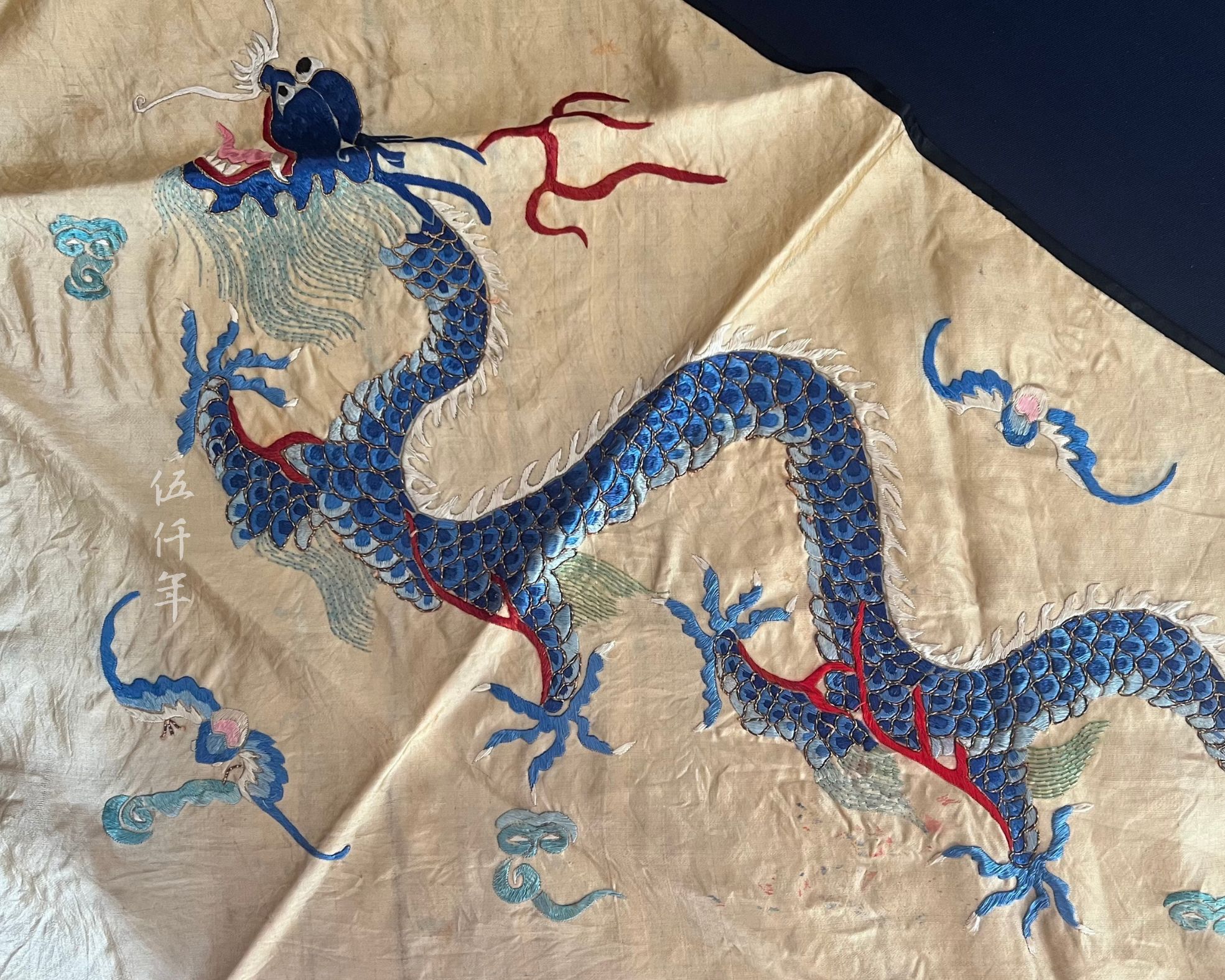
Detail of Triangular Dragon Flag of the Ch’ing dynasty
2. Metal shell casing captured by the armies of the Eight-Nation Alliance when they seized Tientsin in 1900, Ch’ing dynasty.
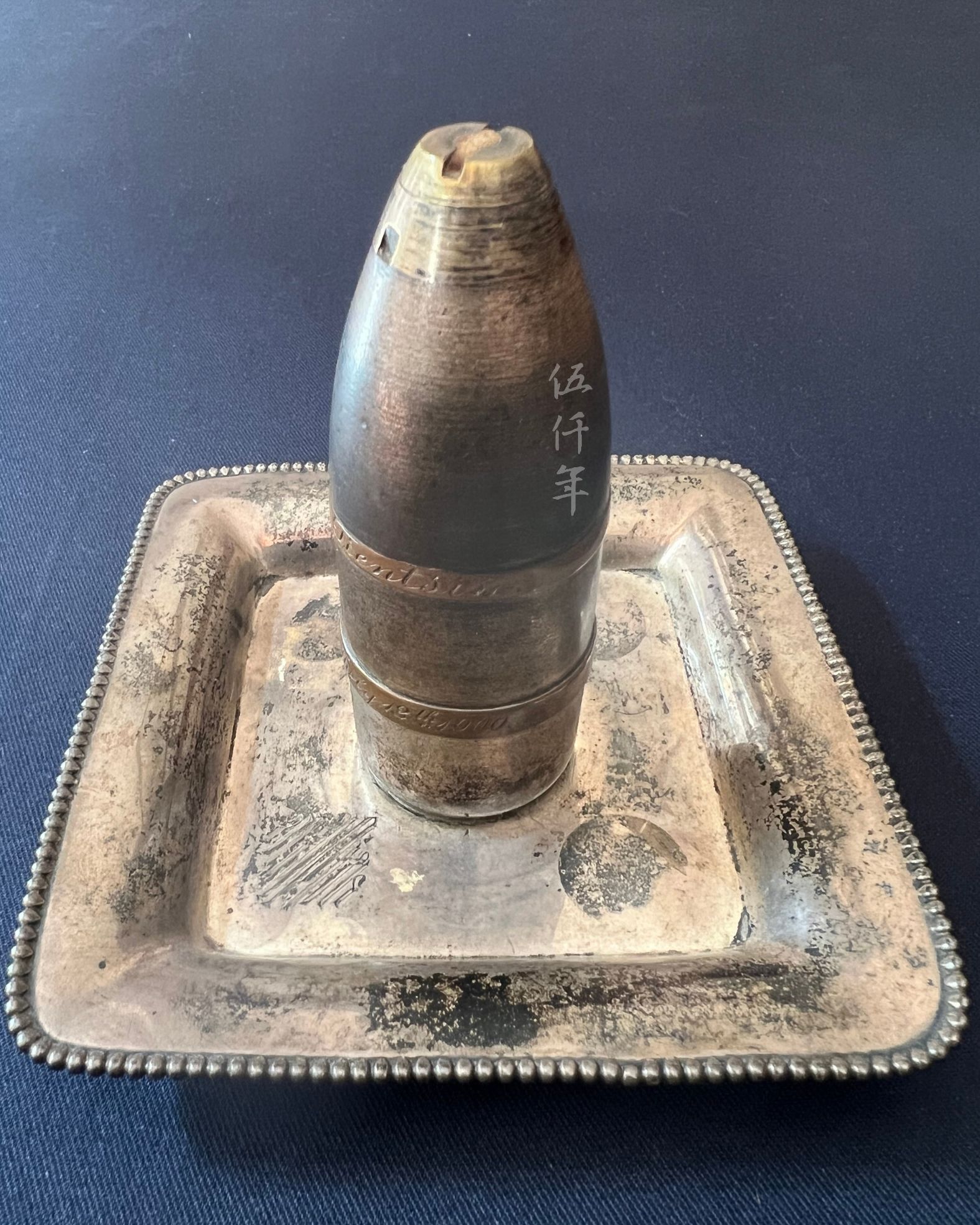
Metal shell casing seized by soldiers of the Eight-Nation Alliance in Tientsin in 1900
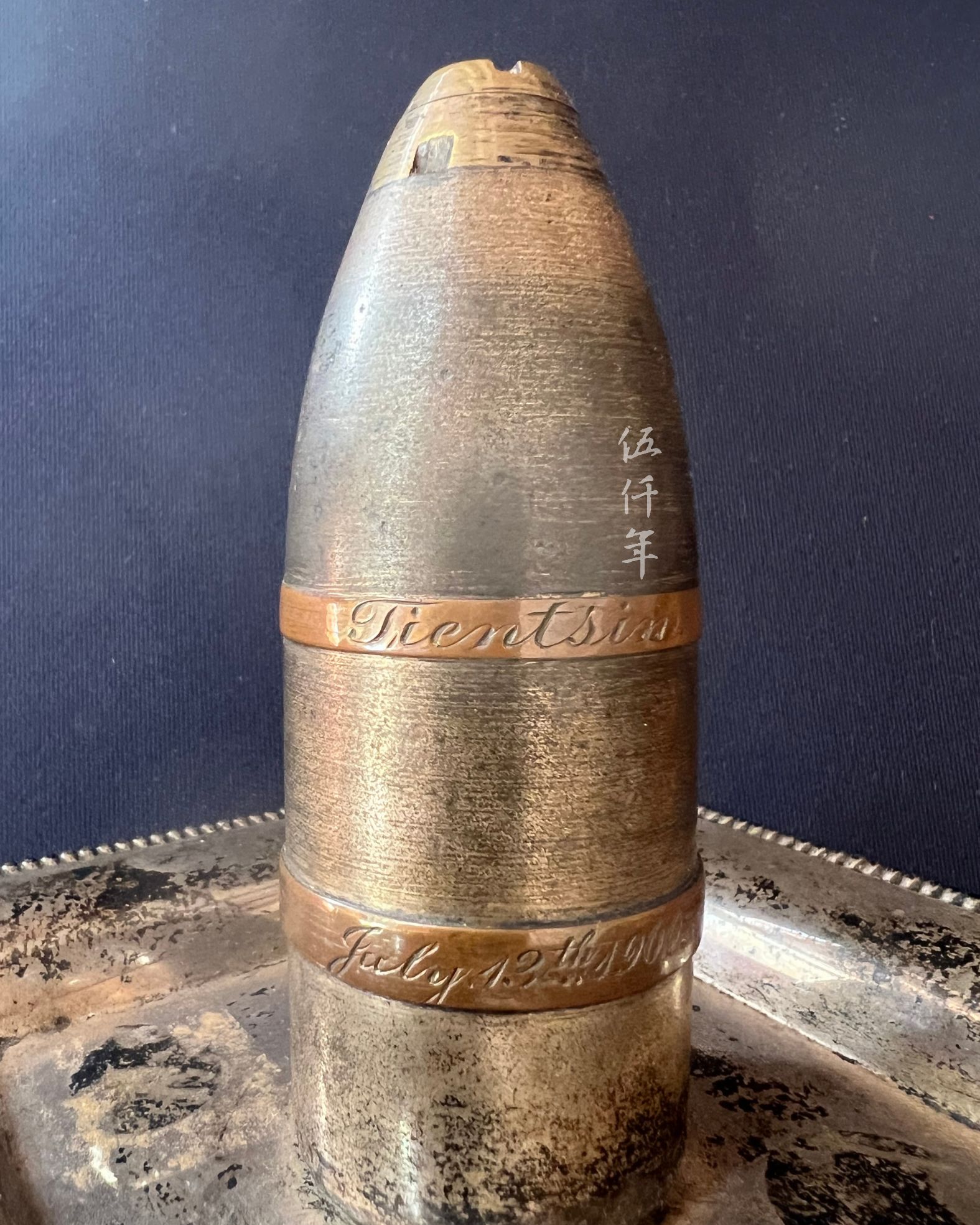
English inscription engraved on the metal shell casing
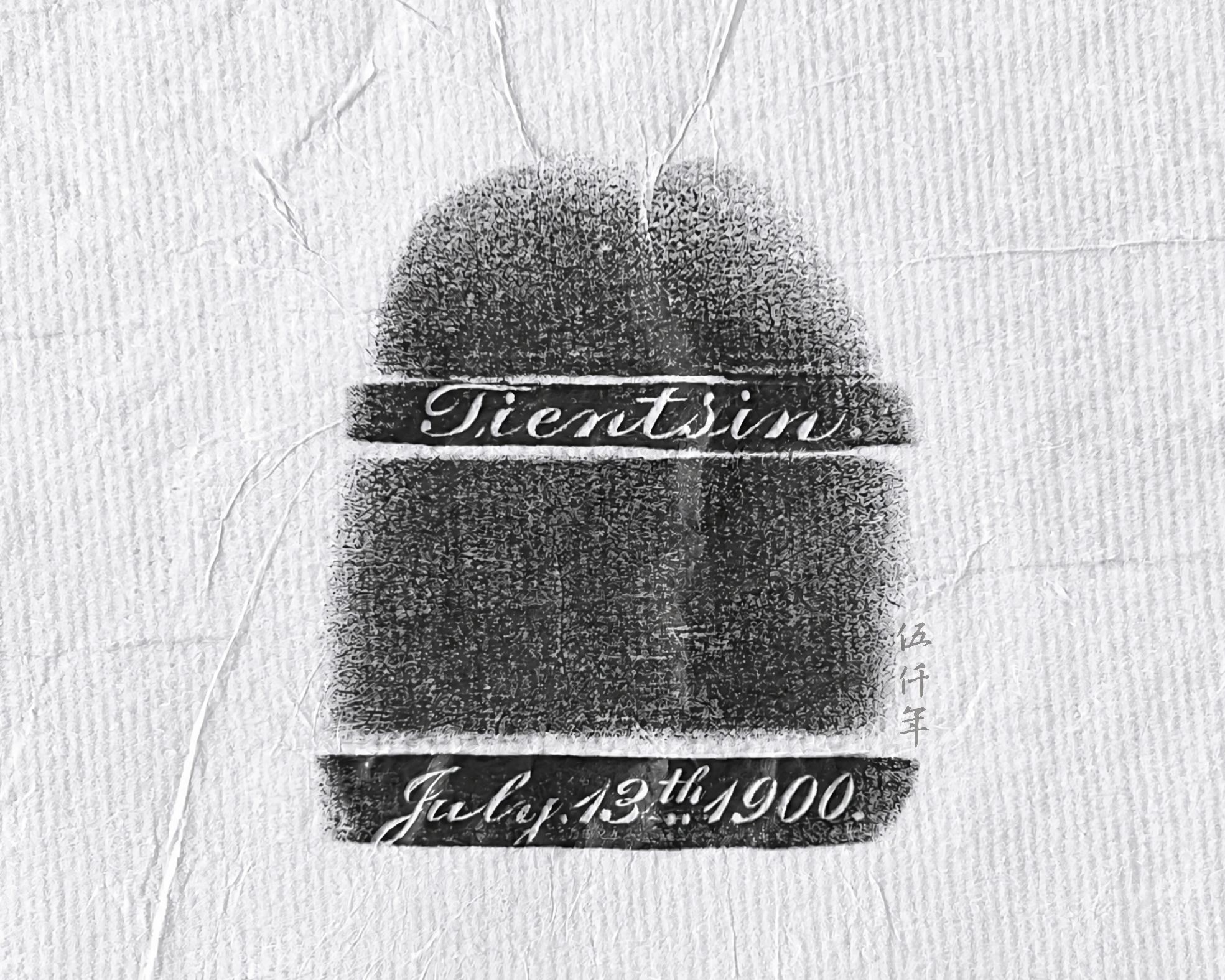
Ink rubbing of English inscription engraved on the metal shell casing
English words engraved on the metal shell casing reads:
“Tientsin,
July 13th 1900”.
On 17 June 1900, armies of the Eight-Nation Alliance occupied Taku Forts in Tientsin. On 9 July, they sacked Pa-li-t’ai. Nieh Shih-ch’eng (聶士成), the provincial commander-in-chief of Chihli, was killed. On 13 and 14 July, the armies of the Eight-Nation Alliance occupied Tientsin. On 14 and 15 August, Peking fell.
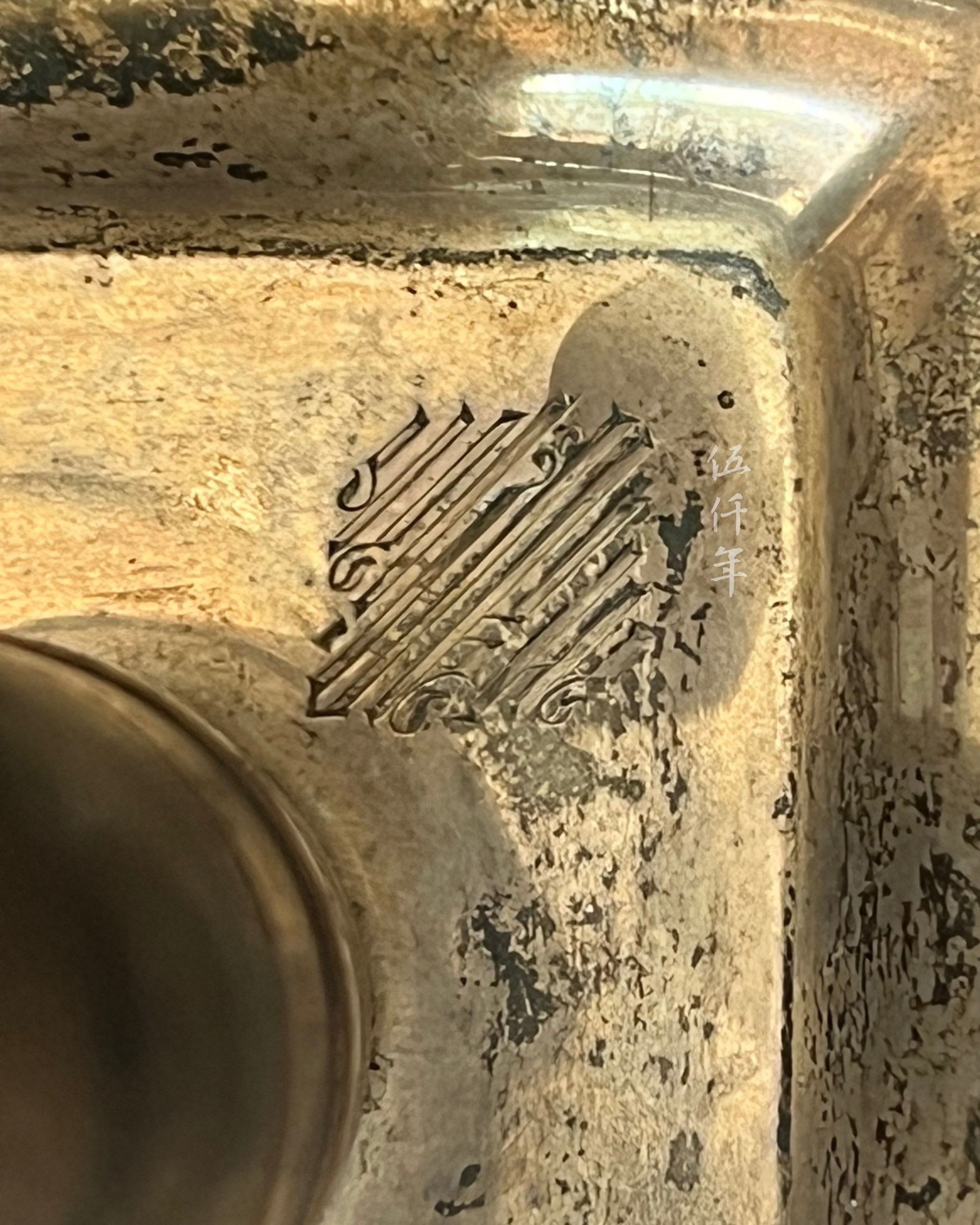
Silver mark on tray holding the metal shell casing
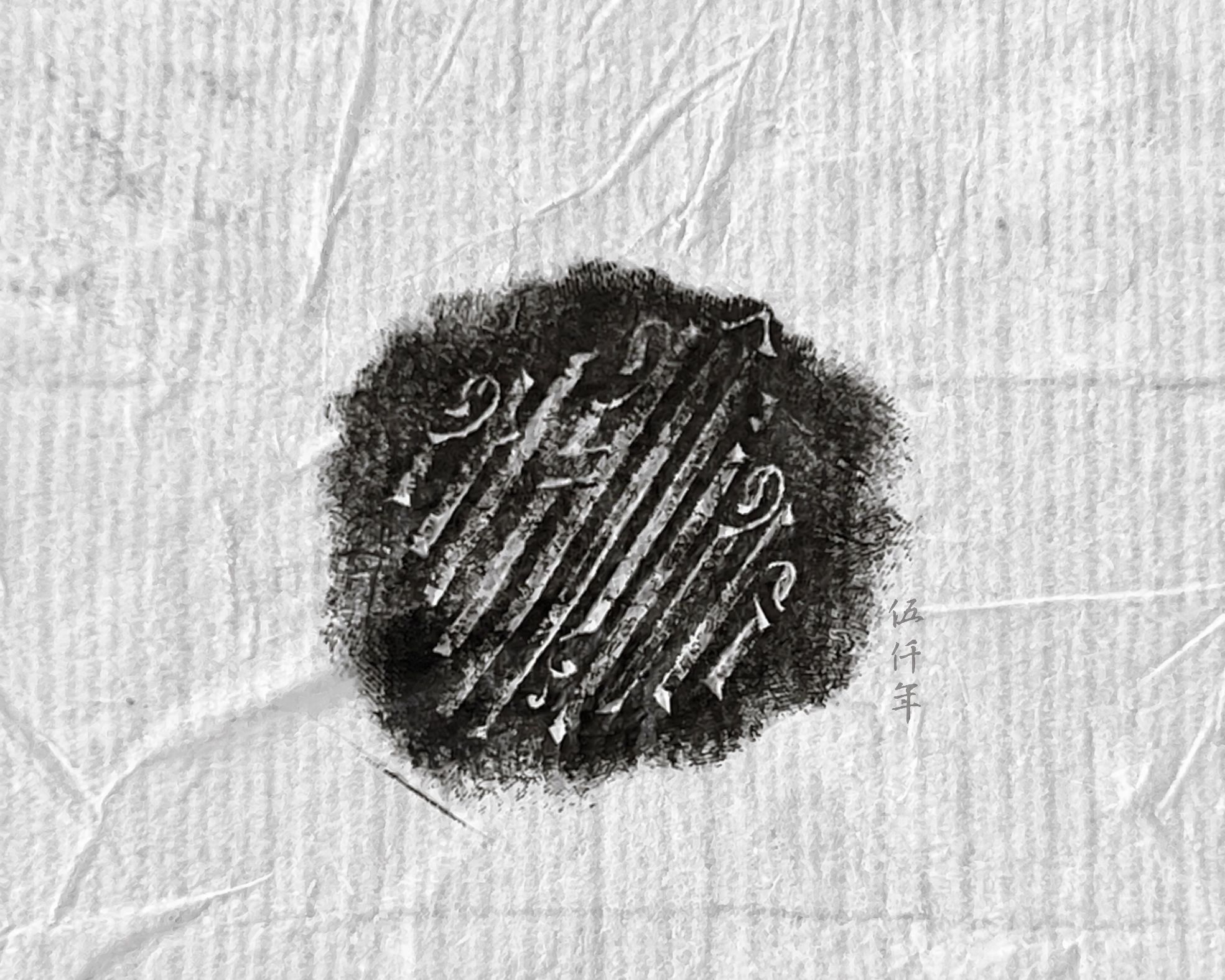
Ink rubbing of silver mark on tray holding the metal shell casing
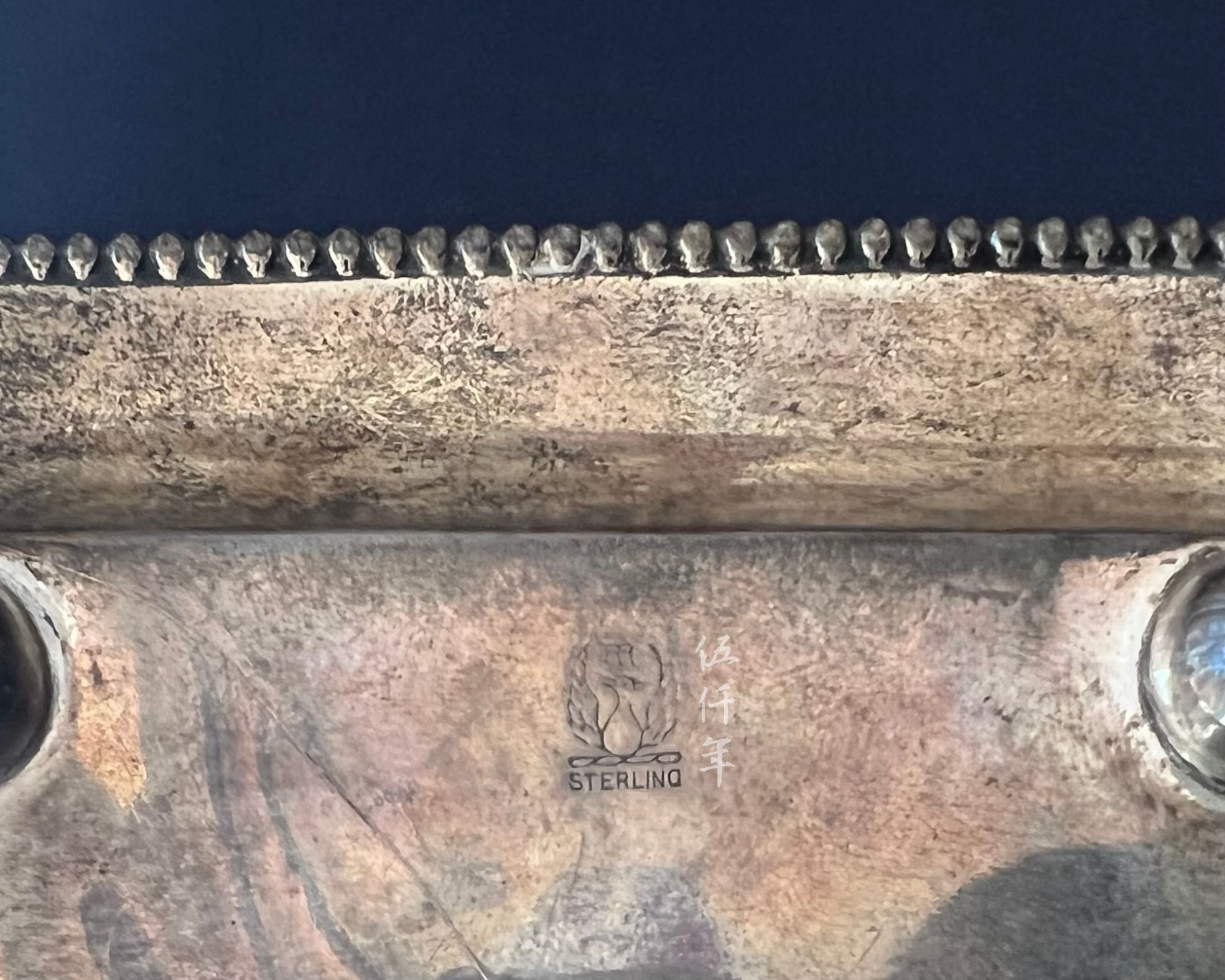
Sterling mark under tray holding the metal shell casing
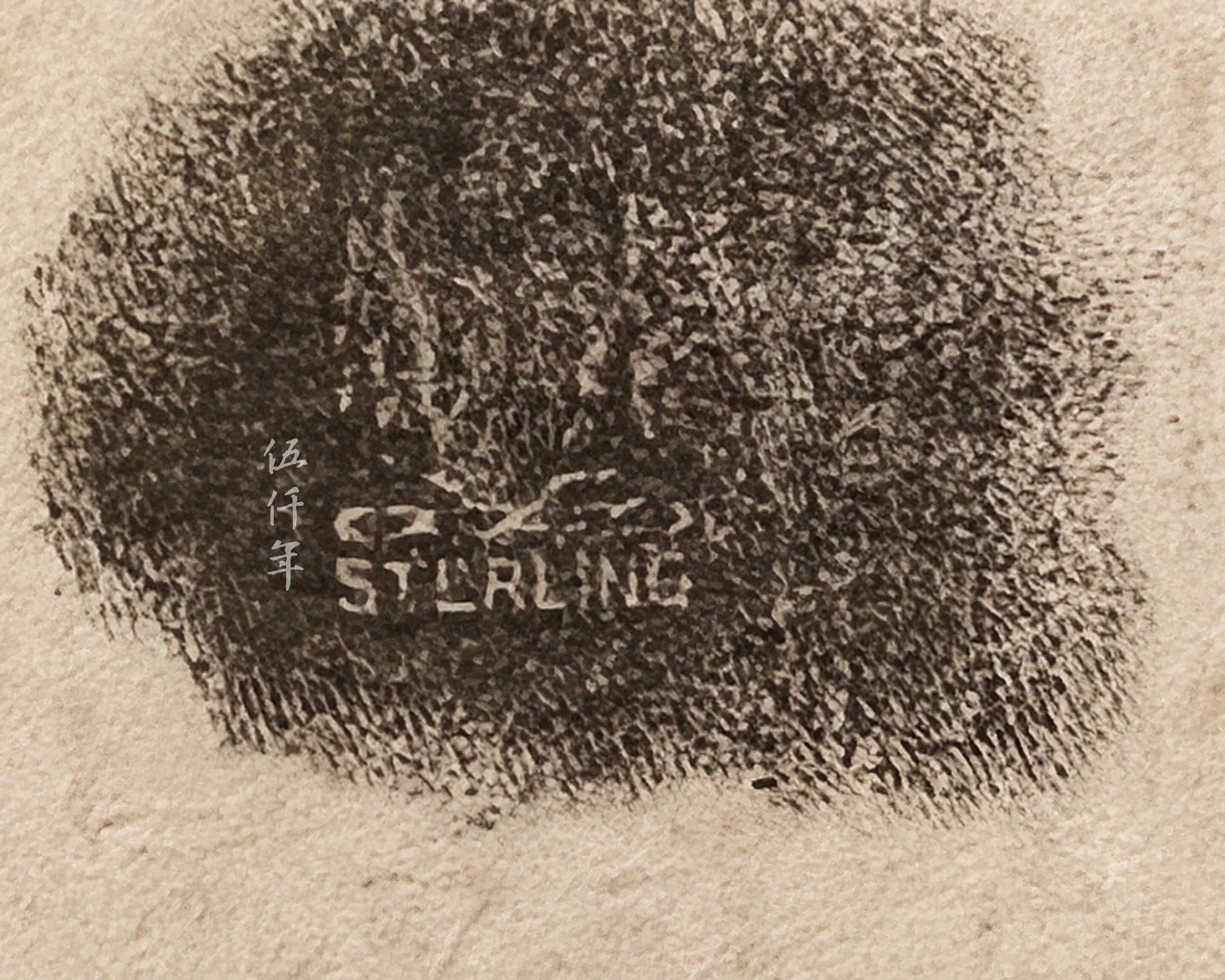
Ink rubbing of sterling mark under tray holding the metal shell casing
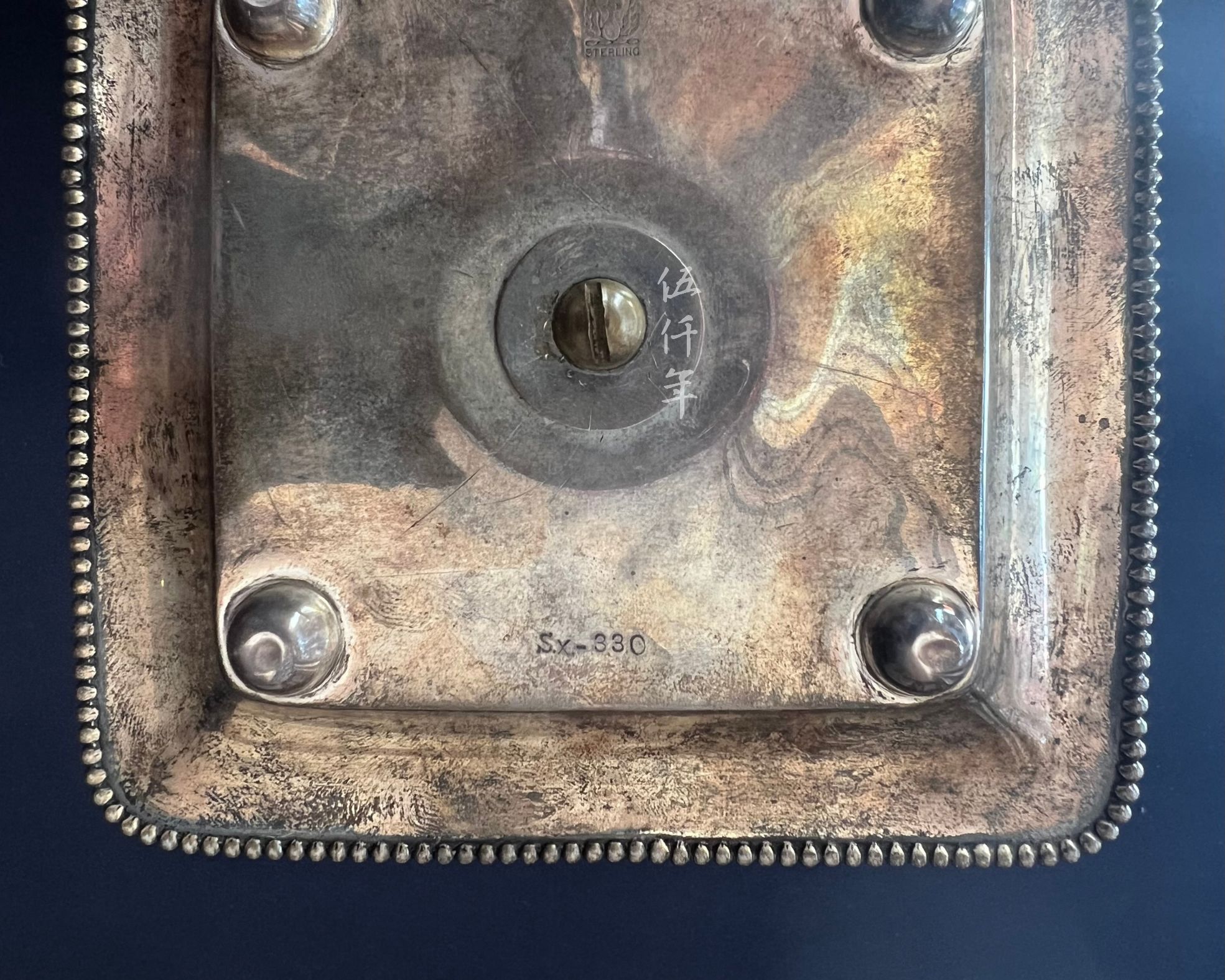
Silver mark under tray holding the metal shell casing
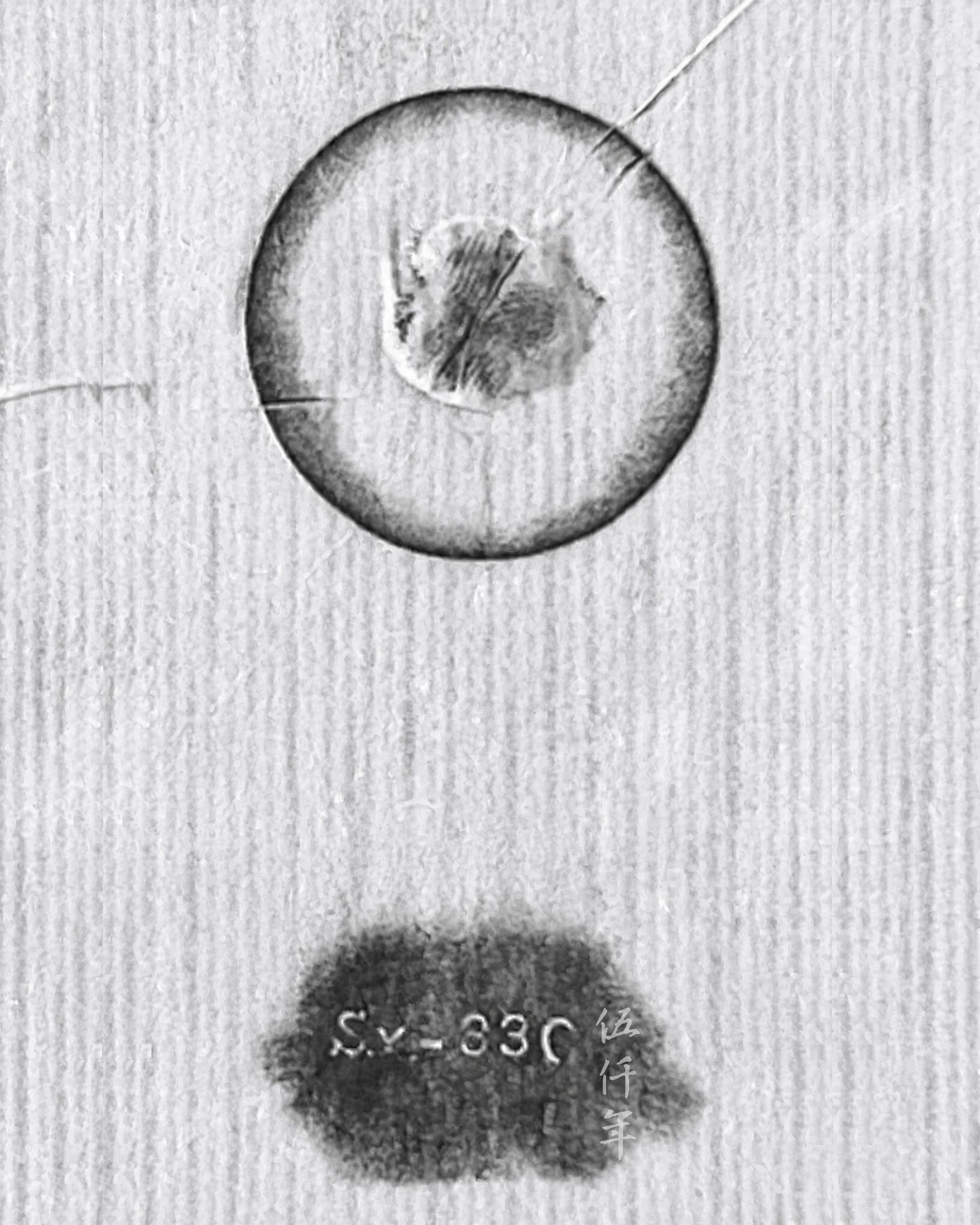
Ink rubbing of silver mark under tray holding the metal shell casing